
Showing posts with label Guy Kibbee. Show all posts

December 26, 2021

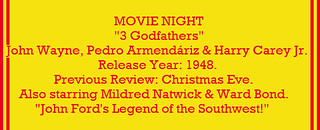
3 Godfathers (1948).

Review #1778: 3 Godfathers.

Cast: 
John Wayne (Robert Marmaduke Hightower), Pedro Armendáriz (Pedro Encarnación Escalante y Rocafuerte), Harry Carey Jr. (William "The Abilene Kid" Kearney), Mildred Natwick (Dying Mother), Ward Bond (Sheriff Buck Sweet), Mae Marsh (Mrs. Sweet), Jane Darwell (Miss Florie), Guy Kibbee (Judge), Hank Worden (Deputy Curly), Dorothy Ford (Ruby Latham), Charles Halton (Oliver Latham), Jack Pennick (Luke), Fred Libby (Deputy), Ben Johnson (Posseman #1), Michael Dugan (Posseman #2), and Francis Ford (Drunken Old-Timer at Bar) Directed by John Ford (#398 - The Last Hurrah, #1324 - 3 Bad Men, #1349 - Stagecoach, #1372 - Fort Apache, #1392 - The Searchers, #1409 - The Man Who Shot Liberty Valance) 

Review: 
Well, if you need a Western with a Christmas bent, here you go? Of course, this also happens to be yet another John Ford and John Wayne collaboration, albeit one that is probably not as well-noted as the others (such as Fort Apache, released around the same time). The film is adapted from the 1913 novel The Three Godfathers, which was written by Peter B. Kyne. That novel had been adapted into a film five times: The Three Godfathers (1916), Marked Men (1919), Action (1921), Hell's Heroes (1930, directed by William Wyler), and Three Godfathers (1936); Ford had directed the 1919 and 1921 films, while Harry Carey Sr had starred in the first two adaptations (I'm sure you are all familiar with the next adaptation of the book in Tokyo Godfathers (2003)). As such, when Ford decided to do another version of this tale, he dedicated it to Carey (who had died in 1947), with the opening title card describing him as the "Bright Star of the early western sky..."). At any rate, this was the fifth starring role for Wayne in a John Ford film, coming off the heels of Fort Apache (1948) that would be followed by She Wore a Yellow Ribbon (1949) and a handful of others, although this might be the lightest of the Westerns they did together. This was the third and final collaboration of Ford and Armendariz (who decided to take on roles besides Mexican cinema in the mid 1940s), while Harry Carey Jr is given an "introduction" despite having done a handful of appearances in film prior to this one, which would be part of a solid run in character roles. The film had three screenwriters in Laurence Stallings, Frank S. Nugent, and Robert Nathan.

You have to understand that the tale is basically a re-telling of the religious tale of the Three Wise Men, so it shouldn't be surprising that there were varying levels of sentimentality in those feature films I just mentioned. The result is a movie that turns out to be just fine, one that will give a fair smile to one's face without turning it into a gloppy mess. For the most part, anyway (106 minutes), since it is sort of a family film that has a bit more chuckles than action (case in point about the adaptation differences, earlier versions featured a bloody gunfight). Well, that and plenty of sand (for Death Valley...doubling as Arizona, anyway), which means that this results in a nice-looking feature that you would expect from Ford. Wayne does fine with what is required from the role in stiff chiseling, one that isn't meant to toe too much into the sentimentality pool that is mostly believable in the long run. Armendariz and Carey Jr make worthy supporting presences in terms of snappy charm that make a useful triangle of pseudo-wise men in a makeshift family feature. Bond is the other key presence, doing exactly what is needed in light casual charm. The sacrifice at the end can only work if one believes it. In two of the previous adaptations (i.e. the 1930/1936 versions), attempts to find suitable water were a key part. Here, it is a bit more tied down, syrupy and curious at the same time. Well, since this is one of the John Wayne features where he isn't engaged in a duel at the end, that shouldn't be too surprising. As long as one stomachs where it goes, all should work out. As a whole, it is a light and charming Western that serves itself well in adapting familiar material with a useful spin and a solid trio that make for a curious Ford selection that follows the holiday tradition well enough without becoming stuck in comparisons. Instead, one takes its message of hope and cheer and runs with it.

Overall, I give it 8 out of 10 stars.

March 28, 2020

Fort Apache.


Review #1372: Fort Apache.

Cast: 
John Wayne (Capt. Kirby York), Henry Fonda (Lt. Col. Owen Thursday), Ward Bond (Sgt. Major Michael O'Rourke), Shirley Temple (Miss Philadelphia Thursday), John Agar (Lt. Michael Shannon "Mickey" O'Rourke), Dick Foran (Sgt. Quincannon), Pedro Armendariz (Sgt. Beaufort), Miguel Inclan (Cochise), Victor McLaglen (Sgt. Festus Mulcahy), Guy Kibbee (Capt. Wilkens), Anna Lee (Emily Collingwood), George O'Brien (Capt. Sam Collingwood), Jack Pennick (Sgt. Daniel Schattuck), Irene Rich (Mary O'Rourke), and Grant Withers (Silas Meacham) Directed by John Ford (#398 - The Last Hurrah and #1324 - 3 Bad Men, and #1349 - Stagecoach)

Review: 
"Anybody can direct a picture once they know the fundamentals. Directing is not a mystery, it's not an art. The main thing about directing is: photograph the people's eyes."

Legends can be an interesting thing to think about when relating to film, depending on who has the vision to make it come alive more so than if one just went to a museum or read a book. As such, it should prove no surprise that this was based on a prior work, in this case a 1947 short story "Massacre", written by James Warner Bellah in The Saturday Evening Post, which was adapted to film by Frank Nugent. It had utilized two historical battles involving Native Americans in their fight against the US Army in the 19th century with the Fetterman Fight and The Battle of Little Big Horn, particularly the leader of the latter battle, George Armstrong Custer, whose certainly has had a debatable reputation that has certainly had varied opinions over his leadership decisions in the battle that led to his death, with the efforts of his widow campaigning on his behalf helping to mold Custer into a legend for a great deal of the 20th century. This is a film that has its own view on Native American alongside a parallel of Custer in its film, which certainly does seem a bit different from the old-fashioned fare from Westerns of its time (compare this film to Unconquered, for example). It is the first film of what is referred to as director-producer Ford's "cavalry trilogy", with each of the films (the others being She Wore a Yellow Ribbon and Rio Grande) featuring Wayne as the main star along with adapting short stories from Bellah in each of the films. It should prove no surprise to see Wayne and Fonda in a Western, since they both stood out in their decades-long careers for their work in them, with the former making roughly one-to-three films a year for this decade; Fonda had slowed his versatile career due to serving in World War II, and he decided to return to the stage, not appearing again in a feature role for the next seven years. This happened to be the fifth-to-last role for Temple along with the first for Agar (an Army Air Corps man who served in World War II), with the two having married three years earlier. One particular person who found themselves a break was Ben Johnson, the champion rodeo cowboy-turned stuntman that found himself with an acting contract because of his help with stopping a runaway wagon from a potential deadly accident.

One will find themselves impressed with the way that Ford handles this capable tale of the nature of leadership and heroism with solid foundation to make fine entertainment. This is a film that Fonda and Wayne share with equal strength of solid acting that match like bighorned sheep on the grass. On one side is the tactically stubborn but capable humane performance from Fonda and on the other is the practical reliability of Wayne in the face of anyone. Bond makes for a fine presence, engaging with rugged rough charm that made him a character actor worth having throughout the years. Temple and Agar are okay, with fair chemistry. Foran and the others make for capable camaraderie through the moments they have on screen in making this regiment as interesting as it needs to be when setting up its conflict - whether within or with its possible enemy. The battles certainly are well-executed, even when one knows the inevitability provided by its inspiration, particularly with its lasting point about legends and glory in perspective of the one who writes it, whether that seems right or not. One is left in awe of the towering Monument Valley when seeing it in the film, particularly with the use of infrared film stock, which was utilized in outdoor sequences to enhance the scenery. There were a few quibbles with the script with stuff one might not expect. Concerns involved a manure pile scene, a shot of dead troopers, keeping contact with the Humane Society when dealing with animals, and an order to not show a toilet on screen (I kid you not). In any case, this is a relatively interesting film, one with a solid cast and ambitions beyond the usual Western of conflict that make it a worthwhile Ford film for its era.

Overall, I give it 9 out of 10 stars.

February 15, 2020

42nd Street.


Review #1340: 42nd Street.

Cast: 
Warner Baxter (Julian Marsh), Bebe Daniels (Dorothy Brock), George Brent (Pat Denning), Ruby Keeler (Peggy Sawyer), Guy Kibbee (Abner Dillon), Una Merkel (Lorraine Fleming), Ginger Rogers (Ann Lowell), Ned Sparks (Barry), Dick Powell (Billy Lawler), Allen Jenkins (Mac Elroy, the stage manager), and Edward J. Nugent (Terry) Directed by Lloyd Bacon (#562 - It Happens Every Spring and #898 - Larceny, Inc)

Review: 
"Sawyer, you're going out a youngster, but you've got to come back a star!"

For the 1930s, the musical had numerous phases of development. Film had gone a long way from musical short films in the earlier half of the 1920s to The Jazz Singer (1927) to The Broadway Melody (1929) and so on, with ones even done in color. However, the craze of doing musicals had stalled quickly in 1931, owing to over-saturation in the market. Of course this small lull would not last long, it just needed some evolution. One key figure in contributing the remedy was Busby Berkeley. By the time of the 1920s, he had already been a field artillery lieutenant in World War I before becoming a dance director and choreographer on Broadway musicals such as A Connecticut Yankee, which were known for their complex choreography. His film choreography career started with Whoopee! (1930), and he would soon be known for his distinct arrangements, which were usually large and/or geometric, complete with a "parade of faces" (kind close-ups of chorus girls distinctly). Berkeley spent 1933 on several films (including his directorial debut with She Had to Say Yes), with Footlight Parade (also directed by Bacon), Gold Diggers of 1933, and this film all turning out to be major successes for Warner Bros, each of which ranking in the top ten in the box office for 1933. His career would continue for the rest of the decade, serving as both choreographer and director on several films, with his last credit being Billy Rose's Jumbo (1962). Who better to do a film like this than Lloyd Bacon, who had previous experience in musical films such as The Singing Fool (1928). The film, as you might expect, is adapted from a novel of the same name by Bradford Ropes, with the screenplay from Rian James, James Seymour, and Whitney Bolton, while Harry Warren and Al Dubin contributed the music and lyrics, respectively. This material would later turn into a hit musical for Broadway in 1980, which ran for nine years.

All of this background material goes to show what you can say about an interesting film when your curiosity is stimulated. This is an entertaining backstage musical, full of rough ambitious energy with a game ensemble cast (a mix of established actors and newcomers) and a reasonable pace at 89 minutes that finds time for some fairly charming songs and a bit of plot to go with it. Simply put, it is a prime musical for its era, lively without seeming too stagey that had plagued other musicals before. Baxter carries the ship with careful control, a man filled with desperate energy that is burning to the last flicker of a waning flame, a familiar type if you've ever seen someone trying to manage people to some form of success. Daniels does reasonably well with her role, doing a fair bit of dancing and having fair chemistry with Brent, who pulls the thin romance off just fine for what is needed. Keeler shows enough spunk for a film debut (her first film appearance had been a cameo in Show Girl in Hollywood three years prior) to make you interested in her path and see her sing her way through. Kibbee certainly works fine with bluster for the brief time one sees him speak. Merkel and Rogers deliver a chuckle or two before doing their part on the stage with singing. In any case, the real spectacle of the show is Berkeley's choreography, most notably with a tracking shot done between the legs of the dancers until it reveals Powell and an un-credited Toby Wing. Other highlights include the "Shuffle Off to Buffalo" sequence, a catchy tune that soon shows a train compartment opening up to reveal plenty more cast mates behind it while showing a shot of the orchestra and audience viewing it (or at least that's what the camera wants you to see). The black backgrounds help when showing the geometric part of the dance numbers, which are quite a treat when seeing this sleek execution work out magnificently. The film certainly tries to capture the grind of its decade when relating to hard struggle of exhausting work and commitment to a craft that one hopes comes to fruition with adulation and not crushing failure, which is made clear with its carefully crafted last scene, with a drained director quietly listening some of the patrons opinions by himself. Sure, he overcame tough odds, but all the opinions are about how he "supposedly" will take credit for the show and discovering the new star, since "some guys get all the breaks". In the end, the film is one that resonates just as well back then as it does now in its basic tenants: that one can make it with enough talent, luck and flat out hard work for the chance at some success to be proud of. It works with Depression-era crowds and it can still work with those curious at heart now.

Overall, I give it 8 out of 10 stars.

February 22, 2012

Movie Night: Mr. Smith Goes to Washington.

Review #102: Mr. Smith Goes to Washington.

Cast
James Stewart (Jefferson Smith), Jean Arthur (Ms. Simmons), Claude Rains (Joseph Paine), Edward Arnold (Jim Taylor), Thomas Mitchell (Diz Moore), and Guy Kibbee (Hubert Hopper). Directed by Frank Capra (#319 - It's A Wonderful Life and #456 - It Happened One Night)

Review
This film is a classic that is well acted and well done. James Stewart is the best in this film, he plays such an innocent naive man who evolves into a man who defends himself even in times of doubt and exhaustion. Arthur does great too, playing a woman who has been corrupted by greed, but she comes to come back full circle. But the one who makes his moments is Rains as the antagonist of this film. He's evolved once from a man who cared and compromised into a machine of himself. The film teaches lessons and makes it's case in a informative format. It truly is a great film after 73 years.

Overall, I give it 10 out of 10 stars.