Showing posts with label Lee Tracy. Show all posts

October 22, 2026

Doctor X.

Review #2607: Doctor X.

Cast: 
Lionel Atwill (Dr. Jerry Xavier), Fay Wray (Joanne Xavier), Lee Tracy (Lee Taylor), Preston Foster (Dr. Wells), John Wray (Dr. Haines), Harry Beresford (Dr. Duke), Arthur Edmund Carewe (Dr. Rowitz), Leila Bennett (Mamie), Robert Warwick (Police Commissioner Stevens), George Rosener (Otto), and Willard Robertson (Detective O'Halloran) Directed by Michael Curtiz (#125 - Casablanca, #416 - Yankee Doodle Dandy, #505 - The Adventures of Robin Hood, #529 - Mildred Pierce, #719 - Mystery of the Wax Museum, #1370 - Life with Father, #2267 - The Walking Dead)

Review: 
Oh sure, let's pick another mad scientist movie from the old old days. At least this one came before the advent of the Production Code, which means you can get a movie with themes that involves murder and cannibalism (okay you won't see people eat others straight up, but, well, beggars can't be choosers), complete with the early two-color Technicolor process (for over 40 years, only the black-and-white version was thought to exist).. The film is based on the 1931 play of the same name by Howard W. Cornstock and Allen C. Miller, for which Robert Tasker and Earl Baldwin served as the credited writers on the film (incidentally, there was an actual killer with one nickname being the "Moon Maniac" that had killed and apparently eaten several people prior to being apprehended in 1934 and executed). A mild success with audiences, Curtiz wound up directing Mystery of the Wax Museum the following year in that soon-to-be obsolete Technicolor process, complete with Atwill and Wray as the leads and a few returning crew members (such as cameraman Ray Rennahan and designer Anton Grot). 1939 saw The Return of Doctor X from Warner Bros. that isn't exactly a sequel given its completely different cast (complete with Humphrey Bogart as the re-named title character). Night Monster (1942), released by Universal featured Atwill in a similar scientist role.

You might wonder what's the setup for something that only goes 76 minutes. Well, it involves an investigator sticking his nose all over figuring out who the creepy man is going around killing people on a full moon that leads to suspicion around a medical academy and the oddballs that are around it (an amputee that studied cannibalism, a pervert voyeur, a paralytic, and a guy studying the effects of the moon). Trying to measure who did it by electrical systems getting the heart rate up before a re-enactment doesn't work the first time but trying it the second time with the people handcuffed to the seats leads to the real creep. This barely mentions the outright annoyance that comes with the bumbling reporter played by Tracy that just has to pervade the movie, complete with time spent in a spooky house (skeletons!) before you get what you really want to know: what lies beneath "synthetic flesh" and the makeup of a nutty scientist? Wray probably comes out the best in spry charm (one has to when playing against a goof before having to be the one rescued at the end), although Atwill certainly made enough of an impression (not quite at full ham, but jolly would be the best way to describe it) that he would get tabbed to do a number of mysteries/horror dramas for the next decade. It all really goes on how much exposition you are willing to go with for this movie, which seems to dawdle on getting to the point of its mumbo-jumbo science when all you need to know is that a guy is going around with hands to spare eating people and will gradually reveal themselves anyway regardless of any "traps". The effect for the actual monster does look pretty good in a disturbing type of clay-man that goes hand in hand with the old comic book type of color present for the film that does give the film a look worthy enough to keep invested. As a whole, Doctor X is a mixed bag: it bumbles and stumbles around the most interesting part of what you might expect from a mystery horror with a fluky setup that happens to also look pretty fascinating with a useful enough edge when actually dealing with the murky world of men and flesh that may make it a worthwhile time.

Overall, I give it 7 out of 10 stars.

December 18, 2022

Liliom (1930).

Review #1941: Liliom (1930).

Cast: 
Charles Farrell (Liliom), Rose Hobart (Julie), Estelle Taylor (Madame Muscat), H. B. Warner (Chief Magistrate), Lee Tracy (The Buzzard), Walter Abel (Carpenter), Mildred Van Dorn (Marie), Guinn "Big Boy" Williams (Hollinger), Lillian Elliott (Aunt Hulda), Anne Shirley (Louise), and Bert Roach (Wolf) Directed by Frank Borzage (#1611 - A Farewell to Arms and #1863 - History Is Made at Night)

Review: 
The movie is an adaptation of the 1909 play of the same name by Ferenc Molnár. The original play actually didn't become a success until the English translation happened on Broadway in 1921, which was followed by a number of a revivals before a musical adaptation was created by Richard Rodgers and Oscar Hammerstein II with Carousel in 1945, which also had its own film adaptation released in 1956. The original play is the one with the sadder ending, let's just get that out of the way. S. N. Behrman and Sonya Levien served as the screenwriters for the movie adaptation, which was the second released adaptation, with the first being A Trip to Paradise (1921). The next adaptation was not too far off, being released in 1934 as a French production by Fritz Lang. Both the 1930 and 1934 versions were distributed by Fox Film Corporation. Since this was a movie released before the Film Code, you get to see the lead characters have a child out of wedlock. At the helm was Frank Borzage, who had joined the sound revolution in features such as Song o' My Heart (1930) that made him quite a prolific presence in romances with distinct visual sense at his peak. Like the original play, it is set in Budapest.

It is an odd little movie, packed with odd imagery within its artificiality, complete with shadows and a romance between two people who can't articulate their emotional feelings for each other beyond a spiritual connection. A grouping of two insecure people probably didn't seem like the kind of film to be an audience hit (and not with anyone who has opinions to say about how the film handles the afterlife, particularly in those days), and it was the kind of movie that for years wasn't even on DVD. But one can now experience a film with a climax that delves a bit into fairytale expressionism before having a few "interesting" words to say about hitting people and the nature of love. It does this despite being more of a film for Hobart and her wonderous eyes that you see shot by Chester A. Lyons. This was one of the first sound movies for Farrell, who you might recognize for his starring roles in silent romances such as 7th Heaven (1927) or City Girl (1930). The high pitch voice was apparently a surprise to some when it came to release, but I'm alright with the withering confidence meant to come out in this odd role that could have been just pathetic for a lesser presence. Hobart was making her feature movie debut, having come in from the theater to the shock of probably no one. The two actors enunciate their lines the way you would expect from a film made in the first few years of sound movies, which means one is watching a pretty stagy movie. Their romance is shaky, but you at least get why they would find themselves in this situation without trying to leave the other in the gutter, complete with their last scene together. It all rests on how the material sits with you once it reaches the train (via rear projection, which was quite new at the time, used by Fox in this and Just Imagine) bringing someone to talk about why they need one more moment among the living. If you can get through that, then it falls down to the climax to hold it all together for one fateful decision that will either strike one as somehow fitting the material well or off-putting. The two characters have about as much chance at moving forward without each other as a carousel has a chance of rotating in a non-circular path, and I guess it means that one really does have to put enough into love when the other partner isn't quite up to putting all the work to match them. As a whole, it definitely isn't the best effort for Borzage when it comes to his prior work, but it is at least a dour curiosity worth a watch for those who want to see a deliberately paced romance go through with a few visual interests for 94 minutes. It makes a suitable bittersweet tale. Laborious for some, but curious for others who choose to seek it out is probably the best way to describe the whole affair.

Overall, I give it 7 out of 10 stars.

May 15, 2014

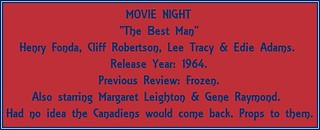
Movie Night: The Best Man.


Review #580: The Best Man.

Cast
Henry Fonda (William Russell), Cliff Robertson (Joe Cantwell), Lee Tracy (Art Hockstader), Edie Adams (Mabel Cantwell), Margaret Leighton (Alice Russell), Ann Sothern (Sue Ellen Gamadge), Shelley Berman (Sheldon Bascomb), Gene Raymond (Don Cantwell), Kevin McCarthy (Dick Jensen), John Henry Faulk (Governor T.T. Claypoole), and Richard Arlen (Senator Oscar Anderson) Directed by Franklin J. Schaffner (#347 - Planet of the Apes)

Review
It's sort of hard to talk about this movie because when it all boils down to it, this is an okay movie. Fonda and Robertson are exceptional, especially when they share a scene, but Lee Tracy is even better, he steals the show and makes it his own in his final performance as he just dominates the movie with a commanding presence. The movie itself is alright, full of supporting characters that either are tolerable or just forgettable, though at least Kevin McCarthy is decent. This is more of a curiosity of a time different from now, but relevant in some ways that surprise even me.

Overall, I give it 7 out of 10 stars.