Showing posts with label John Cassavetes. Show all posts

October 21, 2023

Rosemary's Baby.

Review #2118: Rosemary's Baby.

Cast: 
Mia Farrow (Rosemary Woodhouse), John Cassavetes (Guy Woodhouse), Ruth Gordon (Minnie Castevet), Sidney Blackmer (Roman Castevet), Maurice Evans (Hutch), Ralph Bellamy (Dr. Abraham Sapirstein), Angela Dorian (Terry Gionoffrio), Patsy Kelly (Laura-Louise McBirney), Elisha Cook Jr (Mr. Nicklas), Emmaline Henry (Elise Dunstan), and Charles Grodin (Dr. Hill) Written for the Screen and Directed by Roman Polanski (#631 - Chinatown)

Review: 
Ira Levin was a prolific writer in his day before and after Rosemary's Baby. He had written the 1953 novel A Kiss Before Dying and the play adaptation of No Time for Sergeants. By the 1960s, he had come up with the reasoning that the most suspenseful part of a horror story was "before, not after, the horror appears" and came up with a fetus as the idea for said target. Dealing with a flop in the mid 1960s on Broadway, Levin returned to the idea and reasoned that between making a fetus with impregnation by aliens or the Devil, one basically was stuck with the latter because The Midwich Cuckoos already had dealt with aliens and children. The resulting book (worked over starting in 1965) ended up being so interesting that director William Castle mortgaged his house to buy the rights for the book before it was even published (which occurred in March 1967), as Castle was that confident in a book even in gallery proof form was the one that would make a fine film, and the book ended up as one of the most noted horror novels of its decade. While Paramount Pictures was interested in doing the film, studio head Robert Evans insisted that Castle serve only as producer while having Roman Polanski as director. The French-born director had grown up in Poland and survived the brunt of the Holocaust to study at the National Film School in Łódź before he became a feature director with Knife in the Water (1962). His next three films, made in Britain, involved either horror or thriller aspects with Repulsion (1965), Cul-de-Sac (1966), and The Fearless Vampire Killers (1967). This was the first Hollywood feature for the director, which he also wrote the screenplay that hewed fairly close to the book in several respects. The film was a hit, but Castle dealt with kidney problems after the release that ailed him for a time when he should have basked in the moment of being right. Famously, the ending of the novel/film got William Peter Blatty in a twist that saw him get onto the road to doing his own book about demons in people with The Exorcist (1971). A television film that served as a "sequel" came with Look What's Happened to Rosemary's Baby (1976). Levin saw a variety of his books and plays turned into films over the years, such as The Stepford Wives, The Boys from Brazil, and Deathtrap. In 1997, he wrote a follow-up book with Son of Rosemary. A TV miniseries adaptation of the original novel alongside the sequel book happened in 2014.

Do you ever watch a movie and have that feeling in your stomach that a film with a high reputation really is "just good, not great"? Oh, it happens sometimes (such as the overrated Hereditary or The Invisible Man [2020]), where a film seems to ride really hard on being disturbing in the realm of overt possibilities and so and so on (that, and relying on a short haircut that inspires a chuckle each time I see it). It is amusing that Paramount Pictures distributed this film and Targets in the same year when it comes to horror films hinging in plausibility and the cheaper production (and the one screwed over in marketing) outclasses the former when it comes to flat out getting to the damn point (I find it strangely amusing that the coven is left to blinding actors and being 98% effective in making a man go into a coma in their plans of the whatever). Plus, it doesn't seem to drag its runtime unlike the 137 minutes present here. Sometimes I wondered what would have been if Castle (you know, the guy behind productions such as The Night Walker [1964]) was allowed to have made the film within his own ideas rather than just be the producer. Don't get me wrong, the movie is good and all of the things that come with trying to build suspense with something that you have a good grasp is going wrong earlier than the film believes the viewer thinks they will figure that out. But hey, the film itself, particularly with its one key sequence of lady in bed seeing what she sees and hears in the dark, does make a quality impression in the terror of life under siege to others barging into their lives and their homes. The mental and physical pain that comes out in the film makes for an experience that requires a presence to make it more than words, and it is Farrow (best known previously for her two years on the soap opera Peyton Place in the mid-1960s) that lifts the film as well as one can do with making an involving lead that we can feel for in the realm of reacting to ever-shifting terror (it might seem interesting that a horror film got Academy Award nominations for acting, until you realize Gordon received one and won while Farrow didn't even get a nomination). Gordon of course is effective in that shroud of uneasy weirdness that could only inspire the best type of paranoia and curiosity to go with Blackberry. Cassavetes makes an assuring accomplice, one who is assured even in the face of pathetic qualities that only could come from this (complete with an apt reaction at the end). Evans and Bellamy are on opposite sides of the coin in veteran presences that work out well against Farrow in the shades of doubt and query. In general, the film does work out pretty well in the idea of terror lurking around and possibly inside one's own self, complete with worthy staging to make it feel real. Of course, the ending is a bit on the offbeat side (or for others, perhaps sacrilegious), but as a moment of total acceptance of the scenario that arises from ambition in the face of people that call themselves human, it works. As a whole, it isn't nearly the classic that others might wish to bestow when compared to various others in the 1960s for horror, but it is watchable all the way through with a carefully crafted story that is undoubtedly on there for any horror person to watch at least once.

Overall, I give it 8 out of 10 stars.
Next: Anthology horror, double-packed.

May 28, 2020

Faces.

Review #1428: Faces.

Cast: 
John Marley (Richard Forst), Gena Rowlands (Jeannie Rapp), Lynn Carlin (Maria Forst), Seymour Cassel (Chet), Fred Draper (Freddie Draper), Val Avery (Jim McCarthy), Dorothy Gulliver (Florence), Joanne Moore Jordan (Louise Draper), Darlene Conley (Billy Mae) Written and Directed by John Cassavetes.

Review:
"My films are expressive of a culture that has had the possibility of attaining material fulfillment while at the same time finding itself unable to accomplish the simple business of conducting human lives. We have been sold a bill of goods as a substitute for life. What is needed is reassurance in human emotions; a re-evaluation of our emotional capacities.”

We all know important independence can be in life. It can also be important when it comes to film as well, which proves to be the case with actor and director-writer John Cassavetes, a pioneer of independent cinema. The son of Greek immigrants, he had graduated from the Academy of Dramatic Arts (New York) in 1950 and soon began acting in theater with small bits in film and television following not long after, with works such as The Night Holds Terror (1955) and Edge of the City (1957). He was a proponent of an alternative to method acting through his own workshop that he did in New York City. It was during an appearance on the radio show Night People (hosted by Jean Shepherd) to promote the latter film that he pondered over if someone could make a film about ordinary people (without all the Hollywood business interference). Funds from listeners of the show (which apparently totaled to over $2,000) along with raiding funds from family and friends led him to have a chance to make what he wanted. Over time, he would use funds garnered from acting gigs (with notable performances in films such as The Dirty Dozen (1967) and Rosemary's Baby (1968)) to help fund his films, not wanting to compromise his vision from producers who might have wanted to shift a project to something more "commercial" (although he did do a few films with involvement or distribution with studios, such as the two films before Faces in Two Late Blues and A Child is Waiting). He cultivated his films from his experiences with an fiercely independent streak who once stated that the only person less important than the director on a film set was a talent agent, since he felt a director should create their own material for their films. He was characterized for allowing a manner of improvisation for his actors through their delivery and interpretation of their character, which would shape the story (as opposed to the other way around). Ultimately, he would direct twelve films in a span of 27 years from Shadows (shot in 1957, previewed the following year and then reworked for release in 1959) to Big Trouble (1986, which he disowned) before his death in 1989 at the age of 59. One of his scripts would eventually be adapted into a film after his death with She's So Delovely (1997), directed by his son Nick (the first of Cassavetes' three children to turn to directing).

For this film (his fourth), he spent over six months with filming (most notably filming in the house of his mother-in-law alongside his own) and then three years to edit. The film runs at 130 minutes, but it had existed in numerous forms prior to general release, including an initial cut of six that reduced to four before a preview screening of a three hour version, and a 147 minute version was deposited for preservation at the Library of Congress.  One thing that is for certain is that the film is an interesting look upon communication and how few we really talk to each other. What one thought about communication when it comes to how passive and desperate we are to connect with our loved ones back in 1968 still resonates with how we are now, with Cassavetes managing to make an honest film that sets its own path of casual venom in examining communication with rawness. It can be an uncomfortable sit at times, lingering with conversations on their own terms that can test the patience at times but ultimately work itself out to discussion and curiosity worth having. Marley and Rowlands lead this ensemble (with five of the main six having starred in at least one Cassavetes film before this one) to curious heights, leading one's curiosity with a bit of sadness to it all, whether that means a working man trying to escape his empty love-life in a capable Marley (a character actor with plenty of film/TV credits) or a wiry and knowing performance from Rowlands (an actress of over six decades in film, stage, and television known for collaborations in her husband Cassavetes' films) that serves to drive the film's look at desperation to feel something with someone. Carlin, the secretary-turned-actress makes for a fair debut that captures a hollowed-out person of marriage with subtlety. Cassel shines in carefreeness that pulls you in when he shows himself to try and warm up the presence of desperation without becoming a caricature to laugh at. In the end, this is a bleak movie, but it is one that has a place for doing so on its own terms for its story and for its actors that shows the reflection on the mirror of the 1960s without flinching or making an easy out. It might not be for everybody, but it certainly has a place in inspiring curiosity for those who want something a bit different from the usual fare.

Overall, I give it 8 out of 10 stars.

November 27, 2017

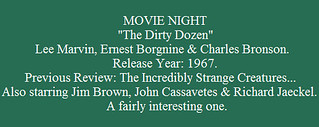
The Dirty Dozen.


Review #1014: The Dirty Dozen.

Cast: 
Lee Marvin (Maj. John Reisman), Ernest Borgnine (Maj. Gen. Sam Worden), Charles Bronson (Joseph Wladislaw), Jim Brown (Robert T. Jefferson), John Cassavetes (Victor R. Franko), Richard Jaeckel (Sgt. Clyde Bowren), George Kennedy (Maj. Max Armbruster), Trini Lopez (Pedro Jiminez), Ralph Meeker (Capt. Stuart Kinder), Robert Ryan (Col. Everett Dasher Breed), Telly Savalas (Archer J. Maggott), Donald Sutherland (Vernon L. Pinkley), Clint Walker (Samson Posey), Robert Webber (Brig. Gen. James Denton), Tom Busby (Milo Vladek), Ben Carruthers (S. Glenn Gilpin), Stuart Cooper (Roscoe Lever), Robert Phillips (Cpl. Morgan), Colin Maitland (Seth K. Sawyer), and Al Mancini (Tassos R. Bravos) Directed by Robert Aldrich (#105 - What Ever Happened to Baby Jane? and #778 - The Longest Yard)

Review: 
Admittedly, war films are not exactly my preference when it comes to what I try to watch for films, but from time to time there can be ones that pique my interest, and this is certainly one that garnered a look. The movie is based on the novel of the same name by E. M. Nathanson, which was inspired by a real-life group called the "Filthy Thirteen". The film has a big cast (as the title suggests) along with a considerable length of 150 minutes, not so much due to the action but the training of the group, although the last parts of the film contains plenty of action. It is evident to say that of the twelve members, six stand out the clearest: Bronson, Brown, Cassavetes, Savalas, Sutherland, and Walker. They have distinct characteristics that they apply well to their roles that just clicks. Marvin is fairly entertaining, having a great sense of gravitas, which could also apply to Borgnine. My favorites of the group are Brown and Sutherland, the former due to him being easily watchable and the latter due to his charm. The film has its share of amusing moments along with its scenes of fellowship with these hard-edged (but watchable) people. I especially like the sequence with Marvin and Sutherland in which the latter has to help fool a general. The war game part is also fairly commendable in its execution as well. Admittedly, the cast is perhaps a bit old to be playing soldiers (the youngest of the group is Cooper and Maitland, both born in 1942 for a film released in 1967), but it isn't too much of a detraction. It's not a movie that relies heavily on a big spectacle action scene, in part because the film isn't meant to be like that. The last sequence (with the château) is a fairly thrilling sequence, but it is one that you can also dwell on due to the characters that we have watched prior to that point. It's a gritty movie that has its shares of bleakness, but it is a well-paced and well thought-out film. Whether the film achieves its goals or not, it is at the very least a fine piece of entertainment.

Overall, I give it 8 out of 10 stars.