Showing posts with label Henry Travers. Show all posts

March 12, 2020

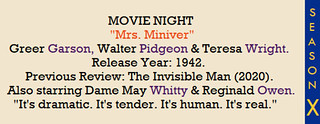
Mrs. Miniver.


Review #1360: Mrs. Miniver.

Cast: 
Greer Garson (Kay Miniver), Walter Pidgeon (Clem Miniver), Teresa Wright (Carol Beldon), Dame May Whitty (Lady Beldon), Reginald Owen (Foley), Henry Travers (Mr. Ballard), Richard Ney (Vin Miniver), Henry Wilcoxon (The Vicar), Christopher Severn (Toby Miniver), Brenda Forbes (Gladys), and Clare Sandars (Judy Miniver) Directed by William Wyler (#509 - Roman Holiday and #1022 - Jezebel)

Review: 
War-time films could come in many genres, and 1942 is a prominent one to spotlight. After all, this film dominated the Academy Awards for its year, winning for Best Picture, Director, Actress, Supporting Actress, Screenplay, and Cinematography. The film is based on a series of newspapers columns for The Times by Jan Struther, which had started in 1937 (with a collection of those columns being published into a book in 1939) on an ordinary sort of woman with ordinary sort of life, with most of the essays being done before World War II was declared, and four writers were credited for adapting it to the screen: Arthur Wimperis, George Froeschel, James Hilton, and Claudine West. At the hand is a director with a prime like no other in William Wyler, who came from working at Universal Studios as a stage cleaner and mover to director of Western quickies in two years. In the next decade, he would hone his craft in a variety of genres from drama to comedy that would lead to plenty of notice with films such as Dodsworth (1936) and Wuthering Heights (1939). A noted perfectionist, he would generally insist on multiple re-takes, which proved to be worth it for several actors, directing 36 actors to Academy Award nominations and 14 to wins, both records. He directed films in six decades until his last with The Liberation of L.B. Jones (1970). Garson and Pidgeon make for a well-rounded bunch of leads (with this being the 2nd of eight collaborations, including a sequel with The Miniver Story eight years later), both having risen from stage to screen (the former in the 30s, the latter in the late 20s) to carry a movie that certainly rouses plenty of spirit and inspiration to make for a solid romance war drama, one wrapped in sentiment under propaganda that makes its mark most of the time.

It certainly rose plenty of spirits, with Winston Churchill once stating that it had done more for the war effort than a flotilla of destroyers, and Franklin D. Roosevelt had ordered the final speech (involving how this is a "war of the people", not just soldiers) broadcast over radio. That speech was written by Wilcoxin (the one who says the striking words) and Wyler the night before filming it. Regardless of its war elements, there is a tender touch to the film that manages to resonate in drama after nearly eight decades that can't be lost to time. It works with a 133 minute pace in holding its family aspects and the looming war together with patience and skill. Garson commands the screen with grace, a courage in the manner of the stiff upper-lip that resonates for her time on screen. Pidgeon does just as much in conveying charm with capable chemistry in the ways you would expect with Garson alongside other scenes when dealing with the war efforts. Wright makes her presence clear any time she is on screen, a vivid and ideal one in a weary-but-able world. A noted actress of the screen (along with her charity work during the first World War) before making her screen debut at 72 in 1935, Whitty strikes attention with no trouble at all, marked with discipline in her nerves in her moments on screen. The other members of the cast do just fine in rounding out the elements necessary to make for capable drama in perseverance. It is the kind of stuff that can drive emotions out for passion, for sacrifice and support that one can still identify with in some way in our trying times today, whether one resides in Europe or elsewhere. For the most part, the film knows where to go in making capable entertainment, and it rightfully endures as a fair gem for both its director and Metro Goldwyn Mayer.

Overall, I give it 9 out of 10 stars.

February 29, 2020

The Rains Came.


Review #1351: The Rains Came.

Cast: 
Myrna Loy (Lady Edwina Esketh), Tyrone Power (Major Rama Safti), George Brent (Tom Ransome), Brenda Joyce (Fern Simon), Nigel Bruce (Lord Albert Esketh), Maria Ouspenskaya (Maharani), Joseph Schildkraut (Mr. Bannerjee), Mary Nash (Miss MacDaid), Jane Darwell (Aunt Phoebe - Mrs. Smiley), Marjorie Rambeau (Mrs. Simon), and Henry Travers (Rev. Homer Smiley) Directed by Clarence Brown (#423 - A Woman of Affairs, #433 - Angels in the Outfield, and #484 - Plymouth Adventure)

Review: 
If you want a disaster film to go along with your romance, I guess this could fit the bill. This was a film that 20th Century Fox spent nearly half of its 100-day schedule in making rain to go along with a flood sequence (using a 50,000 gallon tank of water on a studio soundstage), with 33 million gallons of water used, with a fifth of the $2.5 million budget being spent on flood and earthquake scenes. It surely paid off for its effects crew, since E. H. Hansen and Fred Sersen ended up as the first awardees for Best Visual Effects through this film. Who better to helm the film than veteran director Clarence Brown (a versatile director of romance, dramas and period pieces) and established actors like Loy (a versatile actress known for vamp roles prior to The Thin Man in 1934), Power (a matinee idol in the latter 1930s along with the 1940s), and Brent (a leading man for romances primarily in the 1930s and 1940s) to go with it. The film was adapted to the screen by Philip Dunne and Julien Josephson from the 1937 novel of the same name by Louis Bromfield. A remake would be produced by the studio with The Rains of Ranchipur (1955), which changed the ending (so no one dies). This is a glossy but finely crafted film,  where one will be pleased at what they get on a visual level alongside the romantic quartet when it comes to generating intrigue. Loy certainly seems to be having fun with such a mischievous (at least at first mischievous) headline role, brash but immensely watchable every time she is on screen, whether that involves playful banter or helping the sick. Power comes off a bit reserved, but it works out in making calm passion. This plays itself out with Loy's death scene, where Brown had told her to try acting it out with her eyes open through holding her breath. It is a striking scene, one must say. Brent plays a decent rogue, one that fits in contrast to whoever leading lady he is playing towards, whether that means a clash with Loy or a fresh (in that this was her debut role) Joyce. Bruce (a character actor since 1922 whose most famous portrayal was of Dr. Watson starting in 1939) certainly does fine with a boorish turn, and Ouspenskaya certainly proves a charmer from time to time. The romances play out fine for its 105 minute run-time, where one can see how they'll draw themselves out but not find themselves predicting everything (for a film with a title like this, at least).  In a year with plenty of romance and spectacle on numerous fronts, The Rains Came is a decent little gem among others. It makes for a decent show with its fair passion and well-done effects to make a diverting time to go with, utilizing a workable cast and an accomplished director to get things done without too many troubles.

Overall, I give it 7 out of 10 stars.

Ah yes, the end of the month (and the tribute to the 1930s) has come. If you are wondering, I have not forgotten about doing films from the current year as well. Those will be sprinkled into March at their own time, apart from the primary goal of March, the third phase of Tribute to the Decades with the 1940s.

May 21, 2016

Shadow of a Doubt.


Review #800: Shadow of a Doubt.

Cast
Teresa Wright (Charlotte "Charlie" Newton), Joseph Cotten (Charles "Charlie" Oakley), Macdonald Carey (Detective Jack Graham), Patricia Collinge (Emma Newton), Henry Travers (Joseph Newton), Wallace Ford (Detective Fred Saunders), Hume Cronyn (Herbie Hawkins), and Edna May Wonacott (Ann Newton) Directed by Alfred Hitchcock (#219 - Rope, #223 - North by Northwest, #446 - Spellbound, #447 - Psycho, #450 - Vertigo, #455 - Rear Window, and #553 - Strangers on a Train)

Review
Shadow of a Doubt benefits a great deal from being so tightly wound with suspense and thrills that never let up from beginning to end, the hallmark of a great film noir. Cotten is the first one introduced on screen, and whenever he appears he certainly has an alluring, likable charm, making for such a brilliant villain; when he lets out his other side (such as when he compares rich widows to fat wheezing animals) sneak onto the surface, it certainly makes for making this character very definable and very effective. Wright does a fine job as well, making for a great lead in that she has depth to her, not just being someone who happens to play onto all of these events; she has her struggles and her doubts about someone near to her, and it is all easy to relate and thus makes her character well defined. When she finally discovers the truth, it's a great scene because it finally culminates the clues sprinkled in beforehand (the inscription of the ring, ripping out a page of the paper, etc.), and the movie soon shifts into a game between the two Charlies. Wright and Carey share a good (if not extremely quick) rapport as well. The supporting cast is well done, doing their purpose and roles nicely, because they fit the movie well, being neither too distracting nor unhelpful to the plot. The final scene between the two of them is excellent, being a quick and effective climax that seals the movie neatly. Hitchcock described it as his favorite film, and it's evident that this really is one of his best films.

With that, 800 reviews have been written by yours truly in 1,979 days from December 20, 2010 to the present day. I am proud to have done this for over 5 years, and I am glad to have broadcast these reviews to all of you, wherever you are. I hope you enjoy this review, along with the previous and future installments of this show.

Overall, I give it 10 out of 10 stars.

June 18, 2014

Movie Night: Random Harvest.


Review #596: Random Harvest.

Cast
Ronald Colman (Charles Rainier), Greer Garson (Paula Ridgeway/Margaret Hanson), Philip Dorn (Dr. Jonathan Benet), Susan Peters (Kitty Chilcet), Henry Travers (Dr. Sims), Reginald Owen (Biffer), Bramwell Fletcher (Harrison), Rhys Williams (Sam), Una O'Connor (Shopkeeper), Aubrey Mather (Sheldon), and Margaret Wycherly (Mrs. Deventer) Directed by Mervyn LeRoy.

Review
Romantic films can be many things, they can be pleasant to watch and joyful, or they can be unbearable to watch. This film falls into the first category. Colman and Garson are an excellent duo, and they pair off well each other, they are just perfectly cast, and Colman does a great subdued performance. The supporting cast is fun to watch, even Una O'Connor (evidently she hams it up only in horror films), Reginald Owen is a charm to watch, it's just fun to watch the interactions between everyone. The plot is well crafted, a treat to appreciate. This is a neat little movie practically wrapped in gold paper. This movie is good enough to even be shown on TCM on Tuesday night, picked by none other than guest programmer Gene Wilder (squee!), and I can see why he picked it. It's a good flick to watch, even in summer, I suppose.

Overall, I give it 9 out of 10 stars.

December 25, 2012

Movie Night: It's a Wonderful Life.


Review #319: It's a Wonderful Life.

Cast
James Stewart (George Bailey), Donna Reed (Mary Bailey), Henry Travers (Clarence Odbody), Lionel Barrymore (Henry F. Potter), Thomas Mitchell (Billy Bailey), Beulah Bondi (Ma Bailey), Frank Faylen (Ernie Bishop), Ward Bond (Bert), Gloria Grahame (Violet Bick), and H. B. Warner (Mr. Gower) Directed by Frank Capra (#102 -  Mr. Smith Goes to Washington)

Review
I know it sounds incredibly cliche to review this film, that it sounds all cheerful (The word Wonderful is in the title after all) and all that Christmas spirit and such (which either ends on December 26th or keeps on going until January for some reason). But as it turns out, it's a strangely depressing yet strangely useful film. Capra and Stewart are a good pair, and it works in this film extremely well. I actually thought this would be that film that would be extremely overrated, and that their was another Christmas classic everyone was talking about. I was wrong. Stewart and Travers are the main standouts (though Travers doesn't play a big role till about the last hour), with Bailey not just being a goody goody boy scout, Stewart also convey the darkness that is believable to the end. While it might sound caramel sweet at times, it has some good acting combined with humanity and good will. And isn't that what Christmas needs? Classics to watch, and goodwill toward men and women. While this film wasn't a success in its original release, it would later gain a reputation as one of the Christmas classics. Merry Christmas.

Overall, I give it 10 out of 10 stars.

November 4, 2011

Movie Night: The Invisible Man.

Review #069: The Invisible Man.

Cast
Claude Rains (Dr. Jack Griffin / The Invisible Man), Gloria Stuart (Flora Cranley), William Harrigan (Dr. Arthur Kemp), Henry Travers (Dr. Cranley), Una O'Connor (Jenny Hall), Forrester Harvey (Herbert Hall), Dudley Digges (Chief Detective), and E. E. Clive (Constable Jaffers) Directed by James Whale.

Review
This is the first film I've covered from the 1930s, and it is a good one to cover. This film is a good adaptation (by H.G Wells) of the book and it entertains the viewer in a 71 minute span. The acting is good (save for Una O'Conner, who screams just a bit too much for my taste) for 1933. Rains is a fine main character. The special effects are great for its time. Actually, they still look great, even for today. The film is dramatic, smart, and a bit cunning. On the whole, this is a fairly capable horror film.

Overall, I give it 9 out of 10 stars.