Showing posts with label Wallace Ford. Show all posts

December 22, 2025

T-Men.

Review #2489: T-Men.

Cast: 
Dennis O'Keefe (Dennis O'Brien, a.k.a. Vannie Harrigan), Mary Meade (Evangeline), Alfred Ryder (Tony Genaro – aka Tony Galvani), Wallace Ford (The Schemer), June Lockhart (Mary Genaro), Charles McGraw (Moxie), Jane Randolph (Diana Simpson), Anton Kosta (Vantucci), Art Smith (Gregg), with Reed Hadley (Narrator), and Herbert Heyes (Chief Carson) Directed by Anthony Mann (#1048 - He Walked by Night, #1408 - El Cid, #2010 - Winchester '73)

Review: 
"Violence is always pictorially shocking. You can achieve fantastic effects of violence just by implication and design. And it is one of the good parts of our medium - it tends to shock and tends to excite the imagination and to rouse feelings in the audience that they’ve seen something and experienced something."

Sure, here's another movie involving a government department. Okay, we're not actually talking a paragraph about the U.S. Department of the Treasury, but they are the ones who oversee the U.S. Mint and the Bureau of Engraving and Printing, so yes, it is important that fake currency is investigated and taken out as quickly as possible. The film even features an introduction by Elmer Lincoln Irey, who served as an official for the department before serving as the first Chief of the IRS Intelligence Unit, which prosecuted thousands of people for tax evasion (so yes, the guys who busted Al Capone). Ironically, the movie actually had partial financing from organized crime with John Roselli, a member of the Chicago mob that happened to like movies and formed a silent partnership with Joseph Breen (head of the Production Code Office)*. T-Men was the first film Mann stated as "the first big one" as his previous works were basically ones that were thrust upon him (Mann stated that his days at Republic were fairly grim). Mann worked on the script from scratch and had involvement from William Eirie from the Treasury Department to bring files and create a story with John C. Higgins (of course, Virginia Kellogg was credited with the story while Higgins was credited with the screenplay - however, it has been speculated Henry Blackfort may have been involved somewhere); the research they did there led to them discovering the story of what later became Border Incident (1949). The key producer was Edward Small, who produced one other film with Eagle-Lion and Mann with Raw Deal (released in 1948 that also had O'Keefe as the star) but didn't get fully involved with the company due to feeling like they minimized his contributions. 

Released in late December 1947 on a budget of roughly over $400,000, the movie made over two million dollars, and it was the first of five collaborations between Mann and cinematographer John Alton. I'm sure you can figure out why it matters to have money that isn't fake going around in the general public (hell, how many places do you know that don't have one of those markers around that marks fake money?). What we have here is a lean affair that is definitely entertaining in showing tight work and the people that surround it. Even with the film telling you of its inspiration from an actual case (nicknamed "Shanghai Paper Chase"), you get a worthy semi-documentary feel early on with how it treats the material with efficiency and respect. It's a noir that has respect for its audience and builds its house of excitement for 92 minutes of generally involving fare, which mostly comes at the hands of O'Keefe, who apparently wanted to break into dramas (it helps to have Small as an agent). He proves pretty first rate for what the movie needs in crafty charm that has to play undercover with sincerity that rolls along like a typewriter in rattling consistency. Ford (a vaudevillian in earlier days) makes for a quality gangster presence in usefully odd disposition that gets a particularly brutal end (a steam room). The machinations that arise in trying to seep into the underbelly, even at the cost of being recognized on the street or seeing the death of those who can't cut it, is executed with swift interest by Mann and company (Alton was a pro after all) that makes one invested with the chase from the get-go. As a whole, T-Men is a solid effort for involved, having clear interest for its subject matter with useful energy in its foundation to make a worthy crime noir to recommend.

Overall, I give it 8 out of 10 stars.

*Roselli apparently was later involved in recruitment by the CIA in an attempt to kill dictator Fidel Castro. And then I guess he might be implicated in the boring and worthless conspiracy web of the Kennedy assassination (here's the only take: Kennedy was killed by one and only one loser. The end.). A decade later, he was found dead in a 55-gallon drum in Florida because yes, even 71-year-olds have to get whacked.

September 20, 2024

He Ran All the Way.

Review #2253: He Ran All the Way.

Cast: 
John Garfield (Nick Robey), Shelley Winters (Peg Dobbs), Wallace Ford (Mr. Dobbs), Selena Royle (Mrs. Dobbs), Gladys George (Mrs. Robey), Norman Lloyd (Al Molin), Bobby Hyatt (Tommy Dobbs), and Clancy Cooper (Stan) Directed by John Berry.

Review: 
Remember John Garfield? Tough guy actor, Method acting pioneer, martyr for the cause of not naming names, one probably should remember this actor. He had made his debut on Broadway at the age of nineteen in 1932 after rising from a tough upbringing to honing his craft in New York theatre (such as the Group Theatre). Six years later, he appeared in his first film with Four Daughters (1938) and garnered an Academy Award nomination to start his first couple of years in the Warner Bros. studio system before he decided to venture out with his own production company in the mid-1940s; Body and Soul (1947) was the highlight of the three-year run. Garfield died at the age of 39 from long-term heart problems (he had scarlet fever as a child while missing service in World War II because of his heart) in 1952. One year earlier, he appeared in his last feature film with He Ran All the Way, which was based on the 1947 novel of the same name by Sam Ross. Hugo Butler and Dalton Trumbo wrote the screenplay adaptation. Two months before this film was released, Garfield was asked to testify before the House Committee on Un-American Activities. He was a member of the Committee for the First Amendment, which was in support of ten individuals that were cited for contempt of Congress and blacklisted when they didn't answer questions of alleged involvement with the Communist Party, which included Trumbo; being a part of that committee, combined with a wife who actually was a member of the Communist Party in America and testimony that did not "name names", led to Garfield being ignored by studios. Incidentally, John Berry was also wrapped up in the HUAC witch-hunt, because Edward Dmytryk (a member of the aforementioned "Hollywood Ten") decided to testify and named Berry as a communist (Berry had indeed been in the party for a time). Berry would have to move away from America to find work to direct for a time; Berry returned and eventually got to direct features again, most notably with Claudine (1974). Butler himself was chased out of working in Hollywood for a number of years because of the HUAC. The film, distributed by United Artists, made $1 million on original release.

Seemingly, you can find a noir classic if you know where to go. There is a great sense of claustrophobia present for a movie with such a delicate sense of self for 78 minutes. Garfield as a whole deserved better, but he really pulled it all in with this performance of a scared creature that is exposed to the elements when you see him opposite other people. Sure, you might wonder what he is doing interacting with a mother in the intro where he looks a bit old to still be around living with her, but then I think that even there it seems clear that we are dealing with someone who lives only to use people and things as much as he tries to do because of how alone he really is. Imagine the depths one has to go to make people be around you and all one can come up with is aggression. Garfield just sells that desperation in such a quick amount of time that makes one realize that some Method guys really could just lock in when they needed to. Incidentally, this is the same year that Winters was nominated for her first Academy Award for her performance in A Place in the Sun. Interestingly, she was so into the idea of being into this film with Garfield and Berry that when faced with the idea of having to turn down the film for some contract costume drama (Little Egypt), she intentionally went on an eating habit (apparently over a week and a weekend) to gain weight to get out of that film, which worked. It is easy to see her talent, because she plays opposite Garfield with such worthwhile timing that makes the drama of collaboration with a kidnapper-turned-accomplice so fascinating. Ford provides the usual character actor stuff that is reliable in terms of apprehension, as one would expect from someone in the middle of a growing shaky bond between man and woman. As a whole, this is a damn good movie, with Berry and Garfield leading the way in worthwhile tension in the portrait of a scared creature and the personality that comes out in such a rapid-fire and terse way for such a grim and devastating film, particularly in its climax in those last few minutes.

Overall, I give it 9 out of 10 stars.

October 24, 2022

The Mummy's Tomb.

Review #1908: The Mummy's Tomb.

Cast: 
Lon Chaney Jr (Kharis), Dick Foran (Prof. Stephen A. Banning), John Hubbard (Dr. John Banning), Elyse Knox (Isobel Evans), Wallace Ford (Babe Hanson), Turhan Bey (Mehemet Bey), George Zucco (Andoheb), Mary Gordon (Jane Banning), and Cliff Clark (Sheriff) Directed by Harold Young (#511 - The Three Caballeros and #1799 - Carib Gold)

Review: 
Two years after the release of The Mummy's Hand (1940) came this film, which retained a couple of actors from this film as a sequel (of sorts) to this one. Foran, Ford, and Zucco return for this film, while Lon Chaney Jr replaces Tom Tyler as the title character. Honestly, I fail to see the point of having Chaney in the role, since he doesn't have a word of dialogue beyond all that makeup, and he would end up starring in the next two of these films. Given the time that the film it was made, it should only make sense that the film re-uses footage from the previous Mummy film, and this is done to recap what happened in a ten-minute opening (while Zucco is used to do other exposition before dying after monologuing). So yes, an hour-long film is really 50 when you take that out. You could call it incredibly redundant, but I guess it works if you really don't remember mediocre movies like before. I would like to point out that it is set "thirty years later", which would actually mean this film was set 30 years in the future and since the last one was a contemporary film...well, 1970 sure looks like 1940. 

It sure is a shame that this sequel is only just the same kind of mediocre horror movie, complete with oddball decision making that goes along with the benefit of having less comic relief without dragging along for an intolerable hour. You get a body-count and a silly motivation for the climax, what more is there to say? At least Bey makes for a useful adversary, following in the footsteps of Zucco in terms of smooth devotion before the inevitable story bits come in. So yes, a bunch of actors in elderly makeup are taken down by a mummy that survived being burned that moves at an amusingly slow pace. Hell, one of the guys gets killed when he is cornered at a wall and doesn't think to just...run to the side of him. But hey, the townspeople get a bunch of torches and chase the mummy, which happens to remind one of the Frankenstein movies, with the mummy being a tool to kill, which isn't too fun. My favorite bit is the group of townspeople staying still with their torches before they decide to throw some of them into the house the mummy is present (while people happen to be in the house). In short, nothing really is improved from the last film despite the small improvements from before. Maybe it is a bit interesting to see where the story ends up for Foran and Ford along with Zucco (seemingly alive after getting shot down a staircase), but yeah, they don't really have much to do to make you care very much about what goes on, so the disposability of them isn't exactly a shocker. Hubbard is just kind of there, existing only to interact in the mildest of mild things when the mummy is not on screen. Knox is just as bland, only serving as an object for desires of the most predictable kind, because this is yet another Mummy movie where the priest wants the girl for himself (the last one had them plan to eat tana leaves to be immortal). Sure, it is nice to see Bey in the role rather than someone who would play it for stereotypes, but nothing really changes in terms of captivating drama beyond the mild horror things. As a whole, if you want only a movie that serves the basic requirement of mummy terror and nothing else, then it will probably rank better than the prior Mummy sequel, but otherwise, there isn't really much to say in terms of positivity besides calling it mediocre.

Overall, I give it 6 out of 10 stars.

October 6, 2022

Freaks (1932).

Review #1897: Freaks.

Cast: 
Wallace Ford (Phroso), Leila Hyams (Venus), Olga Baclanova (Cleopatra), Rosco Ates (Roscoe), Henry Victor (Hercules), Harry Earles (Hans), Daisy Earles (Frieda), Rose Dione (Madame Tetrallini), Daisy and Violet Hilton (The Siamese twins), Schlitzie (Himself), Josephine Joseph (Half Woman-Half Man), Johnny Eck (Half-Boy), Frances O'Connor (Armless girl), Peter Robinson (Human skeleton), Olga Roderick (Bearded lady), and Koo Koo (Herself) Directed by Tod Browning (#031 - Dracula, #470 - Mark of the Vampire, and #516 - The Unknown)

Review: 
Admittedly, a horror movie can take time to appreciate, particularly ones that were given the shaft like this one was. After all, the director associated with a film involving "Freaks" seemed exactly the one to direct it. Tod Browning left high school before graduation in order to join the circus. After years of carnivals and vaudeville, he became an actor in 1909, primarily in slapstick shorts, although he was hired in 1913 by D. W. Griffith near the twilight of his time at Biograph Studios. A 1915 accident involving him being drunk while at the wheel of an automobile led to injuries that kept him in bed for a considerable amount of time, which gave him inspiration to write (he had already done a few couple of short films as a director). He returned to work in film after time away, serving as an assistant director on Griffith's Intolerance (1916), and Jim Bludso (1917) was his first feature film. Browning's best work is associated with the star in Lon Chaney, who he did ten features with from 1919 to 1928 (Dracula, Browning's one key success in the sound genre with audiences, was meant to star Chaney before he fell ill). When the sound era dawned, Browning did nine feature films before retiring in 1939. The film is loosely based on the short story "Spurs" by Tod Robbins, and the screenplay was done by Willis Goldbeck and Leon Gordon, while Browning also served as producer. Test screenings of the film for Metro-Goldwyn-Mayer (MGM) proved a tough pill to swallow. Apparently, people ran out of the theater halfway through the movie - I guess a horror film just can't be too scary, and MGM cut the movie from an original run-time of 90 minutes to an hour. The climax was cut down, worse yet. The film did not have the "happy" ending in the original cut, instead going further into just what happened with the character of Cleopatra beyond a scream (because the original had her get trapped under a tree struck by lightning). So yes, the fate of one of the characters is kept the same, but with a twist: their companion is present this time around, albeit as a soprano because of castration.  Maybe it seemed strange for MGM to be the production company. They did do a couple of features beforehand in the 1920s, most notably with Browning's London After Midnight and The Unknown, but I think you will agree that having Irving Thalberg in your corner could be a double-edged sword. Once the film came and went with the box office as a failure, Browning's career never recovered, and he retired after his 46th feature in Miracles for Sale (1939), and he died in 1962 at the age of 82. Hell, in the era of trying to remake movies that were pretty good already, why not try to cover features that were given the shaft like this one? You wouldn't even have to change much of the actual script (one that does the simple art of presenting people as they are), since the only thing necessary would be to just show things as originally intended in the ides of retribution in what it means to go against the collective.

From the contemporary reaction by certain critics, you would think Freaks showed people getting chopped in half. One review actually said that people should put in the hospital pathological ward if the viewer considered it to be entertainment. I think we can safely say that they were clearly wrong. Hell, it didn't even take that many decades for people to carefully recognize that the audience was wrong, because counterculture audiences in Europe found a liking for it in the 1960s, and it became a midnight movie to enjoy in later years. Yes, you could consider it as a melodrama with an ounce of horror for the climax, but that is what makes it all the more interesting and useful to consider in the place of 1930s horror (besides, one grows tired of people deeming movies as just melodramas rather than being, you know, horror, which could also go for so-called psychological thrillers"). It was disrespected in its time by audiences that just wouldn't accept the idea of presenting circus people as anything other than what people thought they were, and the fact that the 90-minute version does not survive is a straight tragedy. The horror is not the people of the circus that happen to have no arms or are conjoined twins, the horror is the people who treat them like crap. What does it mean to be normal is the question provided here, which is done in a thoughtful and entertaining way that was ahead of its time when it comes to "pretty" people being punished by others that get away with it. So yes, there is a mix of established actors (Ford, Hyams, Baclanova, and Victor) mixing with performers such as the Earles, Schlitzie, and the Hilton twins (there were plans to have bigger names cast against the circus people such as Myrna Loy and Victor McLaglen, but this fell through). Granted, the acting is a bit on the okay side, and I do wonder exactly how one came to the decision to cast siblings in the Earles as characters meant to have feelings for each other. Baclanova (once nicknamed "The Russian Tigress") is the key to the film when you boil it down to basics, the embodiment of the horror of man in the cruelty that can be shown to others not like them. Sure, Ford and Hyams are mild counters to that idea, but they are barely important in the long run when you want to see just where mistreatment of people can get you (it should be noted that they were actually vaudevillians before becoming involved in film). Far from exploitation, the circus performers are just shown being themselves, whether that involves a man being able to light a cigarette with no arms or legs or conjoined twins having distinct lives of love.

Oh sure, the climax is the highlight, but consider the gooble-gabble scene a couple of scenes beforehand. Here one is trying to welcome someone into the community despite their misgivings, and all they do is react in disgust at the idea that they are at your level. That would be a pretty sad thing to hear, so it works quite well with what is needed here. And then the climax happens in a flash: a dark night with rain and people that lurk in the background ready to strike. The ending shot should've just been the shot involving the final fate of one of the characters rather than just being a "happy" ending, if only because it is more fun to show the logical conclusion of doing a morality tale rather than just trying to suck up to audiences who think happy endings need to happen in horror too. As a whole, Freaks was ahead of its time, and a little more credit is given for this film for its quibbles (a cut pace and decent if not quite professional cast) because of how it was treated in getting to theaters as opposed to later films with misunderstandings. Had the original cut survived the way it was intended, we would think it was even better and give Browning even more credit as a director, one who specialized in the exotic, the bizarre or just the mystery that comes with life that shows just who the real freak is, which makes it a horror film worth investing all of your time in as opposed to just cutting to the end for the big highlight.

Overall, I give it 9 out of 10 stars.

October 7, 2021

The Mummy's Hand.

Review #1735: The Mummy's Hand.

Cast: 
Dick Foran (Steve Banning), Peggy Moran (Marta Solvani), Wallace Ford (Babe Jenson), Eduardo Ciannelli (the High Priest), George Zucco (Professor / Andoheb), Cecil Kellaway (Tim "The Great Solvani" Sullivan), Charles Trowbridge (Dr. Petrie), Tom Tyler (Kharis), and Sig Arno (The Beggar) Directed by Christy Cabanne.

Review: 
Believe it or not, the Univeral line of horror movies was not a constant cycle that just churned out interesting monster after monster; sure, Universal opened the door with The Phantom of the Opera (1925), but it was Dracula (1931) that set the stage for a craze of films in the next five years that generally adapted literary material such as the works of Edgar Allan Poe or H.G. Wells. The Mummy (1932), however, was instead inspired by the public interest in Egyptian tombs and curses. By 1936, the cycle of these films would take a pause because of the power struggle that came about over ownership of Universal Pictures, which struggled with financial overruns with the Laemmle family in charge. Until the fall of 1938, there were no plans for future films...until Universal heard about the positivity coming from the Regina-Wilshire Theatre in Beverly Hills, which showed a double feature of Dracula and Frankenstein and attracted crowds, including Bela Lugosi being used to promote it; they would make their own prints to show around (while having Lugosi do a wide tour) and soon found themselves in a decision to return into the world of horror. As such, Son of Frankenstein (1939) started a new cycle of horror films from the company, which would include old and new monsters with features such as The Invisible Man Returns (1940), The Wolf Man (1941), and others. However, with the Mummy series, a re-imagining would be done for the four feature films done in the 1940s (each with the title of "The Mummy's [blank]" with this one, Tomb, Ghost, and Curse). The 1931 film featured a mummy by name of Ardeth Bay / Imhotep, while this one features a mummy named Kharis, which would be the name for each of the subsequent films (this does not include the Abbott and Costello crossover film, which spelled it as Klaris). The story was done by Griffin Jay, who also did the screenplay with Maxwell Shane; the film was made on a modest budget of $84,000 while having a bit of footage re-used from the original feature (because why re-stage something you already shot in a time where you couldn't just watch the other film on a whim?) and sets re-used from Green Hell (released the same year, incidentally directed by James Whale). At the helm of director was Cabanne, a stage/film actor-turned-director that would turn out films at a proficient rate from the 1910s all the way until his last film in 1948, with a good deal of them being Westerns. Oddly enough, it was a guy known for Westerns that would play the title character for this film with Tom Tyler. One can imagine why anybody would only want to do one feature where cotton is glued to the face for wrinkles (I imagine it took less than eight hours to get the job done this time around).

This, along with a handful of the horror films of its era, belong to the B-movie classification, ones that could be slickly made and shown out to fill the billing for whatever theatres needed in the era of the 1940s, for better or worse (Frankenstein would turn into a monster mash with varying results, for example). One could probably do better with 67 minutes than to watch a curiously average affair that this film proves to be, one that has a bit more of the Mummy than the original but without as much interest in actually doing anything useful besides attempts at building a quartet that go about as well as riding a bike blindfolded. Technically, the only interesting presence is Zucco, who certainly had a knack for playing the heavy (whether suave or mad), although Tyler and a frame-by-frame blackening out of his eyes is a close second (incidentally, Lon Chaney Jr would play the title character in the next three films, while Zucco would appear in two of them). The effects are fairly decent here too for the character, so there is that to consider. To add one more Western connection, Foran was actually known for his performances in Western musicals and supporting roles. For such a wooden time, he is probably the better of the main four, if only because he fits the requirements of a calm middle man with the bare minimum (the same could be applied to Moran, but playing the one in distress on a slab doesn't help). Nay, the flaws rests with the attempts at making comic relief with Ford and Kellaway. Sure, each actor had a handful of films to show their stuff as character presences, but they seem wasted here because the comic stuff just isn't that interesting. With such a short time to spare (particularly after spending the first few minutes with Zucco in relaying the plot), one doesn't have much patience with goofy things that revolve from trying to trick a magician in a bar to talking about a trick with a pebble. Besides, the mummy doesn't exactly have as much threatening power if all it does is being used as a tool to kill everybody but the main group (involving extinct leaves being turned into tana liquid). The climax is especially annoying in this regard, since Zucco and Ford get to engage in a short gunfight where they somehow shoot at each other but only one manages to hit anything (and if you remember correctly with Zucco, this means nobody really shot the other!) while the mummy stumbles around with a tied up person (brought in by Zucco because he wants to be immortal with her because...guarding the mummy isn't enough?). Honestly, besides torching the mummy, the quarter getting spoils of the tomb they eventually found is probably the most insulting thing, because we are here for the tiniest bit of horror, not fortune. As a whole, the film served as a quick way of getting folks back in the seats for a mummy after eight years of seclusion, and while I can't say I liked the film, it might prove a curiosity for anyone wanting quickly-done horror or for folks already interested in just where Universal liked to go with their monsters.

Overall, I give it 6 out of 10 stars.

Next Time: Abbott and Costello Meet Frankenstein.

January 16, 2017

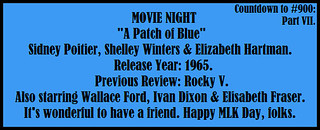
A Patch of Blue.


Review #896: A Patch of Blue.

Cast:
Sidney Poitier (Gordon Ralfe), Shelley Winters (Rose-Ann D'Arcey), Elizabeth Hartman (Selina D'Arcey), Wallace Ford (Ole Pa), Ivan Dixon (Mark Ralfe), Elisabeth Fraser (Sadie), and John Qualen (Mr. Faber) Directed by Guy Green.

Review:
There is something interesting about how the movie paces itself with elements of romance and a touch of good natured humanity. It's not a movie mired in being dated or only relevant for the time, in part because this is still a film that could be made today. Sure, one could be cynical and rail against the literal nature of "love is blind" the movie takes, but I find it to be an entertaining movie in part because of the two leads. There is just something magical and charming about their scenes, where Poitier and Hartman (in her debut performance) simply just click on screen. Hartman makes this naive but charming girl one to care about. Poitier is entertaining as well, showing the right kind of depth and humanity. It's not an innocent movie either, with Winters portraying her character with the right kind of toxic nature that accompanies a movie that has enough punch to be quite effective. Ford (in his last performance) is also quite good in his role, portraying this sad old man without any hint of fakery. You can have scenes where the two are enjoying themselves buying groceries, and other scenes where she tries to navigate herself to the park on her own without help. There is enough emotion and heart that it never feels manipulative nor too sentimental. The movie flows well at 105 minutes, never dragging itself too much while also managing to have a ending that fits the film well in being itself and not going for the easy out. It certainly is a film that leaves itself open to discussion over a good deal of subjects, and it makes the mark of a fairly good movie. While it may not be as influential as Guess Who's Coming to Dinner (#139) was when released two years after this film, A Patch of Blue still manages to leave its mark with the way it presents itself and its characters. Happy Martin Luther King Jr. Day, folks.

Countdown to #900: 10, 9, 8, 7, 6, 5, 4...

Overall, I give it 8 out of 10 stars.

May 21, 2016

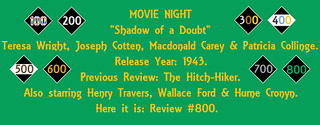
Shadow of a Doubt.


Review #800: Shadow of a Doubt.

Cast
Teresa Wright (Charlotte "Charlie" Newton), Joseph Cotten (Charles "Charlie" Oakley), Macdonald Carey (Detective Jack Graham), Patricia Collinge (Emma Newton), Henry Travers (Joseph Newton), Wallace Ford (Detective Fred Saunders), Hume Cronyn (Herbie Hawkins), and Edna May Wonacott (Ann Newton) Directed by Alfred Hitchcock (#219 - Rope, #223 - North by Northwest, #446 - Spellbound, #447 - Psycho, #450 - Vertigo, #455 - Rear Window, and #553 - Strangers on a Train)

Review
Shadow of a Doubt benefits a great deal from being so tightly wound with suspense and thrills that never let up from beginning to end, the hallmark of a great film noir. Cotten is the first one introduced on screen, and whenever he appears he certainly has an alluring, likable charm, making for such a brilliant villain; when he lets out his other side (such as when he compares rich widows to fat wheezing animals) sneak onto the surface, it certainly makes for making this character very definable and very effective. Wright does a fine job as well, making for a great lead in that she has depth to her, not just being someone who happens to play onto all of these events; she has her struggles and her doubts about someone near to her, and it is all easy to relate and thus makes her character well defined. When she finally discovers the truth, it's a great scene because it finally culminates the clues sprinkled in beforehand (the inscription of the ring, ripping out a page of the paper, etc.), and the movie soon shifts into a game between the two Charlies. Wright and Carey share a good (if not extremely quick) rapport as well. The supporting cast is well done, doing their purpose and roles nicely, because they fit the movie well, being neither too distracting nor unhelpful to the plot. The final scene between the two of them is excellent, being a quick and effective climax that seals the movie neatly. Hitchcock described it as his favorite film, and it's evident that this really is one of his best films.

With that, 800 reviews have been written by yours truly in 1,979 days from December 20, 2010 to the present day. I am proud to have done this for over 5 years, and I am glad to have broadcast these reviews to all of you, wherever you are. I hope you enjoy this review, along with the previous and future installments of this show.

Overall, I give it 10 out of 10 stars.