
Showing posts with label Miguel Ferrer. Show all posts

September 3, 2020

Traffic (2000).


Review #1526: Traffic.

Cast: 
Michael Douglas (Robert Wakefield), Benicio del Toro (Javier Rodriguez), Don Cheadle (Montel Gordon), Catherine Zeta-Jones (Helena Ayala), Dennis Quaid (Arnie Metzger), Erika Christensen (Caroline Wakefield), Luis Guzmán (Ray Castro), Jacob Vargas (Manolo Sanchez), Tomas Milian (General Arturo Salazar), Topher Grace (Seth Abrahams), Miguel Ferrer (Eduardo Ruiz), Amy Irving (Barbara Wakefield), Steven Bauer (Carlos Ayala), D. W. Moffett (Jeff Sheridan), James Brolin (General Ralph Landry), and Albert Finney (White House Chief of Staff) Directed by Steven Soderbergh (#984 - Logan Lucky)

Review: 
"Well, I think a part of you has to be scared, it keeps you alert; otherwise you become complacent. So absolutely, I'm purposefully going after things and doing things that I'm not sure if it's going to come off or not."

There's a difference between one doing films for a living and one making cinema, particularly when it comes to a process-driven director like Steven Soderbergh. He had an interest in film as a teenager that led to him doing his own shorts with a Super 8 and 16 mm camera. He moved to Hollywood by the 1980s and moved his way gradually through roles such as game show composing to concert video directing. His first directing responsibility was the 1985 concert film 9012Live, which featured the band Yes. An idea for a film combined with a cross-country trip led to the development of his first feature in Sex, Lies, and Videotape (1989), a film regarded as an independent classic. Soderbergh (who once described himself as a synthesist) has done a mix of independent and mainstream films over the years, with noted works including Out of Sight (1998), Erin Brockovich (2000), and Ocean's Eleven (2001) that represent a versatile director of heist and psychological movies.

The basis for this film was Soderbergh wanted to make a film about the drug trade without having it be about addicts. With the rights to a property that seemed like what he wanted, producer Laura Bickford presented him with the rights to Traffik, a six-part 1989 miniseries written by Simon Moore that dealt with the illegal trade that wove a story between suppliers, growers, and customers from Pakistan to Germany to England, respectively). Looking for scripts led to one by Steve Gaghan that was about high school students and their problem with drugs and gangs that had Edward Zwick involved as producer, but the writer got him to try and do a film together with both Soderbergh and Zwick. After spending time consulting on the outline and doing films on the side, a script was finished that would have over a hundred speaking parts and split storylines to be shot in two months. The film was released by USA Films after 20th Century Fox went through wanting Harrison Ford for the lead, getting him to sign on, and dropping out even after script changes (which Douglas liked enough to take on the role after declining it initially). Soderbergh (who also shot the film himself) wanted a distinct vision for each of the three stories in order, such as having that involved different filters and contrast, such as no filter for a blue tinted Wakefield story or overexposed film with diffusion filter for Ayala's story or tobacco filter in Rodriguez's story.

It is interesting to view the film through its numerous perspectives that says what it wants about the approach to various cultures and the way that vices inhibit their little worlds in big and small ways of cruciality that shows shades of gray in every place with no real clear answer, with a war that isn't what it looks like on television. It has a cohesive edge in most areas that will inspire curiosity alongside certain emotions that make it stick with a viewer now as it did back in 2000. It doesn't compromise itself with trying to make a definitive statement or judgement on any of the three linked stories but instead lets the viewer make their own impressions on how vices (whatever kind of substance they are) can affect us or others around us without having easy solutions whatever border you live in. Obviously there isn't just one key star in the film, but the one that seems the most prominent to focus as first is Douglas, then followed by del Toro, Cheadle, and Zeta-Jones, although this isn't to diminish the effect others have in support. Douglas proves fairly captivating, one who runs with a hard-lined naivety that makes for a high-strung and capable performance that we can at least see some of which in others or ourselves in what we believe seems right. The speech at the end for example makes a point in what it doesn't say just as much as what actually is said about a fight against substances and ourselves, which Douglas handles neatly. When it comes to del Toro (a Puerto Rico native that shifted his focus from studying business to drama at the age of 20), he sticks out just as well in his distinct storyline (told to us primarily in Spanish with subtitles, which is what Soderbergh desired) in jaded honesty that we follow with great interest because of his well-timed instincts for what seems to be necessary to eke out a living within authority and corruption. This works out best in a little scene involving tourists looking for their car and del Toro telling them about calling a man to help them find the car (after stating the police won't find their car) - it is a fascinating moment that would've probably just been a one-shot blip with a less intuitive actor (incidentally he would later star in another drug war related film with Sicario, which also rules). Cheadle does just as well in reliable nature with a sort of cat-and-mouse game involving procedure and coercion, which he does with careful tension. This reflects just as well on Zeta-Jones in her evolution of principles and moments shared with a sneaky (and fairly effective) Quaid.

There are other aspects that do well, such as Christensen in driving the angle of shocking addiction without seeming like an after-school special act, but it ultimately is the balance of its three storylines in look and tension that makes it a mostly well-done film for its era. It will hold the attention for most of its intentions in 147 minutes that rewards patience through a mostly intact plot and fair camerawork and editing. It accomplishes most of what it wants to speak to us by knocking us over in its statements said and unsaid that excels in uncompromising uncomfortability that speaks truth to hypocrisy now more than ever.

Overall, I give it 9 out of 10 stars.

August 7, 2019

The Manchurian Candidate (2004).

Review #1254: The Manchurian Candidate.
Cast: 
Denzel Washington (Major Bennett Marco), Meryl Streep (Senator Eleanor Prentiss Shaw), Liev Schreiber (Congressman Raymond Prentiss Shaw), Jon Voight (Senator Thomas Jordan), Kimberly Elise (Eugenie Rose), Vera Farmiga (Jocelyn Jordan), Jeffrey Wright (CPL Al Melvin), Simon McBurney (Dr. Atticus Noyle), Bruno Ganz (Delp), Ann Dowd (Congresswoman Beckett), Ted Levine (Colonel Howard), Miguel Ferrer (Colonel Garret), and Dean Stockwell (Mark Whiting) Directed by Jonathan Demme.

Review: 
One could say plenty about the idea of remaking classic films, particularly when it comes to one as classic as the 1962 film The Manchurian Candidate. As much as one could want to deride yet another remake for the sake of remakes, the idea to try and update the Richard Condon novel for the current age does show enough promise to make things seem palpable. The original film was a neo-noir/suspense thriller that had plenty of power within its cast and other elements that inspired plenty of shock and biting satire that one would assume continues as much the second time around. The key differences between the original and this version involves updating the enemy from nefarious communists to an equally nefarious private equity firm alongside making both Shaw and his mother politicians along with one crucial twist involving the climatic assassination. In general, this film also seems more paranoid and aware of its surroundings of when it was made, which stands fairly firm even after fifteen years since its release. Those who are familiar with the work (novel or film) will see where it is going to end up, but it doesn't mean the surprises aren't still there waiting to pounce, most of which land just fine. It surely must've proved a challenge for director Jonathan Demme and writers Daniel Pyne & Dean Georgaris to try and make a follow-up worth the impact that John Frankenheimer and George Axelrod did with direction and writing the first time around. I do think that the final result is a fairly welcome one, deserving of existing alongside its predecessor as a capable if imperfect political thriller.

At least one can say the main foundation of cast members is sturdy to try and hold things together, whether they have time on screen to make a lasting impression or not. In this sense, Washington does a fine job with what is given, taking a different road from what was tasked before, showing plenty of conviction in trying to hold things together enough to grasp at the truth behind what he experienced and what hides behind with what isn't know. Streep shows plenty of fierce vigor whenever she enters the screen, whether when dealing with her on-screen son or with other forces at work, with her ruthless presence being felt handily. Schrieber handles his task without too much difficulty, where you can see the manufactured side of who he has been made to be alongside the vulnerability of what comes out at the surface that can't be meshed out. Voight and Farmiga don't have as much to do here as before, in part because of the fast-tracking that means the nomination goes without too much difficulty (with the rivalry between Voight and Streep not picking up as much steam as it probably could have). Elise's character also undergoes a bit of changes (mainly to add a bit of connective plausibility to how she just happens to be on the same train as Marco besides just being a supermarket clerk), and she does okay with being in the margins of the plot, I suppose. The other members of the cast (including a criminally underused Stockwell) do okay, with Wright making the most impression in his one scene in the beginning, a shadow of himself that serves to cast against the light of heroism shown in the initial scene. After all, the brainwashing sequences (involving an influx of science-fiction) are spread out in the film as opposed to being laid out from the get go, which does tend to work out in the film's favor without being too hokey. Maybe it isn't as subversive as it wants to really be, but at least it does reach some sort of thoughtful levels in its end. It isn't a film that will inspires many re-watches, but I would postulate that it is at least worth one look of consideration, having a cast that clings to a cynical update on what was done before with a little bit of polish and shock to go with it.

Overall, I give it 8 out of 10 stars.

February 7, 2016

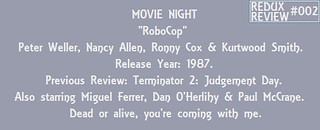
Redux: RoboCop (1987).


Redux #002: RoboCop.

Cast
Peter Weller (Alex Murphy / RoboCop), Nancy Allen (Anne Lewis), Ronny Cox (Dick Jones), Kurtwood Smith (Clarence Boddicker), Miguel Ferrer (Bob Morton), Dan O'Herlihy ("The Old Man"), Paul McCrane (Emil Antonowsky), Ray Wise (Leon Nash), Jesse D. Goins (Joe Cox), Calvin Jung (Steve Minh), Michael Gregory (Lt. Hedgecock), Robert DoQui (Sergeant Reed), and Felton Perry (OCP Executive Johnson) Directed by Paul Verhoeven.

Review
Welcome to a Redux Review of the original RoboCop film, which is a revised review meant to say more about the movie as a whole. The upcoming Redux Reviews are necessary to help better the evolution of Movie Night in all that has changed from its inception in 2010 to the present age - enjoy.

The initial thing that can be said about RoboCop, released on July 17, 1987, is that it showcased more than the sum of its parts from what you would have expected in its era, with layers of satire and emotional depth to make for a compelling movie. The action and violence is certainly entertaining in that goes over-the-top with great results. I remember seeing the scene where Murphy gets gunned down when I was barely a teenager, and even all these years later it still manages to leave an imprint on my mind because of how striking it is. One effect that certainly still ranks high on the memorability scale is the toxic waste infested Emil, right down to the collision with a car. The effects also are pretty well done, and the fight between ED-209 and RoboCop is impressive, right down to the end result (sure, the stairs part is cute, but the moment where one sees the eye of RoboCop exposed is just as striking). The music by Basil Poledouris is brilliant, being both triumphant and emotionally reaching at the right times, using synthesizer and orchestral music very well, with the music at the climax of the move working just right. Of course, there is plenty to say about the movie besides what one can say was enjoyable in imagery, because it is a movie that strikes at the heart of the age it was made in that still strikes a chord today because of how Paul Verhoeven and company succeeded in what they aspired to do despite the hard conditions of filming. The film was written by Edward Neumeier and Michael Miner, with the former being a junior story executive at Universal Pictures before aspiring to write screenplays, as inspired by him seeing the production of Blade Runner (1982); Miner came on Neumeier's radar because of a student video he did, which led to his idea of a robot-themed rock music video converging rightly with Neumeier's idea. Verhoeven, a Dutch director who had just moved to the States best known for films such as Soldier of Orange (1977) and Flesh+Blood (1985), was approached about directing the film after a handful of names dropped out of doing it, and he actually rejected it before his wife encouraged him to give the script a chance - the scene at the abandoned house hooked him onto doing it. The film was made for under $14 million and made roughly $53 million on original release, with its legacy growing in stature in the wake of analysis over its themes involving humanity and corporate policies.

You have to understand that the era of the 1980s had corporate people who were not above reading Japanese texts about killing more effectively. So, a movie involving a corporation taking the task of running a police department and trying to deploy products to rid crime like it was a cancer isn't exactly too off the deep end (one of the writers termed the movie as "fascism for liberals", so take that for what it is worth). The occasional newsbreak/commercials also help to serve the satire in its excesses and absurdity as well, considering that coverage of an ambush of cops with one gravely injured in the attack closes with a broadcaster going "Good luck" to them. The segments lighten up the movie when compared to the violence, which actually was toned down because of the MPAA deeming it an X rather than the R rating targeted...eight times; one can see the un-rated cut on home video now, fortunately.  Eventually, the movie also looks upon the humanity that starts to shine through the title character despite the attempts to strip it away and present it as product, one that results in a soulful and sobering film that could also be construed in religious tones, and Verhoeven has referred to the execution of Weller's character as like a crucifixion.

Weller had spent time studying mime after he managed to be cast in the film, one that had struggled to find a right lead actor because they wanted someone who was both a suitable size that wouldn't look awkward when the suit would be designed around them and also have a good jawline (of course, acting without having the face shown for most of it didn't exactly attract much help either). The studying did not help him much when the actual suit (made of flexible foam latex, polyurethane, and fiberglass) came around, because its bulky nature and long makeup time led to discomfort, complete with dehydration. Eventually, he worked out a more deliberate moving style to help deal with the costume, and it is evident to see how he managed to turn all of this into an excellent performance. He handles the one extended human sequence with warm gusto that you would expect from a cop drama before segueing into the main course handily; the humanity that was thought lost starts to come in bits and pieces that he handles with calm effectiveness, whether that involves him traversing through an abandoned house or the scene where he sees his own face in a reflection before wishing to be left alone. Allen (cast after Stephanie Zimbalist dropped out in preproduction) proves a fitting partner for certain moments to show his lingering humanity in earthy grace. 

It is the adversarial side that makes it all come together of course. Cox may have been known for nice-guy roles, but he sure chomps on this material for all of what it is worth, striking the heart of a great villain in believing in their righteousness to the bitter end no matter who gets struck in their wake. Gang leaders may be tough, but one hasn't seen nothing until he spooks a cocky executive with a few calm words and a hair-pull. O'Herlihy doesn't have a lot of screen time, but he certainly makes his presence felt as the head of corporate sharks. One of my favorite quirks is that Jones regards to the death of an employee via the ED 209 as a "glitch", and the Old Man is more angry at the "temporary setback". Ferrer elevates a corporate wolf-in-sheep's clothing into something charming in its smarminess, one that might have been an adversarial stooge in a different movie but instead ends up something different for satisfaction. Last but not least, Kurtwood Smith does a wonderfully evil job of making Boddicker more than just a cop-killer, with a look that was actually inspired by Nazi leaders. Sure, the execution sequence is a clear highlight, but my particular favorite occurs within a standoff during a negotiation, which involves a line like this: "Oooh. Guns, guns, guns! C'mon, Sal! The Tigers are playing... *slaps table* …tonight. I never miss a game." He has a manner to him that makes him more than just a common street thug, one who controls any scene he is in with confidence (later on, the character spits blood on his booking in jail, as suggested by Smith). The showdown at the end of the movie is riveting, showing the lasting conclusion of Verhoeven's "American Jesus" to its logical endpoint that Smith and company handle well.

The 102 minutes pass by with great execution by Verhoeven and company, as Rob Bottin and his special effects team (which included folks such as Phil Tippet) lend a great hand in making over-the-top spectacle in effects go hand-in-hand with the locations (shot in Dallas, TX alongside Pennsylvania and Long Beach) in seamless style. Sure, some might have had a problem with the violence, but I think it is necessary to understand our own human nature, as if satire is just something you can present in a vacuum or that the darkness of the human spirit isn't lurking within us. I didn't wince at the violence when I saw it years ago, I sure as hell don't see how one can wince at it now. Over three decades later, the legacy of the film is that none of the follow-ups that have passed in its wake have managed to top it in all of the aspects that made the original so striking. The 1990 sequel, with no Verhoeven or the original writers present, proved quite absurd in its continuation of corporate avarice while failing to reach the soulful highlights presented by the original in favor of ultra-violence that lacked a real third act. The 1993 sequel, now without its main star, was an ill-advised attempt at sanitizing the material for younger audiences that made for one hell of a movie to pick apart as a franchise killer. At any rate, the original 1987 movie aimed not for the strings of franchise-making or ultra violent fun but instead for a parable about how far one's humanity reaches even with the confines of a metallic body flung into pursuit for justice. It is a great action film, but it is also a well-done satire that still reaches the mark in corporate insanity and violent absurdity that makes it a movie for all time.

Overall, I give it 10 out of 10 stars.

May 10, 2013

Movie Night: Hot Shots! Part Deux.


Review #375: Hot Shots! Part Deux.

Cast
Charlie Sheen (Topper Harley), Lloyd Bridges (Thomas Benson), Valeria Golino (Ramada Hayman), Richard Crenna (Denton Walters), Brenda Bakke (Michelle Huddleston), Miguel Ferrer (Arvid Harbinger), Rowan Atkinson (Dexter Hayman), and Jerry Haleva. Directed by Jim Abrahams (#028 - Hot Shots!)

Review
It seems only yesterday that I reviewed the first Hot Shots! film. And if yesterday, I mean over 2 years and 347 reviews later. Oddly enough, this is the 375th Review. The first one parodied Top Gun, with the second being a parody of First Blood (#025), with may references to other films. But is the film funny even after 20 years (it being a parody and all) and such? Well...yeah. The puns and gags are endless and the lines may either make you go groan or chuckle, it depends. For me, it was the latter. The cast does a fine job of comedy acting, not too over the top. Sheen once again has a lot of energy that helps out in the action scenes. The action is over the top, as should be, given the parody material, but it manages to mix in the comedy in a strange blend that works well. Is it better than the first one? Not really, but it does at least come close enough, and it still entertains. And given the "parody" movies in recent years, this does the job of making you laugh, which given these days, it is a good thing.

Overall, I give it 8 out of 10 stars.