Showing posts with label 2000. Show all posts

January 28, 2026

Sexy Beast.

Review #2501: Sexy Beast.

Cast: 
Ray Winstone (Gary 'Gal' Dove), Ben Kingsley (Don Logan), Ian McShane (Teddy Bass), Amanda Redman (DeeDee Dove), James Fox (Harry), Cavan Kendall (Aitch), Julianne White (Jackie), and Álvaro Monje (Enrique) Directed by Jonathan Glazer.

Review: 

I suppose I should've done this one sooner. Sexy Beast was the debut feature film of Jonathan Glazer, who grew up in London to a Reform Jewish family (he noted that that in his childhood, he encountered various "East End Jews who had moved to the suburbs for a better quality of life" that imprinted on him with their culture) saw him attend Jewish Free School. He then went to art school because he believed that drawing was the only thing he was good at. However, he got into the habit of directing because there were friends of his in bands that wanted him to shoot music videos for them. Eventually, after graduating with a degree in theatre design from Nottingham Trent University, Glazer got into making film trailers and eventually got into doing commercials; eventually, he did videos for bands such as Radiohead. Apparently, Glazer was slated to direct for the first time with the movie Gangster No. 1 which was written by Louis Mellis and David Scinto based on their play before disagreements with the casting led to all three people leaving (Paul McGuigan eventually made the film in 2000). According to Scinto, Sexy Beast "was born, out of a reaction to all that chaos and soap opera", going from a stage play draft with the working title "Gangster No. 2" to, well, Sexy Beast; the two had one further collaboration turned into a film with 44 Inch Chest (released in 2009 which also featured McShane and Winstone). Made for a budget of roughly $4 million that premiered in the festival circuit in 2000 before going into theaters in 2001, the movie was a light decent hit with audiences, apparently more so in America than expected. Glazer has since directed select commercial advertisements and three further films (which unlike Beast had Glazer serve as co-writer) with Birth (2004), Under the Skin (2013) and The Zone of Interest (2023), which won an Academy Award for Best International Feature Film*.

Glazer apparently called the making of the film "perfect baptism for me" because of the writing that he could trust completely for a film that is particularly intense in its dialogue for what Glazer once called "neo noir" that is basically trying to have a heist while avoiding being a "heist movie". Shaggy dog heist film or not, there is plenty of mischief to experience within the obvious qualities that come with Winstone being paired with Kingsley. It's because you get a passively bulked sunburned lead presence paired with someone who basically is fighting with him on a primal level with such a level of containment that is actually pretty frightening. At least, for a movie that basically shows the upcoming storm by having a boulder crash down the hill onto a pool in the opening minutes. So yes, you can't really hide from your past, but you can sure try to confront the present to maintain a worthwhile future. Within its aspects of the thriller is black comedy that actually is quite entertaining in the machinations of how you can make 88 minutes roll along where you aren't thinking about the heist as much as you are experiencing pros at work. Kingsley just has that magic to startle you with his presence and where he packs his expressions and dialogue in a way that just sounds tailor-made to him while Winstone lumbers as one could only do as someone who aspires to stay in their particular corner of the burning sun (as opposed to the burn of the heist). McShane is intimidating enough in the brief moments one sees of him around the scene of the growing crime (consider how the last scene sees him and Winstone talk about the various truths that lie under the surface). The heist in London isn't the point, it's a film all about what you see and hear in Spain more than anything, I imagine. As a whole, Sexy Beast is basically an acquired taste that either sticks with you or just leaves out the back door. I thought it was curious enough within its maneuvering of the crime film with humor and solid enough performances to make the journey worth watching.

Overall, I give it 8 out of 10 stars.

*It was set in 1943 in the life of German Auschwitz commandant Rudolf Höss filmed in German, Polish, and Yiddish. I hear it's a good movie. I just want to mention that film mostly because the Oscar speech he did talked about the ongoing Gaza war that managed to make a whole bunch of people look like petulant children. 

December 18, 2025

The Adventures of Rocky and Bullwinkle.

Review #2486: The Adventures of Rocky and Bullwinkle.

Cast: 
June Foray (the voice of Rocky / animated Natasha Fatale / Narrator's Mother), Keith Scott (the voice of Bullwinkle / the Narrator, animated Fearless Leader / animated Boris Badenov / RBTV Announcer), Robert De Niro (Fearless Leader), Rene Russo (Natasha Fatale), Jason Alexander (Boris Badenov), Piper Perabo (Karen Sympathy; Julia McAnuff as young Karen), Randy Quaid (Cappy "Frank" von Trapment), Kel Mitchell (Martin), Kenan Thompson (Lewis), with David Alan Grier (Measures), Jon Polito (Schoentell), James Rebhorn (President Signoff), Carl Reiner (P.G. Biggershot), Jonathan Winters (Whoppa Chopper Pilot, Ohio Cop with Bullhorn, Old Jeb), Rod Biermann (Ole; Adam Miller as young Ole), Paget Brewster (Jenny Spy), and Janeane Garofalo (Minnie Mogul) Directed by Des McAnuff.

Review: 
Hey, ever hear of a modern adaptation of an old TV show? You might know from your parents (or grandparents, anyway) about aa show called The Adventures of Rocky and Bullwinkle and Friends, which originally aired from 1959 to 1964 on ABC and later NBC. It was originally devised by Jay Ward and Alex Anderson, who previously collaborated on a program called Crusader Rabbit; Bill Scott was head writer and also part of the voices that made up the show that featured June Foray, Paul Frees and others. It was actually a variety show that consisted of such segments as, well, the serialized adventures of Rocky & Bullwinkle and other segments such as "Dudley Do-Right" (which was adapted by Universal Pictures into its own film in 1999) "Peabody's Improbable History" (later adapted into an animated film in 2014), and "Fractured Fairy Tales". The film was made after many years of development that originally saw Danny DeVito and Meryl Streep for the roles of Boris Badenov and Natasha Fatale; the sciept for the film was written by Kenneth Lonergan. He had been involved in the theater since the 1980s but had done a few film scripts, with his next one being, well, work on Gangs of New York (2002). As for its director in Des McAnuff, he has mostly done work for the stage beyond directing just this film and Cousin Bette (1998), although he co-produced The Iron Giant [1999] (go figure). Released in June of 2000 on a budget of $76 million, the film (produced in the wake of Universal's apparent attempts at trying to tap the old TV market such as Flipper [1996], McHale’s Navy [1997], Leave It to Beaver [1997], Dudley Do-Right) was a considerable financial failure for what either was a flop because it didn't hit for young audiences or didn't hit for "Baby boomer nostalgia" or something.

As someone who wasn't too familiar with the show, I actually kind of like this movie. Sure, it is pretty goofy, and sure, it probably is the ultimate hit-or-miss movie with its gags. But damn it, I like goofy stuff like this. Silly narrators, odd hijinks, a deluge of celebrity cameos for the sake of having them, some strange plot involving animated characters in the real world to go along with a totally-not prescient idea of mass-marketed slop.* The effects for our heroes were done by Industrial Light & Magic that had plenty of involved people trying to accomplish McAnuff's wish to have the characters interact with the space and people that looked simple enough (so, yes, having to deal with problems such as selective motion blurring - you can read more here). Foray and Scott make a quality duo to accompany the film in goofy and sly charm, mostly because they just happen to come off as, well, a worthwhile pair to listen to. Of course, a movie like this needs a human counterpart, which is where Perabo (cast after Monica Potter stepped out) comes in. She does relatively fine here, having a few good moments of actual timing (along with an accompanying joke about her "inner child", heh, get it?) mixed in with plenty of okay ones, mostly because even a mild-energy Quaid is still curious to view*.  It should be noted that De Niro was a co-producer on this film. He seems to have a bit more fun than Russo or Alexander in hammy nature that seems ripe for a goofy adventure, and I would say that is more than enough for a film that relies on ham-handed puns and zippy things. There are an array of bit appearances and one-joke cameos that is mostly highlighted by Winters being three one-bit parts that I'm sure will please a few people for 92 minutes, or perhaps it will make you wonder if would've been better as just an animated movie. But at any rate, the movie could be a decent experience for those who like silly jokes and goofy enthusiasm that may hit just enough to make one have enough chuckles to make one believe it was worth the curious trip.

Overall, I give it 7 out of 10 stars.

*I did have this movie on DVD when I was younger but I was the kind of idiot kid that liked to scratch DVDs on the front side and never actually saw the movie until now. Also: This 2000 article namedrops the wave of the past decade and can you imagine how weirder it got?: The Fugitive, Dennis the Menace, The Beverly Hillbillies, The Flintstones, The Mod Squad, The Avengers, Maverick, Casper, The Brady Bunch, Mission: Impossible, Wild Wild West, Charlie's Angels...
*Call me delusional, but the whole idea of having bad television put on screen sounds a bit like the current day debate over "slop". Sure, people in the film don't try and justify slop like people do try to justify the disgusting use of generative AI, but food for thought.
*Just don't ask him about elections or legal issues.

June 16, 2025

Titan A.E.

Review #2386: Titan A.E.

Cast: 
Matt Damon (Cale Tucker; Alex D. Linz as Young Cale Tucker), Bill Pullman (Captain Joseph Korso), John Leguizamo (Gune), Nathan Lane (Preedex "Preed" Yoa), Janeane Garofalo (Stith), Drew Barrymore (Akima Kunimoto), Ron Perlman (Professor Sam Tucker), Tone Lōc (Tek), Jim Breuer (the Cook), Christopher Scarabosio (the Drej Queen), Jim Cummings (Chowquin), Charles Rocket (Firrikash/ Slave Trader Guard), and Ken Hudson Campbell (Po) Directed by Don Bluth (#1466 - The Secret of NIMH) and Gary Goldman.

Review: 
"A movie to me is about character, about how personalities come together, how they relate to each other and what the ramifications of that are." - Don Bluth

"I think it's the people. The crew has passion. They really want to make it work. They really want to learn more...that teaches me. My whole goal, besides trying to get more production value back into animation, was really to provide an environment like there was at Disney at one time, where you felt secure as an artist, filmmaker, contributor, animator." - Gary Goldman

On June 16, 2000, Titan A.E. basically was released into theaters and died a quick death. But time does heal some wounds, even if it remains the last current effort for its directors in Don Bluth and Gary Goldman. The two had met in 1972 when working at Walt Disney Productions with each at distinct stages of their animation careers: Bluth (seven years older) actually had been hired to work as an assistant animator at the Disney studio in Burbank and even did work for Sleeping Beauty (1959) but found the work "kind of boring" and jumped around to do various things that ranged from a mission for the Church of Jesus Christ of Latter-day Saints to local theater to studying English Literature to eventually returning to animation and, well, that led back to Disney. On the other hand, Goldman was a recent art school graduate that had been accepted to Disney's animation training program and encountered Bluth. Alongside John Pomeroy, the group shared similar ideas about animation and strived to make their own animated film (as an exercise, according to Bluth), with their first effort being Banjo the Woodpile Cat. I think you get it from there: NIMH was a big thing for the "it's not Disney" crowd and the first of a string of movies with varying levels of quality. Goldman moved from producing to co-directing with Bluth with All Dogs Go to Heaven (1989). Sure, there were misfires in their intertwined efforts (The Pebble and the Penguin [1995] was so miserable that the two wanted their names taken off it), but their efforts with Anastasia (1997), the first film for Fox Animation Studios, worked out. Coincidentally, during the time of the release of that film, the starting points for what became Titan A.E. started. "Planet Ice" was slated to be directed by Art Vitello, with November 1997 seeing concrete plans to make it animated rather than live action, complete with a voice cast all picked out (such as Bill Pullman, for example). They had a screenplay drafted up by Ben Edlund before John August came in months later to polish the dialogue and other select re-writes. The result of years of pre-production was $30 million sunk into a whole bunch of recording...and basically little to actually show for it. Where Bluth and Goldman came in is that 20th Century Fox, in need of getting a project going for the animated studio, asked the two to get involved, showing them the script. Despite their lack of expertise of sci-fi, they went with the move; incidentally, Joss Whedon was soon hired to finalize the script. It should be noted that Bluth and Goldman had $55 million and 19 months to get the stuff animated, one that saw them move the apparent focus of the film away from hardware to, well, character, which saw re-recording of certain dialogue (basically they wanted to aim for the family, right down to the teenagers rather than be a "Disney wannabee"). The result was five writers were given credit: the story was credited to Hans Bauer and Randall McCormick while Edlund, August, and Whedon were given credit for the screenplay.*

Goldman stated prior to release that "about 87% of the film is some form of CGI", and perhaps ironically, the visual effects and one certain animated sequence was done by Blue Sky Studios, who would begin production of their first animated film Ice Age the same month that this film was released. Apparently, midway though production is when Fox basically was ready to give up on 2D animation and just focus on 3D ventures, and by June of 2000, over 250 animated staff members at Fox were laid off. Just to twist the knife a bit further, the same week that this movie came out, Fantasia 2000 (1999) by Disney was finally being shown in regular theaters**. Sure, a race against time in fetching one big thing that might as well be a shaggy way to do an ark story is a bit shaky. But it is a neat ride for those who want to buy what it is selling for a movie that has an astounding look within a cobbled-together story. The 94-minute runtime somehow manages the weird effect of breezing by certain aspects (read: familiar tropes) but taking its sweet time to really make sense on other parts. In an age now where certain people seem to believe that any damn animated movie seems up to "re-made" for live action, Titan A.E. is good proof that some stuff really should stay in animation without the risk of being turned into potential slop, one that inspires awe with unwieldy adventure. Forget being generic, it seems like fresh air with its enthusiasm. The rag-tag group of voices are fairly decent, mainly because it isn't merely just picking big names for the hell of it, with Pullman in particular being pretty suitable as a rogue to go along with Damon's wavering sense of humanity (or whatever you want to call it, but burrowing hope seemed silly). The rest of the cast is fairly decent in parts, mainly with adding some levity (Lane comes to mind), which works out when having the bare minimum in characterization for Barrymore to work with. I like its general action and general mood of making sure one wants to take a look at what they are seeing beyond having mild attention (the rock soundtrack might help in that regard). The ice rings sequence is probably the key standout sequence for showing both the potential of understanding why some films just are destined for animation along with having interesting tension to really keep things drawing along. The movie may not always go along smoothly beyond some of the usual expected stuff, namely with a villain that is more interesting to look at than their actual motives, but if you are vibing with what the movie is showing in its atmosphere of trying to scrape along beyond refugees on the food chain, it will be a pretty good time anyway. Underrated and under-looked in its time, Titan A.E. deserves a cult audience willing to stick up for spry adventures in animation.

Overall, I give it 7 out of 10 stars.

*Hell of a writer's room. Edlund is best known for creating The Tick, Bauer wrote Anaconda, August wrote for a handful of Tim Burton movies, and Whedon, well, he went from co-writing Toy Story to something called Firefly... 
**For whatever reason, Fantasia 2000 had *months* of IMAX showings and concert hall screenings before you could just see the damn thing in a normal theater. Go figure, that movie didn't make too much money. The Adventures of Rocky and Bullwinkle was released on June 30, 2000 and had live action and animation to the tune of barely any money. You know what animated movie did make money that June? Chicken Run, which was released on June 23, 2000 by Aardman Features. Funny.

January 9, 2025

High Fidelity.

Review #2333: High Fidelity.

Cast
John Cusack (Rob Gordon), Iben Hjejle (Laura), Jack Black (Barry Judd), Todd Louiso (Dick), Catherine Zeta-Jones (Charlie Nicholson), Lisa Bonet (Marie DeSalle), Sara Gilbert (Anaugh Moss), Chris Bauer (Paul), Lili Taylor (Sarah Kendrew), Joan Cusack (Liz), Tim Robbins (Ian "Ray" Raymond), and Joelle Carter (Penny Hardwick) Directed by Stephen Frears.

Review: 
“I liked the idea of it being in America. It had a sort of, this sort of more optimistic way in which Americans live, seemed to me to add something to it, rather than taking it away. So it lost some of its stoicism and became slightly more romantic.”

Yes, movies from the new millennium are soon to turn 25 years old, so it seemed apt to cover a movie just as much a result of the writers as it is the director. In 1995, essayist Nick Hornby (probably best known already for his 1995 memoir Fever Pitch), had his first novel come out to the frenzied attention of British audiences who apparently found something in themselves with a setting at a London record shop and a distinct inner monologue. There were rumblings of doing a film as soon as the book came out, with plans ranging from having a draft script done by Scott Rosenberg set in Boston or having Mike Newell involved as a director. Eventually, it was sprung to have John Cusack take a crack at writing a film screenplay, one done in collaboration with D. V. DeVincentis and Steve Pink, who each had worked on Grosse Pointe Blank (as released by Buena Vista Pictures Distribution in 1997). It was through Hornby's permission that they could change the setting to Chicago. Basically, Cusack and Pink/DeVincentis would each go through the book and write what they structured from the book and eventually edit what they saw by basically approaching it as "a checklist of things we need to get done". Cusack suggested trying to approach Stephen Frears to direct. He had actually studied law at the University of Cambridge before electing to work as an assistant to Lindsay Anderson at the Royal Court Theatre (he also worked as an assistant to Karel Reisz as well) and he soon honed his skills for British television. He became a feature director with Gumshoe (1971), but he became a name with My Beautiful Launderette (1985). Hornby was apparently quite satisfied with the adaptation, mostly because a good deal of the dialogue addressing the audience is basically straight from the book. In 2020, a television adaptation of the book came out that lasted one season.

There is something strangely comforting about a comedy that doubles as a sort of male confessional. It is the kind of movie made for people who besides having a certain interest in music maybe, just maybe, need to grow up. The love affair one can have with music in all of its meaningful depths and reaches is palpable with the people we experience in the film that actually end up feeling like people we know in some way or form. Maybe we don't all make top five lists, but we sure do stew on something in the great book of lists and hang-ups. Strangely, it reminds me of Annie Hall (1977), which also handles the anatomy of a breakup through a lead that likes to address the audience (of course, one actually feels the pulse of a tolerable human being in terms the direction and in the acting with High Fidelity, so chew on that). From the jump, it is quite understandable to see Cusack at his most curious and possibly his most effective role. He corrals the movie with a certain kind of slacker (one can operate a store and still slack) charism that really does come through in a manner that we follow along with in ways that a lesser actor would've simply just made a muddled mess. I posit that while some people are self-absorbed, we call them friends anyway because there is a difference between terribly behaved people and people with terrible behavior (i.e. the type that needs to hear "shut up!" once in a while), and some movies win out with weirdos like this. We chuckle and recoil at what we see and hear of a person in all of his bewildering aspects because Cusack just happens to have the voice to carry that drumbeat of weirdness to finding something to do besides just looking back. Of course, it just so happens that there is a pretty capable cast right behind Cusack to make things work beyond just a grandstand for music. Black and Louiso are a dynamic pair of amusement because each just happen to have their own distinct type of humor that connects from the jump in terms of timing and general energy for the material that is palpable in more ways than one. Hjejle goes along with the proceedings that arise from being presented in the prism of one-sided weariness that works in parts. There are a few other little surprises to be found in small moments to see someone such as Robbins take one on the chin in one particular scene of imagined confrontation or one particular cameo to raise a chuckle. I like the overall mood of the film, one that doesn't just dally to conventional means to try and say something about weird hangups or the people you see along the way, and doesn't overstay its welcome at 113 minutes. In general, what we have is a film made by people who clearly had an interest in making a confessional for the hang-ups in all of us that has a distinct love for Chicago and enough charm to make one mix themselves into seeing it play out.

Overall, I give it 8 out of 10 stars.

November 5, 2024

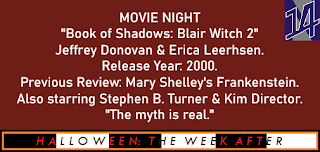
Book of Shadows: Blair Witch 2.

Review #2309: Book of Shadows: Blair Witch 2.

Cast: 
Jeffrey Donovan (Jeffrey Patterson), Erica Leerhsen (Erica Geerson), Stephen Barker Turner (Stephen Ryan Parker), Kim Director (im Diamond), Tristine Skyler (Tristen Ryler), Lanny Flaherty (Sheriff Ronald Cravens), and Lauren Hulsey (Eileen Treacle) Directed by Joe Berlinger.

Review: 
"“My original intent was to make a comment on the dangers of blurring the lines between fiction and reality. Even I didn’t realize how prescient that idea is. We’ve never had more information available at our fingertips yet the truth has never been more elusive.”

Remember The Blair Witch Project? Sure, you probably enjoyed it when it came out 25 years ago in 1999. The film starts with people gushing about the phenomenon of the film and the interest of in how the website apparently really sold folks about the events that supposedly appeared in Burkittsville, Maryland (a town with less than 200 people) as a "documentary". Unfortunately, you are reading the words of someone who thought the original film was an overrated, over-hyped, under-produced fluke. Part of me thought about re-watching the first film before seeing the "sequel", particularly since it had been five years since I saw that film (and three since I saw the 2016 "whatever you want to call it" Blair Witch). But since I had an inkling that this was not going to be a particularly "good" experience, I didn't want to consider watching two mediocre movies back-to-back, so here we are with a curiosity. Artisan Entertainment, wanting to rush out a follow-up as quick as possible, went with Joe Berlinger to direct; he had gone to the studio to pitch a script to the studio that they were more interested in ignoring to instead approach him with scripts they had cobbled together about the Blair Witch (in found footage, again), which he rejected. Amusingly, Berlinger has been on record as saying that he thought the original film that was both effectively done by the filmmakers along with one that "aggravated" him because of its camera work (with relation to reality) along with its marketing hoax that made people really think they were watching a snuff film. At the time, he was noted for his work with Bruce Sinofsky in documentary filmmaking, such as their films chronicling "the West Memphis Three" with the Paradise Lost trilogy (1996-2011).  He co-wrote this film with Dick Beebe. After the film had been shot, Artisan decided, yes, let us change the "ambiguous psychological horror movie" they fast-racked into production to piggyback off the first film to impose more "commercial" elements to the film in post-production, such as seeing brief moments of gore or interrogation that occasionally pop up in the film (for the latter, it was meant to bookend the film as one whole video sequence); Berlinger has been quoted as saying that Artisan did not care for the idea of going for a "Hitchcock-ian" idea of seeing nothing with its violence because in the view of the executive (as quoted by Berlinger), "our audience can barely spell "Hitchcock." The result of spending $15 million was a movie that had a fair audience showing, albeit not one on the level of the original. Berlinger has continued to direct documentaries, although he did return to narrative films once more with Extremely Wicked, Shockingly Evil and Vile (2019). There apparently exist efforts by online people to do an "Artisan Studio Removal Cut" for viewing if you know where to go.

Before I forget, apparently the "book of shadows" involves a witch's book of illusory incantations. That, and the film is a "fictionalized reenactment of events that occurred after the release of The Blair Witch Project [1999] (specifically November 1999)". That's one way to get moving for a film after it gushes about trips to Burkittsville (and TV pundits talking about the first movie like suckers), having a guy get a tube stuck up his nose. Obviously, this is so one can flash back to how things will eventually end up in the "conventional" narrative. It probably is not a great sign that the first 15 minutes has one interesting sight: Director, being first shown lying on a gravestone with a cigarette. The movie may say that people fear what they don't understand but the only thing people should fear here is that the original Blair Witch Project not only managed to trick people into believing the crap spewed out in "found footage" but that people actually thought they could make a follow-up that wasn't just as dumb as before. At least this time one isn't hearing "what was that?" while the camera gets shaken round and round like before...it just merely is a silly movie that has little to no suspense but at least has a narrative worth making fun of to go with some bloodshed, which at least is something tangible. The idea behind the film was yes, the characters we are to follow were the killers and also are blinded by hysteria when it comes to the aforementioned legend. The problem with that is ironically the same problem that happens with cruddy "traditional horror" movies and the aforementioned 1999 movie: I do not like these dorks that much. Director and her attempts at playing "Goth" is at least alluring in ways that Leerhsen just manages to come off as annoying (so anyway, ever heard of a "Wiccan"?). At least Flaherty is meant to be amusingly over-the-top. I shudder to think about the film really would be with the original intent of romp-gone-dour, but what you get is a movie that might as well be thrown up into a toilet. The ideas of trying to be "subversive" for a horror audience at least was handled with some sort of amusement in The Cabin in the Woods (2011; wow, I found a way to compliment that movie in less time than I ever expected). The movie doesnt work for much interest in "what horror fans want" because it doesn't have cohesion in actually making the trip worth shuddering over. All you get is a panicked feeling. As a whole, this compromised mess of a movie is amusing in its monumental mediocrity that shows ideas of interest but flails around just a bit too much (studio or otherwise) to be a worthy winner.

Overall, I give it 5 out of 10 stars.
Next up: The sequel to Ring...well, the real one this time with Ring 2.

October 19, 2023

Dracula 2000.

Review #2114: Dracula 2000.

Cast: 
Jonny Lee Miller (Simon Sheppard), Justine Waddell (Mary Heller / Mary Van Helsing), Gerard Butler (Count Dracula / Judas Iscariot), Jennifer Esposito (Solina), Christopher Plummer (Matthew / Abraham Van Helsing), Colleen Ann Fitzpatrick (Lucy Westerman), Danny Masterson (Nightshade), Jeri Ryan (Valerie Sharpe), Lochlyn Munro (Eddie), Sean Patrick Thomas (Trick), Omar Epps (Marcus), Tony Munch (Charlie), Shane West (J.T.), and Nathan Fillion (Father David) Directed by Patrick Lussier.

Review:
The story goes that when Wes Craven's Scream 3 (2000) was approaching post-production, Bob Weinstein of Dimension Films approached editor Patrick Lussier (who had edited a handful of Wes Craven films but had not directed a feature before) about making a film titled "Dracula 2000", with an understanding that, well he didn't know what it would be about. Lussier and Joel Soisson came up with a draft by the turn of 2000. Apparently though, the script required rewrites, because according to Scott Derrickson (who had his writing partner Paul Harris Boardman there), Weinstein called him to see if he could do rewrites due to the script being "terrible" and approaching filming in two weeks (while saying he was doing it because it was called Dracula 2000). Ehren Kruger was also used for script polishing. Wes Craven's name is used quite a bit in the credits and the promo materials as executive producer, although obviously he didn't have that much involvement with the film. Filming came together by the end of June (after a search to cast Dracula that apparently dragged all the way until the very eve of what came to be a rushed production) and apparently the final cut, after reshoots, came just a few days before release in late December 2000. While the film was not a major success for Dimension, Lussier would end up directing two direct-to-video sequels with Dracula II: Ascension (2003) and Dracula III: Legacy (2005), both of whom have different casts than this film (somehow, Rutger Hauer was recruited to play Dracula in one of them to go with Roy Scheider being in both sequels).

Do I really need to tell you that the film is not particularly good? Beyond a 99-minute runtime that drags its one weird twist to the Dracula story, not only have you seen this kind of film before in previous adaptations, but you have also seen it done with better gusto and better interest as opposed to this amusingly terrible piece of fluff. There are no actors here that seem to do anything with the material that wasn't treaded from even the lesser Hammer Dracula films, and it goes without saying that having one noted name in Christopher Plummer among a cast of "hey, it's the guy or girl from X" makes for a highly silly time indeed. Butler (a Scottish actor with a few film credits) is mostly left to play the role with characteristics that somehow make Bram Stoker's Dracula (1992) seem serious in comparison (complete with hair curlier than the female lead). There is no allure present here, and it especially is amusing because of the idea that Dracula is actually also Judas, adding baggage that never really goes anywhere. The presence never lurks for any sense of doom or any sense of lingering hatred for being alive so long anyway. Miller and Waddell might as well be chasing ghosts with how noncommittal they seem to be making either of the roles interesting, as if they meant to be playing second fiddle to a vampire hunter like, say, Hammer's 1958 Dracula film, but you don't get the pleasure of Plummer getting out of second gear. I have to admit, the idea of a long living Van Helsing that tries to stay alive for the day when Dracula may return so he could kill him is at least semi-interesting, maybe because one never thinks they would see Van Helsing inject himself with blood (as filtered by leeches) from Dracula to stay alive. But one doesn't see any juice there for conflict, especially since one is also supposed to believe that Van Helsing decided "well, I have this blood in me, let me play with my wife anyway" along that. Mardi Gras in New Orleans seems listless here, especially since Dracula is only interested in, uh, whatever he wants from the lady that he has this "connection" to. You've seen the story before, but at least those had the semblance of not looking like a rushed cash-in to a year that makes Dracula A.D. 1972 look legitimate. It is highly amusing to laugh at, such as the vampire flunkies that range from Ryan to Epps in foolhardy level of threat or the climax that involves the image of Christ and a conveniently timed revelation about releasing folks (Dracula, who couldn't hang eons ago, can now hang here because, uh, God wanted him to do so now). I can't recommend it for serious viewing, unless you like to laugh at bad horror.

Overall, I give it 4 out of 10 stars.
next: Frankenhooker.

March 11, 2023

American Psycho.

Review #1984: American Psycho.

Cast: 
Christian Bale (Patrick Bateman), Justin Theroux (Timothy Bryce), Josh Lucas (Craig McDermott), Bill Sage (David Van Patten), Chloë Sevigny (Jean), Reese Witherspoon (Evelyn Williams), Samantha Mathis (Courtney Rawlinson), Matt Ross (Luis Carruthers), Jared Leto (Paul Allen), Willem Dafoe (Donald Kimball), Cara Seymour (Christie), and Guinevere Turner (Elizabeth) Directed by Mary Harron.

Review: 
"What occurred to me is that just enough time had passed to make a period film about the ’80s, and say things about the ’80s, and bring out the satire. And that was interesting to me."

As a director, Mary Harron has aimed to make above all else movies with meaningful things to say beyond just the label of feminism. Born in Bracebridge, Ontario in Canada to an actor/comedian in Don Harron, although the divorce and re-marriage in her family led to her living between Toronto and Los Angeles and later England. Her parents liked to take her to films they wanted to see that were generally art films (i.e. not exactly suitable for children), with her early large influences being Alfred Hitchcock. Later studies at places such as the National Film Theatre and she studied English at St. Anne's College, Oxford University before moving to the States in New York to become a journalist. She wrote and created a magazine for what became the punk scene in the city before later becoming a drama critic in later years. In the 1990s, her interest in the life of Valerie Solanas spurred her into wanting to do a documentary (since she was working as a producer on a program dedicated to American pop culture at the time). In turn, this idea was suggested to become a film, which resulted in the 1996 film I Shot Andy Warhol. In total, Harron has directed seven films in over two decades, with the most recent being Dalíland (2022). The movie is based on the 1991 novel of the same name by Bret Easton Ellis. The original book generated controversy because of its portrayal of violence toward women (as a whole the book is far more visceral in its descriptions by its unreliable narrator in Patrick Bateman of murder along with emotional psychotic breakdowns). Ellis has described the main character of Bateman as being "crazy the same way I was", although he has only admitted this in recent years (he initially stated during the release of the novel that his father was the inspiration while also later calling the book "a criticism of male values that were around me", one that he found easy to observe as a gay man). Ellis had called the book "unfilmable", but Edward R. Pressman bought the rights to film the book in 1992 and persisted for eight years. Numerous names were considered to direct such as Stuart Gordon and David Cronenberg (with Ellis even writing a draft), but Harron accepted an offer to do the film in 1996 under the condition that she could write her own draft. She brought Guinevere Turner on to help write the script while also trying to find the right Bateman (for her part, Turner found the book horrifying alongside really funny while also believing the right spin could make for a "really subversive, feminist movie"). By 1998, Harron thought she found her ideal actor with Christian Bale (at the time mostly known for Empire of the Sun (1987), when he was 13), because she felt he was the only who understood the role as being (in their words) "an alien who landed in the unabashedly capitalist New York of the '80s" when he found the script quite amusing. However, Lions Gate Films tried for a time to recruit Leonardo DiCaprio to star in the film (which Harron vehemently disagreed with), complete with Oliver Stone taking over as director. Thankfully, disagreements between the two led to the return of Harron and Bale, albeit with a small budget of roughly $7 million.

The movie was indeed a modest success at the time of its release in 2000, albeit with a polarized response by some due to the level of violence. Actually, looking back, it is almost as amusing to consider the perception of the film back then as it is to actually look at the film now and share a laugh as the effective satire it ultimately is. It is the work of somebody who may or may not be guilty of murder slipping by in a world focused entirely on lifestyle above all that examines misogyny and masculinity with an awareness and timing that is brilliant to sift through for 100 minutes. Undeniably, the movie is all on Bale and his performance. His method of performance involves plenty of rhythm to go with clarity and control that brings out plenty in isolation and alienation beyond the winning smile shown in a man that in his words is "simply not there". He has the outward charm of someone like Tom Cruise (intentionally done) that is both unsettling and captivating, one who seems to sell every scene he is in (present in all but one) as one of numerous people that we see within the mask they seem to wear (why else does the axe sequence seem to linger on half of his face covered in blood) It is evident that his method preparation paid off for an effective performance that is the perfect act of a warped man in a warped time that shows the vanity of man through people who are never seen working in any scene. The others can only help but drift in the ideal manner when wrapped in the gloss of the 1980s, such as the restaurant trio of Theroux, Lucas, and Sage, or with Witherspoon and her confidence that goes like oil on water when paired against Bale. Sevigny is probably the most sane person in the general web of things, at least because she is in it slightly more than Dafoe and his blend of investigative query/baiting. There are a handful of interesting moments to note (at least ones that have not become Internet memes), ones that show Bale gliding through his environment in the most entertaining of alienated ways, such as him casually admitting his crimes in conversation or him doing a strut right before the axe death with "Hip to be Square" playing.

Ellis described the book as one that he didn't think needed to be turned into a film, since he felt that the ambiguity of the novel would be turned into something "infinitely less interesting" with a medium of film that seemingly demands answers (incidentally, the book later inspired a 2013 musical). The novel leaves it to one's interpretation about what was real and not real, while Turner and Harron's script was intended to show a real effort to have things be real for the main character but at some point "sort of perceiving things differently, but they're really happening." The ending is deliberately meant to confound one over just what really happened (personally, I assume a chunk really happened because watching a movie about murders being shown only to be told they aren't real is dumb as hell). Ellis has been quoted numerous times as to finding the film either as "fine" without being entirely necessary or as one that is "in some ways a complicated movie for me. But overall I like it." As a whole, American Psycho is a worthwhile use of your time for those who are interested in seeing a film that belongs to more than one genre and thus is not instantly easy to peg in one assumption. It is a lean and mean satire with elements of horror that will sift in your head and not escape any time soon after it is finished, which makes for a pretty good time. It is the kind of really good film that may even grow on you further, which probably says a good deal about how far the film's stature has grown in two decades.

Overall, I give it 9 out of 10 stars.

Next Time: Beau Travail.

October 29, 2021

Final Destination.

Review #1749: Final Destination.

Cast:  
Devon Sawa (Alex Browning), Ali Larter (Clear Rivers), Kerr Smith (Carter Horton), Kristen Cloke (Valerie Lewton), Daniel Roebuck (Agent Weine), Roger Guenveur Smith (Agent Schrek), Chad E. Donella (Tod Waggner), Seann William Scott (Billy Hitchcock), Tony Todd (William Bludworth), Amanda Detmer (Terry Chaney), Brendan Fehr (George Waggner), and Forbes Angus (Larry Murnau) Directed by James Wong.

Review: 
“I was actually flying home to Kentucky and I read this story about a woman who was on vacation in Hawaii and her mom called her and said ‘Don’t take the flight tomorrow, I have a really bad feeling about it.' She switched flights and the plane that she would have been on crashed. I thought, that’s creepy- what if she was supposed to die on that flight?”

Oh sure, throw a wrench into the horror film with tinges of the supernatural, that is sure to work out. Technically speaking, having no visible murderer is probably the logical step in trying to make new horror films in the new 21st century without relying on all of the clichés from before. The idea came from Jeffrey Reddick, who was an employee of New Line Cinema for years (working in the worldwide marketing department). A horror fan growing up in Kentucky, he was so gripped by A Nightmare on Elm Street (1984) that he actually wrote a brief script revolving around a sequel (sending it to New Line Cinema's chairman Robert Shaye, who encouraged him to keep writing). With the script that became this film, it had actually started as an idea for a spec script for The X-Files, but it was the advice of a work colleague that persuaded him to try and make it into a film script (which was done as a spec script sold to New Line). After working with producers Craig Perry and Warren Zide in developing the script for sale, James Wong and Glen Morgan (a writing pair who had written for the show) were brought in by New Line to produce and direct, and they became involved with re-writing the script in order to have it be made as a film; Wong was quoted as wanting to do for "planes and air travel what Jaws did for sharks and swimming". Four follow-up films followed in the next eleven years (2003, 2006, 2009, 2011), with a potential for a sixth in the near future.

Sure, they wanted to do something that makes you weary about planes like Jaws for sharks, and I guess the build-up to the plane sequence is the most interesting part of the movie in terms of claustrophobia. They wanted to make the entertainment value in the ride and not so much in the outcome that supposedly respects its audience. Honestly though, the ride just is not that interesting to go with, mostly because a ride is only as good as the number of distractions that get in the way (besides, I am reminded of William Castle when it comes to "ride movies", and he knew how to make a gimmick count). With a movie like this, there are just too many distractions for me to appreciate the movie as anything other than a very average movie that either could have been manipulated for dark laughs or something weirder - the only respect that comes out is that it respects folks who want the easiest deaths possible with the bare minimum of suspense. Honestly, the biggest problem with the movie is that you could probably think of a better movie with the bare ideas presented here than what actually has come from something that probably thought more about the death scenes than what really could have been an interesting way to make a movie about someone cursed with the knowledge of impending death. Of course, my interpretation probably doesn't differ much from the intended idea: instead of having a lead character that looks like a freak to some of the folks (as opposed to say...thanking him?), how about just making him an actual weirdo right from the jump? Or hell, why not a series of deaths that could actually be interpreted as something beyond obvious "accident" material (i.e. more than just a guy slipping on water)? Think about it: a dude goes around telling you the plane is going to explode and a bunch of folks get snared into not dying: what better way to test out fate than by putting them to the test (and it would probably help without having bumbling FBI agents)?  Instead, one is stuck with a middling movie that goes through all the motions with the bare minimum of suspense, which thinks it is clever with the use of John Denver references every now and then (naming your characters after horror directors only works if you aren't thinking about the directors, incidentally). Cardboard cut-outs getting killed with Rube Goldberg-type deaths is still cardboard cut-outs getting killed. although the curse of knowing the potential for death could have made an interesting movie, really. That, or maybe it really was something suited for television. 

Sawa, to his credit, gives it his best for a generic movie, filled with lingering confidence that for the most part keeps on the level with the whole "well, I saw death but I dare to not go insane" thing; simply put, he could be less polite. Larter is also alright, gripped with a sense of knowing that comes from the generic outcast role (incidentally, she would be the only returning actor for the sequel). Smith might be flat, but at least the character is semi-interesting when it comes to one scene near the climax involving trying to get out of the cycle of death (at least, until its end note). Technically, the best performance is from Todd, who has exactly one scene to go and talk about death and runs with it (which includes saying "mack daddy", somehow), which I guess helps out if one needs exposition. The others are pretty flat, in that clichés only work if the ride is fun. It isn't really, but that probably plays into my weird creep theory (the only one who reacts in any interesting way is someone who shows irritation when two of the survivors fight, which is immediately followed by them dying); Cloke is the only adult among teenagers (a loose term, but it checks out), and she has the least to really do besides the death scene (look, you can't spoil a movie that only has a finite bodycount among seven); when you are wondering how much more you could have involving Scott as comic relief, you might have a problem. Roebuck and Smith stumble with the blandest of possible procedural clichés (which only reminds me of how this might have played out before 2001). As a whole, it is a slasher movie with all the middling clichés from before except the part where there is a visible slasher figure. Sure, it has a few decent effects and ideas, but as a whole, making a silly horror movie with one neat trick is still making a silly horror movie, no matter how much gloss you put on it. While I undoubtedly will look on the follow-up films at some point, I can only hope they found better ways of trying to make the ride count for something beyond what they did here.

Overall, I give it 6 out of 10 stars.
Next Time: Saw (2004)

August 18, 2021

The Cell.

Review #1715: The Cell.

Cast: 
Jennifer Lopez (Dr. Catherine Deane), Vincent D'Onofrio (Carl Rudolph Stargher), Vince Vaughn (Special Agent Peter Novak), Jake Weber (Special Agent Gordon Ramsey), Dylan Baker (Henry West), Marianne Jean-Baptiste (Dr. Miriam Kent), Tara Subkoff (Julia Hickson), Catherine Sutherland (Anne Marie Vicksey), Colton James (Edward Baines), Musetta Vander (Ella Baines), Patrick Bauchau (Lucien Baines), James Gammon (Teddy Lee), Jake Thomas (Young Carl Rudolph Stargher), and Dean Norris (Cole) Directed by Tarsem Singh.

Review: 
"The thing about this film is it’s an opera, and there is no such thing as a subtle opera.”

Sure, there are no easy solutions to making a 21st century movie that exceeds the clichés expected from horror or science fiction. At least one knows that there won't be a hampering when it comes to trying to include certain kinds of imagery or attempts at imagination when it comes to trying to show the mind of a killer. Of course, one has to borrow from the traditions of the past by casting singers-turned-actors and trying to crib from better movies while trying to ride hard on imagery and a few decent side performances, complete with costume design from the person who brought you Bram Stoker's Dracula (complete with that same red suit from eight years prior, which looks just as silly as it did back then). Now, that isn't too fair to a director in their debut feature (released 21 years ago). Tarsem Singh actually started as a music video director, doing so for a handful of bands and commercial brands before he got his chance to direct; in two decades, he has directed four further films, although this is obviously the one that stands out for most folks, one where he reportedly aimed for a film like "opera" rather than just a movie about a serial killer. This was the first feature script of Mark Protosevich, who utilized his fascination with serial killers to go with an interest into seeing into one's dreams (while noting stuff like Dreamscape (1984) in that familiarity discussion); while he noted that it could have had more classic suspense, he still appreciated the final result as one that provokes a strong response of both praise and disdain.

Does one desire style over substance? Well, you will get plenty of that here, since one is basically watching a brazen take of The Silence of the Lambs (1991) but with less subtlety (a guy who likes to torture the victim while with a dog that partakes in perverted things? Gee, I wonder...) and horror that is basically a step behind stuff like Seven (1995). Honestly, if you take out most of the attempts at style, this might have been a step away from being something to really make fun of. One probably wonders where the horror and sci-fi merge, well, someone just happens to learn about some new cool secret technology involving virtual reality. Given that a child psychologist can use the technology and fail in the art of navigating a lost child beyond the (music video) dreamscape, one wonders just how they are going to do with a serial killer. Actually, I don't have to guess, because she can't even do it on her own, which is where one needs more of Vaughn (because I guess anyone can just put on the suit and have the cloth put over the head or whatever). The strange thing is that the imagery doesn't really seem to sway me one way or the other when it comes to the side of praise or disdain, since it tries to go hand in hand with generating sympathy for the person having their mind probed...but as the saying goes, all one is doing is putting lipstick on a pig. The makeup looks nice, but watching one long music video with the bare minimum of story only works if I really care about what is going on here, and I've seen movies like that (Tommy (1975)), and they had more tricks up their sleeve.  Simply put, Lopez is not the one to hold a movie like this, one that desires a more interesting presence (again, not to bring up Lambs again, but a Jodie Foster equivalent wouldn't be a bad start) that can goes beyond seeming quizzically confused, complete with elaborate costuming. The dynamic between her and the kid version of the killer is flimsy and ultimately lacking in moral weight, mostly because she mishandles her part of the climax to where one might as well watch dinner theater instead. Incidentally, D'Onofrio is quite interesting here. Really the killer always seems to be more interesting than the hunter in these films, and he seems to draw out the most curious moments that work for the film, one with an aura of creeping presence without seeming like a cliche. Vaughn probably touches upon the usual expectations of the type of role seen in these films, but I respect his commitment to taking a serious role. He certainly seems more right at home with an off kilter agent than Lopez does, that is for sure, mostly because he actually treats the scifi stuff with the reserved charm that comes from not caring about exposition/music video imagery (the rest are fairly disposable, and wasting Gammon for just two scenes has to be a crime). For a movie that fiddles around near two hours with an eye for imagery, I found it very middling in terms of actual interest generated when it came to staying power in what it showed (i.e. one is thinking of better movies when watching a mediocre one). One might as well shove jagged keys in the face with how off kilter everything is, since the narrative doesnt hold too much water beyond a few contrivances that go down the river when it comes to the climax that has a share of predictability (gee, will the victim in a box of water really drown?) even with the whole sequence of Lopez bringing the killer into her world. If I dont really buy into what the movie is selling me, than the imagery isnt going to sway me all that much. As a whole, it has a look that surely will please those in the mood for what it has to show, but the rest of its foundation is a shaky, unwieldy, and overall disappointing mess that could have certainly been worse. Sometimes you can get by with effects and a few (but not all) good support from the cast, but this is not one of those times. 

Overall, I give it 6 out of 10 stars.

February 25, 2021

Men of Honor.

Review #1645: Men of Honor.

Cast: 

Robert De Niro (Master Chief Leslie 'Billy' Sunday), Cuba Gooding Jr (Boatswain's Mate Second Class Carl Brashear), Charlize Theron (Gwen Sunday), Aunjanue Ellis (Jo Brashear), Hal Holbrook (Mr. Pappy), Michael Rapaport (Gunners Mate Snowhill), Powers Boothe (Captain Pullman), David Keith (Captain Hartigan), Holt McCallany (Machinist's Mate First Class Dylan Rourke), and David Conrad (Captain Hanks) Directed by George Tillman Jr.

Review: 

"I realized that some of these aspects related to my path as a filmmaker. And I believe audiences will find a part of themselves in Carl - the best part of themselves - perhaps the part they haven't used lately."

George Tillman Jr wanted to make movies from a young age. The Milwaukee native was shooting things he saw with a 8mm camera he borrowed from his father as a child, but it was the viewing of films such as Five on the Black Hand Side (1973), Claudine (1974), and Cooley High (1975) that inspired him to enter the world of filmmaking. He studied film and video at Columbia College in Chicago before moving into a partnership with a fellow classmate with Robert Teitel in Menagerie Films, a directing and producing partnership. Through years of rising from production assistant to writing/directing his own script, Soul Food (1997) became a hit. Tillman has so far directed seven theatrical films while also serving as a producer on a variety of films, and this is his second overall film, for which he was attracted to the story of Carl Brashear. The son of a sharecropper that did not graduate high school, he was the first African-American graduate of the United States Navy Diving & Salvage School, having done so in 1954 after enlisting in the Navy six years prior. Sixteen years later, having overcome an accident that lost him a leg to be recertified as a diver, he became a U.S. Navy master diver. The path to making a film of Brashear started in 1980 (right after retiring from service) that bounced around from contract deals to a script in 1994 for Paramount Pictures that stalled until it went into the hands of Teitel and Tillman Jr. Budget haggling was a step to overcome alongside getting actors to appear, so here we are with a $32 million film with two Academy Award winners for stars.

There is likely a good reason that this film stood on my shelf for over a decade, because I do know my dad favored certain films that involved the military in some way or just had a good story to tell. Somewhere, in that mindset of 129 minutes spent with this film, is a struggle for something better than average when it comes to a biopic that has an interesting juggling act between its stars. On the one hand, it does manage to accomplish one basic fact: It tells the story of a man who persisted onto his goal no matter what challenge came his way (whether prejudice or one good leg), and it does so with just enough interest to hear more about the story that will likely be enough to overcome its shortcomings for those who are interested in what it wants to say. The sticking point one might have is the very fact that it is a modestly average affair all the way around when it comes to being a conventional biopic, one that just manages to not diffuse itself in tension only because the main two actors do fine enough with the material while the action in the water is at least somewhat interesting to sit through. It is as if someone wanted to make a 50s style drama biopic, one with challenges to overcome while other folks dote on them. In that sense, De Niro does just fine with what he is given, trying to toe the line between hard-driving mentor and maniac without playing to the angle of biopic scene-chewing camp. Granted, it is an angle that can only go so far in middling depth, but De Niro at least seems game for doing it straight rather than playing it off for an unintentional laugh. Gooding Jr (who found himself playing quite a few historical figures in the next few years) does well enough in his own distinct path in playing off courage and interest in the main subject without becoming just a man in a suit, one that has to deal with underwater action with patience alongside other moments that he is fairly up to task for. Theron and Ellis compliment the two in the moments away from the water with adequate results. Honestly, one wonders if there was more of the eccentric Holbrook left on the cutting floor, one who has exactly one scene of focus involving his eccentricities (alongside racism). Rapaport is there for basically three scenes as a counterpart for Gooding Jr that comes and goes.

Of course there are a few embellishments from history to fiction, and at least the film had the participation of the Navy. One particular name comes up with Alberto José do Nascimento, a Brazilian diver who was the only one to support Brashear, complete with being the only one to bunk with him (as opposed to the stutterer played by Rapaport). Of course, De Niro is playing a composite character of people that Brashear dealt with, and the whole episode involving a bar dispute settled with submerging one's head in water apparently didn't happen either. As for the amputation...well it wasn't because he wanted to go right back to the Navy but with a prosthetic - he was plagued by necrosis and infection (with a possibility of keeping the leg, but with a brace, not a cane). At any rate, it is a film of process for diving rather than big moments, building to its rise and fight again type of mantra with reasonable finish. Is it great? Not by any means, but it gets the job done in portraying a useful moment in history with a reasoned cast and director to reach the levels it wants without sinking, and that should be more than enough in the end.

Next Time: Closing time hits soon, but it's time for Selma.

Overall, I give it 7 out of 10 stars.

September 4, 2020

Cast Away.


Review #1527: Cast Away.

Cast: 
Tom Hanks (Chuck Noland), Helen Hunt (Kelly Frears), Nick Searcy (Stan), Chris Noth (Jerry Lovett), Lari White (Bettina Peterson), Vince Martin (Pilot Al), Michael Forest (Pilot Jack), and Jay Acovone (Pilot Peter) Directed by Robert Zemeckis (#317 - The Polar Express, #352 - Who Framed Roger Rabbit, #581 - Forrest Gump, #648 - Beowulf, #701 - Back to the Future, #747 - Back to the Future Part II, and #748 - Back to the Future Part III)

Review: 
"I had a passionate interest in the technique of filmmaking. I think, because of how I was raised, I always assumed that I would be some sort of technician. I just love the process and I thought, "Maybe there's a way I can be a camera man or something."

Innovation is always welcome in cinema, particularly when it comes to the work of Robert Zemeckis. Interestingly, he got his interest in film in a blue-collar upbringing that did not encourage much particular interest in the arts besides television, which he felt was the one thing that was inspirational to him when it came to seeing something different from his Chicago life. He was interested in film through an 8 mm film camera that his family had for themselves, which he would use to gradually hone skills in narrative (using stop-motion work, for example). The film that inspired him the most in terms of its power was Bonnie and Clyde (1967), which made him want to go to film school, to the disappointment of his parents. He did some studies at Northern Illinois University along with film cutting at NBC News and commercial editing before deciding to apply for transfer to the University of Southern California's School of Cinematic Arts. He sent an essay to them alongside a short film he made that was in his words "an illustration of a Beatles song" (essentially an early example of a music video) - while he did receive confirmation to the school, he did not initially receive one from USC itself, until he pleaded with an official to improve his grades. He proved quite well with studies, and one of his short films (A Field of Honor) wound up winning a Student Film Award (which are presented to student filmmakers by the Academy of Motion Pictures Arts and Sciences) in 1975. He moved into features with I Wanna Hold Your Hand (1978) but only reached success after Romancing the Stone (1984), which was soon followed by classics like Back to the Future (1985), Who Framed Roger Rabbit (1988), and Forrest Gump (1994). He is known as an innovator in visual effects along with versatility in various genres in his body of work, which involve both comedies and dramas.

The genesis for this film came in parts of three: Hanks had an idea inspired by an article he saw about Boeing 747s carrying FedEx packages over the Pacific every day involving what would happen if went down. William Broyles Jr was enlisted to develop a story from that idea (with a stay on a deserted beach being the impetus for Wilson the volleyball), and Hanks had approached Zemeckis about it a short while after making Forrest Gump. It would take a few years to both develop the right script alongside with filming, since the latter part depended on Hanks gaining and then losing 50 pounds (with the time spent during that break leading to Zemeckis making a film about another story he was interested in - What Lies Beneath, which share film crews and was released the same year as this). I must admit that this was a film long on my radar to do. The concept is an interesting one, even if it has the task of holding together for over two hours with mostly just one actor present (or perhaps not if one is familiar with Robinson Crusoe, although I was reminded of the subsequent film All is Lost). Being stuck on an island, with a few convenient things around him that changes a guy carried by time into one with all the time in the world to himself. I think we can all relate to the plight of someone that is all alone to themselves, apart from others for significant time with only a few devices (or perhaps none at all) as comfort. The film requires an actor who can exude great everyman charm that can be alone with himself and then share a conversation with a volleyball. In this sense, Hanks seems just right for the part. He carries this film for most of its 143-minute runtime with care for having us keep our eye on his evolution of solitude and desperation. We sense his anguish and heart through moments such as trying to make his first fire or searching through the packages at what was and what never will be. Undeniably though, I do enjoy the film a bit better when Wilson joins the fray as someone for Hanks to bounce off, and it is up to the viewer in what they really feel for when it comes to the beginning and closing scenes, since I do kind of wish that the film just ended without having actually meeting the others again (in other words, end on one specific shot), just to shake things up further. That isn't to say Hunt and the others are bad, only that they only serve a very basic purpose that is casual and okay to follow through. Maybe it just depends on how much one knows about the film before seeing it, though this is a 20-year-old film now, so make your own path. It isn't exactly the kind of film I rank very highly with most of his other work, but Zemeckis managed to pull off a careful curiosity, nonetheless. On the whole, it is an involving movie, one that will surely resonate well with those who like the art of seeing someone fend for their lives with instinct while watching the waves go by.

Overall, I give it 8 out of 10 stars.

September 3, 2020

Traffic (2000).


Review #1526: Traffic.

Cast: 
Michael Douglas (Robert Wakefield), Benicio del Toro (Javier Rodriguez), Don Cheadle (Montel Gordon), Catherine Zeta-Jones (Helena Ayala), Dennis Quaid (Arnie Metzger), Erika Christensen (Caroline Wakefield), Luis Guzmán (Ray Castro), Jacob Vargas (Manolo Sanchez), Tomas Milian (General Arturo Salazar), Topher Grace (Seth Abrahams), Miguel Ferrer (Eduardo Ruiz), Amy Irving (Barbara Wakefield), Steven Bauer (Carlos Ayala), D. W. Moffett (Jeff Sheridan), James Brolin (General Ralph Landry), and Albert Finney (White House Chief of Staff) Directed by Steven Soderbergh (#984 - Logan Lucky)

Review: 
"Well, I think a part of you has to be scared, it keeps you alert; otherwise you become complacent. So absolutely, I'm purposefully going after things and doing things that I'm not sure if it's going to come off or not."

There's a difference between one doing films for a living and one making cinema, particularly when it comes to a process-driven director like Steven Soderbergh. He had an interest in film as a teenager that led to him doing his own shorts with a Super 8 and 16 mm camera. He moved to Hollywood by the 1980s and moved his way gradually through roles such as game show composing to concert video directing. His first directing responsibility was the 1985 concert film 9012Live, which featured the band Yes. An idea for a film combined with a cross-country trip led to the development of his first feature in Sex, Lies, and Videotape (1989), a film regarded as an independent classic. Soderbergh (who once described himself as a synthesist) has done a mix of independent and mainstream films over the years, with noted works including Out of Sight (1998), Erin Brockovich (2000), and Ocean's Eleven (2001) that represent a versatile director of heist and psychological movies.

The basis for this film was Soderbergh wanted to make a film about the drug trade without having it be about addicts. With the rights to a property that seemed like what he wanted, producer Laura Bickford presented him with the rights to Traffik, a six-part 1989 miniseries written by Simon Moore that dealt with the illegal trade that wove a story between suppliers, growers, and customers from Pakistan to Germany to England, respectively). Looking for scripts led to one by Steve Gaghan that was about high school students and their problem with drugs and gangs that had Edward Zwick involved as producer, but the writer got him to try and do a film together with both Soderbergh and Zwick. After spending time consulting on the outline and doing films on the side, a script was finished that would have over a hundred speaking parts and split storylines to be shot in two months. The film was released by USA Films after 20th Century Fox went through wanting Harrison Ford for the lead, getting him to sign on, and dropping out even after script changes (which Douglas liked enough to take on the role after declining it initially). Soderbergh (who also shot the film himself) wanted a distinct vision for each of the three stories in order, such as having that involved different filters and contrast, such as no filter for a blue tinted Wakefield story or overexposed film with diffusion filter for Ayala's story or tobacco filter in Rodriguez's story.

It is interesting to view the film through its numerous perspectives that says what it wants about the approach to various cultures and the way that vices inhibit their little worlds in big and small ways of cruciality that shows shades of gray in every place with no real clear answer, with a war that isn't what it looks like on television. It has a cohesive edge in most areas that will inspire curiosity alongside certain emotions that make it stick with a viewer now as it did back in 2000. It doesn't compromise itself with trying to make a definitive statement or judgement on any of the three linked stories but instead lets the viewer make their own impressions on how vices (whatever kind of substance they are) can affect us or others around us without having easy solutions whatever border you live in. Obviously there isn't just one key star in the film, but the one that seems the most prominent to focus as first is Douglas, then followed by del Toro, Cheadle, and Zeta-Jones, although this isn't to diminish the effect others have in support. Douglas proves fairly captivating, one who runs with a hard-lined naivety that makes for a high-strung and capable performance that we can at least see some of which in others or ourselves in what we believe seems right. The speech at the end for example makes a point in what it doesn't say just as much as what actually is said about a fight against substances and ourselves, which Douglas handles neatly. When it comes to del Toro (a Puerto Rico native that shifted his focus from studying business to drama at the age of 20), he sticks out just as well in his distinct storyline (told to us primarily in Spanish with subtitles, which is what Soderbergh desired) in jaded honesty that we follow with great interest because of his well-timed instincts for what seems to be necessary to eke out a living within authority and corruption. This works out best in a little scene involving tourists looking for their car and del Toro telling them about calling a man to help them find the car (after stating the police won't find their car) - it is a fascinating moment that would've probably just been a one-shot blip with a less intuitive actor (incidentally he would later star in another drug war related film with Sicario, which also rules). Cheadle does just as well in reliable nature with a sort of cat-and-mouse game involving procedure and coercion, which he does with careful tension. This reflects just as well on Zeta-Jones in her evolution of principles and moments shared with a sneaky (and fairly effective) Quaid.

There are other aspects that do well, such as Christensen in driving the angle of shocking addiction without seeming like an after-school special act, but it ultimately is the balance of its three storylines in look and tension that makes it a mostly well-done film for its era. It will hold the attention for most of its intentions in 147 minutes that rewards patience through a mostly intact plot and fair camerawork and editing. It accomplishes most of what it wants to speak to us by knocking us over in its statements said and unsaid that excels in uncompromising uncomfortability that speaks truth to hypocrisy now more than ever.

Overall, I give it 9 out of 10 stars.

September 2, 2020

Crouching Tiger, Hidden Dragon.


Review #1525: Crouching Tiger, Hidden Dragon.

Cast: 
Chow Yun-fat (Li Mu Bai), Michelle Yeoh (Yu Shu Lien), Zhang Ziyi (Jen Yu), Chang Chen (Lo 'Dark Cloud' / Luo Xiao Hu), Cheng Pei-pei (Jade Fox), Sihung Lung (Sir Te), Li Fazeng (Governor Yu), Gao Xi'an (Bo), Hai Yan (Madam Yu), and Wang Deming (Police inspector Tsai / Prefect Cai Qiu) Directed by Ang Lee.

Review: 
"Nothing stands still. That's important in my movies. People want to believe in something, want to hang on to something to get security and want to trust each other. But things change. Given enough time, nothing stands still. I think seeking for security and lack of security is another thing in my movies."

It always helps to broaden your horizons when it comes to movies. Ang Lee cultivated a place for himself as a respected international director through a long road from his birth in Taiwan to studying at both the National Taiwan University of Arts and the University of Illinois at Urbana-Champaign. His studies at each resulted in an interest for drama and arts (with a degree in theater to show for it at the latter), and study at New York University Tisch School of the Arts carried him into film (including an acclaimed thesis film). Despite all of this work in school, it took several years for him to find work in the film industry (where he wrote ideas and screenplays while being a house husband). He was given a chance to write and direct after submitting his work for a competition by the Government Information Office of Taiwan. The result was the martial arts comedy-drama Pushing Hands (1991), a Taiwan-United States production which he would direct and co-write. This was the first of six films he would do in the 1990s, which generally received positive notices from critics and fair audience returns with work such as The Wedding Banquet (1993, which finished second in the submission contest) and Sense and Sensibility (1995).

You don't need me to tell you that this was a great international success, because it most definitely made an impression on audiences in 2000, with over half of its $213 million box office earnings coming in America, resulting in it being known as the most successful non-English language film produced abroad in America (alongside numerous accolades, including an Academy Award for Best Foreign Language Film). This was a massive co-production that needed four countries and multiple production companies that ranged from Taiwanese Zoom Hunt International Productions Company to China Film Co-Production Corporation to EDKO Film (Hong Kong) to Sony Pictures Classics. This was adapted from the novel of the same name by Wang Dulu, who had written it as the fourth in his five-novel Crane-Iron Series (which were serialized from 1938 to 1944) for which Kuo Jung Tsai, Hui-Ling Wang and James Schamus (involved in Lee's films as writer or producer since Lee's first) were tasked to write a screenplay of. Lee had wanted to make a film like this ever since he was a child, and he had read the story in 1994 and was grabbed by the lead character of Jen and her story alongside its abundance of Chinese history and textures. Each country has their own cinema for which to hang their laurels on, but the wuxia genre (which translates to martial heroes) is very much tied to Taiwan, China, and Hong Kong in entertainment.

The diversity of accomplishment in such a production also serves to the cast, which has a majority of its main actors born from those three countries for a Mandarin language film (Yeoh was born in Malaysia and had to train for a year to learn Mandarin). Lee pitched the film to Yeoh as "Sense and Sensibility with martial arts", and it would seem each are perfect for each other in the film. What we have here is a fairly poetic movie in its sensibility that Lee wanted to present (in his own words) as "China of the imagination" that makes for a film of hidden strengths in its mix of Eastern and Western filmmaking that certainly makes for a fascinating experience of destiny and art. Hong Kong film icon Chow does a tremendous job here, having a great composure of integrity and stature that we see quite well in interest without needing platitudes to speak through. Yeoh (also a Hong Kong icon within action) has clearly worked just as hard in fitting with what is needed in strength and conviction in an role bound by loyalty and regret that is terrific. Zhang (a model-turned-actress in her third role at age 20) does wonders in wandering vulnerability that weaves in desire and arrogance with useful spirit that matters in generating meaningful drama between her and Yeoh in the differences that shape them in their lives and what they share in their obligations to society. Chang proves just as reliable in brimming charisma that go well enough when paired with Zhang. Cheng pulls in a soothingly bitter turn as the last main focus, doing well with her little story of counter reactiveness to her own history of repressed desires with others.

The diversity of accomplishment in such a production also serves to the cast, which has a majority of its main actors born from those three countries for a Mandarin language film (Yeoh was born in Malaysia and had to train for a year to learn Mandarin). Lee pitched the film to Yeoh as "Sense and Sensibility with martial arts", and it would seem each are perfect for each other in the film. What we have here is a fairly poetic movie in its sensibility that Lee wanted to present (in his own words) as "China of the imagination" that makes for a film of hidden strengths in its mix of Eastern and Western filmmaking that certainly makes for a fascinating experience of destiny and art. Hong Kong film icon Chow does a tremendous job here, having a great composure of integrity and stature that we see quite well in interest without needing platitudes to speak through. Yeoh (also a Hong Kong icon within action) has clearly worked just as hard in fitting with what is needed in strength and conviction in an role bound by loyalty and regret that is terrific. Zhang (a model-turned-actress in her third role at age 20) does wonders in wandering vulnerability that weaves in desire and arrogance with useful spirit that matters in generating meaningful drama between her and Yeoh in the differences that shape them in their lives and what they share in their obligations to society. Chang proves just as reliable in brimming charisma that go well enough when paired with Zhang. Cheng pulls in a soothingly bitter turn as the last main focus, doing well with her little story of counter reactiveness to her own history of repressed desires with others.

Any film that could have a fight high up into the trees and not seem reliant on CGI or tricks is clearly on the right track for greatness. Great hands of fighting need great choreographers, so enter Yuen Woo-ping, who is known for his direction as fight advisor and his own films since the 1970s that shifted from primarily working in Hong Kong (such as Snake in the Eagle's Shadow in 1978) to work in Hollywood with films such as The Matrix (1999); coincidentally, he would direct the sequel to this film sixteen years later (with Sword of Destiny adapting the fifth book). Its best sequence is likely the scene in the restaurant, one that showcases a display of fury against a whole group with great focus and action. It proves more than a martial arts film made to express a childhood goal, accomplishing a sweeping epic in what one sees and feels with its story that make its fights in the air all the more worthwhile to go along the rest. However one interprets its ending in where it leaps to close out a tale of poetry, it makes for a satisfactory closure of the circle that works in delivering tragedy on the scale of an epic without becoming bogged down in scope. With a pace of two hours, the film shuffles itself along with great air for engaging entertainment through a suitable cast, sweeping fights and music (through Tan Dun and occasional cello work from accomplished cellist Yo-Yo Ma), and an awareness for what makes a great epic come through with focus.

Overall, I give it 10 out of 10 stars.