Showing posts with label Melville Cooper. Show all posts

June 2, 2022

The Private Life of Don Juan.

Review #1845: The Private Life of Don Juan.

Cast: 
Douglas Fairbanks (Don Juan), Merle Oberon (Antonita), Binnie Barnes (Rosita), Melville Cooper (Leporello), Benita Hume (Dona Dolores), Owen Nares (Antonio Martinez), Heather Thatcher (Anna Dora), Joan Gardner (Carmen), Gibson Gowland (Don Alfredo), and Barry MacKay (Rodrigo) Directed by Alexander Korda (#1678 - The Private Life of Henry VIII)

Review: 
If there had to be a swansong for an actor that you could appreciate for what it did to generate a proper sendoff, I think this one might be appropriate for an actor at the stature of Douglas Fairbanks. At one point in time, he was "The King of Hollywood", one who went from comedy roles to swashbuckling features that made him one of the most memorable acting presences of the silent era, and it comes from an actor who entered film at the age of 32 after years of acting in the theater. Perhaps fittingly, the movie was distributed by United Artists, which Fairbanks had help co-found in 1919. His escapades in the silent era (which included him serving as producer and writer on several works) worked well right to his final silent feature in The Iron Mask (1929), which actually had a few select moments with sound. The Taming of the Shrew (1929), his first sound feature, was not particularly successful, and he slowed down his output of features with his health slowly declining due to years of smoking; his son, Douglas Fairbanks Jr, also became an actor with moderate stature that his father oversaw for a time. So yes, it wasn't just a case of Fairbanks having an unsuitable voice for sound films, he just happened to already had his great peak come and go in the previous era.. Now, at the age of 51, he was recruited by director/producer Alexander Korda (having made films in Hungary, Vienna, Berlin, the United States, and France) and his company London Film Productions, which had received attention the previous year for The Private Life of Henry VIII (incidentally, Korda would do an adaptation of The Thief of Bagdad in 1940, just sixteen years after Fairbanks had starred in the last one). It was his last starring role (he had a cameo appearance in one more film), as Fairbanks died five years later of a heart attack in 1939.

The film is based on the 1920 play L'homme à la Rose by Henry Bataille, with a screenplay written by Frederick Lonsdale and Lajos Bíró. The legend of the character Don Juan had been covered before with plays by Tirso de Molina, an opera with music by Mozart, and even an epic poem. This particular version of Don Juan reflects the actor clearly: middle-aged and trapped by his own legend to the point where the image is what survives most more so than the man (which reminds me of the image one would prefer to have about figures in their lives, such as an athlete or maybe an old friend). In that sense, the filmmakers have made an interesting farce that briefly muses on the dilemma that occurs for all folks reaching middle-age: how does one know when to leave the spotlight gracefully? You have a guy who thinks the best thing to escape the challenges of old age and a long-running bit is to have people assume he is dead, only to realize that the image of a young Don Juan in glory is more suitable for Seville rather than admitting the actual image. In short: you have to grow up sometime, because the adversary for the film isn't even one person, it is the idea that time will pass one by without looking (unless one counts authors documenting his exploits with artistic license an enemy). Fairbanks is surrounded by a cascade of women that hides his lessened cavalier action (i.e. climbing one wall rather than a handful), since this is a romantic comedy. With a run-time of 89 minutes, it does start off a bit slow, but it eventually gets its footing together with light chuckles with a fairly game Fairbanks trying to coast through what is needed. Oberon and Barnes make up a capable list of would-be lovers that inspire a bit of interest for the vague sensibility the movie has about men and women. Besides, it is Hume that is the one involved for the rapidly developed climax, one who is desperate for anything to latch onto with her wayward partner. Cooper is the beleaguered companion to the proceedings, wry to the situation presented without dragging the proceedings into anything other than light humor. As a whole, it doesn't quite reach the heights of Korda's big hit with Henry VIII (despite having a bit less studio-bound atmosphere than that film), but it at the very least seems solid enough for light enjoyment with semi-effective charm that matches its star with a look upon one's last journey without turning into an eulogy.

Overall, I give it 7 out of 10 stars.

April 15, 2022

Rebecca (1940).

Review #1828: Rebecca. 

Cast: 
Joan Fontaine (The second Mrs. de Winter), Laurence Olivier (George Fortescue Maximilian "Maxim" de Winter), Judith Anderson (Mrs. Danvers), George Sanders (Jack Favell), Reginald Denny (Frank Crawley), Gladys Cooper (Beatrice Lacy), C. Aubrey Smith (Colonel Julyan), Nigel Bruce (Major Giles Lacy), Florence Bates (Mrs. Edythe Van Hopper), Edward Fielding (Frith), Melville Cooper (Coroner at trial), Leo G. Carroll (Dr. Baker), and Leonard Carey (Ben) Directed by Alfred Hitchcock (#219 - Rope, #223 - North by Northwest, #446 - Spellbound, #447 - Psycho, #450 - Vertigo, #455 - Rear Window, #553 - Strangers on a Train, #800 - Shadow of a Doubt, #910 - Notorious, #963 - The Lodger: A Story of the London Fog, #964 - The Ring (1927), #965 - Downhill, #970 - Mr. and Mrs. Smith, #977 - Frenzy, and #1343 - The 39 Steps, and #1739 - The Birds)

Review:
It does become interesting to consider just how many movies one can see of the late Alfred Hitchcock, particularly since his line of work has taken up nine percent of all films I've ever seen, which is a weird way of saying seventeen films. Of course, the real story is the fact that this was not only the 26th feature film directed by Hitchcock, it was his first directed in Hollywood. Hitchcock was forty years old when he decided to move to Hollywood, having believed that he reached his peak in his native Britain, and it was the efforts of producer David O. Selznick that led to him moving; the two signed a seven-year contract; Hitchcock would end up producing more films by himself than with Selznick, and they would have their disagreements in terms of personality and professionalism when it came to this film, to where they only worked on one other film together in Spellbound a couple of years later, most notably because Hitchcock liked to film a controlled cut without too much extra footage. As such, this is an adaptation of the novel of the same name that had been written by Daphne du Maurier, and it was Hitchcock who had adapted her previous book Jamaica Inn in 1939. Incidentally, the book had been adapted on radio by Orson Welles in 1938, and a stage adaptation had been done by Du Maurier in 1939. Selznick aimed to be quite faithful to the book, as much as one can do with the Production Code, which had one particular rule about spouse death. Hitchcock was a busy man, since this was also the year of release for Foreign Correspondent, which like this film would be nominated for an Academy Award for Best Picture (other films nominated were films such as The Grapes of Wrath, The Great Dictator, and The Philadelphia Story). As it happened, Rebecca would win the award, making it the only Hitchcock film to ever win the honor; Selznick, as the recipient of the award, became the first back-to-back winner for a producer. As such, the screenplay was done by Robert E. Sherwood and Joan Harrison, while the adaptation was done by Philip MacDonald and Michael Hogan. 

Several actors were considered for the main roles, such as Ronald Colman, William Powell, Olivia de Havilland, Loretta Young, among others. Sometimes one needs a Gothic vision to really see the talents of Hitchcock come alive, if only because one wants to see just where the rabbit hole goes in mystery and tortured romance, where the unsaid is more biting than the action. 130 minutes never felt so magnificent when it comes to how Hitchcock has handled the macabre with the terror that comes from memories of a deceased wife that haunts both an estate and the husband himself (incidentally, one never sees the title character nor knows the name of the one of the main characters) that creates such diverting paranoia without becoming a costume show; George Barnes and his cinematography help in that regard to make a stirring film look as alive as it does, and it probably isn't surprising that Barnes won an Academy Award for his work. Of course, the cast is just as effective as the crew. Olivier portrays the vulnerability required with such brooding patience that makes for quite a volatile and curious interaction with Fontaine, one ripped by the past that holds him down further than anything else could, which means one is watching a gripping performance that isn't just a show for Olivier (a talented actor already noted for his performance in Wuthering Heights the year before). Fontaine (the younger sister of actress Olivia de Havilland) had a few key roles in films before this film, most notably Gunga Din (1939), but this was the film that made her a key star (Fontaine however did not care for her typecasting for just melodramatic roles, which would include films done by Selznick like Jane Eyre (1943) and even another du Maurier adaptation in Frenchman's Creek the next year). It doesn't take much to see why she became a star, because her performance is quite excellent, one with the exact type of withering vulnerability required in showing doubt that doesn't become overshadowed by the other members of the cast, and the growing confidence by the second half only helps to make a well-rounded performance of curiosity. Anderson (considered one of the great stage actors of her time) makes a compelling adversarial presence, one who lurks around Fontaine that practically glides from scene to scene (complete with a lack of blinking) that makes the final result all the more haunting. Sanders, when he does show up, makes a perfect cad to view against the others, and the rest of the cast keeps the proceedings dignified and well invested. As a whole, the movie is a classic worth viewing among all the other Hitchcock classics for what is seen and what isn't seen in this Gothic mystery that has the highlights from its director and producer in Selznick without becoming consumed by itself. One can debate just where the film rests among the classics, but one knows by the time the film ends that it is up there in the margins somewhere for what it ends up doing with a master at work.

Overall, I give it 10 out of 10 stars.

December 23, 2013

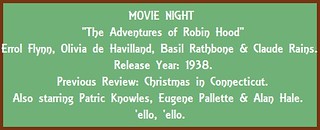
Movie Night: The Adventures of Robin Hood.


Review #505: The Adventures of Robin Hood.

Cast
Errol Flynn (Robin Hood), Olivia de Havilland (Maid Marian), Basil Rathbone (Sir Guy of Gisbourne), Claude Rains (Prince John), Patric Knowles (Will Scarlett), Eugene Pallette (Friar Tuck), Alan Hale Sr. (Little John), Herbert Mundin (Much), Melville Cooper (High Sheriff of Nottingham), Una O'Connor (Bess), and Ian Hunter (King Richard the Lionheart) Directed by Michael Curtiz (#125 - Casablanca and #416 - Yankee Doodle Dandy) and William Keighley (#501 - The Man Who Came to Dinner)

Review
This is the first film I've reviewed that starred Errol Flynn, along with the first of Olivia de Havilland, and they both are impressive, especially when they are paired together in scenes. Flynn is quite the adventurer and he does an extremely great job in the action scenes and the swashbuckling. Basil Rathbone (who I wanted to talk about in more detail when I eventually got to reviewing The Hound of the Baskervilles) is an effective adversary, getting a good fight with Robin at the end, but also being a good foil as well. Claude Rains lurks around as a fine villain that while not having a fight scene, is still a useful villain. The rest of the cast are effective at entertaining, especially Herbert Mundin, who while not given much to do, makes an impression, at least for me anyways. The action is excellent and the Technicolor give the film a colorful, yet memorable look. This is a well made, excellent adventure film that hasn't dated much, if at all.

Overall, I give it 10 out of 10 stars.