Showing posts with label David Carradine. Show all posts

July 16, 2026

Cannonball.

Review #2559: Cannonball.

Cast: 
David Carradine (Coy "Cannonball" Buckman), Bill McKinney (Cade Redman), Veronica Hamel (Linda Maxwell), Gerrit Graham (Perman Waters), Robert Carradine (Jim Crandell), Belinda Balaski (Maryann), Mary Woronov (Sandy Harris), Diane Lee Hart (Wendy), Glynn Rubin (Ginny), James Keach (Wolf Messer), Dick Miller (Bennie Buckman), Paul Bartel (Lester Marks), Stanley Bennett Clay (Beutell Morris), Judy Canova (Sharma Capri), Archie Hahn (Zippo), and Carl Gottlieb (Terry McMillan) Directed by Paul Bartel (#955 - Eating Raoul, #2231 - Death Race 2000, #2440 - Private Parts)

Review: 
Yes, the Cannonball Baker Sea-to-Shining-Sea Memorial Trophy Dash inspired quite a few movies. Once upon a time, in the 1970s, a couple of people got together and wanted to go cross-country across the United States really really fast. It was devised by car magazine writer/auto racer Brock Yates and Car and Driver editor Steve Smith that ran a couple of times in the 1970s (1971, 1972, 1975, 1979) that liked to celebrate the interstate highway and protest against traffic laws.* Various things came about involving speed limits and car rallies (One Lap of America and Gumball 3000, specifically). Believe it or not, Yates actually was planning to do a movie screenplay but was instead beaten to the punch by Samuel W. Gelfman, a producer who hired Paul Bartel and David Carradine (fresh off Death Race 2000 [1975]) to make a movie that would be distributed by Roger Corman's New World Pictures. The resulting script was cobbled together from Paul Bartel and Donald C. Simpson (this was Simpson's only credited screenplay, as the following year saw him named vice president of production at Paramount). Released in July, it was released one month before The Gumball Rally from Warner Bros. (the car race movie with Michael Sarrazin as star). Bartel later stated that while he was never interested in cars or racing, he decided loading the film with cameos and gimmicks that interested him would work out for him (which included a scene of Bartel playing the piano, naturally). The movie (which includes a gauntlet of cameos from Roger Corman to Sylvester Stallone) was not as big a success as Death Race 2000. Yates did get his screenplay made into a film, albeit with an all-star ensemble cast in Hal Needham's The Cannonball Run (1981), complete with a cameo appearance. Coincidentally, both movies had funding from Hong Kong companies: Cannonball had the involvement of Shaw Brothers Studio while The Cannonball Run had the involvement of Golden Harvest (and even the involvement of Jackie Chan as one of the stars).

It's a movie with a very macho Carradine that goes around driving through the mayhem that comes from exploding cars, mid-wit brothers, cars piling onto themselves, and good ol' scrappy fun. Sure, it does plod along at 93 minutes with an array of jokes and action set-pieces that are pretty hit and miss. But I enjoy the general enthusiasm that comes through to say that it is at least curious to sit through once, perhaps as part of a double-header with Death Race 2000 (or, to see the comparison of familiar faces, The Cannonball Run, a movie my dad surely liked enough to have on DVD). If you like Carradine and cars, this is somehow second of a sort-of-trilogy of Carradine, cars, and New World distribution. In 1978, Carradine happened to do another vehicle-related car movie with Deathsport (1978) for New World (with Allan Arkush and Nicholas Niciphor as director). It's the usual type of understated macho performance from Carradine that coasts through the experience with a few kicks and the same number of expressions as say, Clint Eastwood (in other words: fine?). McKinney and his loosely defined adversary position is at least interesting to see play off Carradine here and there, but it mostly is a film for bits and pieces of things (most significantly with Miller, the "that guy!" king). Hell, he probably is almost outshone by R.Carradine and Balaski taking the time in doing the race (which even sees them take a competitor to the hospital). It's a movie built for theatrics: guys playing country songs in a fast car will eventually go by the wayside for a stunt jump over an unfinished bridge (which is cool). Strangely enough, this and Cannonball Run share the same type of conclusion: the lead doesn't actually win the race because a last-second snafu (okay it's a bit dourer in this film as compared to the other one, but still) with its own type of punchline in bringing the wreck back home. It's a movie where you either go "cool", "eh", or "nope", pure and simple. As a whole, it certainly is a step down from Death Race 2000 (1975) in terms of entertainment with the second and last collaboration between Bartel and Carradine, but it still is worth a watch for those who like offbeat movies on the road that is sometimes funny but generally involving to see to the end.

Overall, I give it 7 out of 10 stars.


*In a movie, it's whatever, but here's an easy take: follow traffic laws. People shouldn't die because some pissant had to go 100 on a 75 or because some moron doesn't use their turn signals. 

July 22, 2024

Death Race 2000.

Review #2231: Death Race 2000.

Cast: 
David Carradine ("Frankenstein"), Simone Griffeth (Annie Smith), Sylvester Stallone (Joe "Machine Gun" Viterbo), Mary Woronov (Jane "Calamity Jane" Kelly), Roberta Collins (Matilda "The Hun"), Martin Kove (Ray "Nero the Hero" Lonagan), Louisa Moritz (Myra), Don Steele (Junior Bruce), Joyce Jameson (Grace Pander), Carle Bensen (Harold), Sandy McCallum (Mr. President), Paul Laurence (Special Agent), and Harriet Medin (Thomasina Paine) Directed by Paul Bartel (#955 - Eating Raoul)

Review: 
"Most of my guilty pleasures in this film were ripped out by the roots by Roger Corman before the film ever saw the light of day and substituted with crushed heads and blood squibs. Nevertheless, there is a joke about the French wrecking our economy and telephone system that I still find amusing. And I am pleased by the scene introducing the Girl Fan (played very effectively by my sister Wendy) who is to sacrifice herself beneath the wheels of David Carradine's race car and wants to meet him so that the gesture will have 'meaning'."

Okay, so you have managed to encounter a Roger Corman-related production. Gratuitous and all around weird is what one might expect from a film that was inspired by the publicity that came for the film Rollerball, which was slated for release in June of 1975. Corman found a short story to crib for an adaptation with Ib Melchior's "The Racer", which actually had been inspired by the revulsion Melchior seemingly had when he saw a death at a motor race. Script troubles meant that the film had a prolonged production schedule, which initially had a script written by Robert Thom before re-writes were done by Charles B. Griffith and its eventual director (Corman would play influence when it came to looking over tone, naturally). At director was Paul Bartel, who had made his first noted film with the short The Secret Cinema in 1968 (after several years of shorts, which included work for the United States Information Agency) before becoming a feature director with the horror-comedy film Private Parts (1972), which was produced by Gene Corman; the following year, Bartel did second unit work on Big Bad Mama. Interestingly, Carradine wanted to pick a movie to help his film career after spending three seasons as the star of Kung Fu, the television show he is perhaps most famous for (having seen the show, this is probably true), and the film was released one day after the final show airing; he came around after Peter Fonda was approached and had declined (of course, there was a moment in time during the turbulent production that had Bartel thinking about replacing Carradine with Lee Majors (!), but the two eventually bonded). The film was a hit in the general sense; Bartel's next film was Cannonball (1976), which had Carradine as star that aimed for comedy within its inspiration based on a real race (as you might know). In 1978, Corman, having a contract with Carradine, spearheaded a push for another vehicle-related film with motorcycles that that eventually became Deathsport (as directed by Allan Arkush and Nicholas Niciphor), which was not particularly successful. In 2008, a remake of the film was done by Paul W. S. Anderson, which was the first of five "Death Race" films that were either follow-ups to the 2008 film or in the case of Death Race 2050 (2017, as produced by Corman), a sequel to the original.

So, here is how the future is envisioned by 1975 standards: to pacify the population under a tough regime dealing within crisis comes the "Transcontinental Road Race" that has seen twenty years of violence and gore because of combat of cars and, well, people. You get to see the gauntlet of just who would do these kinds of races: people who dress up like gangsters...and Nazis. In the land of B-movies, it really can come down to just how much fun one sees on screen when it comes to execution and commitment. This is aa pretty neat one that surely delivered a tiny bit of inspiration for Mad Max (1979). The conflict of nudity and gore with the attempts at comedy (the latter was favored by Bartel and Carradine to an extent) makes for a curious experiment that may have a random viewer wondering just what the hell they are supposed to think about its 80-minute runtime of lean and mean nature. That strange casual blend (in of itself a "Frankenstein" creation of Corman and Bartel) of guts and the occasional chuckle that arises from people watching the violence of car-on-man (or in the case of point-seeking to the extreme, the elderly) is a feeling that one always hopes to find in an exploitation film. I particularly like hearing from Bensen and his mimicking of Howard Cosell when it comes to being a voice from the crowd (alongside other "journalists"). Carradine just has a natural charm to him that attracts one's curiosity in what is left said and unsaid within that everyman nature that comes out for a role that if played by a lesser talent would've been just a film with less interesting impact in terms of (pun intended) drive. He has the gumption to roll with the inane goofiness that is apparent even with the real assertion one could argue about just how much curiosity people really have about violence (in living color). It's interesting that two of the early roles for Stallone before Rocky (1976) were Corman productions, with this and Capone being released in 1975 (the same year that he got the inspiration for, well, Rocky). He provides a few good heel chuckles in a cast that is mostly fine in those silly one-note mannerisms (which ranges from the aforementioned Nazi helmeted person to, uh, bits of nudity). There is just a mayhem and energy here that works so well in making light of the obsession that arises from violence in terms of the spectator or opportunistic journalists that is hard to match. The climax is pretty neat in one lasting chuckle that really does prove Bartel had the right idea in mind (Corman wanted to film an ending where the FBI shoots an annoying reporter rather than, well...) in making a film with useful timing in manic commitment without having to be broad about it. In the long run, it is a neatly cheap movie with the idea of conveying what people seem to think about seeing violence play out right in front of them that goes with the entertainment value of the film: fun on the run.

Overall, I give it 8 out of 10 stars.

January 16, 2021

The Long Riders.

Review #1625: The Long Riders.

Cast: 
David Carradine (Cole Younger), Keith Carradine (Jim Younger), Robert Carradine (Bob Younger), James Keach (Jesse James), Stacy Keach (Frank James), Dennis Quaid (Ed Miller), Randy Quaid (Clell Miller), James Whitmore Jr (Mr. Rixley), Kevin Brophy (John Younger), Harry Carey Jr (George Arthur), Christopher Guest (Charlie Ford, Nicholas Guest (Robert Ford), Shelby Leverington (Annie Ralston), Felice Orlandi (Mr. Reddick), and Pamela Reed (Belle Starr) Directed by Walter Hill (#1072 - 48 Hrs, #1091 - Last Man Standing, #1139 - Supernova)

Review: 
"I'd been dying to do a Western for years. I just like 'em. There's a kind of an idyllic quality that surrounds the shooting of them, it seems like a more fundamental film process, more to me what movies are about than clearing crowds off a city street."

The legend of outlaws has spanned a variety of media for over a century, and it is the intrigue of seeing the Old West and all the storytellers that can come from it that make it an interesting curiosity. Whether it is the ballad, or the dimestore novel, or the Western, there always seems to be an interesting idea waiting at the barrel for someone to make seem fresh. There had been various perspectives on the James legend, with one of the more recent films done before this one being The Great Northfield Minnesota Raid (1972), so it would only make sense for yet another adaptation of the James legend (of which there were at least fifteen prior to 1980), albeit with a twist - brothers playing brothers. The idea for the film came about after James and Stacy Keach had starred in a production on television together nine years prior, in which they had played the Wright brothers. James had the idea to play Jesse, while Stacy came up with financing as producer and financer for the play that James wrote. It was briefly staged in New Jersey and Off-Broadway, but they eventually decided to make it into a film for each of them to be involved, and they enlisted the help of Bill Bryden and Steven Phillip Smith to develop the screenplay (the Keaches would also serve as producer alongside Tim Zinnermann). Enlisting the Carradines came in the form of J.Keach approaching Robert Carradine during their time in the production of the TV film The Hatfields and the McCoys in 1974 about being involved with the film, and they soon approached David and Keith with the prospect of doing it, which they eventually agreed. The Quaids came after that, but finding the fourth group came after a bit of turnover, as the Bridges brothers (Jeff and Beau) could not do the film due to schedule conflicts, and it later fell to the Guests (incidentally, the Bottoms family of Joseph, Timothy, and Sam wanted to star as the Youngers). Interestingly enough, a Carradine had already been involved in an adaptation about the legend of Jesse James and Robert Ford, as the eldest Carradine in John (who had four of his sons become actors) had played the latter subject in two films with Jesse James (1939) and The Return of Frank James (1940). That particular film was noted by Walter Hill as the best film made about the Younger-James brothers in terms of character truth, even if the historical accuracy was low.

United Artists agreed to help produce the film if they found a suitable director. Walter Hill certainly fit the mold of a man wanting to tell a good story. The Long Beach native grew up with an interest in film from a young age, although he once thought of being a comic book illustrator before he went into writing and eventually directing in order to tell his own stories. He has described his films as "rather retro", with his genre films generally trying to capture a serious framework within action that take inspiration from Sam Peckinpah among others - after all, he had worked with the director with The Getaway (1972); the clearest influence seems to be The Wild Bunch (1969), particularly with its use of slow motion for certain sequences of violence. Most (but not all) of his films can be argued to have elements of the Western genre, since Hill has noted his liking of complexity with a foundation on simple stories (Hill has argued they are essentially Old Testament morality tales), and this is the fourth feature film that Hill directed. It is a pretty good effort, one that does well with trying to capture a mosaic of the time and landscape that came with folks in the Old West that happen to engage in moral choices involving robbery and murder. In other words, it isn't just a straight action Western, nor one that gives focus to any one individual, instead being just a balanced film with a midwestern feel that makes its 99 minutes count with usefulness. There have been adaptations of the James story since this film (most notably with The Assassination of Jesse James by the Coward Robert Ford), but this film still stands for itself after four decades because of its capable charm, although it wasn't a big hit with audiences upon release (Keach has maintained that the film made a profit, although United Artists was likely thinking about the other Western they released that year that nearly sunk the studio - Heaven's Gate), making just a bit under double its $9 million budget.

When it comes to the first group of brothers, one can say that David proves the best in relative interest, as he is the most adept in charisma without having to strain for it. This seems most apparent during a sequence involving Reed and a new love interest, which naturally ends in a knife fight with a rope for them to chew on and duel. Keith and Robert do fine with a little less time to show, although the sequence with the Pinkertons and an unfortune cousin is a good one. The Keaches do well in their balance of laconic steel (mostly with J.Keach), one that doesn't aim for straight sympathy for the James brothers but instead lets them paint the picture for one to judge - their scene on horseback jumping through the window is likely the best image and moment from the film. The Quaids have a reserved amount of time on screen (most likely due to cutting from the studio), but they do well with being members of chaos (chained or not) that don't fall into the background, mostly with Randy. The Guests lurk right where they need to be in terms of calm sniveling, while Reed and Whitmore Jr fill out the edges in terms of allure and lingering authority that make for a off-kilter balance of a film, revisionist in its approach without seeming like a film relying just on a gimmick. It hits with a worthy punch in its look upon the landscape and the outlaws that became names to remember, no matter the efforts of authority like the Pinkertons or even the firing of a barrel to stop it. While it may not be Hill's best effort, it serves as an interesting start to a productive decade of work that packaged plenty of thrills within some of the confines that made the Western what it was without being chained to it exclusively, and it is a curiosity worth looking into today.

Overall, I give it 8 out of 10 stars.

September 24, 2019

Mean Streets.


Review #1276: Mean Streets.

Cast: 
Harvey Keitel (Charlie Cappa), Robert De Niro (John "Johnny Boy" Civello), David Proval (Tony DeVienazo), Amy Robinson (Teresa Ronchelli), Richard Romanus (Michael Longo), Cesare Danova (Giovanni Cappa), George Memmoli (Joey), Martin Scorsese (Jimmy Shorts), David Carradine (Drunk) Directed by Martin Scorsese (#990 - Taxi Driver and #992 - The King of Comedy)

Review: 
"You don't make up for your sins in Church; you do it on the street; the rest is bullshit and you know it."

It is amazing sometimes to see where a director can go in their path from turning ambition (or someone else's ambition) into something worth being on screen. Scorsese developed a love for cinema from childhood while growing up in Little Italy in Manhattan (with his experiences living there inspiring this film's story), and he subsequently attended  New York University's Tisch School of the Arts, making a few short films before making his debut feature film with Who's That Knocking at My Door (1967), starring Zina Bethune and Keitel in his film debut, which dealt with Catholic guilt. This film also deals with guilt through the lens of a crime film. After serving as one of the editors for the acclaimed documentary Woodstock in 1970, he directed his second film Boxcar Bertha with producer Roger Corman two years later, he was encouraged by actor/director John Cassavetes to make something based on his own ideas, which led to this film (with Scorsese doing the story and co-writing the screenplay with Mardik Martin). Mean Streets was done in a period of 26 days, with Los Angeles being the primary location for all but six of those days (spent where the film was primarily set, New York). Incidentally, Corman offered to fund the film (which ultimately was made for around $500,000) at one point, albeit with an all-black cast. Scorsese found funding with tour producer Jonathan Taplin and eventual distribution from Warner Bros that meant he could do the film as he wanted.

Ultimately, this film is a testament to how someone can really make a film come alive with the right sense of passion and a dynamic cast behind it. It has endured for over four decades in part because of how much it still resonates as a crime drama with its dealings of guilt and sin in the streets. It surpasses its small budget in most areas alongside its surroundings to be something quite captivating in its style that captures plenty of grime through its 112 minute run-time without becoming overwhelming. It moves at its own pace with plenty of control that one could expect from a capable director who wants to make a story come alive without having distractions in the way. With Keitel and De Niro, one can't help but be interested in what happens next, both having an aura that is magnetic whenever either is on screen, the case being especially strong for the former. You can really see the conflict with Keitel pop out on screen without having to be spoonfed direction, where his ambitions and feelings hit their own sort of crossroads. De Niro is a wild fire that burns just as fast whenever he makes his impression, such as reacting to being called a "mook" in the middle of a friendly transaction that evolves into a friendly fistfight. The rest of the cast does just as well, with Robinson having a careful slice of chemistry with Keitel while also being quite watchable, and Proval and Romanus make for a good team with the others. In a film that doesn't have or need a clear hero or villain, the film more around with its own aims and aspirations, where the fights are more inward than anything (although its fistfight is pretty well done) and the spectacle is in how all the drama plays out. There are plenty of crime films to go around, but it doesn't mean that they can't still seem fresh to follow with, with this one seeming like a template for other films to follow (particularly with its use of period rock music). The film ends when and where it needs to end up while leaving its audience entertained and interested in discussing what they saw. It does fine with living up to expectations that one could expect from a director like Scorsese with his first major breakthrough, hitting most of its marks just fine. It aims for the real side of a life in the streets racked with guilt and crime and succeeds without compromise.

Overall, I give it 9 out of 10 stars.

October 3, 2018

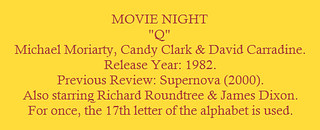
Q (1982).


Review #1140: Q.

Cast: 
Michael Moriarty (Jimmy Quinn), Candy Clark (Joan), David Carradine (Detective Shepard), Richard Roundtree (Sgt Powell), James Dixon (Lt. Murray), Malachy McCourt (Commissioner Nick McConnell), Fred J. Scollay (Captain Fletcher), Peter Hock (Detective Harold Kipps), and Ron Cey (Detective Hoberman) Directed by Larry Cohen.

Review: 
Q (also known as The Winged Serpent and Q – The Winged Serpent) is certainly a film that relies on techniques and gimmicks of the past to generate entertainment. Its director Larry Cohen is best known for b-movie films that fall in some way to either exploitation, horror or sci-fi, with examples of this being movies such as Bone (1972), It's Alive (1974) or later work such as The Stuff (1985). He also served as screenwriter for the film, of which he did for other material such as his creation of the television series The Invaders (1967-68) to even writing Phone Booth (2002). So, what is Q all about? Well, it's an Aztec god (half bird, half reptile) named Quetzalcoatl that nests itself on the Chrysler Building when not taking people out of the sky and devouring them. Naturally, there was a good reason that Cohen wanted to use that building, stating "The Empire State building had their monster, but I thought the Chrysler Building was a better-looking building, so I thought, “Well, they should have their own monster!” It's not hard to find the hallmarks and cliches that you might expect from a horror monster flick like this, but the entertainment is fairly high in part due to a game cast, particularly with Moriarty. There is something so offbeat and weird about his character that he manages to generate such watch-ability from, complete with his own improvised piano piece. He's an interesting anti-hero, never becoming too grating on the audience while also keeping the film afloat for the parts not involving the monster. Who else can make the idea of someone extorting New York for the location of a flying serpent for money seem so amusing and yet compelling at the same time? Clark plays her role with a fair deal of sense and balance that certainly sticks out from the odd stuff otherwise present, and it doesn't come off as distracting in any sense. Carradine pulls off an entertaining performance in a role that probably would've worked fine for a police film, but with him at the helm of facing the usual cop elements (rituals involving Aztec cultists sacrificing people in order to bring Q to life, no less) alongside giving a bit of exposition about the monster, and he handles it effectively enough. Roundtree plays his cop role with the kind of gruffness that corresponds just fine with Carradine for the time he gets to be on screen. The others in the cast are just fine, doing their bits without much struggle. The stop-motion effects, done by David Allen and Randy Cook hold up for the time just decently enough for entertainment value that likely works better than if this film had been made a decade or two later. For the most part, this manages to be a fine piece of entertainment in its 93 minute run-time. It can sometimes be silly but it also has its moments of charm and creepiness that has a winning cast headlined by Moriarty to make this a welcome cult classic right for the occasion for October.

Overall, I give it 7 out of 10 stars.

September 16, 2014

Movie Night: Kill Bill Volume 2.


Review #639: Kill Bill: Volume 2.

Cast
Uma Thurman (The Bride/Beatrix Kiddo), David Carradine (Bill), Michael Madsen (Budd), Daryl Hannah (Elle Driver), Gordon Liu (Pai Mei), and Perla Haney-Jardine (B.B) Directed by Quentin Tarantino (#638 - Kill Bill: Volume 1)

Review
The first film mainly set up the premise of revenge with loads of bloods. The second movie sets up the back story and gives the main character more depth. It's a good thing to have some story that helps develop the mythology, for one thing we actually get to know her name, which helps (unless you're the Doctor), I suppose. The action is still good, though it never hurts to have some dialogue for once. To decide which Kill Bill film is better depends on what you want the most, action or back story/emphasis on dialogue. For me, I like the scenes with Gordon Liu, there's just something so amusing about his scenes, or maybe it's his beard. Liu is such a random character who makes an impression with only flashback scenes, it's stuff like that which make this film not weaker than the first film but at the same level. These are movies chock full of influences from other forms of cinema, with sprinkles of pop culture references and chock full of bloody action. This is at heart a mostly fun movie that manages to be what it wants to be, entertainment. This movie still makes an impact after 10 years, and I imagine that we'll remember this as a classic even 60 years from now.

Overall, I give it 9 out of 10 stars.

September 14, 2014

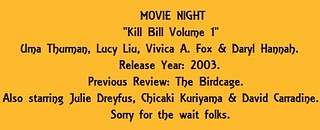
Movie Night: Kill Bill: Volume 1.


Review #638: Kill Bill: Volume 1.

Cast
Uma Thurman (The Bride), Lucy Liu (O-Ren Ishii), Vivica A. Fox (Vernita Green), Daryl Hannah (Elle Driver), Julie Dreyfus (Sofie Fatale), Chiaki Kuriyama (Gogo Yubari), David Carradine (Bill), Michael Madsen (Budd), and Sonny Chiba (Hattori Hanzo) Directed by Quentin Tarantino.

Review
I knew that eventually I would have to review a Quentin Tarantino film, and I had a feeling it would be this film. So how is this film? Is it a masterpiece, a great film, or something possibly overrated and slightly over hyped? In a way, it could be all four answers. The movie manages to be very stylish and memorable with the fight scenes, somehow you can make blood squirts look new, that or I'm just not used to so much blood. Does it need to be realistic to be better? No, I guess not, when we want a film to be more realistic or sillier really varies depending on the film (Best example I can think is the James Bond franchise, does it make sense to love all the eras despite their flaws? Yea, they all have their own qualities and flaws, some more than others, but you get the idea.), and in this case I can forgive it. The cast seem to flow well with each other, Thurman's character is a cool assassin, and that's all you need to know, her swordplay is great to watch. The movie is heart a tribute to 70's cinema films, such as martial arts and kung-fu films along with various others, and in the end this is a movie that is well made, it's a movie that doesn't require much story to work, it's just a film with a lot of determination...and blood, but there you go. Is it a great movie? It might just be one, ask yourself this question: Did you like The Wild Bunch? If you did, there's your answer.

Overall, I give it 9 out of 10 stars.