Showing posts with label Denzel Washington. Show all posts

February 27, 2025

Mo' Better Blues.

Review #2350: Mo' Better Blues.

Cast: 
Denzel Washington (Minifield "Bleek" Gilliam), Spike Lee (Giant), Wesley Snipes (Shadow Henderson), Joie Lee (Indigo Downes), Cynda Williams (Clarke Bentancourt), Giancarlo Esposito (Left Hand Lacey), Bill Nunn (Bottom Hammer), Jeff "Tain" Watts (Rhythm Jones), Dick Anthony Williams (Mr. "Big Stop" Gilliam), Abbey Lincoln (Lillian Gilliam), John Turturro (Moe Flatbush), Nicholas Turturro (Josh Flatbush), Robin Harris (Butterbean Jones), with Samuel L. Jackson (Madlock), Leonard L. Thomas (Rod), and Charlie Murphy (Eggy) Produced, Written, and Directed by Spike Lee  (#1255 - Do the Right Thing, #1543 - Inside Man, #1643 - Malcolm X#1976 - She's Gotta Have It#2181 - School Daze)

Review: 
"I always knew I would do a movie about the music. When I say the music, I’m talking about jazz, the music I grew up with. Jazz isn’t the only type of music that I listen to but it’s the music I feel closest to."

Believe it or not, this was the first collaboration between Spike Lee and Denzel Washington on film. 
The inspiration for the movie came from Lee's interest to do a jazz movie with his own perspective after seeing Bertrand Tavernier's 'Round Midnight (1986) and Clint Eastwood's Bird (1988). The script for the film came up when Lee was working on Do the Right Thing (1989), with the first-draft screenplay being written in fifteen days. The fourth feature film directed and written by Lee, the movie was shot in roughly eight weeks with a budget of $10 million. The movie features the music of the Branford Marsalis quartet with Terence Blanchard doing the trumpet, with Delfeayo Marsalis lending assistance to Bill Lee with the producing of the music recordings (this was the last of four films where the Lees worked together, as they soon had a falling out). One isn't actually seeing the actors (most, anyway) playing the instruments, but they sure do a good job looking the part in imitation, which is more than enough. The first of nine movies Lee directed in the 1990s, it was a mild success at the time; the next movie directed by Lee after this one was Jungle Fever (1992).

Overlooked or not, there is something quite soothing about the way the movie flows in looking at the edges that come with trying to work at one's craft at the expense of relationships. It is hard to show maturity and know what one really wants when one could be working on something else, you might say. It is a movie based on mood and energy that is a curious one in basically reflecting its introduction and ending when it comes to parents and their son when it comes to shaping them and making a choice for them (in a movie where the rest of it is comprised of fallout from certain choices made, naturally). There is a crushing pressure one can feel in trying to hold on to themselves and not burn out into the night while also trying to think that everything is totally normal with how they do things within "fundamentals", and that includes one's love life. Undeniably, the sequence involving Washington opposite the two women in bed (at different times, obviously) is the most striking when it comes to misplaced ideas about people. Washington does pretty well with all of that in mind, mainly because he glides from place to place with weary disposition for what he seems to really want in life beyond that smooth facade of confidence (it takes more than talent to be a saint of jazz, shall we say). Basically, he treats the two women (C.Williams and J.Lee, the former making their film debut) in his life like they were items to check out at the store (incidentally, Lee called it a movie specifically about relationships and not a love story). The two women are only seen in that lens but each handle it with clear differences when it comes to timing and, well, allure. The Turturro brothers pop in from time to time to provide a few chuckles in the business interest side (if one ever believed the current times are weird for stereotypes, inquire further about this movie being called "anti-Semitic" and look to now when it comes to how much people like to waste time looking for stereotypes that aren't there). Lee also does pretty well in shaky stature (as one does when finding new ways to play characters in one's own story, which he did for his first nine movies). By the time the movie has its reckoning with certain decisions made in and out of good reason, one has found a pretty good time with the rhythm that the film has accomplished for itself, one filled with worthwhile interest in showing the power of human contact and making one's mind besides drawing it all in the craft. The relationships matter all around us: the music and the people we hold to us and how it matters so much to hold it tight to us as long as we can, which in this sense works out pretty neatly in the long run.

Overall, I give it 8 out of 10 stars.

February 16, 2024

The Book of Eli.

Review #2175: The Book of Eli.

Cast: 
Denzel Washington (Eli), Gary Oldman (Bill Carnegie), Mila Kunis (Solara), Ray Stevenson (Redridge), Jennifer Beals (Claudia), Evan Jones (Martz), Joe Pingue (Hoyt), Frances de la Tour (Martha), Michael Gambon (George), and Tom Waits (Engineer) Directed by Albert and Allen Hughes.

Review: 
"Allen deals with the actors, I deal with the technical side. Outside of that, we both do everything. I think it came up that way because I went to film school (at Los Angeles City College) and learned more of the technical side. Film school was just putting names on things me and my brother were already doing, different ways of doctoring up stuff. But even when we work together on the set, we both have opinions on each others' area."

Sometimes it matters to be two of a kind. The Hughes Brothers, composed of Allen and Albert, were born in Detroit but raised in California with a clear interest in film from a young age (as helped by their mother, who bought them two VHS machines and a video camera when they were 12). They honed their craft with music videos. At the age of 20, they made their first feature film with Menace II Society (1993). They followed this with Dead Presidents (1995), the documentary American Pimp (1999) and From Hell (2001); Albert moved to the Czech Republic in 2004. At any rate, this film was written by Gary Whitta, but re-writes were done by Anthony Peckham. This is currently the last film made together by the Hughes brothers, although each have continued to direct for separate features and television, such as The Defiant Ones (2017) and Alpha (2018), respectively.

Really one could just interpret the film as a slightly less hokey version of The Postman (1997). Think about it: both movies involve a wandering drifter with a particular vision in mind on their travels that run into someone wanting to maintain control of their part of a post-apocalyptic America that eventually leads to some sort of semblance of hope (hey, one gets a statue and the other gets a gravestone after doing what they set out to do), and both happen to feature a musician in a bit part. Of course, one has hand-to-hand combat and a runtime under two hours (118, but still) with this film, which is set...30 years after some sort of thing happened. Honestly, it probably would've looked the same regardless of if it was 5 or 10 years, but so be it. The result is a mildly involving attempt at parable that comes and goes on just how much one is interested in its eventual climax, which, well, is more a Western than anything (Pale Rider (1985) referred to the Four Horsemen of the Apocalypse in its title, chew on that). The blind leading the blind, in good ol' browns and greys with some brand references (just how big were iPods anyway?), I think you get the idea of where things will go besides the part that really attracts my attention: a few moments of kick-ass with the hands. Of course, Washington is pretty good as the headline enigma to hold the film as long as it can, which exudes faith in the assured manner that fits what you would picture in your head in terms of trying to stay on the path that seems most obvious to him. That, and, well, he does make a quality presence to see handle a bunch of fools in their place that would fit a samurai film. Oldman handles the other side of the coin in just how much knowledge can lead a man on a certain path, which mostly involves craven nature, and this is mildly successful. It isn't exactly a role begging for scene-chewing, because Gambon and de la Tour can do that instead. Kunis makes a blank slate that may or may not work depending on one's patience for, well, seeing where a slate goes for a road movie. The film gives me more of a chuckle in its attempt at playing bleakness and religious nature in a familiar package that is only as good as the commitment to make it something worth sticking with. As a whole, it meanders in a certain type of meandering that could only come from something that is hazy in both construction and look that works best for those who don't look for the obvious signposts but instead just sit for the ride and relax.

Overall, I give it 7 out of 10 stars.

February 28, 2021

Fences.

Review #1647: Fences.

Cast: 
Denzel Washington (Troy Maxson), Viola Davis (Rose Lee Maxson), Stephen McKinley Henderson (Jim Bono), Jovan Adepo (Cory Maxson), Russell Hornsby (Lyons Maxson), Mykelti Williamson (Gabriel Maxson), and Saniyya Sidney (Raynell Maxson) Directed by Denzel Washington.

Review: 
"The star of the movie is the screenplay and August Wilson's words. What Denzel said to me, to Scott, to all the actors, the cinematographer, and the production designer was, 'Don't make any decision without August Wilson's words leading you to make that decision.' Whatever you do, let the words inform your decision first. That's what we all had to abide by."

If the right person is found, the right result will be found for the material to show to the screen. The source material for the film was the play of the same name, which was first developed on the stage in 1983. Written by playwright August Wilson, it was the sixth play done by him in what is now considered part of the "Pittsburgh Cycle", with each play taking place in a different decade of the 20th century. The city native wrote ten plays that all dealt with the African American experience within his city (although one was actually set in Chicago); this and Ma Rainey's Black Bottom (1985) were his first triumphs with audiences, and Wilson would win a Pulitzer Prize for Drama and a Tony Award for Best Play upon Fences' premiere on Broadway in 1987. When asked about the idea of turning Fences into a film, he wanted an African American director, or more specifically, one who would in his eyes be a director that "shares the specifics of the culture of black Americans." Despite Paramount Pictures buying the rights to make a film in 1987, the idea stalled for years, despite Wilson having wrote a screenplay for it before his death in 2005. When there was time at last do make a film, the script was generally kept intact, although there were a few uncredited rewrites done by Washington, Tony Kushner, and Spike Lee in pre-production. In the director's chair was actor/director Washington, who had added directing into his repertoire with Antwone Fisher (2002) and The Great Debaters (2007), and he also served as a co-producer on this feature. The film retains the main duo from the 2010 revival on Broadway with Washington and Davis, who toured for a limited run of 13 weeks and each had been awarded Tony Awards for their performances; Henderson, Hornsby, and Williamson also reprised their roles from the 2010 stage show.

What we have here is a film ripe for great actors to pair with each other that could prove mesmerizing and poetic in the right hands. I'm sure Wilson would have been quite proud of the result in turning his play into a film, as it manages to be quite an entertaining time, one shot right in the setting of the Hill District in Pittsburgh. The film moves with timing of a poet that manages to seem right at home within a film that drives its strength from two actors in their prime that makes one almost seem right there at a distance to hear their cadence come out with clarity in a family drama that generally hits the mark for what it wants to say regarding its time and place (in this case, the 1950s). No matter how much one tries or doesn't try, the folks that raise us a child are always going to be a part of us, flaws or not, where duty matters more so than just having someone liking you for the sake of it. Of course there is also the idea of what a fence means, both literally and in metaphor. In an era of films that seem to bill themselves on trying to out explode the other or try to hit marks on quieter stream services, it is nice to have a film that wants to reach its own depth of interest in terms of meaningful drama that does not come off as too fenced off for interest. Washington and Davis are our main focus, and while each received buzz for their performances, the latter was generally felt to be a supporting presence. To level it as tha is to forget the fact that each compliment the other in their own ways, where one doesn't seem to be lacking the other or feel that they are watching a director-actor's show. Washington does quite well with such an imposing role, one wrapped with plenty of the human element of what makes a father from Wilson's perspective with reasoned edge and tough interest. He makes his dealings with no overblown moments of playing to the rafters that obviously excelled from the performances done in the theater. In that mindset, Davis (who had starred in Washington's first directorial effort but best known for her star role on How to Get Away with Murder) follows with a resourceful touch, one that stands with Washington and brings everyone together with grace and stature to drive the drama just as well as Washington. Each have their moments when paired with Adepo in regards to the nature of parental influence, whether that means devotion or something else, and that is made pretty clear with Davis' scene near the end when talking about what one person meant to her and her son in terms of legacy (the scene Davis and Washington share in a pivotal moment about secrets is a close second). Adepo manages to do his best when faced with acting with either of them with reasoned care. Henderson accompanies the proceedings at times with a bit of charm and advice that goes along fairly well. Hornsby and Williamson close out as the primary support with well-done touch (mostly for the latter). All in all, what we have is a captivating family drama that captures the essence of a time, place, and upbringing that resonates with the viewer through its main two performances with flourish that hits most of its marks for 139 minutes for a solid accomplishment of turning a stage classic into a film.

Overall, I give it 9 out of 10 stars.
Well, I hope you folks enjoyed this month and what it tried to cover with Black History Month. Perhaps it will be done again next year, but I assure you that there will be some surprises ahead in 2021 for Movie Night that I hope you enjoy. Any suggestions you have are always appreciated; thank you and have a good night...

February 20, 2021

Malcolm X (1992).

Review #1643: Malcolm X.

Cast: 
Denzel Washington (Malcolm X), Angela Bassett (Betty Shabazz), Albert Hall (Baines), Al Freeman Jr. (Elijah Muhammad), Delroy Lindo (West Indian Archie), Spike Lee (Shorty), Theresa Randle (Laura), Kate Vernon (Sophia), with Lonette McKee (Louise Little), Tommy Hollis (Earl Little), James McDaniel (Brother Earl), Ernest Thomas (Sidney), Jean-Claude La Marre (Benjamin 2X), and Christopher Plummer (Chaplain Gill) Directed by Spike Lee (#1255 - Do the Right Thing, and #1543 - Inside Man)

Review: 
"We declare our right on this earth to be a man, to be a human being, to be respected as a human being, to be given the rights of a human being in this society, on this earth, in this day, which we intend to bring into existence by any means necessary.” 

When it comes to biographical epics, the best of those type of films are the ones that have plenty of challenge to overcome to portray a human being with the right amount of detail and understanding required that will pack as much insight as it does interest in a depiction that will stand just as well as any documentary or book. This is more than necessary when it comes to the subject of Malcolm X, this much is true. It started with The Autobiography of Malcolm X (1965), which was a collaboration between X and journalist Alex Haley in a series of interviews (for which there were more than 50 done) that were done between 1963 until X's assassination in 1965. Haley was considered at the time to be a ghostwriter for his contribution, but later years have noted his crucial role in discretion with handling the manuscript, and the epilogue was written specifically by Haley as comments of his own on X (three chapters excised from the final version were eventually found and put up for sale years later). Its publication led to a lasting influence on readers and writers alike as the first of numerous works involving the subject of Malcolm X, with a few biographies coming out in the next few decades. For example, one released in 2011 won a Pulitzer Prize but also inspired a response book aimed at correcting it, while a diary of Malcolm X's time in 1964 was released in 2014. The most recent biography was The Dead Are Arising, written by Les and Tamara Payne that was published to noted reviews in 2020.

It should not be surprising that a film was in the development stage as early as 1968 with the sale of rights to filming the novel going to producer Marvin Worth. He had met X long ago in the streets of New York and he would spend nearly 25 years trying to get a film about him to the big screen, which started by hiring novelist and playwright James Baldwin to develop the initial script. Screenwriter Arnold Perl would also be brought in to write for the screenplay, doing so until his death in 1971. The screenplay devised by Baldwin and Perl would ultimately falter into development struggles, although Baldwin would write about X various times over the next few years (such as No Name in the Street (1972), which depicted him from Baldwin's perspective) before his death in 1987 (he described the experience of trying to write a Hollywood adaptation as less than if one was horsewhipped or jailed in Bellevue); Baldwin would not be credited for his work when it came time for this film, as per requested by Baldwin's surviving family. Worth and Perl would work together for a documentary on X that was released in 1972 (done instead of a drama due to a lack of cooperation from close figures to speak on camera), which was mostly constructed of his speeches and interviews with occasional narration and newsreel footage. As was the case two decades later, Betty Shabazz served as a consultant to the filmmakers, and each was distributed by Warner Bros with voice-over work by Ossie Davis (reciting words spoken at X's eulogy). Several writers and directors were considered through a span of two decades (with one potential idea having Richard Pryor as X), and it was the argument over the qualifications of a white man directing in Norman Jewison (director of films like In the Heat of the Night) to direct that led to the ultimate pick in Lee, who had wanted to make a film of X since college (for his part, he received a bit of heat from black nationalists and others like Amiri Baraka that thought it would be a middle-class rendition of X, and more can be found about it in the book Lee wrote of his experiences making the film). 

Perhaps it was fate that Washington would play this role on film. Eleven years earlier, back when Washington was just a struggling actor, he was cast as Malcolm X in an Off Broadway production "When the Chickens Came Home to Roost"; when preparing for the role, he read the autobiography along with tapes and books and was struck by what he saw that he described as being like "heavy, mean stuff...helping me get some things off my chest." Even having Washington cast in the lead role and Lee as director didn't mean an easy production, which would experience immense pressure from community leaders (who feared a film with too much focus on his life before becoming X) to financiers (who aspired for a budget less than $30 million), for which donations were made by several prominent individuals that ranged from Michael Jordan to Prince. In essence, one could sum the feeling generated by the film through its last few spoken words, spoken through archival footage of X himself: "by whatever means necessary." It is the story of a man who forged a path of self-determination that lent clear expression to the frustrations expressed by crowds of people in America with a multi-faceted look at just who he was in the eyes of those who saw him (whether that meant the streets, jail, or on the podium) that makes a portrayal of legacy come through with fiery tension for all of what it wants to say in truths and about what endures about the man in the decades after his death. As X once stated, his life never stayed fixed in one place for too long, and this rings true here. Washington is asked to do a tremendous task of showing this one man go through the stages of life with diverse power that cannot waver, whether as "Red" or as the reborn X. He does a tremendous job here, towering over the other folks with mindset of eyes ready to open to speak of responsibility but also find his eyes open for himself to learn as well as teach as a man with no fear. Through the course of roughly two decades, we see the folks around him that make up three distinct periods of his life with varying effect and a distinct look from cinematographer Ernest B. Dickerson (in his last collaboration with Lee), and a student of history or knowing faces will see a few familiar ones along the way (such as Karen Allen or Bobby Seale, for example). The first spends time with Harlem and Boston with actors such as Lindo, Lee, Randle and Vernon. In those sequences, Washington sells the hustle and bustle of what is needed in tandem with Lindo, who is just as charismatic without having even half the time required, while Lee and the others do just fine. In the next time of focus, one focuses on Washington alongside Hall with a cameo from Plummer (playing self-righteousness with ease). Washington undergoes a new phase with awakening that is helped by Hall and his solemn conviction. The next one is distilled in two forms, involving Bassett and Freeman alongside supporting stuff from Thomas. Freeman does his part in wisdom alongside hypocrisy (a further look into him reveals more than just infidelity, let us say) while Bassett follows with Washington in well enough moments, and they have their part to play when it comes to that fateful climax.

Maneuvering the waters of adapting X to the screen meant a few moments of narrative reconciliation, even with a run time of 201 minutes. For instance, the character of Baines was actually a composite of X's siblings in respect to their role in the redemption of X while in prison. X's pilgrimage to Mecca (which was the first American feature to ever film there, although Lee had to hire a second unit crew to get permission...and Warner Bros actually thought of just doing it in New Jersey) was actually funded by his half sister Ella (also not mentioned), which is interesting considering that it is the last known surviving home of Malcolm in his childhood (he lived there with her for five years). There is one prominent figure absent in the story of the Nation of Islam, one with a legacy stoked with plenty of controversy (you might recognize him as the man behind the Million Man March alongside plenty of controversial remarks thought of as anti-Semitic or homophobic) that reportedly threatened Lee; it is disputed how much involvement the NOI may have had over the assassination even to this day. The film touches on the provocative from start to finish with its ties to the present day, most notably with the appearance of Nelson Mandela, reciting Malcolm's own words to a group of schoolchildren. In short, what we have is a film packed with a great deal of words to say about its subject then and now that generally hits the mark in stoking a statement about what he was to those that saw him in all of his forms, whether that means a kid born into tragedy, or a shaken upbringing into trouble, or a hardened man seeking light, or a man who found himself on a much bigger journey than himself. It could only end with the eulogy given by Davis, with his spoken words reaching ever still even with the passage of 27 years since he gave the words at X's funeral, one that described him as a prince that "didn't hesitate to die, because he loved us so." One could only aspire to live a life worth discussion over rhetoric and actions (controversy be damned) like X, and it is one's privilege to seek out the film for its shining performance in Washington that serves as one of his best alongside a director worthy of capturing it and everything that comes with it in all of its detail that makes it as worthy to see on one's shelf as much as something like Lawrence of Arabia (1962), where the three hours spent are good ones to spend with their eyes open.

Next Time: A television star goes to the director's chair with Once Upon a Time...When We Were Colored.

Overall, I give it 10 out of 10 stars.

September 22, 2020

Inside Man.


Review #1543: Inside Man.

Cast: 
Denzel Washington (Detective Keith Frazier), Clive Owen (Dalton Russell), Jodie Foster (Madeleine White), Christopher Plummer (Arthur Case), Willem Dafoe (Captain John Darius), Chiwetel Ejiofor (Detective Bill Mitchell), Carlos Andrés Gómez (Steve), Kim Director (Stevie), James Ransone (Steve-O), Bernie Rachelle (Chaim), Peter Gerety (Captain Coughlin), Victor Colicchio (Sergeant Collins), and Cassandra Freeman (Sylvia) Directed by Spike Lee (#1255 - Do the Right Thing)

Review: 
"I hope they're doing it because they love it, not because they want to be rich or famous. Not that those things can't happen, but the main reason, the focus is, "This is what I want to do for the rest of my life and I love it." Not to say that you don't want to make money, but the passion should be driven by your love for that particular thing that you're doing. "

It took long enough to get to just one Spike Lee film, so it obviously was going to be a short time before finding another one to cover as a meaningful look upon a director as interesting and progressive as he has proved throughout over 20 films directed in nearly four decades of work. Born in Atlanta, but raised in Brooklyn, Lee attended Morehouse College and New York University Tisch School of the Arts, studying mass communication and film, and he made his first short film with Last Hustle in Brooklyn (1979, inspired by the blackouts in New York City alongside block-parties involving disco that made him want to be a filmmaker) and his first student film in Joe's Bed-Stuy Barbership: We Cut Heads (released in 1983 as his thesis film that won a Student Academy Award). She's Gotta Have It (1986) and Do the Right Thing (1989) would each serve as defining points for Lee (the former as an independent success and the latter as likely one of the best films of the 1980s) in his movement to features that he has also served as writer or producer for a majority for as well doing his own documentaries (with his first being 4 Little Girls (1997) about the 1963 16th Street Baptist Church bombing) all through his own film company in 40 Acres and a Mule Filmworks.

The genesis for the film came from a first-time screenwriter in Russell Gerwitz (who studied computer science and law but worked in the retail clothing business) who was inspired by his vacations around Europe to do a film script (with five years of writing and help from Daniel M. Rosenberg), and it eventually found itself with Imagine Entertainment, with Lee being tapped to direct because of desire from Imagine to work with him (along with Ron Howard deciding to direct Cinderella Man instead). Sure, one could believe this as a potential great thriller. It obviously is very sure of itself in its tricks of the camera and plot that builds for that inevitable last turn for its climax and so on and so forth. In terms of its inspirations and attempts at a twist however, it probably ranks just as decent as The Usual Suspects (1995) in actually pulling things together to make it actually work beyond a cat-and-mouse game with misplaced mousetraps present (while also being inspired by Dog Day Afternoon (1975), which goes okay). The performances generally outweigh the way the script wants to weave its tricks and thrills, which means that it is a fine movie, but it certainly could have been a more interesting one. Washington (in his fourth collaboration with Lee) is fairly up to the task of handling his end of the proceedings with reasoned consistency as the anchor that holds everything together in tension and charm one expects from him. Owen does alright, having to balance a role with a good deal of time spent in a mask that nonetheless makes for a conniving counterpart with the goal of merely committing the perfect robbery, handling that with at least enough to make me believe most of that idea. Foster is fine in a vague kind of role that keeps her in relaxed authority fixing things behind the scenes in sequences shared either with Washington or Plummer, who slides by as a creature of privilege. Dafoe and Ejiofor do alright with their moments with Washington in the usual moments required from being on the beat with tension, even if it seems like one wants to see more of them, really. One thing that is generally different is the inclusion of post-break-in testimonials from hostages as interviewed by the police that are inserted from time to time (with their own type of lighting) in the film, which either helps the film in establishing little cues to follow or seems a bit distracting that depends on the viewer and their perception of what needs to be there in 129 minutes. Of course there's also those little moments beside a heist that are alright, such as a scene involving a kid and violent games (think of the children and how violent games affect them, oh the shock), which just inspires a "sure, uh huh" response after making sure it wasn't supposed to be amusing, alongside other things. For me, the whole film verges on how much composure and stakes actually hold up in the long run. For me, it holds itself a little too much in achieving its promises with execution to what I need to care about: I wish I really cared about this heist more than just the usual curiosity, because it tries hard to really move beyond straight thriller stuff but ultimately is just kept in standard gear but with a respectable director behind it instead. If you like what you see in its performances and see past its smokescreen to what really matters, you might find something really worthwhile for a watch, which is all that really matters.

Overall, I give it 7 out of 10 stars.

September 7, 2020

Training Day.


Review #1529: Training Day.

Cast: 
Denzel Washington (Detective Sergeant Alonzo Harris), Ethan Hawke (Officer Jake Hoyt), Scott Glenn (Roger), Eva Mendes (Sara), Cliff Curtis (Smiley), Raymond Cruz (Sniper), Noel Gugliemi (Moreno), Dr. Dre (Paul), with Harris Yulin (Detective Doug Rosselli), Tom Berenger (Stan Gursky), Raymond J. Barry (Captain Lou Jacobs), Peter Greene (Jeff), Nick Chinlund (Tim), and Snoop Dogg (Blue) Directed by Antoine Fuqua.

Review: 
"Being a kid growing up with Kurosawa films and watching Sergio Leone movies just made me love what it could do to you, and how it could influence you - make you dream."

What we have here is a film comprised of two unifying visions in writing and directing when it comes to shades of gray in the streets and the people that live in it. Fuqua grew up in Pittsburgh, Pennsylvania and described himself as living a rough area that nevertheless found inspiration from films of his youth that affected him such as Seven Samurai and The Magnificent Seven in watching people struggle through their own fight for justice. He studied engineering and fine arts at West Virginia University with the intent to join the military before deciding to enter into filming with music video directing, which he started in 1992 for performers such as Chanté Moore and moved into film directing with The Replacement Killers (1998). The writer of this film was David Ayer, who while born in Champaign, Illinois lived with his cousin in South Central Los Angeles before serving in the United States Navy for two years as a Submarine Sonar Technician (with those experiences inspiring him to write his first published screenplay, U-571). The script for this film had been developed over the course of a few years by Ayer (who would later become a director in his own right) and he spent considerable time observing with people who resided in that area for their perspective on law enforcement, with the 24-hour setting coming through his fascination with seeing a person entirely transformed through one particular day. Fuqua would also do his part in maintaining a realistic atmosphere through shooting on location all around Los Angeles (whether that meant South Central or the Imperial Courts) that meant consultation with undercover cops and gang experts (which extended to the stars of the film).

Perhaps it shouldn't be surprising that Washington does a great job with this role, because it clearly is a challenging role well-suited for a great actor to show nuance with. The film seems to take its lead from films like The French Connection and Dog Day Afternoon in a gritted-teeth telling about police action how it pertains to the community at large with a pace that works itself to fair standards with a solid duo wrapped around a world of brutality involving crooked cops and gangsters that still seems relevant today (the C.R.A.S.H. scandal involving the Los Angeles Police Department occurred by 1998, which was after the development of the screenplay but still prescient by the time of filming). Washington does a great job in depicting the logical next step of trying to take on the pressure-cooker type streets in going over the line and becoming an intimidator of the neighborhood. With a lesser actor, it might have just been an opportunity to go over-the-top in the guise of street justice, but Washington reins in a captivating performance filled with aggressive precision that isn't easy to pin down scene-to-scene. Hawke holds his ground on the other side of authority in ambition choked by underlying darkness, one that does just as well in driving the material forward with patience and an electric rapport with Washington that makes for good drama. Others do just fine in filling the details of a grayish world, such as Glenn with slimy calm, or an unassuming Mendes, though of course the best scene with others is one involving Yulin, Berenger, and Barry as "wise men" in their understanding with Washington when it comes to what's on/off the table. On the whole, one will find a decent experience to be had here through 122 minutes, as it has a general patience and understanding of a time and place that still adheres to how might makes right, with credible pacing and buildup to go with a well-paired duo and capable support to deliver a good thriller.

Overall, I give it 8 out of 10 stars.

August 7, 2019

The Manchurian Candidate (2004).

Review #1254: The Manchurian Candidate.
Cast: 
Denzel Washington (Major Bennett Marco), Meryl Streep (Senator Eleanor Prentiss Shaw), Liev Schreiber (Congressman Raymond Prentiss Shaw), Jon Voight (Senator Thomas Jordan), Kimberly Elise (Eugenie Rose), Vera Farmiga (Jocelyn Jordan), Jeffrey Wright (CPL Al Melvin), Simon McBurney (Dr. Atticus Noyle), Bruno Ganz (Delp), Ann Dowd (Congresswoman Beckett), Ted Levine (Colonel Howard), Miguel Ferrer (Colonel Garret), and Dean Stockwell (Mark Whiting) Directed by Jonathan Demme.

Review: 
One could say plenty about the idea of remaking classic films, particularly when it comes to one as classic as the 1962 film The Manchurian Candidate. As much as one could want to deride yet another remake for the sake of remakes, the idea to try and update the Richard Condon novel for the current age does show enough promise to make things seem palpable. The original film was a neo-noir/suspense thriller that had plenty of power within its cast and other elements that inspired plenty of shock and biting satire that one would assume continues as much the second time around. The key differences between the original and this version involves updating the enemy from nefarious communists to an equally nefarious private equity firm alongside making both Shaw and his mother politicians along with one crucial twist involving the climatic assassination. In general, this film also seems more paranoid and aware of its surroundings of when it was made, which stands fairly firm even after fifteen years since its release. Those who are familiar with the work (novel or film) will see where it is going to end up, but it doesn't mean the surprises aren't still there waiting to pounce, most of which land just fine. It surely must've proved a challenge for director Jonathan Demme and writers Daniel Pyne & Dean Georgaris to try and make a follow-up worth the impact that John Frankenheimer and George Axelrod did with direction and writing the first time around. I do think that the final result is a fairly welcome one, deserving of existing alongside its predecessor as a capable if imperfect political thriller.

At least one can say the main foundation of cast members is sturdy to try and hold things together, whether they have time on screen to make a lasting impression or not. In this sense, Washington does a fine job with what is given, taking a different road from what was tasked before, showing plenty of conviction in trying to hold things together enough to grasp at the truth behind what he experienced and what hides behind with what isn't know. Streep shows plenty of fierce vigor whenever she enters the screen, whether when dealing with her on-screen son or with other forces at work, with her ruthless presence being felt handily. Schrieber handles his task without too much difficulty, where you can see the manufactured side of who he has been made to be alongside the vulnerability of what comes out at the surface that can't be meshed out. Voight and Farmiga don't have as much to do here as before, in part because of the fast-tracking that means the nomination goes without too much difficulty (with the rivalry between Voight and Streep not picking up as much steam as it probably could have). Elise's character also undergoes a bit of changes (mainly to add a bit of connective plausibility to how she just happens to be on the same train as Marco besides just being a supermarket clerk), and she does okay with being in the margins of the plot, I suppose. The other members of the cast (including a criminally underused Stockwell) do okay, with Wright making the most impression in his one scene in the beginning, a shadow of himself that serves to cast against the light of heroism shown in the initial scene. After all, the brainwashing sequences (involving an influx of science-fiction) are spread out in the film as opposed to being laid out from the get go, which does tend to work out in the film's favor without being too hokey. Maybe it isn't as subversive as it wants to really be, but at least it does reach some sort of thoughtful levels in its end. It isn't a film that will inspires many re-watches, but I would postulate that it is at least worth one look of consideration, having a cast that clings to a cynical update on what was done before with a little bit of polish and shock to go with it.

Overall, I give it 8 out of 10 stars.

September 11, 2013

Movie Night: Remember the Titans.


Review #452: Remember the Titans.

Cast
Denzel Washington (Herman Boone), Will Patton (Bill Yoast), Wood Harris (Julius Campbell), Ryan Hurst (Gerry Bertier), Donald Faison (Petey Jones), Ethan Suplee (Louie Lastik), Kip Pardue (Ronnie Bass), Craig Kirkwood (Jerry Harris), Nicole Ari Parker (Carole Boone), Krysten Leigh Jones (Nicky Boone), and Hayden Panettiere (Sheryl Yoast) Directed by Boaz Yakin.

Review
Is their inaccuracies in this film? Of course, no film could even try to be 100% accurate, so mixing the facts for dramatic effect isn't too much of a bone to pick, especially with this film. Denzel Washington is an excellent actor, intense yet subdued at times, which works especially in this film. It's not too hard to make a sports film, but the film tries to transcend that, and while it doesn't always hit, it certainly hits more than it misses. The actors are all well and good, like Will Patton or even Ethan Suplee, which is surprising, I must admit. Is this any better than say, 42? Not entirely, but at least this a fine film, and it certainly is enjoyable in its own way.

Overall, I give it 8 out of 10 stars.

October 13, 2012

Movie Night: Unstoppable.


Review #253: Unstoppable.

Cast
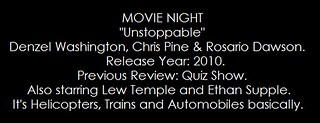
Denzel Washington (Frank Barnes), Chris Pine (Will Colson), Rosario Dawson (Connie Hooper), Lew Temple (Ned Oldham), Ethan Suplee (Dewey), Kevin Dunn (Oscar Galvin), and Kevin Corrigan (Scott Werner) Directed by Tony Scott (Top Gun - #029)

Review
Personally, a runaway train is moderately frightening for me. Trains aren't used as much as they were back then when people had to use the train. What does this statement have to do with this review? I'll tell you later. It's been a long while since I've reviewed something of Tony Scott (Brother of Ridley Scott), who directed films from his first in 1983 to his last in 2010. Scott manages to keep the story interesting enough to keep watching, and...the runaway train is actually a bit frightening, with a decent climax. The acting is alright, Washington (last Review of him: Glory - #101) and Pine (last: Star Trek - #009) do a respectable job together, as does the rest of the cast. It should be a note that this was Scott's last film that he directed (I would've mentioned this earlier, but I wanted to make sure that part would be padded to the end), and it is a good way to go out.

Overall, I give it 8 out of 10 stars.

February 17, 2012

Movie Night: Glory.

Review #101: Glory.

Cast
Matthew Broderick (Colonel Robert Gould Shaw), Denzel Washington (Private Silas Trip), Morgan Freeman (Sergeant Major John Rawlins), Cary Elwes (Major Cabot Forbes), Cliff De Young (Colonel James Montgomery), Andre Braugher (Private Thomas Searles), Jihmi Kennedy (Private Jupiter Sharts), Alan North (Governor John Albion Andrew), and John Finn (Sergeant Major Mulcahy) Directed by Edward Zwick.

Review
This film is based on the 54th Infantry, led by Robert Gould Shaw, as it was the first all African American regiment in the Civil War. The film is told by Shaw's perspective, and it is a good film. The acting is good, especially from Washington (earning a Best Supporting Oscar for it) and Freeman (one of his many roles that he does great in). The film is grand with its locations, its battles, and especially its musical score, which is booming and perfect for a movie like this. The film has one flaw that some do point out. The flaw is that they focus on Shaw more, rather then the Regiment itself for about half the film. The purpose should be focusing on the Regiment, not just the man leading it, but I suppose the point was to have a unifying arc, and Shaw fits the bill. If you want a film dedicated to the Regiment, or interested in seeing a movie to honor the men and women who died in war for Memorial Day, or you just want to see a fragment of the Civil War, then this film is for you.

Overall, I give it 8 out of 10 stars.