Showing posts with label Spike Lee. Show all posts

February 27, 2025

Mo' Better Blues.

Review #2350: Mo' Better Blues.

Cast: 
Denzel Washington (Minifield "Bleek" Gilliam), Spike Lee (Giant), Wesley Snipes (Shadow Henderson), Joie Lee (Indigo Downes), Cynda Williams (Clarke Bentancourt), Giancarlo Esposito (Left Hand Lacey), Bill Nunn (Bottom Hammer), Jeff "Tain" Watts (Rhythm Jones), Dick Anthony Williams (Mr. "Big Stop" Gilliam), Abbey Lincoln (Lillian Gilliam), John Turturro (Moe Flatbush), Nicholas Turturro (Josh Flatbush), Robin Harris (Butterbean Jones), with Samuel L. Jackson (Madlock), Leonard L. Thomas (Rod), and Charlie Murphy (Eggy) Produced, Written, and Directed by Spike Lee  (#1255 - Do the Right Thing, #1543 - Inside Man, #1643 - Malcolm X#1976 - She's Gotta Have It#2181 - School Daze)

Review: 
"I always knew I would do a movie about the music. When I say the music, I’m talking about jazz, the music I grew up with. Jazz isn’t the only type of music that I listen to but it’s the music I feel closest to."

Believe it or not, this was the first collaboration between Spike Lee and Denzel Washington on film. 
The inspiration for the movie came from Lee's interest to do a jazz movie with his own perspective after seeing Bertrand Tavernier's 'Round Midnight (1986) and Clint Eastwood's Bird (1988). The script for the film came up when Lee was working on Do the Right Thing (1989), with the first-draft screenplay being written in fifteen days. The fourth feature film directed and written by Lee, the movie was shot in roughly eight weeks with a budget of $10 million. The movie features the music of the Branford Marsalis quartet with Terence Blanchard doing the trumpet, with Delfeayo Marsalis lending assistance to Bill Lee with the producing of the music recordings (this was the last of four films where the Lees worked together, as they soon had a falling out). One isn't actually seeing the actors (most, anyway) playing the instruments, but they sure do a good job looking the part in imitation, which is more than enough. The first of nine movies Lee directed in the 1990s, it was a mild success at the time; the next movie directed by Lee after this one was Jungle Fever (1992).

Overlooked or not, there is something quite soothing about the way the movie flows in looking at the edges that come with trying to work at one's craft at the expense of relationships. It is hard to show maturity and know what one really wants when one could be working on something else, you might say. It is a movie based on mood and energy that is a curious one in basically reflecting its introduction and ending when it comes to parents and their son when it comes to shaping them and making a choice for them (in a movie where the rest of it is comprised of fallout from certain choices made, naturally). There is a crushing pressure one can feel in trying to hold on to themselves and not burn out into the night while also trying to think that everything is totally normal with how they do things within "fundamentals", and that includes one's love life. Undeniably, the sequence involving Washington opposite the two women in bed (at different times, obviously) is the most striking when it comes to misplaced ideas about people. Washington does pretty well with all of that in mind, mainly because he glides from place to place with weary disposition for what he seems to really want in life beyond that smooth facade of confidence (it takes more than talent to be a saint of jazz, shall we say). Basically, he treats the two women (C.Williams and J.Lee, the former making their film debut) in his life like they were items to check out at the store (incidentally, Lee called it a movie specifically about relationships and not a love story). The two women are only seen in that lens but each handle it with clear differences when it comes to timing and, well, allure. The Turturro brothers pop in from time to time to provide a few chuckles in the business interest side (if one ever believed the current times are weird for stereotypes, inquire further about this movie being called "anti-Semitic" and look to now when it comes to how much people like to waste time looking for stereotypes that aren't there). Lee also does pretty well in shaky stature (as one does when finding new ways to play characters in one's own story, which he did for his first nine movies). By the time the movie has its reckoning with certain decisions made in and out of good reason, one has found a pretty good time with the rhythm that the film has accomplished for itself, one filled with worthwhile interest in showing the power of human contact and making one's mind besides drawing it all in the craft. The relationships matter all around us: the music and the people we hold to us and how it matters so much to hold it tight to us as long as we can, which in this sense works out pretty neatly in the long run.

Overall, I give it 8 out of 10 stars.

February 26, 2024

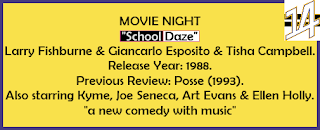
School Daze.

Review #2181: School Daze.

Cast: 
Laurence Fishburne (Vaughn "Dap" Dunlap), Giancarlo Esposito (Julian "Dean Big Brother Almighty" Eaves), Tisha Campbell (Jane Toussaint), Kyme (Rachel Meadows), Joe Seneca (President Harold McPherson), Ellen Holly (Odrie McPherson), Art Evans (Cedar Cloud), Ossie Davis (Coach Odom), Bill Nunn (Grady), Branford Marsalis (Jordan), Kadeem Hardison (Edge), Spike Lee (Darrell "Half-Pint" Dunlap), Darryl M. Bell (Big Brother X-Ray Vision), Joie Lee (Lizzie Life), Alva Rogers (Doris Witherspoon), Jasmine Guy (Dina), and Samuel L. Jackson (Leeds) Produced, Written, and Directed by Spike Lee (#1255 - Do the Right Thing, #1543 - Inside Man, #1643 - Malcolm X, and #1976 - She's Gotta Have It)

Review: 
I don't pretend to know the legacy of certain films, but I do have an interest in the film that comes after one makes their debut feature, particularly if it happens to be one from a director as prominent in black cinema as Spike Lee. School Daze (1988) is curious not only as one released two years after She's Gotta Have It (his formal debut after his student films and shorts, remember) that was followed almost immediately by his third effort in Do the Right Thing one year later. This film was shaped by his experiences that he had when attending Morehouse College (a historically black college in Atlanta) in the late 1970s. Island Pictures, which had distributed Lee's first film, had planned on doing this film as well, but wavering issues in the budget (which finished above $6 million) eventually led to Columbia Pictures acquiring it. Strangely, a movie that talks about sororities and fraternities had a bit of a tough task in finding a place to shoot the film, which included Morehouse (irony?) before Atlanta University was utilized. Apparently, the film had different housing for certain groups of the cast, which led to an unscripted (and filmed) confrontation at a "stepping show". The movie was a modest hit with audiences.

Every so often I have to remember that films of a certain age could actually talk lightly about issues that mattered that seem distinct from now, which starts pretty quickly with a film that starts with someone trying to do a protest about divesting from South Africa. Of course, what really matters for this film is how people treat each other in the facets that come in... colleges and dorms. Within the divides that comes from people of the same color and distinct privileges is a film that also happens to have a few music numbers. I personally don't have any experience with fraternities, but I think we can understand that divides between certain groups and classes is not always black and white as it might seem. Of course, it seems like a fable one tells to try and get people to wake up (almost as if they were in a... daze) to the issues that are mired in the muck beyond arguments over hair. One can say progress has been made in a certain place, but how much of what we say is progress as opposed to being lip service? I liked the movie fine, even though its 121 minute runtime does tend to make one desire the tiniest bit more from its ending, which almost seems to be direct but brief as possibly can be. Fishburne has all the confidence required in a film surrounded by apathy that isn't merely played as a martyr but one with his own biases and charms. The musical numbers are executed with varying effectiveness, but probably the best sequences of the film are in smaller moments. I especially like one scene involving Fishburne and his group going out into town to eat only to confront some locals (which is where Jackson appears briefly) that resent them in their own privileges, because if there is one thing to say about people, it is that there are people who will just look down on anyone who want better for themselves, even to the point of calling them a certain word and say that they'll be like them "just like us". Esposito makes an ideal wannabee with a total absence of awareness for anything but his own group for a distinct act of the public. His narrowmindedness strikes most of all, even with Campbell (and accompanying status in loyalty) right there on the divide of hair and sororities. Amusement is here and there in those selection of scenes for a movie not focused on showing the classroom (Davis having a scene in trying to motivate his football team is a real chuckler). At the end of the day, the black experience is one that cannot be thought as just simple to pin down for easy stereotypes, regardless if one is a college man or not. Living in apathy that just thinks about wallowing in where they are or just being content with a small piece of the action is just not enough when one could also wake up to what's around them. The film is mildly effective in its approach as a whole due to a game cast that makes Lee's second effort at least a useful curiosity to seek out on its own terms.

Overall, I give it 7 out of 10 stars.

February 16, 2023

She's Gotta Have It.

Review #1976: She's Gotta Have It.

Cast: 
Tracy Camilla Johns (Nola Darling), Tommy Redmond Hicks (Jamie Overstreet), John Canada Terrell (Greer Childs), Spike Lee (Mars Blackmon), Raye Dowell (Opal Gilstrap), Joie Lee (Clorinda Bradford), Dennis Karika (The Trainer), S. Epatha Merkerson (Dr. Jamison), and Bill Lee (Sonny Darling) Directed, Written, and Produced by Spike Lee (#1255 - Do the Right Thing, #1543 - Inside Man, and #1643 - Malcolm X)

Review: 
"I'm a filmmaker. I know what I want to do. I'm not making movies to become famous or become filthy rich or to have 10 million beautiful women...I just want to present Black people as I know them-as I know they haven't been portrayed in Hollywood."

You know, for all of the attention I gave Spike Lee for classics such as Do the Right Thing (1989) and Malcolm X (1992), I do wish I actually started at the beginning with his career, if only because it is far more interesting to go from point A to point B with seeing how a filmmaker evolves (or gets better) over time. Well, that, and because without She's Gotta Have It, who knows if one gets the films that came later from Lee? Of course, the real beginning (as probably mentioned before) is Joe's Bed-Stuy Barbershop: We Cut Heads (1983), as it was his master's degree thesis at the Tisch School of the Arts, which attracted attention. However, he couldn't find a major studio that wanted to work with him and his ideas on his terms, so when he did She's Gotta Have It, his first feature-length film, he did all on his own with funding from various sources (grants, deferred payments, and personal favors). It was shot over a dozen days on a budget of $175,000 in Brooklyn (which is where Lee grew up after his family moved from Atlanta). Of course, it only took screening the film at places such as New York University of a rough cut that pushed the film to completion (with Lee pitching himself at these screenings, obviously). The movie was a fair hit for the independent circuit, which helped set the stage for Lee doing further films in consecutive years such as School Daze (1988), Do the Right Thing (1989), Mo' Better Blues (1990), Jungle Fever (1991), and Malcolm X (1992). Three decades later, a television adaptation of the movie was developed by Lee, who directed every episode of the two-season series that ran on Netflix.

Lee wanted to challenge sexual stereotypes that looked upon both African American men and women with frank honesty, which results in a distinct feature film debut. He took inspiration from seeing male friends of his boast about how many female friends they had and basically reversed it (while taking inspiration also from Rashomon (1950)). In fact, he came up with a questionnaire on the sexual habits of young women and asked women he knew about what answers made sense. In that sense, I think the movie works just fine as an indie comedy-drama that makes some steps forward in presenting distinct viewpoints in sexuality for a mostly compelling curiosity. With its black-and-white photography (except for one scene) and its habit of characters talking to the screen for 84 minutes, the movie is a lament for one's freedom to make choices on their own happiness, regardless of what the perception might be from others. This is the one defining role for Johns, a stage actress who had to be convinced over the course of months by Lee that he could make a compelling character. She does a reasonable job in portraying the dilemmas that come with one perspective of youth with hang-ups, a free spirit with agency. Terrell, Hicks, and Lee play the three suitors of distinct types: the high-class vain one, the "sensitive" one, and a joker.  Terrell amuses me the most in vanity, a stuck-up snob that has the timing required in showing just how much one really can (and in some ways, should) love themselves. Hicks and his vulnerable sensitivity is probably the one most relatable when it comes to seeing what really lurks behind the spoken and unspoken phrases, while Lee is fairly amusing. Probably the only scene that strikes a different chord from the rest is the rape scene, which Lee has expressed regret over, since he felt it made light of rape that he wishes he could take back. The movie is what Lee called a "free style" film, one that is a hybrid of narrative and documentary, one shot by future director Ernest Dickerson and edited by Lee. As a whole, the movie comes and go in trying to establish compelling points about true desires and expectations that will challenge the viewer the slightest bit, whether that involves them nodding their head or rolling their eyes the slightest bit (so yes, one either rolls with these folks or treats them amusingly). Lee wanted to present a compelling Black tale and I would say he succeeded in that respect considering what would come afterwards, which helps to shape plenty of reasons to give this a curious glance.

Overall, I give it 8 out of 10 stars.

Next up: Tongues Untied.

February 20, 2021

Malcolm X (1992).

Review #1643: Malcolm X.

Cast: 
Denzel Washington (Malcolm X), Angela Bassett (Betty Shabazz), Albert Hall (Baines), Al Freeman Jr. (Elijah Muhammad), Delroy Lindo (West Indian Archie), Spike Lee (Shorty), Theresa Randle (Laura), Kate Vernon (Sophia), with Lonette McKee (Louise Little), Tommy Hollis (Earl Little), James McDaniel (Brother Earl), Ernest Thomas (Sidney), Jean-Claude La Marre (Benjamin 2X), and Christopher Plummer (Chaplain Gill) Directed by Spike Lee (#1255 - Do the Right Thing, and #1543 - Inside Man)

Review: 
"We declare our right on this earth to be a man, to be a human being, to be respected as a human being, to be given the rights of a human being in this society, on this earth, in this day, which we intend to bring into existence by any means necessary.” 

When it comes to biographical epics, the best of those type of films are the ones that have plenty of challenge to overcome to portray a human being with the right amount of detail and understanding required that will pack as much insight as it does interest in a depiction that will stand just as well as any documentary or book. This is more than necessary when it comes to the subject of Malcolm X, this much is true. It started with The Autobiography of Malcolm X (1965), which was a collaboration between X and journalist Alex Haley in a series of interviews (for which there were more than 50 done) that were done between 1963 until X's assassination in 1965. Haley was considered at the time to be a ghostwriter for his contribution, but later years have noted his crucial role in discretion with handling the manuscript, and the epilogue was written specifically by Haley as comments of his own on X (three chapters excised from the final version were eventually found and put up for sale years later). Its publication led to a lasting influence on readers and writers alike as the first of numerous works involving the subject of Malcolm X, with a few biographies coming out in the next few decades. For example, one released in 2011 won a Pulitzer Prize but also inspired a response book aimed at correcting it, while a diary of Malcolm X's time in 1964 was released in 2014. The most recent biography was The Dead Are Arising, written by Les and Tamara Payne that was published to noted reviews in 2020.

It should not be surprising that a film was in the development stage as early as 1968 with the sale of rights to filming the novel going to producer Marvin Worth. He had met X long ago in the streets of New York and he would spend nearly 25 years trying to get a film about him to the big screen, which started by hiring novelist and playwright James Baldwin to develop the initial script. Screenwriter Arnold Perl would also be brought in to write for the screenplay, doing so until his death in 1971. The screenplay devised by Baldwin and Perl would ultimately falter into development struggles, although Baldwin would write about X various times over the next few years (such as No Name in the Street (1972), which depicted him from Baldwin's perspective) before his death in 1987 (he described the experience of trying to write a Hollywood adaptation as less than if one was horsewhipped or jailed in Bellevue); Baldwin would not be credited for his work when it came time for this film, as per requested by Baldwin's surviving family. Worth and Perl would work together for a documentary on X that was released in 1972 (done instead of a drama due to a lack of cooperation from close figures to speak on camera), which was mostly constructed of his speeches and interviews with occasional narration and newsreel footage. As was the case two decades later, Betty Shabazz served as a consultant to the filmmakers, and each was distributed by Warner Bros with voice-over work by Ossie Davis (reciting words spoken at X's eulogy). Several writers and directors were considered through a span of two decades (with one potential idea having Richard Pryor as X), and it was the argument over the qualifications of a white man directing in Norman Jewison (director of films like In the Heat of the Night) to direct that led to the ultimate pick in Lee, who had wanted to make a film of X since college (for his part, he received a bit of heat from black nationalists and others like Amiri Baraka that thought it would be a middle-class rendition of X, and more can be found about it in the book Lee wrote of his experiences making the film). 

Perhaps it was fate that Washington would play this role on film. Eleven years earlier, back when Washington was just a struggling actor, he was cast as Malcolm X in an Off Broadway production "When the Chickens Came Home to Roost"; when preparing for the role, he read the autobiography along with tapes and books and was struck by what he saw that he described as being like "heavy, mean stuff...helping me get some things off my chest." Even having Washington cast in the lead role and Lee as director didn't mean an easy production, which would experience immense pressure from community leaders (who feared a film with too much focus on his life before becoming X) to financiers (who aspired for a budget less than $30 million), for which donations were made by several prominent individuals that ranged from Michael Jordan to Prince. In essence, one could sum the feeling generated by the film through its last few spoken words, spoken through archival footage of X himself: "by whatever means necessary." It is the story of a man who forged a path of self-determination that lent clear expression to the frustrations expressed by crowds of people in America with a multi-faceted look at just who he was in the eyes of those who saw him (whether that meant the streets, jail, or on the podium) that makes a portrayal of legacy come through with fiery tension for all of what it wants to say in truths and about what endures about the man in the decades after his death. As X once stated, his life never stayed fixed in one place for too long, and this rings true here. Washington is asked to do a tremendous task of showing this one man go through the stages of life with diverse power that cannot waver, whether as "Red" or as the reborn X. He does a tremendous job here, towering over the other folks with mindset of eyes ready to open to speak of responsibility but also find his eyes open for himself to learn as well as teach as a man with no fear. Through the course of roughly two decades, we see the folks around him that make up three distinct periods of his life with varying effect and a distinct look from cinematographer Ernest B. Dickerson (in his last collaboration with Lee), and a student of history or knowing faces will see a few familiar ones along the way (such as Karen Allen or Bobby Seale, for example). The first spends time with Harlem and Boston with actors such as Lindo, Lee, Randle and Vernon. In those sequences, Washington sells the hustle and bustle of what is needed in tandem with Lindo, who is just as charismatic without having even half the time required, while Lee and the others do just fine. In the next time of focus, one focuses on Washington alongside Hall with a cameo from Plummer (playing self-righteousness with ease). Washington undergoes a new phase with awakening that is helped by Hall and his solemn conviction. The next one is distilled in two forms, involving Bassett and Freeman alongside supporting stuff from Thomas. Freeman does his part in wisdom alongside hypocrisy (a further look into him reveals more than just infidelity, let us say) while Bassett follows with Washington in well enough moments, and they have their part to play when it comes to that fateful climax.

Maneuvering the waters of adapting X to the screen meant a few moments of narrative reconciliation, even with a run time of 201 minutes. For instance, the character of Baines was actually a composite of X's siblings in respect to their role in the redemption of X while in prison. X's pilgrimage to Mecca (which was the first American feature to ever film there, although Lee had to hire a second unit crew to get permission...and Warner Bros actually thought of just doing it in New Jersey) was actually funded by his half sister Ella (also not mentioned), which is interesting considering that it is the last known surviving home of Malcolm in his childhood (he lived there with her for five years). There is one prominent figure absent in the story of the Nation of Islam, one with a legacy stoked with plenty of controversy (you might recognize him as the man behind the Million Man March alongside plenty of controversial remarks thought of as anti-Semitic or homophobic) that reportedly threatened Lee; it is disputed how much involvement the NOI may have had over the assassination even to this day. The film touches on the provocative from start to finish with its ties to the present day, most notably with the appearance of Nelson Mandela, reciting Malcolm's own words to a group of schoolchildren. In short, what we have is a film packed with a great deal of words to say about its subject then and now that generally hits the mark in stoking a statement about what he was to those that saw him in all of his forms, whether that means a kid born into tragedy, or a shaken upbringing into trouble, or a hardened man seeking light, or a man who found himself on a much bigger journey than himself. It could only end with the eulogy given by Davis, with his spoken words reaching ever still even with the passage of 27 years since he gave the words at X's funeral, one that described him as a prince that "didn't hesitate to die, because he loved us so." One could only aspire to live a life worth discussion over rhetoric and actions (controversy be damned) like X, and it is one's privilege to seek out the film for its shining performance in Washington that serves as one of his best alongside a director worthy of capturing it and everything that comes with it in all of its detail that makes it as worthy to see on one's shelf as much as something like Lawrence of Arabia (1962), where the three hours spent are good ones to spend with their eyes open.

Next Time: A television star goes to the director's chair with Once Upon a Time...When We Were Colored.

Overall, I give it 10 out of 10 stars.

September 22, 2020

Inside Man.


Review #1543: Inside Man.

Cast: 
Denzel Washington (Detective Keith Frazier), Clive Owen (Dalton Russell), Jodie Foster (Madeleine White), Christopher Plummer (Arthur Case), Willem Dafoe (Captain John Darius), Chiwetel Ejiofor (Detective Bill Mitchell), Carlos Andrés Gómez (Steve), Kim Director (Stevie), James Ransone (Steve-O), Bernie Rachelle (Chaim), Peter Gerety (Captain Coughlin), Victor Colicchio (Sergeant Collins), and Cassandra Freeman (Sylvia) Directed by Spike Lee (#1255 - Do the Right Thing)

Review: 
"I hope they're doing it because they love it, not because they want to be rich or famous. Not that those things can't happen, but the main reason, the focus is, "This is what I want to do for the rest of my life and I love it." Not to say that you don't want to make money, but the passion should be driven by your love for that particular thing that you're doing. "

It took long enough to get to just one Spike Lee film, so it obviously was going to be a short time before finding another one to cover as a meaningful look upon a director as interesting and progressive as he has proved throughout over 20 films directed in nearly four decades of work. Born in Atlanta, but raised in Brooklyn, Lee attended Morehouse College and New York University Tisch School of the Arts, studying mass communication and film, and he made his first short film with Last Hustle in Brooklyn (1979, inspired by the blackouts in New York City alongside block-parties involving disco that made him want to be a filmmaker) and his first student film in Joe's Bed-Stuy Barbership: We Cut Heads (released in 1983 as his thesis film that won a Student Academy Award). She's Gotta Have It (1986) and Do the Right Thing (1989) would each serve as defining points for Lee (the former as an independent success and the latter as likely one of the best films of the 1980s) in his movement to features that he has also served as writer or producer for a majority for as well doing his own documentaries (with his first being 4 Little Girls (1997) about the 1963 16th Street Baptist Church bombing) all through his own film company in 40 Acres and a Mule Filmworks.

The genesis for the film came from a first-time screenwriter in Russell Gerwitz (who studied computer science and law but worked in the retail clothing business) who was inspired by his vacations around Europe to do a film script (with five years of writing and help from Daniel M. Rosenberg), and it eventually found itself with Imagine Entertainment, with Lee being tapped to direct because of desire from Imagine to work with him (along with Ron Howard deciding to direct Cinderella Man instead). Sure, one could believe this as a potential great thriller. It obviously is very sure of itself in its tricks of the camera and plot that builds for that inevitable last turn for its climax and so on and so forth. In terms of its inspirations and attempts at a twist however, it probably ranks just as decent as The Usual Suspects (1995) in actually pulling things together to make it actually work beyond a cat-and-mouse game with misplaced mousetraps present (while also being inspired by Dog Day Afternoon (1975), which goes okay). The performances generally outweigh the way the script wants to weave its tricks and thrills, which means that it is a fine movie, but it certainly could have been a more interesting one. Washington (in his fourth collaboration with Lee) is fairly up to the task of handling his end of the proceedings with reasoned consistency as the anchor that holds everything together in tension and charm one expects from him. Owen does alright, having to balance a role with a good deal of time spent in a mask that nonetheless makes for a conniving counterpart with the goal of merely committing the perfect robbery, handling that with at least enough to make me believe most of that idea. Foster is fine in a vague kind of role that keeps her in relaxed authority fixing things behind the scenes in sequences shared either with Washington or Plummer, who slides by as a creature of privilege. Dafoe and Ejiofor do alright with their moments with Washington in the usual moments required from being on the beat with tension, even if it seems like one wants to see more of them, really. One thing that is generally different is the inclusion of post-break-in testimonials from hostages as interviewed by the police that are inserted from time to time (with their own type of lighting) in the film, which either helps the film in establishing little cues to follow or seems a bit distracting that depends on the viewer and their perception of what needs to be there in 129 minutes. Of course there's also those little moments beside a heist that are alright, such as a scene involving a kid and violent games (think of the children and how violent games affect them, oh the shock), which just inspires a "sure, uh huh" response after making sure it wasn't supposed to be amusing, alongside other things. For me, the whole film verges on how much composure and stakes actually hold up in the long run. For me, it holds itself a little too much in achieving its promises with execution to what I need to care about: I wish I really cared about this heist more than just the usual curiosity, because it tries hard to really move beyond straight thriller stuff but ultimately is just kept in standard gear but with a respectable director behind it instead. If you like what you see in its performances and see past its smokescreen to what really matters, you might find something really worthwhile for a watch, which is all that really matters.

Overall, I give it 7 out of 10 stars.

August 9, 2019

Do the Right Thing.


Review #1255: Do the Right Thing.

Cast: 
Spike Lee (Mookie), Danny Aiello (Sal), Ossie Davis (Da Mayor), Ruby Dee (Mother Sister), Giancarlo Esposito (Buggin' Out), Bill Nunn (Radio Raheem), John Turturro (Pino), Richard Edson (Vito), Roger Guenveur Smith (Smiley), Rosie Perez (Tina), Joie Lee (Jade), Steve White (Ahmad), Martin Lawrence (Cee), Leonard L. Thomas (Punchy), Christa Rivers (Ella), Robin Harris (Sweet Dick Willie), Paul Benjamin (ML), Frankie Faison (Coconut Sid), Samuel L. Jackson (Mister Señor Love Daddy) Produced, Written and Directed by Spike Lee.

Review: 
When it comes to great movies, there is generally a sense early on its duration where you know this is going to be more than just a good experience of entertainment. For me, the turning point was probably a short sequence involving Aiello and Turturro's characters involving the latter wanting the former to close down his pizzeria and do something else with his life as opposed to serving the neighborhood any longer than has been the case for 25 years. You have had a look into these people's lives over the course of the film up to now (all of which over the course of one day, naturally), so seeing how a conversation can have some certain preconceived notions seem to bubble even further than what has already happened on screen. One lives on his pride for the people that grew up on his pizza while the other feels nothing but loathing resentment, where being accosted by a guy selling pictures on the street means being rude and loud to their face. This is such a vibrant film, one that grasps for what it wants to say about intercity life and the people that accompany it with their respective type of personalities and preconceptions. For what its worth, the film is still relevant three decades after its release now more than ever, seeming in step in terms of its execution of direction from Lee to bring these characters to life alongside a story that clicks without a hitch from start to finish. Aiello is the best of a group with plenty of useful castmates to go around, showing plenty of surly ruggedness one could expect for such an interesting character however one interprets him and his actions. Davis shines just as well, having a mix of humor and dignity with his key role whenever necessary, whether when on screen talking about doing the right thing or something else. Turturro and Edson certainly play the brotherly sided coin with a fair edge, where their differences stand clear alongside brotherly ties without having a safe closure. Nunn plays the key in making his time count, compelling with a boom box as company.

Whether the character is involved with an amusing moment or something more serious, each actor do their part to make it stick with conviction, whether it is the corner-men of Harris-Benjamin-Faison and their cracks through the day or the time spent at the pizzeria and the people working (and mostly talking) on food for the neighborhood, with the two hour run-time slipping by without much struggle. When the film shifts itself from a mix of comedy and drama to a sudden turning point, it hits with a devastating punch - whether one knows anything about what happens in the film or not before viewing, it makes a key point on the nature of prejudice and what makes for the right thing when the moment needs it. In addition to all of this is wonderful cinematographry from Earnest Dickerson, who does well with making the look of the film seem readily consistent to take place over a day with good lighting (in general, it is quite an achievement to make a film in a few weeks on location) and also good music from Bill Lee. It keeps the pedals rolling without betraying its efforts for its conclusion, keeping a roaring spirit that progresses beyond the final reel. On the whole, this is a thoughtful and entertaining film that pulls quite a punch with forming an interesting world come alive and show the layers beneath the quirks, for which one can still learn from now. It is worth a viewing, preferably with a crowd.

Overall, I give it 10 out of 10 stars.