Showing posts with label John Carradine. Show all posts

October 23, 2025

The Invisible Man's Revenge.

Review #2450: The Invisible Man's Revenge.

Cast: 
Jon Hall (Robert Griffin / The Invisible Man), Leon Errol (Herbert Higgins), John Carradine (Dr. Peter Drury), Alan Curtis (Mark Foster), Evelyn Ankers (Julie Herrick), Gale Sondergaard (Lady Irene Herrick), Lester Matthews (Sir Jasper Herrick), Halliwell Hobbes (Cleghorn), Leyland Hodgson (Sir Frederick Travers), and Doris Lloyd (Maud) Produced and Directed by Ford Beebe. 

Review:
You may or may not remember that The Invisible Man wasn't exactly the Universal favorite. It took seven years from the release of The Invisible Man (1933) to merit a follow-up and, well, they never appeared in one of the Universal crossover movies, so you got The Invisible Man Returns (1940). Instead, you got stuff like The Invisible Woman (1940), a comedy feature (starring Virginia Bruce) and Invisible Agent (1942), a spy movie that happened to have Jon Hall play the title character. With this movie, Hall became the only actor to play an Invisible Man in multiple movies. The movie was directed and produced by Ford Beebe, a grab-bag man of directing various genres for cheap, whether as the Western with Overland Bound (1929), the serial such as Flash Gordon's Trip to Mars (1938) or the adventure with Bomba, the Jungle Boy (1949-1955). The movie was written by Bertram Millhauser, who had written for several mysteries such as four Sherlock Holmes movies. Previously, Beebe had directed a horror movie for Universal with Night Monster (1942).  Universal did one other Invisible Man, albeit as a spoof, with Abbott and Costello Meet the Invisible Man (1951). There were movies abroad that cribbed from the H. G. Wells novel such as The Invisible Man Appears (1949) and The Invisible Avenger (1954), which each had effects work by Eiji Tsuburaya and there was also the Japanese feature The Invisible Man vs. The Human Fly (1957). And then of course there was some overrated Universal movie in 2020.

Now we are in the realm of pushing mad scientists to the sidelines for tired plots about revenge. To put it out of the way, this is the weakest of the three Invisible Man movies. You would think a movie that relies on draining blood from people to maybe become visible again would have an effect on you, but nope, the whole thing is just played for mild-mannered scare. The story (77 minutes long) isn't even that involving either, since the lead character is presented as just a weird guy trying to get revenge, so even if his motives were interesting beyond "maybe" being screwed over in safari, he does his stuff in the most complicated of ways, because it isn't enough to target two people, no, he wants to get their daughter married to him as well. He gets rescued by someone and decides, yes, I'm going to give them a bit of a boost and try to help them win a game of darts too. The ending is sheer audacity in ridiculous: the loyal dog of the guy the Invisible Man kills ends up being responsible for his demise, because he just happened to wander all the way through. Hall in general is too bland to really make this path of "revenge" that interesting. Carradine at least looks enthused to not be in a Universal movie with makeup (he played Count Dracula a few times) but he isn't even allowed to really go off for curiosity. Sure, his plan to help a guy gain visibility (dog gets drained of blood) sounds mad but he is quickly disposed of anyway. To say nothing of the bland triangle between Hall, Curtis, and Hendrick is the easiest thing, because really, getting money sounds more compelling than having to get visible just so you can "get" a girl. Everything is stacked in just doing things in the corniest of ways that don't even make for a great showcase of invisible effects this time, save for a scene or two. As a whole, for a studio that pumped out stuff such as House of Frankenstein the same year as this, you get basically the same amount of rushed ham-handedness for a pretty tired movie. 

Overall, I give it 6 out of 10 stars.

November 25, 2024

The Astro-Zombies.

Review #2314: The Astro-Zombies.

Cast: 
Wendell Corey (Holman), John Carradine (Dr. DeMarco), Tom Pace (Eric Porter), Joan Patrick (Janine Norwalk), Tura Satana (Satana), Rafael Campos (Juan), Joseph Hoover (Chuck Edwards), Victor Izay (Dr. Petrovich), and William Bagdad (Franchot) Produced and Directed by Ted V. Mikels.

Review: 

When you cover watch over a thousand directors at least once in going through the road of movies, maybe eventually you will land on the road of Ted V. Mikels. He had been born in Minnesota but mostly raised in Oregon with Croatian & Romanian heritage that liked to do amateur photography as a youth before taking on the stage in the late 1940s. He started making his shorts and educational documentaries in the 1950s with his own film company while in Bend, Oregon before making his debut as a feature filmmaker with Strike Me Deadly (1963). He apparently decided after that to move to Glendale, California and move to a place decorated to look like a castle (for a few years, Mikels would have several women live in said castle, as they were aspiring filmmakers that I'm sure has no other implications). The development of what became his sixth film (after movies with such illustrious titles like Dr. Sex [1964] and The Black Klansman [1966]) apparently started around the time of his first movie, with Mikels writing this with Wayne Rogers (who he had worked with in the aforementioned Dr. film before becoming more known for his role in M*A*S*H). Mikels plugged away at directing/writing/producing movies (the next movie made after Zombies? The Corpse Grinders, which was about cats liking human flesh while one subsequent videotaped movie apparently featured Mikels casting himself as someone to get beaten up by women), which would include sequels to Astro-Zombies in 2004, 2010, and 2012. He was even the subject of a book (called "Film Alchemy") and a documentary in his lifetime prior to his death in 2016 at the age of 87.

It isn't easy to make an ugly puddle where barely anything of note happens with such "name" actors, but Mikels sure has accomplished it here. This is a movie that has a title sequence featuring toy robots and gunfire noises (the ending does just as much). The most interesting person to view is Satana, who you might recognize from Faster, Pussycat! Kill! Kill! (1965). It is a divine experience in boredom, languishing with little for one to really focus on in coherence that basically makes one want to yell at the clouds for having tried to spend 94 minutes of life on this. You get shots of a lady in a bikini that is tied up on a table that somehow never gets out of the table to go along with the schlock you might see coming from an opening that gives you that first shot of what the title character looks like: a guy in a mask and weird sounds. The best thing about the movie might be the portrait of Lyndon B. Johnson you can see in the background (he was the best President of the 1960s, what's not to respect?). This actually was the last film for Corey (who died of cirrhosis of the liver in 1968), who had appeared in a handful of character roles such as The Search (1948) and Rear Window (1954). It's sad to see him go out like this with a film that basically lets him go by the wayside in such flattering detail in camerawork and words to say into the ether. Pace may be the "lead" presence, but you might as well just replace him with a broomstick. At one point, one of the creatures holds a flashlight to his head to charge his cells, because of the solar power and stuff. Things just happen in the film with little to really draw it together until it actually happens on screen in a manner that doesn't have coherence. The movie may call itself "Zombies" but it basically cribs from Frankenstein with the whole digging for body parts and demented brain stuff to go along with some sort of spy plot fiddles around with Satana commanding the screen more so for the costume stuff (one time you see her in pink) than the actual character stuff. Carradine is a pro at just being there to say lines for the paycheck at an age where if you're going to be the evil scientist, you can say anything and it'll sound spooky enough. As a whole, this is a magnificently terrible movie that serves as the equivalent of watching static, filled with little promise and little reward.

Overall, I give it 1 out of 10 stars.
Next up: another new name joins the club with a movie all about love and weirdness with name actors...
....mother of God, Bolero.

October 6, 2024

The Mummy's Ghost.

Review #2265: The Mummy's Ghost.

Cast: 
Lon Chaney Jr (Kharis), John Carradine (Yousef Bey), Robert Lowery (Tom Hervey), Ramsay Ames (Amina Mansori), Barton MacLane (Police Inspector Walgreen), George Zucco (High Priest Andoheb), Frank Reicher (Professor Matthew Norman), Harry Shannon (Sheriff Elwood), Emmett Vogan (Coroner), and Lester Sharp (Dr. Ayad) Directed by Reginald Le Borg (#1179 - The Black Sleep)

Review: 
Okay, so here we are with another Mummy film (in the timeline of 30 years after The Mummy's Hand as established by The Mummy's Tomb). It's hard to believe that this is the third of the four Kharis films released from 1940 to 1944, and yet here we are. It is funny that Zucco returns for this film, having apparently survived being shot and going down the stairs from the last two films just so he can go assign the task of getting the mummy to the character played by John Carradine (creatively called Yousef Bey, after the last film had used named the follower character Mehemet Bey and the 1932 film had used "Ardath Bey"), who was busy enough to be on four Universal horror films (the others being The Invisible Man's Revenge, House of Frankenstein, House of Dracula). The film was written by Griffin Jay, Henry Sucher, Brenda Weisberg, as based on a story by Jay and Sucher. The movie was shot quickly in August/September of 1943 but wasn't released until June of 1944. This is also yet another movie where a priest tries to get involved with a woman while trying to deal with Kharis. Oh, and reincarnations involving people thought to be the long-dead woman lover, which you might recognize as being from the 1932 Mummy film. The movie was done by Reginald Le Borg, an Austrian who had moved to the States in 1934 that rose from staging in film to bit part actor to directing by the late 1930s. He had made films for the Office of War Information during World War II but got to be part of Universal in 1943 for a handful of their films, most notably the first three "Inner Sanctum Mystery" films; he didn't care for his horror films, but he was a craftsman of several films in the B-level for many years.

You are not getting anything different that you saw in Tomb or Hand, but are you really that surprised? Sure, those movies weren't actually that good, but you could at least say they tried. Here, there just isn't anything to really grouse about, and this is a movie with Carradine in it. He just doesn't get that much to really do when compared to the stuff you saw before when it comes to goofy priests. Lowery might as well be an actual broomstick. Ames has one defining characteristic: a streak of white in her hair, which clearly means danger and sleepwalking. Since one knows that Chaney had a painful time with the makeup (couldn't even scratch an itch), it does amuse to see him try to go around with one good arm (such as with a fence). The people in the film sure have a fun time trying to avoid him, and it is pretty funny to see in a giant case of steps for the climax. Probably the most amusing thing about the movie is the use of a dog to help guide the people around to find the mummy, because then one can make a lazy Lassie joke. Nah, actually, my favorite joke is that a few times the movie has someone ask "Amon-Ra" to aid his quest and I could simply say "but Amon-Ra (St. Brown) plays in Detroit." The only thing that saves the movie is the ending, because for once, you don't get to have a happy ending wrapped up in the last five minutes. I do wonder just what the headline writers or folks did when it came to the time after the swamp episode ("Men Swamped By Swamp", anyone?). In conclusion, nothing has been improved from before in a series of serviceable but wholly "not particularly good" 1940s Mummy films. Making one have to debate between Hand and Tomb for the "best follow-up to The Mummy until being blown out by the 1999 rendition" is a sad task indeed.

Overall, I give it 6 out of 10 stars.

November 23, 2021

Myra Breckinridge.

Review #1762: Myra Breckinridge.

Cast:
Raquel Welch (Myra Breckinridge), Rex Reed (Myron Breckinridge), John Huston (Buck Loner), Mae West (Leticia Van Allen), Farrah Fawcett (Mary Ann Pringle), Roger C. Carmel (Dr. Randolph Spencer Montag), Roger Herren (Rusty Godowski), George Furth (Charlie Flager, Jr), Calvin Lockhart (Irving Amadeus), Jim Backus (Doctor), John Carradine (Surgeon), and Andy Devine (Coyote Bill) Directed by Michael Sarne.

Review: 
“When you’re young, you do things sometimes that are impossible because they are impossible. There is a delight in attempting the extraordinary, the immensely difficult merely because it is so. Myra Breckinridge for me became more and more this kind of challenge, the chance to say what I believed was ultimately anarchic and satirical.” - Michael Sarne

“There was this strange bouquet of personalities that were attached to this film, and each one of them was bigger than life in their own sphere. And you thought, Maybe this is the best idea that ever happened, and maybe it’s the worst.” - Raquel Welch

In 1968, Gore Vidal wrote and published a novel in Myra Breckinridge. I have not read the book, but it has been called one of his most famous works, one that challenged the sexual norms of American life in culture and society while also dabbling in writing for film and television from time to time, which included un-credited work on Ben-Hur (1959); incidentally, Vidal was loosely inspired by the exploits of John “Bunny” Breckinridge, a wealthy drag queen that you would recognize from his performance in Plan 9 from Outer Space (1959). Two years later, an adaptation of the novel was done by 20th Century Fox to the derision of Vidal and numerous critics, for which a half century has not quite seen a rehabilitation of what has been considered a turkey of its time. Keep in mind, Hollywood now had a rating system rather than a Production Code, and it followed a decade that had seen films like Easy Rider (1969) and Midnight Cowboy (1969)...along with stuff such as Skidoo (1968). In other words, producers wanted to get with the "hip" crowd, but without getting too much into it. It was one of two X-rated films (well, at the time it was rated X, although now it is R) to be released by Fox alongside Beyond the Valley of the Dolls, which had unfavorable reviews as well, but it managed to be both a box office hit and find its own cult following (coincidentally, that movie also featured a film critic in its production). With this film, not only was the feature disowned by Vidal as a "joke" (albeit one he reportedly never saw), it effectively destroyed the career of the man who directed it as well in Michael Sarne (who occasionally dabbles in acting and painting). Vidal had the first crack at a script (of course Bud Yorkin was the first director in mind for the film), but it did not go well, because Fox (specifically producers David Brown and Richard Zanuck) apparently thought it needed to be as crazy and zany as one would think the ideas presented in the novel evoked. Sarne, who actually had a novelty hit as a singer in the 1960s, had exactly one other major studio film credit: Joanna (1968), which while not a hit at the time was at least given decent reviews. David Giler was brought in to try and deliver a script that would have apparently been a bit more straight-forward (while suggesting George Cukor to take over as director, which Sarne actually endorsed). Each would end up with a writing credit. If there ever was a more bewildering selection of cast mates for any particular movie, I'm sure this one would be one to discuss near the top. On one side, you have a star in Welch who wanted to try and escape the sex symbol status and try to aim for further legitimacy. On the other side introduces a(alleged) film critic with no prior acting experience in a key role. On another side, you have a famous director acting while the director behind the lines tells folks how much he hated his works (because he wanted Mickey Rooney, I kid you not). And, of course, Mae West, making a comeback movie while in the throes of feuding with Welch. Oh, and the debuts of Farrah Fawcett and Tom Selleck. If you think about it, any director that calls one of its stars an "old raccoon" (well, in retrospect, he stated she had a "marvelously artificial way of acting"), another a "old hack", and then spends valuable production time shooting food and "thinking"...probably got exactly what they deserved.  

What do you expect from a movie that has lines such as “the destruction of the last vestigial traces of traditional manhood”? Or how about "Myra Breckinridge is a dish, and don't you ever forget it, you motherfuckers - as the children say nowadays."?  My favorite was probably the one where she states as a Golden Age film nut that there wasn't an unimportant film made in Hollywood between 1935 and 1945 (????) Well, for one, you could expect a memorable experience, this much is true. Beyond the flurry of stock footage and name actors is a movie that drives exactly one thought through one's head: it is the equivalent of seeing someone trying to sing and walk while blindfolded...in a garden full of rakes (and judging by how miserable some of the folks were on the film, I would imagine that they would likely rather go through the rake rather than make the movie again if asked). In theory, this is an interesting cast to feature in a film, even with West in a pseudo-comeback move (Carradine, however, may end up being the most fitting person to have a one-note showing in an one-note movie). It starts with a bizarre dance sequence between two folks who can't quite match in rhythm (Reed and Welch) and never recovers from there. Oh, but don't even get started on the editing choices that come through a movie that acts like sitting still is a sin against nature. Sure, the biggest critique of the film at the time owed to how it managed to offend both folks that were already critical of the book (i.e. conservative audiences) AND folks that were curious to see a misguided attempt at making a studio movie of something that begs for an arthouse experience (or perhaps a French director, if we want to go further into esoteric mockery). The decision to use old film clips throughout the movie does not help matters either, since nothing of merit actually seems to be said with the clips, since this isn't exactly a worthwhile satire; sure, you can show a bunch of Laurel & Hardy clips all you want, but that isn't going to prove anything. Did I mention the twist ending? If this was the part that really sold the studio, they probably should have doubled the amount of alcohol they were drinking.  

If you can believe it, Welch actually wanted to play both Myra and Myron. I can believe that she really wanted to do a movie that would give her some sort of argument for being an actress beyond what you saw (and didn't hear). In a sea of bad decisions, she manages to do the best in terms of performance, probably because she gives it a great go for this artificial role. She can laugh at the movie now, and I can appreciate her attempts at comedy (or whatever is supposed to be present here) far more than anyone else here. Well, I would make a cutting remark about Rex Reed and his attempts at acting in a debut, but having to say "where are my tits?" is humiliating enough. Besides, he seethed at making the film and later talked plenty when it came time to write of the film and its troubled production (for which there was plenty of rope to hang).  Technically, Sarne has been quoted as saying he was "threatened" by Huston's presence, because, well, one would likely be quite speechless at having to direct a man would directed great movies and also acted from time to time in good ones (Sarne merely thought he couldn't act). Huston seems to doze his role with mild abandon, as if he knows that nothing he does here could possibly be the high or low point for an embarrassment like this, so being stuck in neutral is fair. Mae West had not appeared in a film since The Heat's On (1946). Of course, she had made a name for herself in the early sound-era with her raunchy presence...and she agreed to do this film provided she could write her own material. This somehow involves her having multiple music numbers. One could make a note about the dubiousness of West acting as if she is still 26, but stating that her performance seems like it is pulled out of a different movie is enough (that, and anybody who has a problem with Welch earns negative points); one could only wonder how making a flop like this did not stop her from trying to do another comeback a few years later with Sextette (1977) . It is the only film credit for Roger Herren, who either couldn't get film credits after this film or simply fell off the Earth. The infamous pegging scene probably didn't help. Of course, since it features stock footage being spliced in, it also manages to do exactly nothing with how confused it is. The supporting cast looks puzzled as to just what kind of movie they are in (yes, even Carmel), and yet the movie is always quite watchable in its dazzling failure of 94 minutes because it has dazzling style in clothing choices and in its shots that make the stuff shown on screen all the more baffling. 

Well, you have read a thousand words of talking about a turkey. Would I recommend trying to find this film? If you are a curious filmgoer who likes to watch dazzling bad taste...if you are a curious filmgoer who wants to see just how bad a movie can mangle attempts at satire or attempts at something involving gender...if you are a curious filmgoer who wants to see Raquel Welch in a role that shines above the cast in the most ironic of ways...if you can stomach all that, this is the movie for you. It is the mother of all ill-conceived ideas, one too curious to be thought of as the worst of anything but deserving of a great laugh at the expense of both filmmaker and studio.

Overall, I give it 4 out of 10 stars.

Next Time: Inchon.

October 21, 2021

The Howling.

Review #1744: The Howling.

Cast: 
Dee Wallace (Karen White), Patrick Macnee (Dr. George Waggner), Dennis Dugan (Chris Halloran), Christopher Stone (R. William "Bill" Neill), Belinda Balaski (Terri Fisher), Kevin McCarthy (Fred Francis), John Carradine (Erle Kenton), Slim Pickens (Sam Newfield), Elisabeth Brooks (Marsha Quist), Robert Picardo (Eddie Quist), Margie Impert (Donna), Noble Willingham (Charlie Barton), James Murtaugh (Jerry Warren), Jim McKrell (Lew Landers), Kenneth Tobey (Older Cop), and Dick Miller (Walter Paisley) Directed by Joe Dante (#007 - Looney Tunes: Back in Action, #096 - Gremlins, #097 - Small Soldiers, #1494 - Gremlins 2: The New Batch)

Review: 
"We have a fondness for this kind of thing. They're our fairy tales. The trick, then as now, is to try to find a way to connect this material to people who are younger and don't have a background in the classics."

As the saying goes, everyone is entitled to one good scare. And as it turns out, there was plenty of room to expand on the legend of the werewolf, mostly because there had been quite a lull in meaningful story-telling since the most prominent wolf film came with The Wolf Man (1941). Of course, there had been a handful of werewolf films in the subsequent four decades, such as 1957's I Was a Teenage Werewolf (released by American International Pictures, an inspiration for filmmakers like Dante), but the 1980s seemed like the best time to let loose with a beastly tale for the times. 1981 ended having three major horror features with werewolves as the subjects for general release: The Howling (released in March), Wolfen (released in July), and An American Werewolf in London (released in August); while An American Werewolf in London was the most successful of the group, this film has managed to endure just as much in its own perspective on the werewolf that has worthy effects and cast to work well four decades after its release. To start with, this film is an adaptation of the novel of the same name by Gary Brandner, released in 1977 (the first of three in the series). However, production of the film resulted in various scripts and directors going through to the point where it became a loose adaptation, complete with Jack Conrad being replaced by Joe Dante while Terence H. Winkless was replaced as script-writer for John Sayles (who had worked with Dante on Piranha in 1978); a cursory glance of the source material notes similarities within stark differences: the circumstances of the opening attack (and occupation) are altered, alongside the fact that the setting was a town as opposed to a patient resort (complete with a certain connection); lastly, while both end with two characters getting out of the town, each have different ways of inducing an open ending (in other words, the last line is both a gag and bait). Strangely enough, Brandner would co-write the screenplay to Howling II: Your Sister Is a Werewolf (1985), the first of seven sequels to this film, which had loose continuities with each other that resulted in two theatrical releases and the rest direct-to-video (perhaps it was irony that this happened at all, since Dante apparently stated in a Q&A that he disliked the book...with Brandner in the audience). 

A movie with character presences like McCarthy, Carradine, AND Pickens? Shoot, sign me up for 91 minutes. Sure, the in-joke references added by Dante to stuff like previous horror films (or naming characters after horror directors) or with certain wolf names is fine, but the curiosity will vary depending on one's taste, much in the same way one wonders just what a werewolf desires from humans: cattle or prey. Of course, it really is about what it means to deal with one's animalistic desires in the guise of a werewolf movie that actually plays like a slasher for a significant amount of time (as devised by Dante, who wanted to bring in the supernatural elements slowly); having a protagonist that isn't a werewolf probably helps in freshening up the expectations, too. Wallace does fine in balancing the long and winding road that comes with seeing weirdos at every turn, whether that means "self-help" folks or lingering nightmares of reality, which she sells better in its second half. Macnee pops in from time to time with his take on dignified quackery that seems pretty relevant now when it comes to the line of what is the best way to spend time with desires of animals. Dugan does okay with a cursory role (one that in an older movie perhaps would have had him as the lead focus), at least until the climax anyway; Balaski is also fine, but anyone that can handle terror with wolves like a champ is worthy in my book. Honestly, it is the supporting folks that seem to generate more curiosity (although Stone and his stoic timing, wolf or not, is close), which comes out best with the ever-casual Pickens or the spry nut in Carradine, while Brooks captivates well in presence (without saying much) and Picardo makes a worthy adversary in looming creepiness. 

Rob Bottin was responsible for the werewolf transformation scenes (which involved humanoid creatures rather than the desire of the studio to use "large wolves", as quoted by Dante). If you remember, there was also another werewolf film in 1981 with An American Werewolf in London, and the effects man for that was Rick Baker, who had decided to help with the effects for this film as a consultant and designer (since London had been stuck in pre-development for nearly a decade); when the other film actually did start to ramp into being made, Baker left to do that film (while giving advice to Bottin). The effect involved air bladders (as suggested by Dick Smith), animatronics, and spirit gum that had the actor in the chair (Picardo) being there for ten hours (of course, there were also parts that had to be done with animation and stop motion, although it isn't as lengthy is usage); Bottin also helped to supervise the way his effects would be shot and lit, for what its worth. While Baker would end up being the winner of the first Academy Award for Best Makeup (while Bottin didn't even get a nomination, which instead went to Stan Winston for Heartbeeps), one can certainly appreciate each effects man for what they managed to do with making their mark count in conviction when it comes to matching the mood of what is required from each transformation: one that looks painful and one that looks prideful. As a whole, I admire the way the film handles the werewolf legend with atmosphere that lends attention for terror and satirical fun that makes for a worthy curiosity as one of the most curious horror features to come out in the 1980s. No matter which werewolf film of 1981 was better than the other, the important part to remember is that each one served as a worthy crawl in horror that weaved their own perspective on the creature with distinct effects that only seem to look better and better after four decades with conviction all the way around for the season.

Overall, I give it 8 out of 10 stars.

September 27, 2021

Munster, Go Home!

Review #1727: Munster, Go Home! 

Cast: 
Fred Gwynne (Herman Munster), Yvonne De Carlo (Lily Munster), Al Lewis (Grandpa), Butch Patrick (Eddie Munster), Debbie Watson (Marilyn Munster), Terry-Thomas (Freddie Munster), Hermione Gingold (Lady Effigie Munster), Robert Pine (Roger Moresby), John Carradine (Cruikshank), Bernard Fox (Squire Lester Moresby), and Richard Dawson (Joey) Directed by Earl Bellamy.

Review: 
To crib from cliché, remember The Munsters? Oh, I'm sure at least one of you is familiar with the television show, one that premiered (and ended) over a half century ago. But hey, a recap wouldn't hurt, particularly from someone who found themselves watching each of the 70 episodes of the show a year ago. The show ran from September 24, 1964 to May 12, 1966 on CBS. It was created by Allan Burns and Chris Hayward (who each had served as writers on The Rocky and Bullwinkle Show), who had submitted the idea to Universal Studios; Norm Liebman and Ed Haas were then tasked to write a pilot script, while Joe Connelly and Bob Mosher (creators of Leave It To Beaver) were producers. Perhaps it was a coincidence that a sitcom with tinges of the macabre aired right at the same time as another sitcom involving a family with the macabre aired with The Addams Family. Of course, this is a show involving ordinary folks in suburban life that just happen to look like monsters, so who knows in a decade that had plenty of interesting premises. In any case, right around the time of the second season, plans for a film were begun by Universal, who undoubtedly wanted to cash in on introducing the characters to a wider audience (i.e. folks outside the States that had not watched it yet - by the time the series ended its second and final season there were 70 episodes); production for the film began shortly after the end of the production of the series, and it was shot over the course of a month in Hollywood, complete in Technicolor (perhaps it is ironic that one factor attributed to the end of the show was the arrival of a campy competitor series in Technicolor with Batman). Tasked to write the film was Joe Connelly, Bob Mosher, George Tibbles, and Earl Bellamy (the latter three had written several episodes on the show while the latter directed seven episodes). 

The movie was not a major success at the time, but at least it can be said that the series managed to live on in syndication, and a reunion film and sequel series came about in the 1980s; attempts at re-booting the Munsters has persisted for over a decade (with the latest attempt being one directed by Rob Zombie). Honestly, I have mixed feelings about the show (one that attracted my interest because, well, how many TV shows think to do a sitcom with monster makeup?), one that was mildly effective with its attempts at, well, being a sitcom with campy values that had a bunch of puns and gags that came and went (one involving the only non-monster character being thought of as the ugly duckling, ha-ha, huh?). Honestly, the middling quality of the film is not a surprise to those who had watched the show, as if the only difference is not having a laugh track to help with chuckles. Perhaps comparing it to Batman '66 is unfair, but honestly that show seemed to do better with generating good natured humor in regard to how it took its situations with tongue-in-cheek nature, with its theatrical adaptation being just as interesting to watch on the big screen as it was on TV. To me, this is a thin plot that just happens to be 96 minutes long (weirdly enough, its failure influenced the makers behind Get Smart to not do a feature, instead turning the script into a three-part episode). Of course, this is like criticizing a tree for having a few dead branches - the tree does what it does, and it takes a fair eye to appreciate it. To its credit, one knows that the main group does their finest with keeping things on level, mostly with Gwynne (good natured despite plenty of makeup), De Carlo (the tying force), and Lewis (basically playing himself). There isn't a moment where they seem bored with what they are doing, and they each share little interesting moments that will draw a smile for those familiar with these folks (incidentally, they would reprise their roles one more time together with the TV film The Munsters Revenge 15 years later); the sequence between Gwynne and Lewis bumbling around the house looking for the supposed secret of the house is probably the best part of the film, complete with a quiet De Carlo sharing time with a bucket. Patrick has less to do than usual for the film, unless one counts "sleeping in the cupboard" as a thing. Watson replaced Pat Priest in a move felt to boost the then teenaged actress with the studio. She does okay, mostly because the role is quite ordinary to begin with, sharing time with Pine with very okay qualities. Terry-Thomas does fine as the key new face, making his cad presence known for fair chuckles to go with Gingold. Carradine, who, in a habit of being in anything, had actually appeared on the show a few times before, rounds out the cast with his usual lumbering presence within a face full of makeup that I'm sure folks familiar with him will appreciate in their own way. As a whole, my quibbles on the show should not affect the curiosity one can have with the film as a whole, since anyone who cares for the show will find a worthy time to spend here, one that has a few chuckles with a familiar group of folks that makes for a curious sight. There is just enough to sneak by without too many eye rolls (intentionally, anyway), and I suppose that should be just enough for those who are with what the movie wants to do in simple chuckle times with folks who look like creatures.

Overall, I give it 7 out of 10 stars. 

August 12, 2021

The Patsy (1964).

Review #1710: The Patsy.

Cast: 
Jerry Lewis (Stanley Belt), Everett Sloane (Caryl Fergusson), Phil Harris (Chic Wymore), Keenan Wynn (Harry Silver), Peter Lorre (Morgan Heywood), John Carradine (Bruce Alden), Ina Balin (Ellen Betz), and The Four Step Brothers. Directed by Jerry Lewis (#963 - The Nutty Professor [1963] ,#1404 - The Bellboy)

Review: 
The working title of the film was Son of Bellboy, and I suppose it makes sense to do a loose connection with The Bellboy (1960), since each featured Lewis playing a bellboy named Stanley that got into hijinks. Of course, the previous film was in black & white while having Lewis speak minimally while this feature has quite an interesting main set filled with color (green carpeting, for example). At any rate, what we have here is a movie that dares to aim for amusement with a character that will occasionally bubble into that light of painful awkwardness without becoming fodder to grouse about. It just so happens to involve a patsy surrounded by yes men that might as well be still prevalent today with regards to carefully packaged entertainers fit for the masses (whether through television or video screen). Sure, times have changed in the past five decades when it comes how they come out onto our attention…think about it: in a time of influencers and products made for folks eager to consume product before next product, there is something interesting about seeing a movie where all the steps don't necessarily have to come together to make something people want to watch in public. I think in that regard it makes for a fairly decent movie, albeit one with a slightly less smooth hit-and-miss ratio of gags to time when compared to some of other films with Lewis, who also co-wrote the film with Bill Richmond (a frequent co-writer for films with Lewis as director, as Richmond, a musician-turned gagman, would work on seven of the twelve completed films); this was the fifth film that Lewis directed. But hey, if 101 minutes seem useful enough to go with a mix of guests with notable character presences, this will be right up your alley.

The toadies certainly make it count in pulling strings handily enough without over-reaching, although I am skewed positively because of my familiarity with Wynn, Lorre, and Carradine (even though the latter two basically are there to play yes-man and watcher, respectively). At any rate, this was the last film appearance for Lorre, who died five months before the release of the film along with the penultimate film appearance of Sloane. Of course, a film with a bit to say about show business has a few cameos (much as a star vehicle about Vegas just happens to have George Raft). They mostly come and go without seeming too ragged, at least when your list goes from Scatman Crothers to Hedda Hopper to Ed Sullivan - the middle cameo probably gets the most mileage, probably because of a silly hat that ties with artifice. I respect Lewis and his commitment to the bit when it comes to a character that isn't necessarily meant to be funny all the time but can still generate worthy curiosity without artifice (and no, it isnt just "being himself", it just means he plays his hand without standing to cliches). Balin plays okay as the straight toady that has some sensibility and makes a fair match for Lewis. The bit involving a makeshift tie, done without dialogue, is a fairly neat little sequence to help round the film down, clicking. The last gag is probably my favorite, since it takes down the last bit of artifice when it comes to making entertainment with awareness, and apparently it came about because Lewis couldn't think of a good ending. The film has touched of biting humor in poking at the star system within promoters and the very artifice of Hollywood without becoming a spiteful piece to shudder at. Folks familiar with the timing of Lewis in his execution of directing and acting will find it worthy for a look, and this also extends to those not as familiar with Lewis. Life goes on with or without a star or patsy to kick around, so enjoy as many pieces of entertainment with them, I suppose.

Overall, I give it 8 out of 10 stars.

July 8, 2020

The Secret of NIMH.


Review #1466: The Secret of NIMH.

Cast: 
Elizabeth Hartman (Mrs. Brisby), Derek Jacobi (Nicodemus), Hermione Baddeley (Auntie Shrew), John Carradine (The Great Owl), Dom DeLuise (Jeremy the Crow), Arthur Malet (Mr. Ages), Peter Strauss (Justin), Paul Shenar (Jenner), Aldo Ray (Sullivan), Shannen Doherty (Teresa Brisby), Wil Wheaton (Martin Brisby), Ian Fried (Timothy "Timmy" Brisby), Jodi Hicks (Cynthia Brisby), Edie McClurg (Miss Right), and Tom Hatten (Farmer Fitzgibbon) Directed by Don Bluth.

Review: 
"I prefer that animation reach into places where live action doesn't go, and it seems like all of animation nowadays is trying to go where live action is."

It takes some sort of courage to set forth and make your own film, particularly when it comes to one you could be proud to say could rival the pros of the day. In this case, this is one that came from defectors of Walt Disney Productions that tried to keep the spirit of traditional animation films alive with a meaningful story and values that they believed had decreased from the company in recent years. The group, headed by animators such as Don Bluth, John Pomeroy, and Gary Goldman, had spent over four years animating a prior short in the 27-minute Banjo the Woodpile Cat (1979), which was looked upon with apathy when they asked Disney about their interest in buying the film. Bluth had developed an interest in Disney from a young age, which led to two separate stints with the company (starting with Sleeping Beauty (1955) as an assistant and closing with his abrupt exit during The Fox and the Hound (1981) with the others), with notable work including The Rescuers and Pete's Dragon (1977). It was artist Ken Anderson who sparked interest in doing a film of the Robert C. O'Brien book Mrs. Frisby and the Rats of NIMH (rejected by Disney when offered the book because they had "already got a mouse...and we've done a mouse movie."), who gave the book for Bluth to read that was later given to others to read that led to interest in doing a film. It would become a reality with another ex-Disney group in James L. Stewart's Aurora Productions, under the terms of a $5.7 million budget and 30 months to make the film, with long hours for the animators and staff (with 110 hour weeks near the end of production). The film made just around $15 million upon release, but it eventually developed a following of its own that gave it a tremendous reputation among animation films, and Bluth would go on to do nine further films as a director in the next two decades (with varying success and failure).

The film had four credited writers in Bluth, Goldman, Pomeroy, and Will Finn while Steven Barnes was a creative consultant for his initial draft (which had focused more on the rats of NIMH like the book that was revised later to focus on Brisby). What a marvelous little film, one might say when it comes to an experience like this. It can't be denied that there is plenty of striking color and technique to achieve a wonderful mythic tale with plenty of craftsmanship that springs from utilizing ideas such as rotoscoping (live action footage traced over into animation) or backlit animation (in an attempt to recreate artificial light/fire). It is the kind of film that you show to others as an example of what one might want from "mature" animated films for everyone, where it doesn't talk down to either the young or older audience that looks upon the experience - they will find a bunch to adore with its ambitious animation and attempts at a dark story with a suitable path for a fantasy experience and a game cast. This is an interesting cast to highlight, since the voices and abilities of those actors were deemed crucial to matching who they were going to play, finding people to cast based on previous work that they liked, such as Hartman (a troubled but talented actress who had made her debut with A Patch of Blue seventeen years prior), DeLuise (for his work in The End (1978) of all things) or Jacobi and Strauss from their work in miniseries (I, Claudius and Rich Man, Poor Man, respectively). It obviously paid off well, since everyone seems to fit well with who they are meant to be playing, which springs to life with our focus in Hartman (in her last role before her suicide five years later), a sensitive but soothing presence that we appreciate in seeing her courage play out to us. Jacobi serves the film well with a mystical and alluring presence that makes every little sentence count, starting with the opening. Others such as Baddeley (in her final role before her death in 1986) and DeLuise do well with a light hand to connect with Hartman and give the film space to breathe in its initial moments and further. Carradine (in his fourth and last animated role), appearing in one sequence with his distinct voice is recognizably capable for what is needed. Shenar makes his time count as the main threat behind things, while Malet and Strauss fill out the rest with fine spirit. In the long run, the films works out for 82 minutes with quick pacing and a reliable foundation to go with diverting animation to make a worthwhile adventure worth checking out for all ages as a great achievement for Bluth and his animators in a decade that could offer plenty of entertainment for audiences that needed a right touch for everyone to enjoy meaningfully.

Overall, I give it 9 out of 10 stars.

June 22, 2020

The Shootist.

Review #1453: The Shootist.

Cast: 
John Wayne (J.B. Books), Lauren Bacall (Bond Rogers), Ron Howard (Gillom Rogers), James Stewart (Dr. Hostetler), Richard Boone (Sweeney), Hugh O'Brian (Pulford), Bill McKinney (Jay Cobb), Harry Morgan (Marshall Thibido), John Carradine (Beckum), Sheree North (Serepta), Rick Lenz (Dan Dobkins), and Scatman Crothers (Moses) Directed by Don Siegel (#893 - Dirty Harry and #920 - Invasion of the Body Snatchers)

Review: 
"I think in America I'm looked upon as the equivalent of a European director--which is quite laughable. I've never had a personal publicity man working for me. So all this came out of the blue--all this publicity. The cult was not engineered. It festered, in a sense. And erupted. And it did me a lot of good."

"The guy you see on the screen really isn't me. I'm Duke Morrison and I never was and never will be a film personality like John Wayne. I know him well. I'm one of his closest students. I have to be. I make a living out of him."

Time waits for no man, where a life and a career each have a beginning, middle, and eventually an end. In a career that spanned a half century, John Wayne appeared as a star or in a small part in over 150 films in a variety of genres (with the Western and war genre being the most prominent) with plenty of collaborations taking place that would serve him and others well in too many films to list. By the time of this film, he had been survived a diagnoses of lung cancer in 1964 (which led to having surgery to remove a lung and four ribs) along with other health problems for the rest of his life, which proved especially apparent for filming here (with compromised breathing during filming in Carson City alongside influenza). He was driven to do this film because of the desire to star in the title role, which apparently had been rejected by several actors such as Paul Newman and George C. Scott. Wayne finished the film but found himself diagnosed with stomach cancer in early 1979, which led to his death on June 11 at the age of 72. The film is adapted from the novel of the same name by Glendon Swarthout with a screenplay by his son Miles and Scott Hale. At the helm as director was a careful craftsman in Don Siegel, who had started his career as a montage director for Warner Brothers before becoming a director with The Verdict (1946), the first of a career comprised of noirs, action films, and Westerns (with this being the fifth-to-last film of his career). 

Wayne helped in recruiting old friends of his to star in the film, such as Stewart (his first film role in five years, having moved his focus to television work while having a hearing impediment), Bacall (who worked with him in Blood Alley 21 years earlier), Carradine (who made several appearances in Wayne films), and Boone (who had worked with Wayne before in Big Jake but is most commonly known for his lead role in Have Gun – Will Travel). There is a great deal of familiarity and foreboding nature to this film, a quiet elegy to a time of the past when it comes to the legend of the gunfighter. We've seen these kinds of characters before in other films, and we know a good deal of where the film urges to go. And yet, there is an undeniable power to how enjoyable the final result is, buoyed by a grizzled Wayne that shows plenty of dignity that we come to expect from him without becoming wrapped in self-serving pity, an actor who lives and reacts on his own terms for consistency. He may not be known as the most sensitive actor, but one can't help but care for those moments where he stands without a gun just as much as the parts with it. Bacall follows along with reserved grace to make a worthwhile pairing in the moments with Wayne, while Howard makes a curious youthful(ish) presence to accompany Wayne with slowly-growing interest. While Stewart has just two scenes in the film, it is always nice to see him around with his stately presence nonetheless, solemn yet fitting. Boone, O'Brian, and McKinney make for worthy adversaries when the moment requires it, while Morgan, Carradine and Crothers prove amusing. There were key changes made to the script from the novel, particularly with its climax. The book had ended with Howard's character shooting Wayne after the gunfight left him mortally wounded, which led to him throwing the gun away. In the film, he shoots the bartender that shoots Wayne in the back and then throws the gun away. I like the climax and its simplicity, which accompanies a film of 100 minutes that achieves most of what it wants with a carefully sensitive nature to lead up to one more gunfight that we can't help but enjoy to see play out with the familiar faces out in play. 

Overall, I give it 8 out of 10 stars.

May 9, 2020

The Man Who Shot Liberty Valance.

Review #1409: The Man Who Shot Liberty Valance.

Cast: 
John Wayne (Tom Doniphon), James Stewart (Ransom "Ranse" Stoddard), Vera Miles (Hallie Stoddard), Lee Marvin (Liberty Valance), Edmond O'Brien (Dutton Peabody), Andy Devine (Marshal Link Appleyard), Ken Murray (Doc Willoughby), John Carradine (Maj. Cassius Starbuckle), Jeanette Nolan (Nora Ericson), John Qualen (Peter Ericson), Willis Bouchey (Jason Tully), Carleton Young (Maxwell Scott), Woody Strode (Pompey), Denver Pyle (Amos Carruthers), Strother Martin (Floyd), and Lee Van Cleef (Reese) Directed by John Ford (#398 - The Last Hurrah, #1324 - 3 Bad Men, #1349 - Stagecoach, #1372 - Fort Apache, and #1392 - The Searchers)

Review: 
"This is the West, sir. When the legend becomes fact, print the legend."

The ravages of time strikes all of us in the end. What is destiny and history but in the eye of the one telling it? This can apply as a philosophical question but also to film as well, particularly with John Ford and this particular film. The 1960s was the sixth and final decade in which Ford directed a film, having won four Best Director Academy Awards and two more for his war documentaries in the years before. It was not the last Western that he would direct (that went to his penultimate film Cheyenne Autumn, released two years later), nor was it his last feature (he directed four more films after this one, the last being 7 Women in 1966), but this film is generally regarded as the last great film of Ford's lengthy career, with Sergio Leone describing it was the only film that Ford "learned about something called pessimism." By this time in his career, Ford found it harder to fund his features, with this taking months for Paramount Pictures to greenlight the feature, and he found some resentment in having Wayne forced onto him as star, although said resentment could also be due to being shuttled off to second unit work not meant to be used on John Wayne's The Alamo (1960). This also happened to be Ford's last black-and-white film, and the decision to shoot it in this process was evidently his decision alone and not a matter of budget. Ford is on record for stating his preference for black-and-white photography over color, calling it "real photography" that requires one to be careful and know where to lay the shadows and make the right perspective. It just happens that it also helps in suspending disbelief (at least most of it) in the idea of 50-year old Wayne and Miles portraying characters significantly younger for a majority of the film, which would be filmed mostly on the lot as opposed to Monument Valley.

The film was adapted by writers James Warner Bellah and Willis Goldbeck from a 1953 short story by Dorothy M. Johnson. At any rate, this is an involving and successful look upon its ironic tale of a hero and his destiny, a thoughtful Western that utilizes its familiar company of actors and crew for Ford to tremendous effect. It moves at its own pace and structure at 123 minutes that is filled with more grit and realism than Ford's previous output, where the myth can prove to endure far more than the facts themselves, for better or worse. Stewart, as one would expect from such an distinct everyman like him, does tremendously well in carrying his composure and idealism in the face of danger and destiny, whether that means interacting with the townsfolk about statehood or having to use a gun to save himself. In that sense, Wayne fits like a glove on the other side of the main coin, significantly grittier in presence but still having plenty of rough conviction to make this compelling, despite his troubles with this film. He felt that this was a tough role for him, seeming merely functional to the plot to have to make a part out of (while opposing the idea that it was one with ambiguity, since he hated and distrusted ambiguity), and Ford's heaping of abuse (ranging from his failures to make it as a football player to his lack of war service) did not help. Miles accompanies the last angle of the film's careful love triangle with subtlety and care. Marvin, known for his supporting and villainous roles, excels in a title role with plenty of viciousness and grime to go around in each scene he is in, such as the delegate scene or the showdown near its end. O'Brien proves just as adept in inspiring curiosity as a presence and voice for a town, while Devine inspires a few chuckles as said town's supposed authority. Others don't have as much time on screen, but they do make it count, such as Carradine and his grand-old bluster present in the last twenty minutes or a composed Strode. One is invested in this tale that is being told through flashback without growing tired of its capturing of what made the Old West: a tall tale with honesty, amusement and a conclusion worth writing home about, where men can be made or broken on the strength of a lie (or in this case, a myth). In any case, this is an entertaining and thoughtful Western from John Ford as one would expect from such a distinguished filmmaker who honed his craft in delivering entertainment over the course of six decades that has something for everyone now more than ever.

Overall, I give it 9 out of 10 stars.

April 18, 2020

Around the World in 80 Days.

Review #1393: Around the World in 80 Days.

Cast: 
David Niven (Phileas Fogg), Cantinflas (Passepartout), Shirley MacLaine (Princess Aouda), and Robert Newton (Inspector Fix), with appearances from Edward R. Murrow (Prologue narrator), Finlay Currie (Andrew Stuart), Robert Morley (Gauthier Ralph), Noël Coward (Roland Hesketh-Baggott), Sir John Gielgud (Foster), Charles Boyer (Monsieur Gasse), Sir Cedric Hardwicke (Sir Francis Cromarty), Melville Cooper (Mr. Talley), John Carradine (Col. Stamp Proctor of San Francisco), Jack Oakie (Captain of the SS Henrietta), in addition to Fernandel, Cesar Romero, Reginald Denny, Peter Lorre, George Raft, Red Skelton, Marlene Dietrich, Frank Sinatra, Buster Keaton, Col. Tim McCoy, Joe E. Brown, Andy Devine, and various others. Directed by Michael Anderson (#717 - Logan's Run)

Review: 
"Do not refer to Around the World in 80 Days as a movie. It's not a movie. Movies are something you can see in your neighborhood theatre and eat popcorn while you're watching them....Show Around the World in 80 Days almost exactly as you would present a Broadway show in your theatre."

It should only prove fitting that a film like this was meant to be treated as a major event for the masses, since this was an experience like no other for a decade that had plenty of spectacle to show in a time that desired entertainment that manage to receive accolades for itself. No expense would be spared in making such a monumental exercise of excess, with six million being spent for over 60,000 extras and 70,000 costumes made/rented alongside thousands of actors and plenty of miles traveled to show something to try and impress the viewer, which should only prove appropriate for its producer in Mike Todd. He worked in a variety of jobs after dropping out of high school, such as selling shoes, drugstore soda jerk, and construction businessman before eventually finding interest in Broadway in the late 1930s. Over the course of the next few years, Todd would produce several shows on the stage that ranged from burlesques to musical comedy revues to even an operetta. In the 1950s, he found himself involved with film when he got involved in getting behind Fred Wallers' widescreen process Cinerama, which was featured most notably with This is Cinerama (1952). He soon moved to another venture involving a widescreen process that would bore his name in Todd-AO with Robert Naify in 1953, which would become a theater sound leader for films in the next few decades that simplified its setup to one camera and lens, with the Todd-AO widescreen process being debuted in Oklahoma! (1955).  Todd would reap plenty of benefits from producing this film, winning an Academy Award for Best Picture to go along with four other awards for color cinematography, editing, scoring, and adapted screenplay (which had three writers, including John Farrow, who directed a bit of footage before quitting). Tragically, Todd would die just two years after the film's release in a plane crash at the age of 48.

This was based off Jules Verne's 1872 novel of the same name, which has been adapted to several forms of media alongside film over the past century. Interestingly enough, this film begins by showing snippets from another adaptation of a Jules Verne work in A Trip to the Moon (1902), likely one of the most influential films of its time from noted director Georges Méliès. Both do a fine job when it comes to showing a sense of wonder and imagination, this much is true. In the case of Todd's production, he surely wanted to keep people's attention for 182 minutes with a travelogue around the world that is worth one look for the curiosity of it all, particularly whether to see if it has lost any of its luster to time, which does sometimes seem the case. One cannot deny that Niven and Cantinflas do a tremendous job together, inspiring curiosity and humor at times when together. Niven does his part with the type of dignity and composure that one enjoys for an adventure. Cantinflas, a Mexican icon for comedy then as now, proves to be quite amusing with his antics, such as when gets into a bullfight (as performed by the actor himself). MacLaine (in her third role of her film career) shows up somewhere in the middle of all this, and she nearly becomes lost with all theses presences around, where Newton's bluster proves effective as a foil to all of this. One may very well play a game of spot-the-international star when trying to pass the time when it seems the film is flying up its own ego, whether that means a wordless piano performance from Sinatra or hammy times with Raft and Carradine or one-shot turns like Lorre or Keaton, where half don't even have names to go with their "role", although at least it is nice to see Hardwicke and Gielgud. The film is nice to look upon at times, whether through a costume or some scenery to view upon. It is a film aiming for light-heart entertainment that succeeds on fair craftsmanship in the parts that matter without becoming a complete shell of arrogance that could kill a more pompous ambition. Adventures like this can be fun if one is in the mood for what it is trying to sell and have three hours to spend with spectacle.

Overall, I give it 7 out of 10 stars.

March 19, 2020

Bluebeard (1944).

Review #1364: Bluebeard.

Cast: 
John Carradine (Gaston Morrell), Jean Parker (Lucille Lutien), Nils Asther (Inspector Jacques Lefevre), Ludwig Stössel (Jean Lamarte), George Pembroke (Inspector Renard), Teala Loring (Francine Lutien), Sonia Sorel (Renee Claremont), Henry Kolker (Deschamps Lutien), Emmett Lynn (Le Soldat), and Iris Adrian (Mimi Roberts) Directed by Edgar G. Ulmer (#797 - People on Sunday, #803 - Detour, and #943 - The Man from Planet X)

Review: 
Surprise, surprise, Onward will be delayed, since I could not view it in time before movie theaters began their temporary closure in light of the coronavirus. In any case, time to move on to continuing the tribute for the month.

Who better to deliver low budget noirs than Edgar G. Ulmer and Producers Releasing Corporation? The two almost seem made for each other. The film was inspired by famous French folktale Barbe bleue (written by Charles Perrault), first published in 1697 that told of a wealthy man who had a habit of murdering his wives. The story has been adapted to numerous media over the years, from a 1901 film by George Melies (among at least six other adaptations) to opera to ballet. Ulmer had first come to Hollywood in 1926, having worked as a stage actor and set designer in Austria (living in Vienna after being born in Olomouc, Austria-Hungary, now considered part of the Czech Republic). He would go on to a distinguished career with films in four different decades. His first directorial efforts were People on Sunday (1930), a production written by Billy Wilder that Ulmer co-directed with Robert Siodmak before moving on Damaged Lives (1933), an American/Canadian exploitation film about diseases. His one main studio film in The Black Cat (1934) was a huge box office hit. However, he was relegated to doing films for Poverty Row studios because he had an affair with Shirley Kassler, who was married to a relative of a studio head before divorcing him for Ulmer. She would later serve as script supervisor on most of the films that followed from Ulmer, spent primarily with ethnic dramas and low budget studios like PRC, which had been founded in 1939 to do low-budget fare that could be used for double bills while never spending more than $100,000 for productions, which worked for 179 films in seven years total before being acquired by Eagle-Lion Films (which later disbanded in 1950).

With a shooting schedule of six days, it is a triumph of Ulmer that this film noir (written by Arnold Lipp, Werner H. Furst and Pierre Gendron) turned out so well for what it does, a decent little gem. One must be impressed by how he made a spellbinding experience with a standout performance from Carradine, a prolific presence given a chance to deliver chills. He has quite an alluring power to him, trapped with obsession that makes it worthwhile to spend time with. Parker keeps up with him just fine, an innocent yet manageable counterpart. Asther does fine with making some authority seem to mean something without being completely washed away by Carradine and Stossel makes for a sniveling secondary aspect of the film count. One has an inkling of where the film is going to go (crime doesn't pay, or at least that's the lesson one is meant to get from films of the era), but it doesn't mean the methods are going to be cut and dry, where Ulmer makes something out of what would've likely been just another B-movie. It is an interesting experience at 72 minutes, a movie that is stagy but watchable when it needs to be that overcomes cash-strapped foundations with a can-do cast headlined by Carradine in generating interest in something that makes for a solid public domain pick. It's the journey that counts, and this one is helped by Ulmer in getting its foot in the door.

Overall, I give it 7 out of 10 stars.

February 27, 2020

Stagecoach (1939).


Review #1349: Stagecoach.

Cast: 
Claire Trevor (Dallas), John Wayne (Ringo Kid), Andy Devine (Buck), John Carradine (Hatfield), Thomas Mitchell (Doc Boone), Louise Platt (Lucy Mallory), George Bancroft (Marshal Curley Wilcox), Donald Meek (Samuel Peacock), Berton Churchill (Henry Gatewood), and Tim Holt (Lieutenant Blanchard) Directed by John Ford (#398 - The Last Hurrah and #1324 - 3 Bad Men)

Review: 
When the right actors and directors are in place to tell a tale of the Old West, it can make for great entertainment. In the early parts of the 20th century, there were plenty of Western films to go around, whether made with a bit of ambition in budget or made on the cheap. John Wayne served as star to several films of the latter category for a majority of the 1930s, most notably with Poverty Row company Monogram Pictures (although there were films he made with the bigger studios, albeit as B-pictures). Although one recognizes his good performance from his feature starring debut in The Big Trail (1930) now, it was considered a financial flop at the time, which did not help his career. But one man knew he had some promise. Who better to exude such confidence than John Ford? For his first Western in thirteen years, Ford tried to attract interest from the major studios to make his film the way he wanted, but it was Selznick International Pictures (founded by noted producer David O. Selznick) that found itself attracted to it more than the majors. Of course, Selznick wanted big name stars to headline the film like Gary Cooper or Marlene Dietrich as opposed to Wayne, but Ford stood firm and eventually found his producer in Walter Wanger with United Artists, albeit with a budget of just $500,000. The film is an adaptation of Ernest Haycox's 1937 short story "The Stage to Lordsburg", done so by Dudley Nichols, who had won an Academy Award for his screenplay in a previous collaboration with Ford earlier with The Informer (1935). A film like this would not come easy - for the director nor its stars. Ford was a man who liked to keep his actors on their toes, describing Devine at one point as a "big tub of lard" and Wayne as a "big oaf". Of course Devine provides a well-done performance (complete with his riding of six horses, which helped him get the part) and Wayne is the everyman that all should look up to, with Ford being the guide in challenging his actors to new heights. Of course one cannot forget Monument Valley, a region on the Arizona-Utah border with plenty of sandstone buttes to behold. Ford loved the place so much that he would return to use it for several films in the following decades, with its wide open spaces blending in with the studio-filmed coach sequences and the backlot usage for the town parts. One who should not be forgotten for their contributions is stuntman Yakima Canutt. The first is his help in suggestions when it came to trying to pull off a sequence with the stagecoach floating across a river with passengers in it (his solution? hollow logs tied to the coach). The second is his stunt-work with the memorable attack of the stagecoach by the natives, in which he rode full speed alongside the coach on a horse, with the most notable stunt being him falling between two lead horses before hanging from the rig before letting go to allow for the horses and the stagecoach to pass over him. Of course the way they handled the horses for filming during said sequence is not as astonishing, as they used a "Running W" device that essentially circled the legs of a horse with an iron clamp and strong wires for when they needed a horse to tumble after its rider was "shot" (with the obvious result being an effective trick but plenty of injured horses). The attitude towards Native Americans that this film has (as is the case with numerous Westerns of the time) is certainly dated, but I am sure it will note adversely affect the general enjoyment of the film as a whole.

One cannot forget about the ensemble in all of this. It is a brilliantly assembled group, each of which being clearly defined in their presence that does not get lost in the shuffle of adventure. A group of eccentric but well definable (and therefore relatable) folks on a trip wracked with some sort of problem either internally or externally seems fairly familiar, but this is a well-executed one at that, moving with the rhythm of a horse on the move. One cares for this group of travelers during this 96 minute trail, and it all starts with Wayne and his memorable close-up entrance. He provides wonderful dignity in a manner that extends to his time spent with Trevor. They share careful chemistry with each other, rolling with the tension that comes with a journey without needing to resort to cliches of the heart, which goes well with the weary vulnerability she exudes. Devine provides squeaky charm of the best sort - you would be proud to have him around for a ride or a story. One cannot forget Carradine (who went from stage company to 300-film company in a six decade career) and his sleek gambler nature that aligns with Platt in contrast quite well. Mitchell (in an Oscar-winning turn) provides warmth and eccentric nature through the wise drunk man routine that pays off in spades for each moment. Bancroft provides grit with authority that is to be expected to the ends the film needs to go to, while Platt, Meek and Churchill each provide distinct qualities that make them seem more than just in the background, wrapped in either dignity, meekness, or prejudice. By the time the film gets to its sequence involving the chase of the stagecoach through dangerous territory, one has found themselves never really wanting the trail to find its end, riveted at what they see go on with a crew at the top of their game for the perfect time (this of course did not stop someone from remaking it in 1966). The build-up to the final showdown is just as exquisite, magic in delivering tension without needing to show a big gun-fight to make an impact. Wayne became a star because of this film, and he would team up with Ford in several productions over the following three decades, most of which (but not all) being Westerns. 1939 was a great year for films, and this is one of those films, a legendary tale worth viewing to understand what one can do with an ensemble cast and a hard-nosed determined director at the helm to make history.

Overall, I give it 10 out of 10 stars.

January 9, 2019

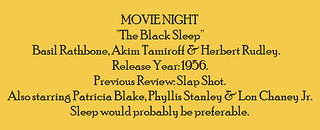
The Black Sleep.


Review #1179: The Black Sleep.

Cast: 
Basil Rathbone (Sir Joel Cadman), Akim Tamiroff (Udu the Gypsy), Herbert Rudley (Dr. Gordon Ramsay), Patricia Blake (Laurie Munroe), Phyllis Stanley (Daphnae), Lon Chaney Jr. (Dr. Munroe aka Mungo), John Carradine ("Bohemund"), Bela Lugosi (Casimir), and Tor Johnson (Mr. Curry) Directed by Reginald Le Borg.

Review: 
With horror films, there surely is an expectation for terror and suspense with some sort of capable cast of characters to make something worth watching as entertainment. With this film, that statement isn't too particularly true, since the only thing that drives the film is its cast. It has an occasional shocking moment or two, but there isn't enough energy present in its story to make something other than just a fairly forgettable piece in a decade filled with films with frights and schlock that stand out much clearer. When the most interesting thing to view is one shot of an exposed brain seeping cerebral fluid (second place going to Rathbone's hand double used for the surgery being an actual neurosurgeon), perhaps your movie needs a bit more noteworthy things to go around. Undeniably, the one thing that does shine above all else for this feature is Rathbone, who manages to give his role a fair bit of dignity that goes past being just the madman scientist who values results over things such as not operating on living patients and their brains, balancing a bit of tragedy with scientific ambition. Alas, not even he can save this film from falling into the world of blandness. Perhaps the story from Gerald Drayson Adams and screenplay by John C. Higgins (both of whom were mostly writers for adventure or mystery films) is to blame a bit. The dilemma involving the use of live brains would probably work better for a film with a bit more action to it, or at the very least would work better in a film that had a more compelling second lead than Rudley. He isn't too particularly interesting, and his chemistry with Blake is cursory at best, so there isn't too much driving drama (or much suspenseful horror, for that matter) besides occasional moments with Rathbone until the climax. It doesn't help that Chaney is tasked to simply growl, either. Lugosi appears in the film, although he has no spoken lines. Sadly, this was the last film of his to be released during his lifetime, as Lugosi died on August 16, 1956, just two months after the film's premiere. Tamiroff, playing a role originally intended for Peter Lorre (prior to disputes over salary rates) is alright, but he falls into the background for a good chunk of it. When the film finally decides to arrange an ending, what better way than to have Carradine chew a bit of scenery as a character who believes he is a legendary crusader from the 11th/12th century? It may be a bit ridiculous to see him (along with Johnson and another actor playing people affected by the brain surgery) run amuck on the people doing the experiments, but at least it is something to give the film a bit of a jolt, even if it is a bit on the over-the-top side, what with Carradine chanting "Kill!" and all. On the whole, it isn't a terrible experience, and the 82 minute run-time isn't too interminable to go through, but it really is only worth it for people willing to look past the lack of suspense and look more at the atmospheric moments and a fairly game performance from Rathbone. I don't think that the film does enough to prove a winner, but it is at the least a curious little horror film that serves its purpose better than some other horror films of its time (such as The Beast of Hollow Mountain (1956) for example), so take it for what it's worth.

Overall, I give it 6 out of 10 stars.