Showing posts with label 1916. Show all posts

March 29, 2023

Where Are My Children?

Review #1993: Where Are My Children?

Cast: 
Tyrone Power Sr (District Attorney Richard Walton), Helen Riaume (Mrs. Richard Walton), Marie Walcamp (Mrs. William Carlo), Cora Drew (Walton's Housekeeper), Rena Rogers (Lillian - Housekeeper's Daughter), A.D. Blake (Roger - Mrs. Walton's Brother), Juan de la Cruz (Dr. Herman Malfit), and C. Norman Hammond (Dr. William Homer) Directed by Lois Weber (#644 - The Blot and #1809 - A Chapter in Her Life) and Phillips Smalley.

Review: 
In 1914, Margaret Sanger found herself indicted for violating obscenity laws because she sent a pro-contraception newsletter in the mail. She fled the country for a time and then returned. In 1916, she opened a family planning and birth control clinic in Brooklyn. She was arrested not long after the clinic opened and later tried as both running a public nuisance and distributing prohibited contraceptives. A staunch opposer of abortion, she founded the American Birth Control League in 1921, which later became known as Planned Parenthood (there were other people involved in the push for birth control as a movement, such as Emma Goldman and Mary Dennett, incidentally). Perhaps it isn't a surprise that the Universal Film Manufacturing Company made a film loosely inspired by the proceedings. The film was directed by Lois Weber and Phillips Smalley, who were married at the time and worked on a variety of films together (in 1908 for example, he worked in the Gaumont Film Company). Of course, they were not listed as directors in the original credit (so yes, the rare no-director credit for a film), and they also served as producers and writers that was based on a story by Lucy Payton and Franklin Hall. Weber and Smalley returned to the subject of birth control with The Hand That Rocks the Cradle (1917), which they each directed and starred in as a film about a birth control advocate imprisoned for her work. Sanger wrote and produced her own film about birth control that same year. Each film is lost, however (the latter was found by the Supreme Court to not fall under the protection of the First Amendment in free speech). The print I watched was a reconstruction (as funded by the Women's Film Preservation Fund of New York Women in Film and Television) that had been done in 2000 from several incomplete prints from America and Europe that saw a surviving post-production script used to help with ordering shots and give text to incomplete intertitles. 

You know, it is not every day that you see a movie that has a lead character that believes in eugenics (incidentally, Sanger was a believer in negative eugenics, but I can think of worse things to be a part of, such as talking about eugenics in any kind of good light in the current day). That, or a 62-minute movie that doesn't even bother to give a name to one of the lead characters besides "Ms." Of course, this is also a movie that starts by talking about unborn children residing in "Heaven's gates" until they are either born on Earth (wanted or not) or they are sent back, complete with a shot used a couple of times over involving the gates. Honestly, I wish the 1917 film was the one we could see instead. Maybe there was something more compelling about a film that actually talked about birth control rather than the distinct anti-abortion film present here. It shows mostly affluent women going with abortions while an attorney discovers just why his wife has more parties than children around the house. The only time it really talks about birth control is when the doctor (early in the film) is asked about the pamphlets he is giving out (which say stuff such as: "when only those children who are wanted are born, the race will conquer the evils that weigh it down" or positing the question about if unwanted children born to ignorant people could suffer disease and asking for people to save the lives of mothers not willing to give birth to unwanted children), since his work usually takes him to the slums. Really it just invites the question as to why the rich are getting abortions in the first place rather than birth control, or why we are not focusing on a movie about the less fortunate dealing with unwanted children, but who knows. Power was a noted actor of his time, but be doesn't really help the role seem anything more than just an off-putting focus to have (i.e., who the hell wants a lead that likes eugenics?). The rest of actors are okay, but nothing inspiring (it's weird that Riaume was actually credited as "Mrs. Tyrone Power", since she was married to him at the time). It isn't particularly interesting as a look upon child care because it is more about the dangers of abortion (either as something the rich use or when someone dies from it) that is not nearly as compelling as the filmmakers think it is. The shots with the gates for unwanted children is just a weird way to convey the proceedings, but nothing tops an ending where a couple is just shown stewing alone with the children they could've had being ghosts. As a whole, it is a social drama that seems a bit too hollow to make the impact it thinks it wants beyond mild exploitation that probably could've been done better years later rather than this.
 
Overall, I give it 6 out of 10 stars.
Next: Women's month ends with Jeanne Dielman, 23 quai du Commerce, 1080 Bruxelles


June 27, 2019

The End of the World (1916).


Review #1237: The End of the World.

Cast: 
Olaf Fønss (Frank Stoll - Mine Owner), Carl Lauritzen (Mineformand / Mine Forman West), Ebba Thomsen (Dina West), Johanne Fritz-Petersen (Edith West), Thorleif Lund (Minearbejder / Worker Flint), Alf Blütecher (Styrmand / Ship's Mate Reymers), Frederik Jacobsen (Den vandrende Prædikant / The Wandering Preacher), and K. Zimmerman (Professor Wissmann) Directed by August Blom.

Review: 
It sure is hard to believe it has been a while since I covered a film from Denmark, where I covered Master of the House (1925) in 2017 - along with being only the 12th film from the 1910s to be done here. In any case, it seems necessary to deliver another world cinema review, which I hope you folks enjoy.

The End of the World (known as Verdens Undergang in its native country) can certainly be called a curiosity, having been released just six years after the passing of Hailey's Comet. with the Earth actually passing through the comet's tail on May 19; there had also been a Great Daylight Comet that year, for which at one bright point it even outshone the planet Venus. It also was a film released in the midst of World War I, for which the country was neutral on. The curiosity for me is in how the comet effects would look, having been done by showers of fiery sparks and shrouds of smoke. The other curiosity is admittedly how Blom and writer Otto Rung get to this climax with their story, which does try to juggle itself with a few threads, revolving around romance, manipulating stocks through the comet, panic through the streets and unrest throughout social classes. In this sense, the effects do shine a bit more handily than its story, but it isn't exactly a hard film to sift through, and I will say that the pacing is relatively steady through its 77 minute run-time. It doesn't test the patience of its audience too much, soaking in its melodrama in the ways you could expect from a film of its ilk, where you see actors try to live up to what is needed to be seen on screen to accompany occasional inter-titles that further the plot (or say something about a character), with the only sound you'll hear is from musical composition (unless you're watching a silent film with no actual music). In any sense, the actors do a fine standard job with such material, playing their types to a T that makes its ultimate fate a bit of a foregone conclusion, with its ending being a bit ham-handed but serviceable, and it surely must have played fine for its target audience. It can prove to be a hokey film at times (gotta love the rich people deciding to have a party on the day a comet is going to hit), but I can give credit for its fair ambition to make a efficient little tale without going completely overboard. Honestly, this is the kind of movie one could just re-purpose for a 70s disaster movie (such as Meteor (1979), although that was pretty terrible), so at least one can enjoy this movie for its own interpretation of the disaster movie before that was even termed as an actual genre. This is a film you can find fairly easily on the Internet, having been restored by the Danish Film Institute in 2006. In the end, I feel that there is just enough in its parts to make this a worthy piece to check out for movie lurkers wanting something from the past century that like a bit of worldly flair in their dramas.

Overall, I give it 7 out of 10 stars.

December 16, 2015

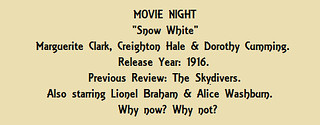
Snow White (1916).


Review #768: Snow White.

Cast
Marguerite Clark (Snow White), Dorothy Cumming (Queen Brangomar), Creighton Hale (Prince Florimond), Lionel Braham (Berthold - the Huntsman), and Alice Washburn (Witch Hex) Directed by J. Searle Dawley.

Review
While this is not the Snow White film everyone thinks about, this was the earliest feature adaptation, made 20 years before Walt Disney's version. Fittingly, this film was released on Christmas Day, so that's (technically) another reason to watch right around now. This was adapted from the 1912 play (which also had Clark as Snow White), which had been inspired from the classic tale by the Brothers Grimm written in 1812. It's interesting to see a movie made in 1916 (a year not previously covered here) and the ways that films were made, with regards to editing, effects, and even storytelling. The effort to make a movie is always impressive, but it also is impressive when it was made in a era where features weren't quite the norm they are now. The acting is much like a filmed stage play, which makes sense given the history. The inter titles are relatively well paced (when they aren't switching typefaces. One of my favorites come from the dwarves: "It's a Girl. I saw one once."). I especially love the names of the seven (Blick, Flick, Glick, Snick, Plick, Whick, and Quee). This film was considered lost until 1992, when it was found (with Dutch inter titles) and restored by the George Eastman Museum. While the movie may not be as notable as the Disney film, it did have one notable viewer: Walt Disney, who was inspired enough by this film that he made it the subject of his own version of Snow White 21 years later. The movie takes a while to get going, but it is well paced at about 60 minutes, so I'd recommend it to anyone looking for a different Snow White to watch around the Holidays.

Overall, I give it 8 out of 10 stars.