Showing posts with label Barboura Morris. Show all posts

October 12, 2024

The Wasp Woman.

Review #2275: The Wasp Woman.

Cast: 
Susan Cabot (Janice Starlin), Fred Eisley (Bill Lane), Barboura Morris (Mary Dennison), William Roerick (Arthur Cooper), Michael Mark (Dr. Eric Zinthrop), Frank Gerstle (Les Hellman), and Bruno VeSota (Night Watchman) 
Produced and Directed by Roger Corman (#368 - The Little Shop of Horrors, #684 - It Conquered the World, #852 - The Terror, #931 - Not of This Earth, #1007 - Attack of the Crab Monsters, #1039 - Five Guns West, #1042 - War of the Satellites, #1136 - Gas-s-s-s, #1147 - X: The Man with the X-ray Eyes, #1186 - A Bucket of Blood, #1423 - The Wild Angels, #1425 - The St. Valentine's Day Massacre, #1674 - Machine-Gun Kelly, #1684 - Creature from the Haunted Sea, #1918 - House of Usher, #2030 - The Trip, #2113 - The Undead, #2211 - The Intruder)

Review: 
Oh sure, a movie about a woman trying to deal with her fears of getting older in the eyes of the public by using strange substances. Wait, what year is this? Anyway, this was directed by Roger Corman in his fourth year as a director (which for him was two dozen movies in), complete with being among the first he made for his company The Filmgroup to help with distribution (read: trying to do productions without dealing with certain unions). The story was done by Kinta Zertuche (in her only screenplay, having served an assistant on Beast from Haunted Cave and Attack of the Giant Leeches) while the screenplay was done by Leo Gordon (the occasional writer of films such as The Cry Baby Killer to go along with acting). The movie (which lasts 66 minutes) is in the public domain, although there exists a version that was longer (73 minutes) because Corman asked Jack Hill to direct a few scenes for television a few years after the release of the film - the scene was an introduction to the Zinthrop character being fired for working on wasps instead of what he was assigned to do. In 1995, the movie was remade as a television production directed by Jim Wynorski with oversight from Corman (who saw a handful of his films remade in that era).

It is pretty unfortunate that the movie is not that great, because there sure seems to be a bit of potential to have made something really unnerving in the terror of trying to cope with aging. However, one basically gets The Fly (1958) crossed with The Wolfman but with very little tension zipped into a five-pound bag of corn. The body count is stretched pretty thin to go with little to really draw upon in suspense beyond watching the movie just for the sake of having nothing better to do (the film paired with it in double features was Beast from Haunted Cave, incidentally). This actually was the last movie for its star in Cabot, who appeared in a handful of Westerns and adventure movies (mostly in supporting roles) before doing work for Corman starting in 1957, with whom she appeared in six productions from Carnival Rock (1957) to this. Cabot did some stage work in the later years prior to her murder in 1986. It is a strange way to close a film career, wearing an odd little mask (with little place to breathe if dealing with vapors and a broken bottle) to go with spitting chocolate sauce onto people. But she expressed in later years that it was Corman who gave her "a great amount of freedom", so take that with a grain of salt. The peril presented by our lead is at least one that can be relatable: trying to survive the fear of being passed by in the sands of time. The rest of the cast is serviceable for a mostly quiet staging that doesn't really require too many sets or too much bombast. Even the wasp costume isn't that bad when you get down to it, mostly because with a bit more time or staging, you really could make something out of that unsettling mask in say, a metamorphosis rather than basically going with the "Wolfman" trick. It could've been so much more tragic but instead is just not quite enough to rise above "heh, I guess". As a whole, the general tragedy of chasing for victories of the superficial can only really work with a film committed to really striking somewhere in visual terror too. It is the kind of movie that I can't call good but will at least lend up as not being as bad as it sounds. When faced with little to do on a a weekend, this would be at least somewhat curious to look up.

Overall, I give it 6 out of 10 stars.

July 3, 2023

The Trip (1967).

Review #2030: The Trip.

Cast: 
Peter Fonda (Paul Groves), Susan Strasberg (Sally Groves), Bruce Dern (John), Dennis Hopper (Max), Salli Sachse (Glenn), Barboura Morris (Flo), Judy Lang (Nadine), Luana Anders (Waitress), and Dick Miller (Cash) Produced and Directed by Roger Corman (#368 - The Little Shop of Horrors, #684 - It Conquered the World, #852 - The Terror, #931 - Not of This Earth, #1007 - Attack of the Crab Monsters, #1039 - Five Guns West, #1042 - War of the Satellites, #1136 - Gas-s-s-s, #1147 - X: The Man with the X-ray Eyes, #1186 - A Bucket of Blood, #1423 - The Wild Angels, #1425 - The St. Valentine's Day Massacre, #1674 - Machine-Gun Kelly, #1684 - Creature from the Haunted Sea, and #1918 - House of Usher)

Review: 
"I wanted the picture not to be a pro-LSD picture and not to be an anti-LSD picture because my trip was very good, I had no bad effects in my trip at all. It was wonderful. Yet I felt I really shouldn’t be accused of proselytizing for LSD, and at the same time I knew people had had bad trips, so I was trying to be neutral, and I had to ask people what had happened on their bad trips, and incorporate some of what they had experienced into it to make it neutral."

Admittedly, when I think of Roger Corman, the words "counterculture trilogy" don't exactly come to mind. Research by others involving films involving so-called "hippies" has labeled The Trip as the second of his films involving the counterculture, with Gas-s-s-s (1970) being thought of as the last of the three and The Wild Angels (1966) being the first. Whatever Corman intended, one thing is clear when it comes to The Trip: it was meant to be quite an interesting experience in line with what Corman usually tried to do with American International Pictures. Hell, he certainly tried to do his own research to get things moving, which first involved reading the work of Timothy Leary, a noted psychologist, author, and advocate for psychedelic drugs which in this case involved lysergic acid diethylamide (LSD), although others would also know Leary for phrases that he came up with, such as "turn on, tune in, drop out". This drug, if you didn't know, was first synthetized in 1938 by Albert Hofmann. I would like to mention that Hofmann (after accidentally finding out the effect of LSD with ingestion years later) argued for LSD as a possible tool for psychiatry within the right place of awareness and safety rather than used for entertainment. So yes, he had plenty to think about the counterculture and their use of something he called "medicine for the soul". As for Corman, he eventually came to the conclusion that reading and asking folks about it was not enough, he had to try LSD for himself. After all of that, Corman, having a good trip, decided to make a film relying on experiments with cinematography and visual elements to carry a film that isn't really about much besides a drug trip. Of course, I can't forget that the film was also written by Jack Nicholson, which came about after Corman had Charles B. Griffith (his writer on previous material) write a couple of drafts, one of which was done as a musical; Nicholson apparently wanted to play a role in the film, but Corman wanted to reuse Dern from the aforementioned Angels film (which he and Fonda both starred in). The film was released less than a month after Corman's one big-budget venture with The St. Valentine's Day Massacre, but The Trip (made on a budget 1/4th the size of the other one) was a major hit for AIP. If you didn't connect the dots already, Fonda and Hopper would star together in a future film involving the road and the counterculture (with Nicholson and Anders in tow) in Easy Rider (1969).

Evidently, the way to go with this film is to turn off one's mind, relax, and float downstream. Regardless of how one feels about the attempt of neutrality, there is something quite, uh, offbeat about how the film goes about in wandering for 82 minutes. Strangely though, I find it far more interesting of the counterculture films that Corman did as compared to Wild Angels or with Gas-s-s-s, probably because the raucous biker experience of "freedom" of the former and the latter's attempt at "post-apocalyptic dark comedy" seem quite hollow compared to the simple goals presented here. It certainly won't be as ridiculous to watch as say, Reefer Madness. Those who find it tedious will have as much justification to say so as the folks who label it as pure cinematic exercise. It all depends on how much patience on has with lingering sequences of a man going through a really weird time that includes fantasy sequences, folks accidentally breaking into people's houses, and musical backdrops involving jazz or organ and horns for a score. With that in mind, Fonda actually does a pretty good job here, a dazed performance that is totally inviting and right for the scenario presented that doesn't seem ripe for exploitation. You get bits and pieces of who he is around and during the trip, and it namely involves vulnerability that one would think about when it comes to one's awareness being tuned into weird putty. Hopper and Dern play the guides on the would-be road of awakening, which is mostly amusing in bits and pieces. The women in the film in Strasberg and Sachse come and go in a rate that suggests discussion over just what they actually mean to Fonda beyond what they look on the surface, but remember that LSD was indeed meant more than just tripping out, so take that in mind. A handful of psychedelic/counterculture films would come and go in the coming months, whether that involved Something Weird (1967), or say, Head (1968), or Skidoo (1968), you get the idea, but The Trip should prove just fine for the curious at heart that like entertaining looks at the experience of doing a trip with useful imagery that is both what you think and don't think would happen if you were the one put in the lead scenario here. And for that, Corman clearly was in his element here in a decent experience.

Overall, I give it 7 out of 10 stars.

May 6, 2021

Machine-Gun Kelly.

Review #1674: Machine-Gun Kelly.

Cast: 
Charles Bronson (George R. 'Machine Gun' Kelly), Susan Cabot (Florence 'Flo' Becker), Morey Amsterdam (Michael Fandango), Richard Devon (Apple), Jack Lambert (Howard), Frank DeKova (Harry), Connie Gilchrist ('Ma' Becker), Wally Campo (Maize), Barboura Morris (Lynn Grayson), Lori Martin (Sherryl Vito), George Archambeault (Frank), Robert Griffin (Mr. Andrew Vito), Michael Fox (Detective Clinton), and Larry Thor (Detective Drummond) Directed by Roger Corman (#368 - The Little Shop of Horrors, #684 - It Conquered the World, #852 - The Terror, #931 - Not of This Earth, #1007 - Attack of the Crab Monsters, #1039 - Five Guns West, #1042 - War of the Satellites, #1136 - Gas-s-s-s, #1147 - X: The Man with the X-ray Eyes, #1186 - A Bucket of Blood, #1423 - The Wild Angels, and #1425 - The St. Valentine's Day Massacre)

Review: 
Admittedly, one really has to spread out the time spent in what I would like to call the AIP Zone. The hundreds of films that came from the studio of American International Pictures in that nifty little era it encapsulated could make for quite a few interesting marathons, and it only makes sense to encounter Roger Corman yet again. By this point in time, Corman had directed over a dozen films in the span of three years, and he did so in a variety of genres that ranged from westerns to science fiction, although he would dabble in the field of crime films and noirs (Rock All Night (1957) is one of Corman's favorites). Well, there is that other distinction to note for this movie in seeing Charles Bronson in a leading role. The Pennsylvania native (who changed his name from Buchinsky on advice that his name might affect his career) had started appearing in films and television early in the decade that eventually grew into supporting roles of note with Apache (1954). The same year that he would star in this film also saw him with a lead role on television in Man with a Camera, which ran for two years on ABC; at any rate, he would move on from middling support roles to leading support acting (incidentally, this would not be the only film Bronson did for AIP, as he would co-star in Master of the World three years later). Interestingly enough, the role was actually not initially viewed with him in mind, as Dick Miller at one point was announced as the star. Robert Wright Campbell served as the writer for the script, and this was the second of six movie scripts that he would do for a Roger Corman film.

You may or may not recognize that this is loosely based on the exploits of the criminal of the same name (a nickname given to him by his second wife, Kathryn, who had bought him the weapon), one of the numerous criminals that was referred as a public enemy to justice (alongside others of the 1930s, for which filmmakers would cover in cinema, and AIP released this film as a double feature with The Bonnie Parker Story), although his crimes dealt with bootlegging and robbery. His infamous moment occurred when he had kidnapped tycoon Charles Urschel for ransom in July 1933 (keep in mind, kidnapping became a federal offense in this year); when you think about it, the real story behind the capture is interesting, because Urschel actually played a key part in the capture of the suspects by noting the evidence around him (namely the sounds that he could hear when blindfolded and held captive for nine days). Two months after the kidnapping, Kelly alongside his wife and others were arrested, and the myth is that he apparently had surrendered to FBI agents - obviously, the mythmakers had to stretch the report of Kelly just raising his hands in the corner and saying nothing. At any rate, I doubt that the real Kelly (who died after serving 21 years in prison, for which he was teased by some as "Pop Gun Kelly" because of the stories he told) was afraid of death like the person depicted in this film, and yet here we are with a fairly interesting movie. It probably isn't a great historically toned film, and it definitely is a pretty cheap movie (made for about $60,000 in ten days), but there is an interesting quality to its efficient pace that works far better than it should. Corman wanted to make a movie about a criminal that was "just a coward and a giver", one that didn't hone to the Robin Hood mold that he felt gangster films usually went to. In other words, we have a movie about a criminal couple that has a considerable difference of power that one would be surprised to see from its time - a robber that might brandish a big weapon but is a meek man defined by the person behind him. It doesn't exactly raise any new heights to the gangster genre, but there is something affable about its grip in tension when it comes to the dynamic between Bronson and Cabot in the drive for the elusive "more". Bronson would find his mark with steely roles in later years, but there is something curious about what he manages to do when it comes to making Kelly out into a somewhat complicated being. That isn't to say that he is turned into a man of sympathy, but there is something here that seems raw and relevant in the way one would see a junkyard dog on and off its leash (the pace of violence isn't too gratuitous either, which actually matches up with its title character well - aside from the moments where there's a tiger present to spook up folks scared of big cats with teeth). Cabot called this film the most satisfactory of the six that she made with Corman, and it isn't hard to see why. She does quite well here, devastating in her zeal when it comes to maneuvering the machinations that come from acting as part of the one-two punch when it comes to wheeling and dealing. In other words, she doesn't become or chew the scenery to the detriment of the film (which can happen in weaker films that only have one thing in mind). She compliments the criminal aspect of this tandem with a show of composure that plays on instinct when it comes to impulse. The movie relies on these two playing that dynamic for 80 minutes that generally works out; that isn't to say the other actors aren't anything special, but I think you know what I mean when it comes to a weary man if his weapon is missing (besides, hearing about a guy losing his arm to a tiger is probably more memorable than a kid being a hostage). The fear of death isn't exactly something that one can make fun of in any case, especially when one thinks of the choices made to get where they are in that moment, which could happen to you just as much as what happens here. As a whole, while it certainly plays fast and loose with facts, the fact that it tries to play around with the idea of not needing a blaze of glory moment combined with Bronson and Cabot make for a far more interesting movie than what it could have been. It moves with the shadows for clean-cut pulp that certainly can make for quite a guilty pleasure. 

Overall, I give it 8 out of 10 stars.

January 31, 2019

A Bucket of Blood.


Review #1186: A Bucket of Blood.

Cast: 
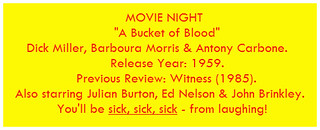
Dick Miller (Walter Paisley), Barboura Morris (Carla), Antony Carbone (Leonard de Santis), Julian Burton (Maxwell H. Brock), Ed Nelson (Art Lacroix), John Brinkley (Will), John Herman Shaner (Oscar), Judy Bamber (Alice), Myrtle Vail (Mrs. Swickert), and Bert Convy (Lou Raby) Directed by Roger Corman (#368 - The Little Shop of Horrors, #684 - It Conquered the World, #852 - The Terror, #931 - Not of This Earth, #1007 - Attack of the Crab Monsters, #1039 - Five Guns West, #1042 - War of the Satellites, #1136 - Gas-s-s-s, and #1147 - X: The Man with the X-ray Eyes)

Review: 
Horror and comedy films are generally entertaining on their own, but mixing the two genres together can certainly invite the possibility of something really interesting, particularly if you have a good set of hands on and behind the camera. Roger Corman and an handy ensemble cast are sure up to the task. Unsurprisingly, the budget and time to shoot for this film was fairly low - $50,000 and five days (shooting under the working title of "The Living Dead"). The sets themselves were leftovers from another AIP film, Diary of a High School Bride (1959). Fittingly, the sets would be re-used for The Little Shop of Horrors the following year. Miller, although he was happy with the story and humor from the finished product, wasn't too happy with the production values, noting the mannequins used for the statues and the fact that they didn't put plaster on him (instead using grey makeup) for the last scene. Corman and screenwriter Charles B. Griffith spent a day drifting around beatnik coffeehouses, using observations of the scene along with ideas and reactions to make the basic story, which in some ways resemble Mystery of the Wax Museum (1933).

In any case, this is a pretty enjoyable little movie, shining fairly well with a good degree of black humor and occasional scares that prove efficient for a 66 minute run-time. Perhaps a longer film might've resulted in the characters being fleshed-out a bit more (or perhaps a bit more emphasis on horror), but the material involving the beatniks is pretty funny anyways, as one might expect from people with a bit of pseudo-intellectualism and offbeat nature. Miller does well making this hapless yet ambitious lead interesting to view the film through - after all, he is basically playing a serial killer (with a calling card, no less), but he manages to have the right kind of presence the film needs to go on. The other cast-mates don't have as much time, but they each do decently with their roles when needed, such Morris and her encouraging nature or Burton and his offbeat poetry. The movie has its limits with money and time, but it manages to carry itself with some dark charm through some magic with silly lines and a game cast that make for a good time. Like with other Roger Corman films, this is certainly one to advise for anyone with a curiosity towards some fun that makes for quite a delight.

Rest in peace to Dick Miller, who died yesterday. He was a noted character actor who appeared in several films over six decades of work - appearing in films such as The Terminator (1984) alongside over a dozen films for Roger Corman.

Overall, I give it 8 out of 10 stars.