Showing posts with label David Strathairn. Show all posts

September 14, 2022

Sneakers (1992).

Review #1886: Sneakers.

Cast: 
Robert Redford (Martin Bishop / Martin Brice), Ben Kingsley (Cosmo), Sidney Poitier (Donald Crease), David Strathairn (Irwin 'Whistler' Emery), Dan Aykroyd (Darren 'Mother' Roskow), River Phoenix (Carl Arbogast), Mary McDonnell (Liz Ogilvy), Stephen Tobolowsky (Werner Brandes), Timothy Busfield (Dick Gordon), Eddie Jones (Buddy Wallace), George Hearn (Gregor "Greg" Ivanovich), Donal Logue (Dr. Gunter Janek), Lee Garlington (Dr. Elena Rhyzkov), and James Earl Jones (NSA Agent Bernard Abbott) Directed by Phil Alden Robinson (#488 - Field of Dreams)

Review: 
Ensemble movies need their appreciation too, if you think about it. Do you remember WarGames (1983)? In the process of writing the script for that film, Lawrence Lasker and Walter F. Parkes discovered the existence of "sneakers", which refers to hackers that well, sneak into a computer system somewhere (in this case, the hackers here are hired by banks to break in and test the security system). A number of drafts eventually attracted the attention of Phil Alden Robinson, and he ended up spending nine years trying to get the film going. Getting the attention of Robert Redford (cast in a role originally intended with a star in their mid-40s as written by people in their 40s) helped the process and eventually led to a film with a cadre of actors that went from veteran stars to younger names such as River Phoenix (this was the penultimate movie released before his death the following year) while squeezing James Earl Jones in for one scene. Lasker and Parkes also produced the film, which was their fourth venture together (one of them was Awakenings (1990)). Clearly, the movie is really more of a take on the caper movies of yesteryear with its distinct characters in its ensemble, although the message about a world run by "little ones and zeroes" probably still seems quite true after three decades. You probably remember Robinson as the director of Field of Dreams (1989), his second effort; Sneakers is his third feature effort, and his next feature film ended up being Freedom Song eight years later.

Admittedly, it is a nice little movie when it comes to seeing familiar faces in an attempt at a techno-thriller/heist movie. Oh sure, it is a movie that does extoll a little bit about the quirks of a new age where having control of the information might be more important than having the fastest gun. Sneakers does so with a grasp of a number of cliches you have probably seen in countless heist movies with how you can describe the supporting characters in two-word phrases or how the climax is operated (besides the literal slow-motion sequence), right down to needing to acquire a box. In that sense, it can either prove as a comfort movie with plenty of enjoyment from an age like the 1990s or just an average ensemble, and I think it works out more often than not to make a quiet winner. Redford does well with what is needed in general charm, a uniter of misfits with what you've seen a few times from him (perhaps playing a bit of The Sting but without looking like a copy). Poitier, in his penultimate appearance in a feature film, still has the knack for steely timing to contrast the semi-whimsical others, mostly against Aykroyd (amusingly, when approached for the film, he actually was more interested in playing the Cosmo role before being told that Kingsley was signed for it). Kingsley doesn't have as much to really do as the adversary, but in a movie with just a fraction of action and more about the general chase, this works out okay in general familiarity (better him than a ham or a nonentity, perhaps). Strathairn lends a few chuckles to go along with a wiry Phoenix that make the most of those little moments to shuffle the plot. McDonnell makes a quality deadpan middleperson, one who does share a few interesting moments with Redford alongside some chuckles with Tobolowsky, who seems to be having a ball with his moments on screen. 126 minutes is admittedly a big ask for thrillers to enjoy, but I think it does pull enough out of the bag of enjoyment to work at the expectation required from its cast and crew. It's a movie about a couple of scraps who just want to untangle themselves from a weirdo conspiracy involving uncertainties that is dealt with in wry patience that makes a solid little three-decade gem. If fun-loving ensembles trying to play caper is up your alley, go right ahead with this one, where the game of concerns of privacy still holds true now.

Overall, I give it 8 out of 10 stars.

September 18, 2020

Good Night, and Good Luck.

Review #1539: Good Night, and Good Luck.

Cast: 
David Strathairn (Edward R. Murrow), George Clooney (Fred W. Friendly), Robert Downey, Jr (Joseph Wershba), Patricia Clarkson (Shirley Wershba), Frank Langella (William Paley), Jeff Daniels (Sig Mickelson), Tate Donovan (Jesse Zousmer), Ray Wise (Don Hollenbeck), Alex Borstein (Natalie), Thomas McCarthy (Palmer Williams), Rose Abdoo (Mili Lerner), Reed Diamond (John Aaron), Matt Ross (Eddie Scott), Grant Heslov (Don Hewitt), featuring archive footage of Joseph McCarthy, Liberace, Roy Cohn, and Dwight D. Eisenhower. Directed by George Clooney (#851 - The Monuments Men, #1187 - Leatherheads)

Review: 
"I'm not a snob, I like entertaining films as well. But when you do a film like this, or like Three Kings - films that get you in a bit of trouble - it's fun to open up a debate." - George Clooney

It helps to make a message movie if you have enough talent or know-how to get it done right, so it figures that George Clooney wanted to add directing to his foray in addition to acting. The Kentucky-born Clooney attended Northern Kentucky University and the University of Cincinnati (studying broadcast journalism with the former) before dropping out and doing odd jobs like selling shoes before being inspired to take up acting, which resulted in him getting a variety of small roles on TV and film beginning in 1984 that included stints on shows like The Facts of Life (1985-87) and Roseanne (1988-91) before hitting a breakthrough with ER (1994-99) and subsequent film work with From Dusk till Dawn (1996). This is the second film that Clooney was director for, with his debut having been Confessions of a Dangerous Mind (2002). Clooney also served as a co-writer with Grant Heslov (who also served as producer of the film) while being paid $1 each for acting, producing, and writing in order to help with the budget.

In theory, this could make for a pretty good civics lesson in terms of film quality. It yearns to cover a subject probably not too familiar to younger audiences in the Edward Murrow/Joseph McCarthy conflict in regard to journalism and fear in a different time for belief when it comes to the Red Scare. Granted, I am familiar with it in part because of a recent television episode I saw this year depicting McCarthy on American Experience (the one and only show on PBS currently running that I would keep with me on an island), but here we are. What we ultimately have here is an effort that looks the part and surely could teach the part...but just isn't quite as great as it really could be. I applaud the use of black-and-white (filmed in a greyscale set while done through desaturation after production for release on B&W print stock), in that it does make a modest attempt at period piece drama without looking like a desperate attempt at emulating 1950s/60s films like 12 Angry Men (1957), this much is for sure. But if I really desired a throwback to an older era in terms of style or substance, by goodness I would just watch those films in how they constructed their story instead. It yearns so desperately to be thought of as a film to ponder discussion about fear and ethics within the workplace and beyond, but it just seems lacking in fulfilling all of its desires beyond platitudes that seem too hagiographic to actually say something about Murrow beyond the obvious (which will surely rank differently with either admirers or detractors of him).

It is the idea that it could bring about holding one to honesty and being careful about what is told to us in media that is more attractive than what really gets shown, and the style + acting is the thing that braces things from collapse. Strathairn practically blends himself perfectly into the role, deftly doing well with what is given to him in capturing succinct dignity that carry the re-creation of words from the past without trouble, albeit with one significant quibble. Technically speaking, everyone else is fine, but they all fall into the same trap with Strathairn: in following along with its singular focus on its subject matter without much else room for context, the lives of the folks we are following seem practically empty in comparison, as if these people didn't have lives beyond the news. For example, Downey Jr and Clarkson's little chemistry involving them having to hide their marriage from work is an interesting one with a few little "cute" moments, but they as a whole don't contribute much else besides that to the film in terms of charm or substance. Clooney follows along the action with Strathairn fine, but there's always that sinking feeling that he will just blend into the background and you wouldn't even notice/care, as the nuance slowly morphs into something else. Langella is interesting to view, but he seems more deserving of further substance beyond carefully cut moments. Others provide jumble words about come and go fine, but one is begging for a longer focus or at least something to draw upon that doesn't feel like a point-by-point film of events.

The historical quality can prove interesting (for better or worse) to view in the classroom, particularly with its usage of vintage footage of McCarthy (which is better in some way than having an actor try to replicate him). Of course, the whole part about See It Now being reduced from its regular weekly slot happened in 1955, not immediately after the McCarthy episode (which was attributed to its low ratings in prime-time, including a loss in a primary sponsor in Alcoa, as compared to his "lite fare" Person to Person, which lasted longer). The film even starts with an inaccuracy involving listing Murrow's accomplishments before he starts his speech to the Radio and Television News Directors Association in 1958 by listing "Harvest of Shame" - which wouldn't air for two more years (dramatic effect staging is one thing, but it really is a bit dubious when trying to stage Murrow's speech about "wires in a box" with date misremembering). The See It Now show (broadcast March 9) probably hastened McCarthy's demise, but one bigger key would be something more indirect - ABC's decision to air the hearings of McCarthy vs the U.S. Army live gavel-to-gavel beginning in April (with that key moment of asking about "having no sense of decency" being in June - if one goes by records of polling of McCarthy however, he reached his peak of opinion approval in January of 50% before dropping negative by April). 

Again though, it all depends on how much one can really cover of the perspectives of that time and place. In this sense, what we have here is a film that runs way too short at 93 minutes, as if the footage involving depth and awareness ran off a cliff. This isn't so much a period classic as it is one that desperately requires citations and books to run parallel with it. This is an example of a film that will either stick in one's minds as something to ponder on with worthwhile discussion on the merits that land or one that will fester in the frustration of what didn't land. Call me an iconoclast or stubborn, but this film just didn't work enough for me in freeing my quibbles with its deluge of style over substance and scope that make it any better than if one simply picked a different way to experience history and the discussion that comes with it.

Overall, I give it 6 out of 10 stars.

August 12, 2020

A League of their Own.

Review #1500: A League of their Own.

Cast: 
Tom Hanks (Jimmy Dugan), Geena Davis (Dorothy "Dottie" Hinson), Lori Petty (Kit Keller), Madonna (Mae Mordabito), Rosie O'Donnell (Doris Murphy), Jon Lovitz (Ernie Capadino), David Strathairn (Ira Lowenstein), Garry Marshall (Walter Harvey), Bill Pullman (Bob Hinson), Anne Ramsay (Helen Haley), Megan Cavanagh (Marla Hooch), Freddie Simpson (Ellen Sue Gotlander), Tracy Reiner (Betty "Spaghetti" Horn), Bitty Schram (Evelyn Gardner), Renée Coleman (Alice "Skeeter" Gaspers), and Ann Cusack (Shirley Baker) Directed by Penny Marshall.

Review:
"I hadn't worked with so many women before. I thought it was something I should do. But I wasn't doing it just to do a women's picture. The problems as they're presented in the movie apply to both men and women. It's about, "Don't be ashamed of your talents." It's a universal thing."

It should figure that at least one good comedy is featured here involving the Marshall family. Older brother Garry rose from joke writer to television that morphed into developing television programs, with such shows as The Odd Couple, Happy Days, and Laverne & Shirley before going into film direction. As for Penny, she had grown from a childhood of tap dancing to small parts on film and television before being given substantial work with Garry's teleivision series, with the most prominent being her starring role on Laverne & Shirley that ran from 1976 to 1983. Encouragement from her brother led to an interest in directing (starting with an episode of Working Stiffs along with a few episodes of her own show). Her first feature Jumpin' Jack Flash (1986) was a mixed hit, but Big (1988) proved a major critical and audience hit. Marshall was inspired by a 1987 documentary she had seen about the All-American Girls Professional Baseball League, which she had not heard of before. She sought out the creators of the work - Kim Wilson and Kelly Candaele (whose mother Helen Callaghan played for five years in the league) in developing the story while Babaloo Mandel and Lowell Ganz (responsible for scripts such as Splash and City Slickers) developed the screenplay.

Technically speaking, this is not a straight historical film about the AAGPBL, which went by various names that started with referring to it as softball (since the league was trying to draw on the popularity of women's softball, since both used underhand pitching) before adding and then removing professional from the title for a league that ultimately lasted from 1943 to 1954, which really did have the players play in short outfits along with tight restrictions on what they could do socially (imagine giving an athlete ettiquite classes today), with the famed Wrigley Field indeed serving as the initial tryout location in real life. True, there would be a sale by its head to an entrepenur who felt he could do just as well in operating the league as he did with advertising Philip K. Wrigley's products along with the league - Arthur Meyerhoff. Obviously the winner of the championship did not result from something as silly as a plate collision  - in fact, Racine won the title the first year over Kenosha in a sweep. The "induction" scene at the end involving the Baseball Hall of Fame is tricky - it wasn't so much an induction but just a permanent exhibit featuring players. Of course we aren't here to talk about history, the reason I had interest in the film is simple - my love of baseball, the definitive American sport for everyone, featuring actors that had to have at least some talent in baseball to participate in the film (injuries still happened from mishaps on the field, as one could expect). Where the film clicks best is in getting some laughs within its baseball trappings, which shine gradually over a film that while admittedly lengthy at just a bit over two hours is still a crowdpleaser. Hanks grabs the attention once the baseball action slides into the first quarter, and he does a pretty good job in lending tempered amusement with his natural treating of the dialogue (the crying in baseball one is the easiest to cite becuase of how catchy it is). Anyone who can lend a decent hand in acting and playing a decent game of baseball gets a nod in my book, so it figures Davis does the best job in that regard, confident and entertaining whether on the diamond or away from it that makes for spiriting/sparring moments with others like Petty or Hanks. As for Petty, she does well with the material, resoundant and interesting to see among others with brimming rivalry that she handles fine. Others in the cast prove fine with their moments, like a quirky Madonna and her pal O'Donnell or a solid bit from Lovitzl or resourcefulness from Strathairn and Marshall. It generally works best when dealing with building its baseball action with quirky lines about trying to play and live with these folks along with the rules that go with it, with the interpersonal stuff proving fine - we are talking about a fictionalized story with a real league, after all. As long as it generates interest in the true AAGPBL, it can do what it pleases. On the whole, it isn't a surprise that this proved a hit nearly three decades ago, as it proves diverting with humor and heart to generate a fine mix of fact and fiction that serves any audience well in good entertainment.

Overall, I give it 8 out of 10 stars.

October 22, 2019

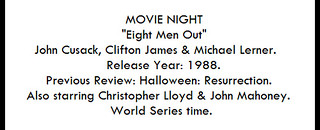
Eight Men Out.


Review #1287: Eight Men Out.

Cast: 
John Cusack (Buck Weaver), Clifton James (Charles Comiskey), Michael Lerner (Arnold Rothstein), Christopher Lloyd (Bill Burns), John Mahoney (Kid Gleason), Charlie Sheen (Happy Felsch), David Strathairn (Eddie Cicotte), D. B. Sweeney (Shoeless Joe Jackson), Michael Rooker (Chick Gandil), Don Harvey (Swede Risberg), and James Read (Lefty Williams) Written and Directed by John Sayles.

Review: 
Yes I know, not a horror film. However, today is the start of the World Series, which incidentally features my Houston Astros, so how could I resist covering a baseball movie? This one had been on my list for quite a while, so it only makes sense to do it now. Enjoy, and let's hope for a wonderful World Series result.

It is interesting to note the passing of 100 years since the Black Sox scandal, in which eight players of the Chicago White Sox were accused of throwing games in the 1919 World Series in conspiracy with gamblers. A public trial ensued in 1921, for which none of the accused players were convicted of any crime, although they were banned from playing professional baseball for the rest of their lives. A tale as old as time for baseball (a sport I adore) undeniably has inspired writers to adapt it into stories. Eliot Asinof wrote an account of the scandal in 1963, while W. P. Kinsella's wrote a magic realist novel with Shoeless Joe (1982, which was adapted into Field of Dreams the same year as this film). It isn't hard to say that baseball fans will certainly have interest in seeing this tale come to life in film while non-baseball fans will have a little harder time getting behind what this movie wants to show with this (questionably accurate) period drama. When it comes to baseball movies, this is probably safe middle ground stuff, doing just fine with its look and some of its ensemble moments while being a bit lacking when it comes to making everything really stick (particularly when it comes to some egregious liberties taken with real events, which is just as true with the novel and its combination of fictional characters into what is meant to be a non-fiction narrative). It clocks in at just a few seconds under two hours, for which the first half proves more favorable than the latter half (what better way to combine baseball cliches than courtroom cliches), seeming to have a few amusing moments with its cast. As such, the highlights include Cusack, Strathairn, Sweeney, and Rooker, with each actor of the conspiracy sticking out, such as Cusack and his bright disposition (even when faced with a bunch of crooked teammates), or the calmness of the others in their belief of that allure one calls more money. Minor highlights include James and Mahoney, making crucial points count just fine. How much guff can one give about accuracy about adapting the scandal to film with source material that took its own liberties with the facts (the Internet sure does help occasionally when it comes to finding tidbits of information, such as Society for American Baseball Research (SABR), who recently had made an article detailing numerous myths about the scandal, such as the White Sox actually having a high payroll (for 1919), or the gamblers being approached by the players (as opposed to the other way around), or the grand jury testimony being stolen (which they simply re-created later on anyway, which didn't have a big effect on the trial). If you really wanted to go further, the Internet is your friend for finding things to pick at (for better or worse). For me, it does tend to rankle me, in part because a film should know a little better about getting more than basic concepts right, especially stuff like Christy Mathewson (famed baseball legend) being the one that helped out the journalist investigation as opposed to Lardner (played by Sayles himself). In the end, I find that the film does best when letting the players speak for themselves along with its baseball action, with its foundation having quite a few cracks that can make this a hit-or-miss kind of movie. For me, it is a fair single, worth a look if one is curious enough for an old-timey but fair-minded day at an old ballpark.

Overall, I give it 7 out of 10 stars.

June 3, 2019

Godzilla: King of the Monsters (2019)


Review #1227: Godzilla: King of the Monsters.

Cast: 
Kyle Chandler (Dr. Mark Russell), Vera Farmiga (Dr. Emma Russell), Millie Bobby Brown (Madison Russell), Bradley Whitford (Dr. Rick Stanton), Sally Hawkins (Dr. Vivienne Graham), Charles Dance (Colonel Alan Jonah), Thomas Middleditch (Dr. Sam Coleman), Aisha Hinds (Colonel Diane Foster), O'Shea Jackson Jr. (Jackson Barnes), David Strathairn (Admiral William Stenz), Ken Watanabe (Dr. Ishirō Serizawa), Zhang Ziyi (Dr. Ilene Chen and Dr. Ling), with T.J. Storm (Godzilla) Directed by Michael Dougherty.

Review: 
It's about time for this one. Perhaps this review may prove a bit too long - but I wanted to have some fun with saying as much as I could with a film I really did anticipate - after all, I didn't cover four Godzilla movies for nothing, so here's a Godzilla-sized review for the hell of it - 1,000 words for your enjoyment. 

Five years can certainly pass by when it comes to movies. Godzilla (2014) was a fine movie that worked to get out of the shadow of doubt that an American adaptation of Toho's monster franchise couldn't actually succeed. I really can't say I have too many memories of the film, but I might as well just snatch some words from way back when:

"The cast isn't bad (though I wish there was more Bryan Cranston in it), our main character is okay even though it seems the cast get more screen time then the monster himself, Godzilla. The movie seems to want to build tension and wait, so it cuts the first two monster fights (along with waiting an hour to show Godzilla) so we don't see much and then relents and shows the final fight, which is fantastic."

Of course, I also don't remember giving it a 9, but yet here we are. The only other Godzilla film that I had covered at the time was the original Gojira (1954). I hadn't (and still haven't) even touched the 1998 American attempt at Godzilla, with me just going in cold for some big monster action. Actually, I haven't returned to the 2014 Godzilla since I saw it in the theater all those years ago, perhaps since I don't usually re-visit each film I go see on the big screen. In the five years since its release, Toho re-started the series with Shin Godzilla (2016) while Legendary Pictures continued their pursuit of a "MonsterVerse" with Kong: Skull Island (2017). Just three cast members (Watanabe, Hawkins, Strathairn) return for this one, with a few references included throughout while doing a bit of ret-conning and changes in tone that make for a fairly decent if not perhaps as challenging monster movie. The first film had a screenplay by Max Borenstein and a story by David Callaham, while this one has director Dougherty as co-writer and co-screenwriter while retaining Borenstein for the screenplay once again alongside Zach Shields. It lingers a little too long at 132 minutes (eleven minutes longer than its predecessor), but I felt that I enjoyed a good majority of what I saw on screen, albeit more when it focused of its monsters than its cadre of characters. The quirk of the original having its only interesting character being wasted midway through is modified by this film having a quirk of having sprinkles of just mildly interesting characters. This film is basically a re-imagining of Ghidorah, the Three-Headed Monster (1964), albeit with a somewhat developed foundation of human characters that makes for a less silly experience. Honestly, as long as there is an entertaining monster mash somewhere in its run-time that isn't overshadowed by something else, you have my vote, and this one gains that vote for the most part. This is a $200 million CG spectacle with monsters that takes itself mildly seriously - once a year is just enough for my standards, really, even if I am aware of the prevailing tastes for other kinds of action films for the summer.

It is a loud and sometimes dumb movie, but I can't help but adore its ambition at spectacle. Each monster, from Godzilla to King Ghidorah, is rendered really well, looking quite crisp that retains the characteristics from before (like the latter and its three heads) while making sure they stand out in their own ways, which proves to be a fairly done strategy. While I do wish there was a bit more emphasis on shown spectacle of distraction (as opposed to just showing things already being destroyed), at least I can say that this one manages to retain most of the wrath that nature can bring onto us if not careful from the earlier movie. I never feel lectured or bored when it comes to trying to peddle some plot threads on me, with the parts involving specific frequencies for the monsters faring best over parts involving discussions in rooms over what to do. The cast does what they can, some faring better than others. Chandler is fine to follow around with, straight-laced yet completely willing to go along with what occurs on screen without seeming like a drag on what occurs in the basis of a monster movie. Farmiga does fine as well, with the focus on her and Brown being fairly subtle. Brown shines just as well when shown on screen. At least the family angle the film pushes is okay, since the film can't just be all on the monsters and their ties to myths and legends from yesteryear. Whitford and his attempts at being comic relief (by being the equivalent of someone on the Internet lecturing you on "uberscience lol" at 8am) come off as a bit tepid, although Middleditch doesn't fare too much better. Dance comes off as ridiculous as the human adversary - I don't care too much about the eco-terrorism angle, but the parts involving trying to restore a sense of balance in the world with Titans (as opposed to the previous film's classification of the monsters of MUTO)  Not having too much to do with Hawkins is a bit disappointing, although at least Watanabe gives the film some sense of emotional depth. Rounding out the cast is passable performances from Hinds, Jackson and Ziyi. With all of that mind, where else did I find time to show some joy besides seeing a bunch of occasionally creative fight sequences and a bunch of CGI in the dark? I found some fun within Bear McCreary and his music, taking some inspiration from previous music beats from the Godzilla series from Akira Ifukube - any time you do a cover of a Blue Oyster Cult song (particularly "Godzilla") gets a nod from me as well. With a looming sequel in Godzilla vs. Kong next year, this is a movie that succeeds in garnering interest to see some more monster mashing without regret. It proves as a worthy follow-up to its predecessor while also living up to the standards of other Godzilla films before it without too many stumbles yet having plenty of thrills to make one satisfied.

Overall, I give it 8 out of 10 stars.

May 18, 2014

Movie Night: Godzilla (2014).


Review #582: Godzilla.

Cast
Aaron Taylor-Johnson (Lieutenant Ford Brody), Ken Watanabe (Dr. Ishiro Serizawa), Elizabeth Olsen (Elle Brody), Juliette Binoche (Sandra Brody), Sally Hawkins (Dr. Vivienne Graham), David Strathairn (Rear Admiral William Stenz), and Bryan Cranston (Joe Brody) Directed by Gareth Edwards.

Review
It may have taken a while to get to another Godzilla film (#167 - Gojira), but I finally got around to it. And what better way to review a Godzilla movie then the latest one? Imagine being in the theater, a packed house after waiting an hour (or so) in line and then a while longer with trailers and such (The Giver film sounds like it'll be awful, Edge of Tomorrow reminds me of Groundhog Day for some reason, etc, but you get my point), the movie premieres. And the biggest cheer of the audience in the whole movie? When Godzilla uses his atomic fire breath. Heck, even I cheered for that because some things are just too awesome to say in words, so we say them in claps. The movie itself is good and certainly deserves a sequel. The cast isn't bad (though I wish there was more Bryan Cranston in it), our main character is okay even though it seems the cast gets more screen time then the monster himself, Godzilla. The movie seems to want to build tension and wait, so it cuts the first two monster fights (along with waiting an hour to show Godzilla) so we don't see much and then relents and shows the final fight, which is fantastic. Godzilla looks fantastic, looking incredibly imposing, and the roar is just great to listen to. Gareth Edwards does a great job directing as well, making me hope he returns for a sequel. The movie may take a while to getting what makes Godzilla awesome, but the payoff is excellent enough to leave you wanting more.

Overall, I give it 9 out of 10 stars.