Showing posts with label Canada Day Feature. Show all posts

July 1, 2019

The Cat in the Bag (Le chat dans le sac)


Review #1240: The Cat in the Bag (Le chat dans le sac)

Cast: 
Barbara Ulrich (Barbara), Claude Godbout (Claude), Manon Blain (Manon J'sais-pas-qui), Véronique Vilbert (Véronique), Jean-Paul Bernier (Jean-Paul), André Leblanc (Toulouse), with Paul Marie Lapointe (Messieurs), Jean-V. Dufresne (Messieurs), and Pierre Maheu (Messieurs) Directed by Gilles Groulx.

Review: 
I knew that at some point I would cover a film from Quebec cinema, particularly to how it relates to Canadian cinema. Quebec experienced their first movie projection in a theater room in 1896, but it took decades before a real cinema industry would occur for the province (a mostly francophone population), especially when the French branch of the National Film Board of Canada was established and became autonomous in 1959, leading to debut of several directors such as Michel Brault and Gilles Groulx. The province went through a period of turmoil in terms of change between society, politics and culture for numerous decades that is generally referred to as a Quiet Revolution. All this relates to the film, one that is a product of Direct Cinema, which grew in the region that serves under the documentary genre with lightweight film equipment along with live sound that wanted to capture reality with truth along with questioning reality's relationship with cinema, which was popularized with Chronique d'un été (1961) by French director and anthropologist Jean Rouch along with sociologist Edgar Morin, with one of the cinematographers of the film being Brault.

To call it just a coming-of-age story of a young man would simplify things a bit too easily - It is a film about a young man who is occupied by a budding relationship with a fellow young lady but questions his identity as a French Canadian living in Montreal that seems to reveal some sort of feeling at heart of a society as unique as Quebec. When asked about filmmaking in 1964, Groulx stated that "A filmmaker is a journalist: he must inform and comment. For me, what counts in a film is the moral, what the author has to say. Mere technique is meaningless. The story, too, is meaningless; it's the pretext for the film; it's like the model for an impressionist painter."

One can see the angst all around through crisp black-and-white photography and music from John Coltrane that serves as a mix of documentary and fiction that proves quite interesting to view through the lens of over five decades and other certain aspects. It definitely wants to challenge the viewer, that can be assumed, and it surely moves itself efficiently in its 74 minute run-time without having to strain itself in overwrought lecturing or strain in trying to cover too many things at once. One highlight involves its final act, with a few scenes spent in a snowy cabin - it surely makes the isolation and contrast stand out really quite starkly when it comes to the path one can take in search of self. It doesn't have too much of an ending, leaving itself to the thought on the viewer about what could occur with the path of the young fellow looking for a place within a society looking to etch its own statement within a nation that can be viewed through two people and their view - a Quebecois who is occupied with intellectual readings and his alienation over contemporary society and an anglophone who is occupied with passion for the theatre that doesn't share such concern. Ulrich and Godbout certainly prove worthy to the task of making this drama click, each playing with such compelling anxiety that makes for a natural fit for the mold required from Brault. It can be easy to relate to one or both of these folks, and the film doesn't find itself stuck pushing hard to get you to like (or accept) who they are, instead it just lets you in for a view or two with a bit of conviction and perhaps a bit of awakening. In the end, it surely is a film for thought that sticks out for its ambition in what it wants to say without choking the viewer out of entertainment or interest. It certainly fits well as a curiosity piece, especially for one wanting a bit of perspective from way back when from Quebec cinema at a key time for growth.

Happy Canada Day, folks. I hope you enjoyed this interesting doubleheader - there were quite a few possibilities leading up before I figured that these two films would prove for quite a fun time and give some perspective while sticking out from the films that usually come through this show - whether from America, Canada or somewhere else. Hopefully there will be some fun films to sit through and cover for the rest of the month.

Overall, I give it 8 out of 10 stars.

Stereo (1969).


Review #1239: Stereo.

Cast: 
Ronald Mlodzik, Jack Messinger, Paul Mulholland, Iain Ewing, Arlene Mlodzik, Clara Mayer, and Glenn McCauley. Written and Directed by David Cronenberg (#816 - Crimes of the Future, #1127 - eXistenZ, and #1220 - A History of Violence)

Review: 
One would wonder what would make a film like this, also known as Stereo (Tile 3B of a CAEE Educational Mosaic), stick out from the usual fare of entertainment. This ultimately proves to be a film that seems more ripe for dissection than a complete watch for entertainment's sake, complete with voice over (owing in part due to noise that Cronenberg's camera made during filming) and a few sound effects. If you are into movies of the experimental / art house genre that try to be something really different with a bunch of educational terms (and a few moments of silly jargon) that talk about telepaths, weird personal exploration, personality splits, and other various events. I can't really say that this was something I found to be worth endorsing, since it meanders and lingers a bit too long with itself, making for a weird 65 minute experience - the best thing that stands out really is when there is a voice over, only if because having no sound (or music) and watching things occur is a pretty strange experience. The actors seem to be having a fine time, walking around Scarborough College (University of Toronto, for which Cronenberg is a graduate of) and making a few faces.

At least I can give credit to Cronenberg, who was just 26 when this film came out, having served as director, writer, producer, editor and cinematographer, which he repeated for his next feature (which retained some of the cast from this one, notably in Mlodzik). It isn't so much a boring time as it is just one of those experiences that you'll feel a bit curious about what you saw more than finding it as just a waste. Giving it a bit of thought to what goes on may or may not help with said assessment. Watching either of his two experimental films (or even his short films with Transfer (1966) and From the Drain (1967)) might make for an odd night in terms of looking at quirky material through the eyes of someone developing their directorial senses with relish - they may not prove to be great, but at least it will play well with the crowd it wants to sit with. At least you won't have one of those little voices that will cry out and say "you just don't get it" when you finish assessing what you saw, at least. Take it for what it is worth.

Happy Canada Day folks. It is good to have done a Canada Day Feature after having done it for five previous years from 2013 to 2017. It happened that this is also the 50th anniversary of the directorial debut of noted Canadian director David Cronenberg, so this made perfect sense for today, since the first film I covered of him was the next film that he did after this one.

Overall, I give it 6 out of 10 stars.

July 1, 2017

Nobody Waved Good-bye.


Review #959: Nobody Waved Good-bye.

Cast:
Peter Kastner (Peter), Julie Biggs (Julie), Claude Rae (Father), Toby Tarnow (Sister), Charmion King (Mother), Ron Taylor (Boy friend), Bob Hill (Patrolman), Jack Beer (Sergeant), Sean Sullivan (Probation Officer), Lynne Gorman (Julie's mother), Ivor Barry (Interviewer), Sharon Bonin (Waitress), Norman Ettlinger (Landlord), and John Vernon (Lot Supervisor) Directed by Don Owen.

Background:
Today, July 1, 2017, is the Sesquicentennial (150th) of Canada. Over the past few years, I have covered Canadian films over the years (#406: Whispering City, #407: Why Shoot the Teacher?, #408: Goin' Down the Road, #409: The Apprenticeship of Duddy Kravitz, #588: All Is Lost, #607: Back to God's Country, #608: Tomorrow Never Comes, #679: Black Christmas, #722: The Changeling, #815: Starship Invasions, #816: Crimes of the Future), with nine of them being on Canada Day itself since 2013, with this being the fifth year for me doing this. As such, I figured it made perfect sense to continue the Canada Day Feature tradition once again, in honor of the neighbors from the north. 

Review:
I picked this movie because of interesting it sounded, a movie that morphed from being about probation officers to a coming-of-age-story. A small crew of five people was used, with only a short outline by Owen (and no screenplay) used, with improvised dialogue based on discussions with the actors and cameraman John Spotton. It was filmed in three weeks on a budget of $75,000 while filmed in Toronto. In any case, this is a neatly made movie that manages to be quite efficient with its intent and style. The stark realism and the camera shots that seem documentary-like are quite effective, not letting the movie seep into mere film entertainment; it doesn't really have a moral to tell by the end, but you can definitely see what the film is trying to show with Kastner, who plays off this brash immature lead character quite well; even with those characteristics, he is still watchable through his pursuit of adulthood in the film. Biggs also does a fine job in the film as well, being young and weird but also capturing a bit more sense within her that seems quite believable. Rae and King play the parents of our lead quite neatly, being the right kind of "adversaries" for Peter while also seeming quite fair. The scenes with the two main leads (or the one involving a discussion with a French Canadian about individuality and identity) are relatively watchable, with the scenes involving the parents being tense. Even characters with small roles (like Vernon) have an impact, with his smarmy nature sticking out any time he's on screen. The film has a look that seems quite down-to-earth, even if it may seem a bit dated (one scene is shot with hidden cameras) to some. I found it to be quite nice in its realism and acting, while being unabashedly Canadian. This film was thought of as the ninth best Canadian film in 1984 by the Toronto International Film Festival, though it fell off the list in the 1993 edition. However, this film is readily available to watch from the National Film Board of Canada, and I'd recommend it for the sake of having something that is neatly done in 80 minutes.

Happy Canada Day, folks. I hope you've enjoyed this review and my attempt at celebrating Canadian cinema over the past few years. Oh...and go Montreal Expos! I know they don't exist right now, but still. After all, the Expo 67 (done fifty years ago) was the basis for the team's name when they came into existence two years later.

Overall, I give it 8 out of 10 stars.

July 1, 2016

Crimes of the Future.

Review #816: Crimes of the Future.

Cast
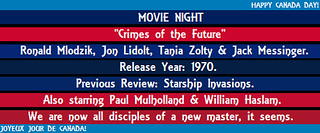
Ronald Mlodzik (Adrian Tripod), with Jon Lidolt, Tania Zolty, Jack Messinger, Paul Mulholland, William Haslam, and William Poolman. Directed by David Cronenberg.

Review
The 2nd part of this celebration on Canada Day ends with Crimes of the Future, the first time a David Cronenberg film has been featured on Movie Night. The movie was directed, written, produced, edited and shot by Cronenberg, born in Toronto. I can't say I remember the last time I watched an experimental film, complete with a bunch of unknown actors and Mlodzik as our narrator in a movie that certainly relies on imagery more than anything. But the main question is if the movie is any good? I suppose it all comes down to what you feel about watching something a bit different than the usual sci-fi fare. It lasts just barely over an hour, but to some it may feel much longer, depending on the amount of patience one has for something that is strange in its own right.

I'm not in the camp of going for movies just because they aren't in the mainstream, but I'm also not in the camp of outright rejecting something that doesn't appeal to everyone. I try to go into all the movies I see with at least some sort of open mind, and though I do admittedly differentiate in reviews of certain movies from time to time, there is an attempt to try and understand the effort taken in movies, even ones like this. The cinematography (also by Cronenberg) is decent, sometimes showing the strangeness of a world that may already be doomed. It's a twisted movie, with a mindset that does not skew towards what it wants to be, as strange and sad as it may be. If you are into movies of the experimental / art house genre that try to be something really different, you might be for it. I can't make myself give this a positive review, but it is at least a movie with effort. 

 Overall, I give it 6 out of 10 stars.

And with this ends another Movie Night on Canada Day. It is not my native country, but I felt that since it was close to my nation's Independence Day, it only made sense to try and include some Canadian films into the mix of the American celebration three days later. I hope you enjoyed the reviews.

Original image: 

Starship Invasions.


Review #815: Starship Invasions.

Cast
Robert Vaughn (Professor Allan Duncan), Christopher Lee (Captain Rameses), Daniel Pilon (Anaxi), Tiiu Leek (Phi), Helen Shaver (Betty Duncan), Henry Ramer (Malcolm), Victoria Johnson (Gazeth), and Doreen Lipson (Dorothy) Directed by Ed Hunt.

Review
Another year, another Canada Day to celebrate. I've done reviews dedicated to Canadian films before (#406 - Whispering City, #407 - Why Shoot the Teacher?, #408 - Goin' Down the Road, #409 - The Apprenticeship of Duddy Kravitz, #607 - Back to God's Country, #608 - Tomorrow Never Comes, and #722 - The Changeling), but this time I decided to pick one a bit different from the previous bunch - a sci-fi film (also known as Project Genocide in the UK, with War of the Aliens and Alien Encounter being the two titles of the movie before being renamed to the one seen above). It was filmed in Toronto about UFO's, with First Canadian Place (the tallest skyscraper in Canada) being featured in one scene. Believe it or not, this is a hokey kind of sci-fi film, with telepathic aliens, a suicide device used as a superweapon, and multiple shots of ships looking like hubcaps. It only makes sense for all the aliens to be telepathic, because without it they would have to speak with each other, instead of just being dubbed in the booth, so Lee is sadly relegated to just being silent, save for his voice from time to time. Vaughn certainly fits into the movie well enough, not being over-the-top or underplayed, even in a movie without much standout acting.

I have to admit, a group called the "Legion of the Winged Serpent" is pretty unique sounding, even if it's just a bunch of aliens in black garb, apparently descendants of transplanted humans, whatever that means. There is something strange about all these proceedings, maybe it's the random suicides (by the device, but still random), or the way the plot moves. At least it's not a simple invasion movie, though the merging of UFO accounts (such as the garb and robot design) really mesh weirdly with the Intergalactic League of Races and their pyramid in the ocean of the Earth. I find it funny they made a Galactic Treaty about not attacking Earth, when the Serpents just ignore it anyway. The movie runs quickly enough at around 90 minutes, and while it is a hokey kind of sci-fi film released on the heels of Star Wars, but there is a certain charm to the ridiculous nature of a movie that tries to mesh a bunch of aspects together to make for a movie best suited for being watched with a little bit of ribbing along the way.

Overall, I give it 6 out of 10 stars.

July 1, 2015

The Changeling.

Review #722: The Changeling.

Cast
George C. Scott (John Russell), Melvyn Douglas (Sen. Joseph Carmichael), Trish Van Devere (Claire Norman), Eric Christmas (Albert Harmon), John Colicos (De Witt), Jean Marsh (Joanna Russell), and Roberta Maxwell (Eva Lingstrom) Directed by Peter Medak.

Review
As Canada Day slowly ended today, I decided to celebrate Canada once again with this film mainly because it sounded too interesting not to. While the movie is set in Seattle, it was mostly filmed in Canada, more specifically Vancouver, incorporating shots of some Seattle landmarks and Vancouver landscape. In fact, the house featured in the movie was actually a modern house with a Victorian facade added on. As for the movie itself, it's pretty good. The atmosphere of the movie is well-maintained and helps contribute to an interesting movie that is both engaging and chilling. Scott has a commanding presence that keeps the movie on track, and he has a good rapport with Van Devere and Douglas. It's a movie that develops itself surely and steadily, making for good mystery while also having good thrills as well, especially at the end. I like the set they used for the house, and I also like the shots of both Vancouver and Seattle, which look nice. It's a good movie that has some scares while also being engaging. The movie runs well and never seems to drag on while also managing to keep a consistent tone and never waver. Ultimately, it's a good gem of horror. I hoped you enjoyed your Canada Day, and if you're not Canadian (like me), at least listen to O Canada once.

Overall, I give it 8 out of 10 stars.

edit-2026: revised image

July 1, 2014

Movie Night: Tomorrow Never Comes.

Review #608: Tomorrow Never Comes.

Cast
Oliver Reed (Jim Wilson), Susan George (Janie), Raymond Burr (Burke), John Ireland (Captain), Stephen McHattie (Frank), Donald Pleasence (Dr. Todd), Paul Koslo (Willy), John Osborne (Robert L. Lyne), Cec Linder (Milton), and Richard Donat (Ray) Directed by Peter Collinson.

Review
One of my favorite scenes from this movie is when Oliver Reed's character randomly asks for a table and some beer in the middle of a hostage situation, and at one point, he's just sitting in the shade, taking his time as tourists watch him. I don't know why, but it's just hilarious, maybe it's the random nature of the scene, or the fact that Reed's just sitting there outside as a hostage situation goes on. Anyway, this is the second part of the Canadian double feature, and this was a Canadian-UK production, with a few Canadian actors (Burr, Ireland, McHattie) and a few British actors (Reed, George, Pleasence), in the cast, along with a rare acting appearance by playwright John Osborne. The movie was at filmed in Quebec, with the majority of the movie taking place in a hotel, or near a hotel for that matter. The movie has its moments of tension and actual suspense, and the real fun is wondering what will happen next, or who'll appear next. I was actually surprised Pleasence was in this movie, but he is, briefly and he is at least entertaining. Reed is fun to watch, he looks like a kid who didn't get a toy he wanted 40 years ago and just remembered the event, especially with those glasses (but I'm the last person who should make jokes about wearing glasses). He is enjoyable though, and the rest of the cast (save for Paul Koslo, who comes off as a thrill-seeking dunce) work well, especially McHattie, who is good at delivering tension. The movie is well made, and surprisingly dark especially at the end, but it is overall a good movie that is recommended for a day like this. 

Happy Canada Day, northern neighbor.

Overall, I give it 8 out of 10 stars.

original image: 


Movie Night: Back to God's Country.

Review #607: Back to God's Country.

Cast
Nell Shipman (Dolores LeBeau), Charles Arling ('Sealskin' Blake), Wheeler Oakman (Peter Burke), Wellington A. Playter (Captain Rydal), and Roy Laidlaw (Baptiste LeBeau) Directed by David Hartford.

Review
There are many notable people from Canada I didn't cover last year, such as Norma Shearer, Donald Sutherland, Seth Rogen, Dan Aykroyd (whose birthday is today), Michael J. Fox and even William Shatner, and so in honor of our neighbor from the north, I'm reviewing two movies having to do with Canada. 

The first is this film, the second oldest movie ever reviewed on this show, released nearly 95 years ago, and one of the earliest Canadian features, and the most successful silent film in Canada's history. Shipman helped to write the film (which was already adapted from a short story by James Oliver Curwood), and she stars in it as well. The movie lasts about 72 minutes, so it's a breeze to get through, and though the plot may be somewhat paper thin, it at least is enjoyable to watch, though a little music would have helped. The blue tint for night is good looking, and the scenery is nice, the cold near wasteland is fine for a film like this. Shipman is a fine hero to watch, and the rest of the cast is decent, this is overall a decent movie that while starting slow, does manage to entertain, and on Canada Day, I guess that's all that matters. 

Overall, I give it 8 out of 10 stars.
The next film will be Tomorrow Never Comes, stay tuned, as it will be posted in a few hours. Go...Blue Jays?
original image:


July 1, 2013

Movie Night: The Apprenticeship of Duddy Kravitz.

Review #409: The Apprenticeship of Duddy Kravitz.

Cast
Richard Dreyfuss (Duddy Kravitz), Micheline Lanctôt (Yvette), Jack Warden (Max Kravitz), Randy Quaid (Virgil Roseboro and Lenny Kravitz), Joseph Wiseman (Benjy Kravitz), Denholm Elliott (Peter Friar), Henry Ramer (Dingleman), Joe Silver (Farber), and Zvee Scooler (Grandfather) Directed by Ted Kotcheff (#025 - First Blood)

Review
To close out Canada Day, I decided to review this film from 1974 (have decided that reviewing Prom Night [1980] would be nonsensical), with familiar actor Richard Dreyfuss as the main lead. I already have watched Dreyfuss in American Graffiti and Close Encounters of the Third Kind, which were both good. This film is where Dreyfuss gets to shine even more, perfectly acting a character who (at least I hope) is perfectly unlikable (though ironically, he believed his performance was terrible), in someways a parallel to Goin' Down the Road, both films cover the spirit of people trying to succeed in a cold-hearted world, with its small benefits and its disasters. Lanctot is alright, but Randy Quaid (Who I last saw in Independence Day, which wasn't exactly good) is better, he manages to blend well into the film, not going over the top, a subdued but fine performances as two characters. The rest of the cast are good, and it is always nice to see Denholm Elliott, no matter what he does. This is a well-made film that manages to have really good scenery but even better filmmaking, a sad film that has biting comedy at times, but it does not veer from its course, keeping itself in check, and managing to be an excellent film.  

Overall, I give it 9 out of 10 stars.

And that is the last film for Canada Day, I hope you enjoyed my attempt to give Canadian films some spotlight, because at least I did.

Original image: 


Movie Night: Goin' Down the Road.

Review #408: Goin' Down the Road.

Cast
Doug McGrath (Peter McGraw), Paul Bradley (Joey Mayle), Jayne Eastwood (Betty), Cayle-Lorraine Sinclair (Selina), Nicole Morin (Nicole), and Pierre La Roche (Frenchie La Roche) Directed by Donald Shebib.

Review
Goin' Down the Road feels like a documentary with its film style but it doesn't sugarcoat the characters, it doesn't try to overly happy, it nearly borders on depressing, but it is cohesive and it does manage to tell a useful story. The acting blends in with the film tone, rugged, but useful, This isn't a cheery little optimistic film; it tries to deliver lessons that uses Canada in the landscape to give more of a feeling and more of an edge to the film. The directing is alright, as this film flows well and it also runs well, not going on too long or too short. This is a really good film, and Canada should be proud of this film, for all that it is worth in its emotion and all of its pride, which is something to say about.

Can Canada succeed once again? (This is Part III of my four film review special for Canada Day 2013).
Overall, I give it 9 out of 10 stars.

original image: 

Movie Night: Why Shoot the Teacher?

Review #407: Why Shoot the Teacher?

Cast
Bud Cort (Max Brown), Samantha Eggar (Alice Field), Kenneth Griffith (Woods), Chris Wiggins (Lyle Bishop), Michael J. Reynolds (Bert Field), John Friesen (Dave McDougall), and Gary Reineke (Harris Montogomery) Directed by Silvio Narizzano.

Review
There are quite a few Canadian connections with this film, which features filming in Alberta (doubling for Saskatchewan while Silvio Narizzano, a Montreal native, directed.

This comes right up my alley for Canada Day. So how is it? It's a decent film that starts off a bit slow but chugs hard with a lot of effort. Bud Cort is a good actor in this film and carries this film along for a good chunk of the film. While the scenery is nothing much to look at it, this film does have some comedy and a good dose of drama to keep itself in check, managing not to be too outdated but keeping itself in tone, not forgetting its roots, which is a good thing.

Overall, I give it 8 out of 10 stars.
original image: 

Movie Night: Whispering City.

Review #406: Whispering City.

Cast
Helmut Dantine (Michel Lacoste), Mary Anderson (Mary Roberts), Paul Lukas (Albert Frédéric) and John Pratt (Edward Durant) Directed by Fedor Ozep.

Review
Ah Canada, America's neighbors of the North (unless you live in Alaska), the creators of hockey, the second largest country in the world, home of ten provinces and three territories from British Columbia to Quebec. There are Canadians known for film, such as James Cameron, Norman Jewison, Jim Carrey, David Cronenburg, and Mary Pickford (the last two listed I will cover in more detail in reviews in the future), so in light of Canada Day, I decided to review a few Canadian films, and Whispering City...is one of them. Filmed in Quebec City and with a limited cast, A fun fact is that Whispering City was filmed in English and in French. The film itself runs at about 90 minutes and it flows okay, not going on for too long in dialogue, and the actors don't do too bad, doing alright in a noir from the north. It is kind of a curious film to watch as it is easy to find and   the scenery isn't too bad, especially when Montmorency Falls is shown, a crucial part in the film. This is a decent well manner film that tries hard and manages to be a success in its own right, for all that is and all that it is worth, which I suppose makes sense.

Overall, I give it 7 out of 10 stars.

Original image: