Showing posts with label George Sanders. Show all posts

June 23, 2026

The Black Swan.

Review #2548: The Black Swan.

Cast: 
Tyrone Power (Jamie Waring), Maureen O'Hara (Lady Margaret Denby), Laird Cregar (Sir Henry Morgan), Thomas Mitchell (Tom Blue), George Sanders (Captain Billy Leech), Anthony Quinn (Wogan), with George Zucco (Lord Denby), and Edward Ashley (Roger Ingram) Directed by Henry King (#1687 - O. Henry's Full House, #2223 - The Gunfighter)

Review: 
It probably helps to cover a swashbuckler movie every now and then, even one that basically freewheels around its alleged "source material". Taking the title of the 1932 novel of the same name by Rafael Sabatini (you might remember that he previously had his novels adapted into films with Captain Blood [1922/1935], and Bardelys the Magnificent [1926]), the movie had a screenplay by Ben Hecht and Seton I. Miller. At the helm for direction was the solidly reliable Henry King, fresh in the middle of directing Remember the Day (1941) and The Song of Bernadette (1943). This was one of three films with O'Hara (who had joined Fox with How Green Was My Valley [1941] as among the leading cast, which included To the Shores of Tripoli and Ten Gentlemen from West Point. She had meant to co-star with Power with Son of Fury: The Story of Benjamin Blake (1942) but dropped out due to illness. With this film, she noted her happiness in the film, once stating it was "everything you could want in a lavish pirate picture." The movie was a fairly decent hit at the time, and Leon Shamroy won an Academy Award for his cinematography (shot in color*) on the film.  

You've got a 1600s setting with a few interesting effects and shots to go along with a fairly efficient 85-minute runtime that freewheels with history (the real Morgan, a privateer and plantation owner who was knighted in 1674, served on the Assembly of Jamaica and also was a Lieutenant Governor and occasional interim governor before he died in 1688, as one does when living to his fifties) for a fairly decent effort. I don't think it's exactly on the level of say, The Mark of Zorro (1940) when it comes to a slapdash Power film, but it's still a pretty amiable time, mainly because you see enough enthusiasm from its main cast. It's the "love, gold, and adventure!" movie to swallow up like it was cotton candy, filled with hokum in the "loving care" type - you either have that patience or don't. With the war effort booming in 1942, Power enlisted in the Marine Corps in August, with Crash Dive being the last one before he went through training/combat missions until he returned in 1946. He has the panache required to just step into the swashbuckling type (debate all you want who managed it better between him and, say, Errol Flynn*) with general ease of charm without looking like he wants to be somewhere else. The leading ladies can change, the staging might differ, but you can still see the commitment present in the swagger to just go through the motions and not make it sound tired. O'Hara doesn't exactly as much to really grab onto for the character besides the usual swooning type for adventures where one sees the adventurer face the odds and beat them and, well, you know what happens. But at least she is game for matching with Power with fiery grace and got onto better things. Cregar (a stage-turned-film actor that got his supporting roles in 1941 and was going to be a leading man before his untimely death in 1944) hams it up with captivating warmth that probably captures the film more than anybody, and that includes the credible attempts from adversaries in Sanders and Quinn. It's a sword-splitting movie that looks decent enough, has a few credible moments in swinging around without swinging completely for the fences that doesn't dawdle - what more could you ask for? For a 1940s movie, an average movie of its time is still as desirable as ever.

Overall, I give it 7 out of 10 stars.


*Remember that folks could win for cinematography in black-and-white and in color for several years.
*At least people don't call Power a creep.

April 15, 2022

Rebecca (1940).

Review #1828: Rebecca. 

Cast: 
Joan Fontaine (The second Mrs. de Winter), Laurence Olivier (George Fortescue Maximilian "Maxim" de Winter), Judith Anderson (Mrs. Danvers), George Sanders (Jack Favell), Reginald Denny (Frank Crawley), Gladys Cooper (Beatrice Lacy), C. Aubrey Smith (Colonel Julyan), Nigel Bruce (Major Giles Lacy), Florence Bates (Mrs. Edythe Van Hopper), Edward Fielding (Frith), Melville Cooper (Coroner at trial), Leo G. Carroll (Dr. Baker), and Leonard Carey (Ben) Directed by Alfred Hitchcock (#219 - Rope, #223 - North by Northwest, #446 - Spellbound, #447 - Psycho, #450 - Vertigo, #455 - Rear Window, #553 - Strangers on a Train, #800 - Shadow of a Doubt, #910 - Notorious, #963 - The Lodger: A Story of the London Fog, #964 - The Ring (1927), #965 - Downhill, #970 - Mr. and Mrs. Smith, #977 - Frenzy, and #1343 - The 39 Steps, and #1739 - The Birds)

Review:
It does become interesting to consider just how many movies one can see of the late Alfred Hitchcock, particularly since his line of work has taken up nine percent of all films I've ever seen, which is a weird way of saying seventeen films. Of course, the real story is the fact that this was not only the 26th feature film directed by Hitchcock, it was his first directed in Hollywood. Hitchcock was forty years old when he decided to move to Hollywood, having believed that he reached his peak in his native Britain, and it was the efforts of producer David O. Selznick that led to him moving; the two signed a seven-year contract; Hitchcock would end up producing more films by himself than with Selznick, and they would have their disagreements in terms of personality and professionalism when it came to this film, to where they only worked on one other film together in Spellbound a couple of years later, most notably because Hitchcock liked to film a controlled cut without too much extra footage. As such, this is an adaptation of the novel of the same name that had been written by Daphne du Maurier, and it was Hitchcock who had adapted her previous book Jamaica Inn in 1939. Incidentally, the book had been adapted on radio by Orson Welles in 1938, and a stage adaptation had been done by Du Maurier in 1939. Selznick aimed to be quite faithful to the book, as much as one can do with the Production Code, which had one particular rule about spouse death. Hitchcock was a busy man, since this was also the year of release for Foreign Correspondent, which like this film would be nominated for an Academy Award for Best Picture (other films nominated were films such as The Grapes of Wrath, The Great Dictator, and The Philadelphia Story). As it happened, Rebecca would win the award, making it the only Hitchcock film to ever win the honor; Selznick, as the recipient of the award, became the first back-to-back winner for a producer. As such, the screenplay was done by Robert E. Sherwood and Joan Harrison, while the adaptation was done by Philip MacDonald and Michael Hogan. 

Several actors were considered for the main roles, such as Ronald Colman, William Powell, Olivia de Havilland, Loretta Young, among others. Sometimes one needs a Gothic vision to really see the talents of Hitchcock come alive, if only because one wants to see just where the rabbit hole goes in mystery and tortured romance, where the unsaid is more biting than the action. 130 minutes never felt so magnificent when it comes to how Hitchcock has handled the macabre with the terror that comes from memories of a deceased wife that haunts both an estate and the husband himself (incidentally, one never sees the title character nor knows the name of the one of the main characters) that creates such diverting paranoia without becoming a costume show; George Barnes and his cinematography help in that regard to make a stirring film look as alive as it does, and it probably isn't surprising that Barnes won an Academy Award for his work. Of course, the cast is just as effective as the crew. Olivier portrays the vulnerability required with such brooding patience that makes for quite a volatile and curious interaction with Fontaine, one ripped by the past that holds him down further than anything else could, which means one is watching a gripping performance that isn't just a show for Olivier (a talented actor already noted for his performance in Wuthering Heights the year before). Fontaine (the younger sister of actress Olivia de Havilland) had a few key roles in films before this film, most notably Gunga Din (1939), but this was the film that made her a key star (Fontaine however did not care for her typecasting for just melodramatic roles, which would include films done by Selznick like Jane Eyre (1943) and even another du Maurier adaptation in Frenchman's Creek the next year). It doesn't take much to see why she became a star, because her performance is quite excellent, one with the exact type of withering vulnerability required in showing doubt that doesn't become overshadowed by the other members of the cast, and the growing confidence by the second half only helps to make a well-rounded performance of curiosity. Anderson (considered one of the great stage actors of her time) makes a compelling adversarial presence, one who lurks around Fontaine that practically glides from scene to scene (complete with a lack of blinking) that makes the final result all the more haunting. Sanders, when he does show up, makes a perfect cad to view against the others, and the rest of the cast keeps the proceedings dignified and well invested. As a whole, the movie is a classic worth viewing among all the other Hitchcock classics for what is seen and what isn't seen in this Gothic mystery that has the highlights from its director and producer in Selznick without becoming consumed by itself. One can debate just where the film rests among the classics, but one knows by the time the film ends that it is up there in the margins somewhere for what it ends up doing with a master at work.

Overall, I give it 10 out of 10 stars.

June 12, 2017

Ivanhoe (1952).


Review #946: Ivanhoe.

Cast:
Robert Taylor (Sir Wilfred of Ivanhoe), Elizabeth Taylor (Rebecca), Joan Fontaine (Rowena), George Sanders (Sir Brian De Bois-Guilbert), Emlyn Williams (Wamba), Robert Douglas (Sir Hugh De Bracy), Finlay Currie (Sir Cedric of Ivanhoe), Felix Aylmer (Isaac of York), Francis de Wolff (Front De Boeuf), Norman Wooland (King Richard), and Basil Sydney (Waldemar Fitzurse) Directed by Richard Thorpe (#327 - Jailhouse Rock)

Review:
Based off the historical novel of the same name by Sir Walter Scott, Ivanhoe manages to shine as a fine piece of entertainment, filled with Technicolor spectacle and costumes to go with it. I can't say it's as good as The Adventures of Robin Hood (#505), for example, but it is at least a pretty interesting piece of work. Robert Taylor is a capable lead, managing to give off a commanding presence pretty quickly. An interesting fact is that Taylor, along with Thorpe and producer Pandro S. Berman, would later make two more films together in the next few years (Knights of the Round Table and The Adventures of Quentin Durward), forming an unofficial trilogy. Elizabeth Taylor does a fine job in this sweet but also capable character. Fontaine doesn't have as much to do, but she gives off a competent feel. The three form an interesting love triangle that does prove somewhat compelling, alongside the main plot, anyway. Sanders is the main adversary, and he does an alright job in making him somewhat three dimensional, particularly around the end of the film. The Norman-Saxon plot is decent, though nothing too special. Miklós Rózsa does a fine job with the music score, being quite heroic and quite fitting for the movie. The jousting sequence is well executed, and the battles are also pretty well done in capturing excitement and pacing.  Within its 106 minute run-time is a movie that balances a fine line between action and structure that does not drag itself too often, and while it may succeed more in the former than the latter, it definitely is worth consideration, with its spirit of thrills outweighing the risks.

Overall, I give it 8 out of 10 stars.

January 30, 2017

A Shot in the Dark.


Review #899: A Shot in the Dark.

Cast:
Peter Sellers (Jacques Clouseau), Elke Sommer (Maria Gambrelli), George Sanders (Benjamin Ballon), Herbert Lom (Charles Dreyfus), Tracy Reed (Dominique Ballon), Graham Stark (Hercule Lajoy), Moira Redmond (Simone), Vanda Godsell (Madame LaFarge), Maurice Kaufmann (Pierre), Ann Lynn (Dudu), David Lodge (Georges), André Maranne (François), Martin Benson (Maurice), and Burt Kwouk (Kato) Directed by Blake Edwards (#329 - The Pink Panther and #481 - The Party)

Review:
One thing that definitely can be said about this is that it certainly continues the laughs from The Pink Panther (released less with Sellers in control this time around as the main lead, with a more peculiar accent that became the hallmark of the character. With a great deal of slapstick and gags that combine with an engaging cast willing to have fun, A Shot in the Dark is also a fine sequel, while introducing newcomers that would become mainstays in the franchise, such as Lom as the long-suffering Dreyfus and Kwouk as Cato, the skilled servant used to "help" Clouseau in keeping his skills. Both are prime in their roles, with the latter getting especially more compelling the more the film goes on. It's also a pretty decent mystery as well, where the facts and allure balance handily with a movie that never veers too seriously but also never veers too ridiculously off-point, where every scene has something worth watching. Sellers and Sommer have a fair balance of chemistry together, right from their opening scene, where Clouseau catches on fire. Sellers seems at ease doing this role, with the right sense of bumbling incompetence that never ceases to entertain nor overstay its welcome, even when it repeats a gag or two a few times. I'd say some of the situations, but that just spoils the fun of what is a good romp. The movie gets wild, but it never goes completely off the rails, always having a sense of responsibility, with a fairly concocted climax as well.  At 102 minutes, A Shot in the Dark is also pretty well paced, having the right amount of gags and characters to make for a fun movie for anyone.

Countdown to #900: 10, 9, 8, 7, 6, 5, 4, 3, 2, 1. Tomorrow night: Number Nine Hundred.

Overall, I give it 9 out of 10 stars.

October 23, 2015

All About Eve.


Review #750: All About Eve.

Cast
Bette Davis (Margo Channing), Anne Baxter (Eve Harrington), George Sanders (Addison DeWitt), Celeste Holm (Karen Richards), Gary Merrill (Bill Sampson), Hugh Marlowe (Lloyd Richards), Thelma Ritter (Birdie), Gregory Ratoff (Max Fabian), Marilyn Monroe (Miss Casswell), and Barbara Bates (Phoebe) Directed by Joseph L. Mankiewicz.

Review
Based off "The Wisdom of Eve" by Mary Orr, All About Eve is a movie that held the record for most Oscar nominations (14) until Titanic tied it over four decades later, with five actors receiving nominations, and one (Sanders) winning. In fact, Joseph L. Mankiewicz won two Oscars for the movie (Best Director and Adapted Screenplay). 65 years later, the movie is heralded as a classic. And why not? It is great. It's interesting that the big highlight in a movie all about Eve is not Eve herself, but Bette Davis and her tremendous screen presence. She is always interesting to watch and always entertaining, especially when interacting with the cast. Baxter is effective in making her character come off as innocent and helpful...for a while, anyway. Her scene with Holm in which she would will be willing to use Karen's deep friendship with Margo as leverage just to get a part shows the extent of Eve's manipulation. But while her ambition got her out of one problem along with getting her this far, it may have gotten her into another situation...but the movie ends on a different character, named Phoebe. The final scene, with her taking the award and imagining herself winning one is certainly fitting. Sanders manages to ingrain his character into the narrative. He may be snide. but his way with words is much more devastating. His scene with Baxter at the end, is especially well-done, as the movie comes full-circle. The movie begins with Eve winning an award for her performance in a play...but maybe in a way she hasn't won. She won the award, but perhaps at the cost of her heart, in a sense. One actress who also is in the movie, though brief, is Marilyn Monroe, whose character also plays a role in regards to Eve's rise. Monroe doesn't get much to do, but she is interesting to watch, especially when being guided by Sanders in his attempts to give her a career. The movie certainly looks well in both fashion and just in general, with the Costume Designers (Edith Head and Charles LeMaire) winning an Oscar for it. Bottom line, the movie is interesting to watch, especially if you love big performances and love big classical drama.

Thank you for reading this 750th Review. I hope you enjoyed it.

Overall, I give it 10 out of 10 stars.

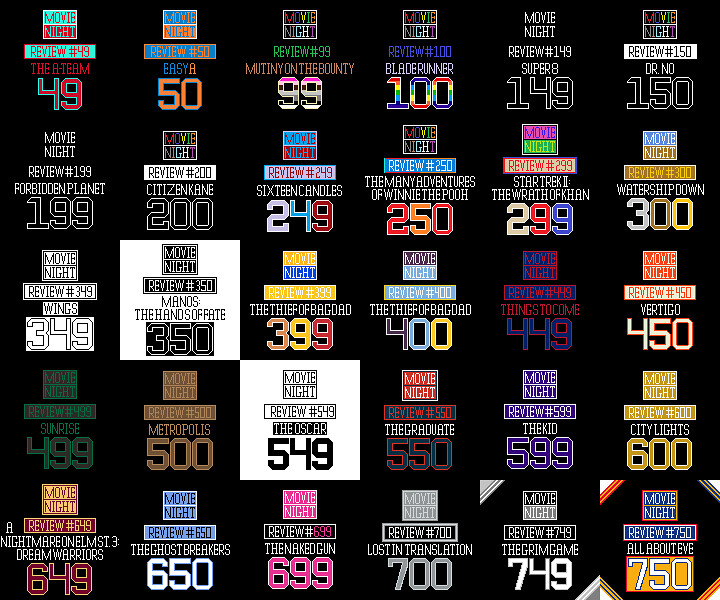
For all of the appreciation over the past 750 reviews, I made a collage detailing from the first big landmark (and the number before it is, as customary)...all the way up to now. Thank you. Enjoy.


October 27, 2012

Movie Night: Village of the Damned (1960).


Review #270: Village of the Damned.

Cast
George Sanders (Gordon Zellaby), Barbara Shelley (Anthea Zellaby), Martin Stephens (David Zellaby), Michael Gwynn (Alan Bernard), Laurence Naismith (Doctor Willers), Richard Warner (Harrington), Jenny Laird (Mrs. Harrington), Sarah Long (Evelyn Harrington) Directed by Wolf Rilla.

Review
This film was based off the novel The Midwich Cuckoos, by John Wyndham in 1957 which has been adapted into two movies and radio adaptations, with this film being one such adaptation. So how is it? It is..creepily delectable. The acting is good, especially from Martin Stephens (one of the main children), who does a creepy, yet useful performance. The main leads do a stand-up job as well, but this is not the only thing that helps out, that would be the chiller aspects (It was chilly in my house while watching this) The eyes are the thing that gets me everytime they get shown, as are just the idea of children advancing rapidly in a small village. I wish the film could've been a bit longer so there could be some more scares (Barely lasts longer then Batman: Mask of the Phantasm), but oh well. In the end, this is an excellent film filled with scares and chills.

Overall, I give it 9 out of 10 stars.