
Showing posts with label James Woods. Show all posts

October 1, 2026

Videodrome.

Review #2585: Videodrome.

Cast: 
James Woods (Max Renn), Debbie Harry (Nicki Brand), Sonja Smits (Bianca O'Blivion), Peter Dvorsky (Harlan), Leslie Carlson (Barry Convex), Jack Creley (Dr. Brian O'Blivion), Lynne Gorman (Masha), Julie Khaner (Bridey James), David Bolt (Raphael), and Reiner Schwarz (Moses) Written and Directed by David Cronenberg (#816 - Crimes of the Future, #1127 - eXistenZ, #1220 - A History of Violence, #1239 - Stereo, #1624 - Shivers, #1712 - The Fly [1986], #2132 - Crimes of the Future [2022], #2276 - Rabid [1977])

Review: 
 "I've always been interested in dark things and other people's fascinations with dark things. Plus, the idea of people locking themselves in a room and turning a key on a television set so that they can watch something extremely dark, and by doing that, allowing themselves to explore their fascinations."

We do love our technology, don't we? Now more than ever, the lines between reality and what we actually see for "entertainment" (television, phone, what have you) is blurred. The human body is the battlefield for what is "too far" and it probably goes without saying to consider how far the word "goon" has gone beyond its original meaning. People will believe what they see and hear from their screens, and you could figure that out in the time when people still used tapes (hell, in different future days, there were people who believed what they heard on the phone from alleged cops). One man's reality is another's delusion, and it goes doubly for how far things have moved from TV being reality and therefore reality being less than TV, as they say. Apparently, when David Cronenberg grew up in his native Toronto as a kid, he could tune into American TV signals from Buffalo in the States when the Canadian stations went off the air and the idea of maybe seeing something he shouldn't see lingered in his mind. The ideas gestated in his head (as one does when knowing about Marshall McLuhan, who taught at the University of Toronto when not being the one considered the "father of media studies") before getting a good chance to do the film with his particular growing reputation. With partial financing from Universal Pictures (it should be noted that this was the last film of his made in the Canadian "tax shelter" era) and filming in Toronto, Videodrome actually did get released to hundreds of theaters in February 1983 and promptly died in theaters, with Cronenberg once musing it wasn't an "exploitation sell [or]...an art sell." At any rate, it soon developed a cult following (various videos exist involving the making of the film, as seen here).

You get a shelter that has homeless people gather to watch television, people who communicate through a TV screen, a certain point where the lines between reality and fantasy blur, and, oh yeah, gooey body horror moments within the actual horror of what really does lurk beyond "special names" and manipulation of people's obsessions. It's not what you see that's important in terms of the "videodrome", it's the fact that reality can in fact be shattered by those who live on the screen that really matters in control. It all leads to Woods and his commanding presence in a cynic with no sense of philosophy beyond "there's an outlet somewhere" (wiser minds wondered if it was really the medium that was the message). There is a killer instinct within Woods to just make a role look so intense by the way you see him maneuver with his expressions more than anything that reaches to the heart of all with the perverse rot in one's soul (which, well, is the type that can be alluring to a certain type of stimulated person). His certain type of "soul" does go hand-in-hand with how Harry (the vocalist of Blondie who dabbled in acting such as Union City [1980], this and Hairspray) treats the world of over-stimulation and curiosity. Her awareness of craving pleasures and pain (for whatever you might read when seeing someone stuff a cigarette on their chest) is the type of alluring "question mark" (well, if you go with that from an interview with her); with so much time spent in a box, you almost could call it a virtual performance (compared to the v-tubers of the now, I suppose being told about the flesh is an improvement). In the battlefield of what airwaves are to be seen in the mind to take the bed with you, one sees the dueling sides with Smits & Creley and Carlson & Dvorsky to sobering effect, well, at least when you consider that both want to shape would-be users for a certain type of evolution. Sure, the plot of the movie is loose, particularly when it comes to really figuring just what is hallucination (full-scale, if you will) and what is the horrors of actually seeing a new type of hell (slits in the abdomen and appendages to the arm that might as well be a new type of sex organ). You just have to enjoy the ride of raveling and unravelling in stimulation to see that, yes, the video screen really can be a tool or weapon and you are living in that world right now. With an efficient pace of 89 minutes that rides the wave of grime and bleak nature of what it really means to see beyond the flesh, it's a pretty good way to unsettle oneself in the eyes of stimulation.
 
Overall, I give it 9 out of 10 stars.


It begins. We're going to try and get as many horror movies as we can, which will run the gamut from franchise stuff such as Saw V all the way down to anthology picks to the oldies to beyond while having time for spectacular fun in November. Stay spooked.

October 30, 2023

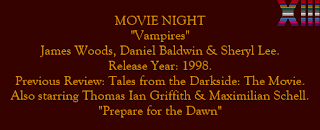
Vampires (1998).

Review #2130: Vampires.

Cast: 
James Woods (Jack Crow), Daniel Baldwin (Tony Montoya), Sheryl Lee (Katrina), Tim Guinee (Father Adam Guiteau), Thomas Ian Griffith (Jan Valek), Maximilian Schell (Cardinal Alba), Mark Boone Junior (Catlin), Gregory Sierra (Father Giovanni), and Cary-Hiroyuki Tagawa (David Deyo) Directed by John Carpenter (#068 - Halloween (1978), #634 - Escape from New York, #712 - The Thing (1982), #732 - Escape from L.A., #1221 - Dark Star, #1298 - They Live, #1479 - Big Trouble in Little China, #1605 - Starman, #1874 - Assault on Precinct 13)

Review: 
"I got into this business to make Westerns. I didn't get into it to make horror movies. I got typecast. But once I got over that, I realized it's like John Wayne. I wrote one script for him back in the '70s. He always wanted to play heavies. He was tired of playing the good guy, but he said, 'Oh, they like me that way.' I'm like a good whore; I go where I'm pushed."

On October 30, 1998, John Carpenter's Vampires was released to the general public. The film is based on the novel Vampire$, as written by John Steakley in 1990. Years had been spent in development by Largo Development, who recruited Russell Mulcahy (most notably the director of the first two Highlander films) to try and develop it as director with apparent ideas to have Dolph Lungren serve as the star. This did not come to pass, and Carpenter was approached to do the film right as he was on the idea of retiring after production of Escape from L.A. (1996) had been less than fun to make. The writing credit for the film is lent to Don Jakoby, although there were clear re-writes by Carpenter, who had been approached of the idea to do the film to look over two screenplays - one by Jakoby and one by Dan Mazur (evidently one script involved a part set in France with a church battleground and the other involved a mall with teenagers turning into vampires). Carpenter apparently liked both and thus utilized select elements from each to go with parts from the book before having to modify it again when the budget was suddenly slashed from $80 million to $20 million at the last minute. 25 years later, it probably seems apt to look back on what Carpenter was saying when it came to being asked about the film back then, and one quote certainly could stick with you. He mused that films nowadays (read: 1998), particularly with horror films starting with stuff such as Scream (1996) seemed to have a "postmodern style" when it came to winking at the audience and that his film tried to do the opposite. In case you were wondering, Blade (1998), a film also dealing with a vampire hunter dealing having to stop some sort of ritual from being done by an evildoer vampire, was released just a few months earlier in August (to be technical, Vampires was really released a bit earlier than October in France, but do you really care about France?). As one might expect, Carpenter also composed the music for the film. Two direct-to-video sequels followed in the next couple of years, but they had no involvement from Carpenter, so nope.

Carpenter obviously thought his vampires were savage enough to seem different from those ones that seemed to brood at times. The strange thing isn't so much that Woods is the lead actor here as it is the fact that Carpenter went through a row of names and somehow thought about R. Lee Ermey (the studio felt he lacked the star power and declined the idea). Oh hell, I was fine with the film, what can I say? Granted, it obviously isn't one of Carpenter's best films (of the five features he did in the 1990s, this was apparently his only successful one with audiences, but there are folks who will tell you about giving In the Mouth of Madness (1994) or the aforementioned Escape a second look). But I like Carpenter (thank goodness we live in an age where people remember The Thing as being great rather than the rubes that hated it back then), and I like his ideas in trying to do a Western with vampires that seems more familiar with Sam Peckinpah than his general influence in Howard Hawks. In the 108-minute runtime, you might say the best way to judge the film is how one rides with the opening action sequence, because it is the one big moment with the entire cast before basically doing a rendition of The Wild Bunch. Of course, this bunch involves vampire hunters sanctioned by the Catholic Church (they are pretty good at dragging folks into the sun, so they get leeway for drinking and screwing around at night) that deal with the general rules of vampires: stakes and the sun are the one to deal with vampires that don't care for crosses or turning into bats. Where else would vampires be around but in New Mexico? At the helm is Woods, who is actually pretty amusing in overblown macho-ness. His flippant energy is entertaining to me for that element of curiosity of just who would be more dangerous, the vampire beast or being in the same room with him. Carpenter apparently let him ad-lib for a take before doing one that adhered to the script and evidently the off-color stuff was left in at times. Sure, it isn't the timeliest of off-color stuff (oh hey, never check out an actor's Twitter account), but, well, his crudity suits the film like a glove rather than coming off as schtick (if it was really schtick, he wouldn't be wearing blue jeans the whole time). His intensity is fun, what can I say? Baldwin and Lee don't exactly have as much to do in deference to the hunt besides an attempt at chemistry that is shaky (particularly since the only reason the latter is there is because of a temporary psychic link formed to the villain...by a bite on the inside thigh). Griffith doesn't have as much to say as the general threat, but he makes a fair ferocious threat in feral desires, one who sees the night every time but with the lust for more that is, well, accurate (at least to a night owl like me, anyway). Schell may have the most inevitable of all paths for the film next to Guinee, but they both do fine in varying tones against Woods in "Catholic patience". In general, the film is a road film, one that dwells a bit in conversation of where to go in weary doggedness that can only be done the same way one has seen in a Western where a man brings his folks along for the ride to possible certain death because damn it, it's their ride (of course, there is the horror stuff one thinks they will see such as a handful of vampiric terror like severed limbs, so...). It even ends on a variation, because who else could tell doomed folks to go with God before giving them a head start on an inevitable chase to death? I think, at the end, I ended up liking the film a bit more when I processed it, even if I can acknowledge that it won't be everyone's cup of tea of weary Western-soaked vampire guns-in-the-sun. If you respect Carpenter as that director of human nature in worthy entertainment, well, the film (now 25 years old) will be just right up one's alley.

Overall, I give it 8 out of 10 stars.
Next up: Cronenberg-mania.

June 23, 2021

Surf's Up.

Review #1691: Surf's Up.

Cast: 
Shia LaBeouf (Cody Maverick), Jeff Bridges (Zeke "Big Z/Geek" Topanga), Zooey Deschanel (Lani Aliikai), Jon Heder (Chicken Joe), Mario Cantone (Mikey Abromowitz), James Woods (Reggie Belafonte), Diedrich Bader (Tank "The Shredder" Evans), Dana Belben (Edna Maverick), Brian Posehn (Glen Maverick), with Kelly Slater and Rob Machado (themselves) Directed by Ash Brannon and Chris Buck (#579 - Frozen)

Review: 
Truthfully, I don't know anything about surfing. I have spent more combined time at a water park than at the beach, and I say this as someone who barely travels to begin with, but I imagine that there is quite the interesting time one could have spending a summer with waves and time to ride (If I had viewed something like The Endless Summer (1966), the originator of the travelling surf craze, I probably would have said the exact same thing). Naturally, we have a surf movie involving penguins. Welp, there were quite a few penguin-themed movies to come out in such a short span with each other, whether as a nature-documentary in March of the Penguins (2005) or with Happy Feet (2006, which started development after this one had started). The last one is interesting to note, because that film and this one include motion capture within its animation; Surf's Up has a look of a hand-held documentary because of motion capture that was done of the movement of a camera operator, and it is probably interesting to note that the voices of the "film crew" chronicling said adventures are of the two directors in Ash Brannon and Chris Buck. Each had studied in character animation at California Institute of the Arts (Buck, eleven years older, was first), and both eventually did teaching there (Brannon was Buck's student for a time). Buck worked for Disney in the animation department on a few films (ranging from animator to character design to supervisor) before he directed his first film with Tarzan (1999). Brannon did work for both Disney and Pixar, which included serving as a co-director with Toy Story 2 (1999). At any rate, this is the second feature to come from Sony Pictures Animation, which had announced this film as being in development when the studio was established in 2002.

The screenplay was written by Don Rhymer, Ash Brannon, Chris Buck, and Chris Jenkins, while the story was written by Jenkins and Christian Darren. Look at it this way: at least the cast was recorded together, so this isn't just a brand movie with talking animals that reeks of complete corporate product. The film wasn't quite a great success with audiences, but one can only imagine how when you make a film for $100 million, although a direct-to-video sequel would be made with Surf's Up 2: WaveMania (guess what that is about) a decade later. The attempts at a laidback atmosphere within a "camera crew" really can't sustain itself fully for an 85 minute movie, but it proves to be an okay movie when it comes to casual amusement in doing the fundamentals in engaging the audience without ringing their heads with anything obnoxious or any blatant clichés. In other words, it may be by-the-numbers, but it does these things just fine for a movie with surfing penguins (if you can watch one where they sing, surfing isn't too off). LaBeouf proves worthy in making a readily generic lead story come around with a little bit of charm, talking to the audience with enough reach that we don't keep our eyes on something else (namely some nice looking waves) for too long. Truthfully, the most casually interesting presence is probably Bridges, abiding with calm composition that only comes from an offbeat mentor. Deschanel comes and goes in attempts at zippy charm to act with LaBeouf, which doesn't really go very far, really. Heder, apparently picked when the producers saw him in Napoleon Dynamite (I'll take a rain check on that), strolls along with a hint of amusement when it comes to trying to be more casual than the film, which I guess proves okay for brief moments. Woods gets to have his best impression of "speaking to the manager" for moments that I chuckle at pretty well. Bader gets to channel some insecure bravado for a few interesting moments to chuckle at, which I find just fine to cap a movie with some resemblance of enjoyment when it comes to learning "lessons" about enjoying the wave and the folks around oneself. Yes, it's a movie about surfing and penguins, and it is exactly as average as you could expect, which means that at least it didn't have a chance to be a complete grab in cynicism, which I guess means that this could prove a decent time for a night in the summer.

Overall, I give it 7 out of 10 stars.

August 31, 2020

Any Given Sunday.


Review #1523: Any Given Sunday.

Cast: 
Al Pacino (Tony D'Amato), Cameron Diaz (Christina Pagniacci), Dennis Quaid (Jack 'Cap' Rooney), James Woods (Dr. Harvey Mandrake), Jamie Foxx (Willie Beamen), LL Cool J (Julian Washington), Matthew Modine (Dr. Ollie Powers), Jim Brown (Montezuma Monroe), Lawrence Taylor (Luther 'Shark' Lavay), Bill Bellamy (Jimmy Sanderson), Andrew Bryniarski (Patrick 'Madman' Kelly), Lela Rochon (Vanessa Struthers), Lauren Holly (Cindy Rooney), Ann-Margret (Margaret Pagniacci), Aaron Eckhart (Nick Crozier) Directed by Oliver Stone (#095 - Wall Street, #1090 - Platoon, and #1265 - Natural Born Killers)

Review: 
"I love intelligent films that come at you fast. I don't have attention deficit disorder, my mind moves fast. There's a lot to deal with in my films. We had so many facts to go through, so the governing style was flash, cut, flash, repeat."

One needs to see a bit of distinct vision every now and then from a director, and Oliver Stone closed out his 20th century with another distinct focus in football. He had been a student at Yale University before doing service in Vietnam first through teaching students English in Saigon to wiping Merchant Marine ships to dropping out of Yale and enlisting in the United States Army. He went into New York University after that and graduated with a film degree in 1971. He made his first film as a director with the cheapie Seizure (1974) before getting the chance to write Midnight Express (1978), which resulted in an Academy Award for his script despite inaccuracies of the depiction of the real-life prison story. The Hand (1981) followed for Stone as a director, but the five years between this and his next was crucial, since he wrote Conan the Barbarian (1982) and Scarface (1983) in that time. He rocketed to further prominence with Platoon (1986) that kept him busy over the prevailing years, with this being his 15th as director/writer. He has touched subjects such as war with Salvador (1986), biopics with The Doors (1991), to crime with Natural Born Killers (1994), all seeming distinct in their provocative nature by Stone.

I wonder if Stone wanted to make the ultimate football film. What we have here is truly a hodgepodge of clichés and assumptions you can have in a sports film, right from an upstart rookie becoming a star and then needing to not become consumed in arrogance, a wearied wise coach (perhaps like Tom Landry?), action montages, and even having actual athletes as stars (of which there are several notable ones of the past like Lawrence Taylor or Johnny Unitas). Stone had first expressed an interest in a football project with an early 1980s script about an old linebacker he wrote in mind for Charles Bronson. Years later, he met journalist Richard Weiner. He had developed a script with former player Jamie Williams about a black quarterback. This would be combined with scripts done by John Logan and Daniel Pyne alongside inspiration from You're Okay, It's Just a Bruise by Robert Huzienga Jr (former team physician of the Los Angeles Raiders detailing player injuries); Stone and Logan would get screenplay credit while Pyne and Logan got story and Weiner and Williams were consultants. This frenzy also applies to editing, since there are four listed as part of the film. Stone clearly was under the mindset that football was somehow like war, particularly with how it marched on as a team together as opposed to individual only, while also seeing the other sides of football life (like the pain and egos). On a basic level, I would say that this is a decent movie, wrapped with making an involving film packing an ensemble worthy of carrying most of its weight that Stone wants to put on them on and off the field that can be fairly entertaining. Of course it also is considerably lengthy at 162 minutes (157 for the director's cut, in which twelve minutes were cut for pacing while adding six minutes of other scenes) with a self-importance like no other in its presentation of football players as the modern gladiator (complete with a brief flash of Ben-Hur to drive home the point) with all of the excesses that come from Stone's view on the matter. It is firmly a film of the 1990s in all the right and weird ways, one that I chuck a smile at when it stops doing flashes of editing and focuses on just the basics.

Pacino does quite well with the material required in garnering a leader one could rally around in all of the moods required, whether that involves weary loneliness or stubborn dominance that seems fairly convincing in rally curiosity. Diaz matches him in cleverness that never seems like a doorstep to forget about, a figure of new-school arrogance that does seem quite amusing. Quaid does fine with a man on his last leg of fame (and perhaps health) - respectable without being drowned in pity. Woods doesn't have too much to really do, but he is quite a conniving figure behind the lines that has one really good scene to munch on involving him being caught in a lie about the health of the players. Foxx (picked after Sean Combs lost the role apparently because he couldn't throw a football) captures the bravado of a rising star and all that comes with it in good detail, whether that involves brimming confidence or sparring words with anyone. Others such as Cool J and Taylor make the best of their time on screen in charm and coarse acting that resonate the siding of the football action in its business and excess. It can't quite keep every thread going without being a bit lost, but at least its numerous showing of games do look fairly convincing (hits and all) within a fictionalized football league (in the year 2001 no less). It still has a punch when it comes to the TV-infected sensationalism and other various topics, and it definitely seems willing enough to want to inspire a thought without bashing your head with it. On the whole, it lumbers to points about football gladiators and its exploitation a bit too much, but it does work itself enough to win out in the end.

Next Time: We venture into the 21st century.

Overall, I give it 8 out of 10 stars.

May 9, 2019

Final Fantasy: The Spirits Within.


Review #1217: Final Fantasy: The Spirits Within.

Cast: 
Ming-Na Wen (Doctor Aki Ross), Alec Baldwin (Captain Gray Edwards), Ving Rhames (Ryan), Steve Buscemi (Neil), Peri Gilpin (Jane), Donald Sutherland (Dr. Sid), James Woods (General Hein), Keith David (Council Member #1), Jean Simmons (Council Member #2), and Matt McKenzie (Major Elliot) Directed by Hironobu Sakaguchi and Motonori Sakakibara.

Review: 
Perhaps this movie is like the tale of Icarus. However, instead of daring to fly near the sun on illustrious wings of feathers, this is a film that dares to soar as the first photo-realistic computer-animated feature film, made over the course of four years with a budget of $137 million (with at least half the budget being spent on marketing from Columbia Pictures and construction in Hawaii of a studio for Square Pictures, whose demise rose from the eventual failure of the film at the box office). Final Fantasy (created by Hironobu Sakaguchi) is a series of fantasy role playing video games, with each installment being stand-alone tales that have recurring elements in terms of game mechanics, with fifteen main titles being released since 1987. Undeniably, it is easy to give praise to the ambition that the makers of this film had towards delivering something that would inspire curiosity and interest, although it seems more for the animation than the actual story in any case. It just can't help itself being a visual spectacle even after two decades of age (although it may take a bit of time to get used to its type of flair), at least. The spirit aspect feels a bit too hokey to really make for a compelling story, with the twist involving their true nature (with a name like Phantoms, take one guess) not making as much an impact. It feels too clumsy with trying to handle its characters, particularly with its main character, who never comes into focus as someone to really follow along with.

That's not to say I didn't like the performances of the cast, who each do their parts just fine. Wen does okay with what she is given, even if her chemistry with Baldwin (probably the most practical performer here) reads more like an audio-book than something befitting a movie, especially a science-fiction one. Rhames, Buscemi and Gilpin all do okay, providing little moments of amusement until they aren't needed by the plot. Sutherland fills the wise old shoes of his character without much trouble (ponder on the whole Gaia theory stuff as you wish, however), and Woods is finely tuned to play with a good deal of ham to his performance, which work out okay, even if his motivations feel a bit too underplayed to really resonate. The writing can't quite make them feel like people to gel with, as if I am watching one long cut-scene with no way to break free. The story was done by Sakaguchi, while having a screenplay from Al Reinert (writer of films such as For All Mankind and Apollo 13) and Jeff Vintar (co-writer of I, Robot). The parts involving the Gaia only serve to make the film seem more deeply rooted than it really is, with a climax that feels too patched up to have an impact. It isn't so much a junk food type of sci-fi movie as it is just an off-brand piece of candy that looks nice but is a bit stale in all the wrong places to really sit right. With a run-time of 106 minutes, it will prove fine for the eyes to sit with while resonating less with its aims that at drag a cobbled assortment of sci-fi gobbledygook across the line without being a complete success. I didn't feel that it was a waste of my time, but I did feel disappointed that it wasn't worth it just enough. I do find science fiction movies to be a fun thing to sit through, but I couldn't find this one to be just as fitting of praise as others that dared to show a different kind of reality or look.

Overall, I give it 6 out of 10 stars.