August 5, 2026
City Heat.
June 30, 2026
The Outlaw Josey Wales.
December 19, 2025
The Rookie (1990).
December 27, 2023
The Dead Pool.
April 21, 2022
High Plains Drifter.
November 9, 2021
Sudden Impact.
April 9, 2021
The Enforcer.
February 10, 2021
Bird.
Cast:
Forest Whitaker (Charlie "Bird" Parker), Diane Venora (Chan Parker), Michael Zelniker (Red Rodney), Samuel E. Wright (Dizzy Gillespie), Keith David (Buster Franklin), Diane Salinger (Baroness Nica de Koenigswarter), Michael McGuire (Brewster), James Handy (Esteves), Anna Thomson (Audrey), Damon Whitaker (Young Bird Parker), Arlen Dean Snyder (Dr. Heath), Sam Robards (Moscowitz), and Bill Cobbs (Dr. Caulfield) Produced and Directed by Clint Eastwood (#1252 - Space Cowboys, #1310 - Million Dollar Baby, #1476 - Pale Rider, #1501 - Unforgiven, and #1550 - Gran Torino)
Review:
"I'd love to go back in time. To Bourbon Street in the 20's, to 12th Street in Kansas City in the 30's, to 52nd Street in the late 40's."
It was once said by Miles Davis (a legend in his own right in music) that one could tell the history of jazz in four words: "Louis Armstrong. Charlie Parker." Jazz, one of the great music genres of the times, certainly had plenty of historical figures leading the way, and the key to understanding one of its styles rests with Charlie "Yardbird" Parker. The Kansas City native used his time on this Earth for a variety of impactful compositions that clearly touched upon numerous listeners with his alto saxophone of fast tempos and improvisation before his death in 1954. One of those folks was Clint Eastwood, who heard the musician play in Oakland when he was just 15. The film was made on a budget of $9-14 million and came around years after its script was developed by Joel Oliansky in 1980 (shaped by recollections from colleague Teddy Edwards), and it was originally intended to be a project for Richard Pryor. There would be participation from a variety of people close to Parker, such as his common law widow Chan Parker, provided recordings to Eastwood that she had in a vault. It was the first Eastwood film that he had directed where he did not appear in any form (Breezy (1973) had a cameo of him). This was the first of a group of jazz-related programs that Eastwood would be behind in some form (mostly producing), with 1988 also seeing the release of a documentary of the life of Thelonious Monk. It is the sound that matters most when it comes to this film (particularly with music coordinator and former alto sax at Birdland Lennie Niehaus, tasked with writing for the instruments to play where the original piano music was playing), since the recordings of Parker had to be digitally and electronically isolated from the solos, with modern backing tracks recorded over.
While it was not a success with audiences at the time of its release, it certainly has an appeal for those interested in jazz or for those who yearn to see someone at the top of their craft, struggles and all. The beauty of the film is the rhythm it carries with its tribute to a jazz legend with a biography that depicts selections from his life without rote routine or a judging eye. In a way, it moves like a beat you might hear in a jazz composition with all of the thoughtful moodiness required to make a worthwhile time. All interesting biopics have a performance to carry it and no one should be surprised by Whitaker and his effectiveness in bringing Bird to the screen. This was the first starring lead role for Whitaker, who had entered films and television with supporting roles in 1982 such as Tag: The Assassination Game (1982) and Platoon (1986) after a back injury had him shift focus away from football, although he did do some study in music before doing drama. He is the guiding force that makes the film work as smoothly as it does, one that can justify spending plenty of time with in all the soulful aspects that makes for a fascinating experience. He manages to carry talent alongside pain that we can see play a note alongside play his burden without just finding it easy to take judgement or easy pity for as a man. In other words, we see the genius that comes from the notes in the fragments that come out alongside his highs and lows that came with a struggle with addiction to heroin. Venora plays a worthy settling piece to the times away from the road, one with warmth and reason that come around with various scenes that jump from end to end (whether involving interludes at home or near the ends of the timeline spent). Zelniker does fine in those moments on the road, balancing talent with wracked nerve that obviously strikes a chord with what is needed with Whitaker, whether that means an albino act or struggles with oneself (incidentally, the real Rodney participated in the production and is even mentioned in the credits). Wright does well with following along with the beat required from Whitaker without being stepped on (as one would see coming from another figure of bebop jazz, who was touring at the time of production). David and his time spent are quite fleeting, but he sure does well with setting up one particular scene quite well involving cymbals despite playing a composite. Salinger plays the fateful part needed from someone who invites curiosity (incidentally, the real life Baroness was also featured in the documentary about the life of Monk, which aired the month before her death). I suppose any biography is going to have twiddling with the facts, and there are a few things one might quibble with, which is interesting for a film of 155 minutes. Maybe it depends on how much one knows on the subject to begin with, since one might not know about Parker's other marriages (which I probably should have guessed with the whole common thing I described earlier) or lack of mention to associations Parker had with musicians like Miles Davis. In the end, it just comes down to how much one finds themselves enjoying the experience to be had with an elegy for a legend that captures what it means to move to the tune of one's own beat as a film for all of the musicians.
Next Time: Legends in the fields of laughter come together for a most unusual film with a one-time director. Night time comes for Harlem Nights.
Overall, I give it 8 out of 10 stars.
September 28, 2020
Gran Torino.

Review #1550: Gran Torino.
Cast:
Clint Eastwood (Walt Kowalski), Bee Vang (Thao Vang Lor), Ahney Her (Sue Lor), Christopher Carley (Father Janovich), Doua Moua (Fong "Spider"), Sonny Vue (Smokie), Elvis Thao (Hmong Gangbanger No. 1), Brian Haley (Mitch Kowalski), Brian Howe (Steve Kowalski), Geraldine Hughes (Karen Kowalski), Dreama Walker (Ashley Kowalski), Michael E. Kurowski (Josh Kowalski), John Carroll Lynch (Martin), and Chee Thao (Grandma Vang Lor) Produced and Directed by Clint Eastwood (#1252 - Space Cowboys, #1310 - Million Dollar Baby, #1476 - Pale Rider, and #1501 - Unforgiven)
Review:
"I liked that it dealt with prejudice, that it was about never being too old to learn — we talked about that before, about always moving forward, progressing."
This was the 29th directorial effort of Clint Eastwood, a name very familiar with numerous films highlighted previously. The 2000s only continued that trend with films such as Million Dollar Baby (2004) or with his Iwo Jima duology in Flags of Our Fathers and Letter from Iwo Jima (2006). He gradually took on less roles as a star, with this being his fourth and last role in the decade (of course anyone would be glad to be over 70 and still take on roles from time to time), with this one serving as an audience favorite. The screenplay was written by first-time writer Nick Schenk with a story by him and Dave Johannson. Schenk had done some work with television (a game show, a mixed martial arts show, and comedy sketches) while working in construction and fruit truck driving that wrote his script at a bar, while Johannson sold furnaces. It was the experiences Schenk had with Hmong co-workers people at construction that inspired the main character (whose characteristics were stated by others in why it couldn't be made). However, after finding producers to help option the script and a bit of bouncing around, it found its way to Warner Brothers with Eastwood, who accepted it without apprehension - the story had only one modification made from script to to screen, which was to change the setting from Minneapolis to Detroit (for tax breaks).
In a way, this proves to be the last of a specific theme in the films of Eastwood - namely the idea of having messed with the wrong man at exactly the wrong time to do so, one who becomes an unintentional hero to those who seek out his scowl-turning tenacity. He might as well be thought of as the hodgepodge of Archie Bunker and Dirty Harry, a man of evolving sensibility towards others but also in the cycle of violence. Even a retirement from Westerns can't help shake the idea that the genre is present in those basic ideas (resembling The Shootist, in its aging fighter, aspiring ward and ultimate note on violence). Whether the film actually accomplishes its goal of said breaking away from said stuff is up to the viewer, naturally. For me, I thought it was a decent film, even if it seems a bit wedged stuck in between being a coming-of-age film involving one finding their courage or just being a confrontational one of a man against the streets infringing on his lawn. I think it actually worked a bit better when involving the Hmong culture and the parallels that come from it with family when faced with Eastwood - or at the very least what seems like their culture, since there since there was discussion over perceived inaccuracies in the film that came from writers, cast members, and crew. In any case, it is the fact that the performances are fair enough to go alongside fine production values that keep the film from seeming completely washed away in a dated capsule.
Eastwood is probably the best part of the film, in that he fits the mold of what is needed in acid-laced edge that does not so much cry for redemption as he so much softens himself from sharp prejudice to at the very least finding some sort of peace as we go along with him and his grimace, winces and all. The Hmong actors do fine, but "natural acting" without having much rehearsal to go with it can make a wooden time to see play out, because they can only go so far when faced with someone like Eastwood. Vang subsequently described the struggles associated with his performance as one that "doesn't look like stellar acting to me". He stated that he and others did not have much consulting with Eastwood, since he wanted "natural acting", so to speak while finding trouble with a character he felt was negated by the script in submissiveness; the scene with the barber is a bizarre expression of that, trying to assert just what one needs in terms of friendly exchange of insults and banter that doesn't really gel well with actually building this character up as opposed to a bit of a gag. Her makes an okay impression in accompanying Eastwood for a time in snark and culture info-giving. Carley is the only other one giving any sort of impression, and it takes a while for him to not seemingly crumble into a corncob in quivering persistence. The others seem to be there for the occasional vague moment with everything riding on the one professional star, which could have been an unwieldly time with less conviction from an actor. It all depends on how much one buys the gradual growing-bond between Eastwood and the community that goes alongside macho melodrama that bubbles itself in observation for 116 minutes that only scratches the surface of changing attitudes towards others. In that sense, it may prove a minor effort in Eastwood's extensive body of work, but it certainly has an appeal for those who find it having enough grasp on its subject to make it mean something in the end.
Overall, I give it 7 out of 10 stars.
August 13, 2020
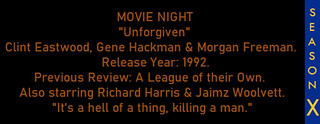
Unforgiven.
Review #1501: Unforgiven.Cast:
Clint Eastwood (William "Will" Munny), Gene Hackman ("Little" Bill Daggett), Morgan Freeman (Ned Logan), Richard Harris (English Bob), Jaimz Woolvett (The Schofield Kid), Saul Rubinek (W. W. Beauchamp), Frances Fisher (Strawberry Alice), Anna Thomson (Delilah Fitzgerald), David Mucci (Quick Mike), Rob Campbell (Davey Bunting), and Anthony James (Skinny Dubois) Produced and Directed by Clint Eastwood (#1252 - Space Cowboys, #1310 - Million Dollar Baby, and #1476 - Pale Rider)
Review:
"Gene Hackman was interesting because I gave the Unforgiven script to his agent and he said no, he didn't want to do anything violent. But I went back to him and said, "I know where you're coming from. You get to a certain age and I'm there too, where you don't want to tell a lot of violent stories, but this is a chance to make a great statement"
It's easy to make a lasting great Western when it is going to be the last one you make after a long career defined by them. Eastwood had at least one defining Western that he was featured in, whether that involved television with Rawhide or with films such as A Fistful of Dollars, Two Mules for Sister Sara, or Pale Rider. This was his 17th directorial effort (and fourth involving the Western), and it surely proved a fitting last hurrah for Eastwood to declare as his last Western so as to not repeat himself or others (which has proven correct in for over two decades). The script for this film was written by David Peoples (who prior to writing had been a editor for TV and news programs) in 1976, with one development title being "The William Munny Killings", and one inspiration for him when it came to the depiction of violence was Taxi Driver. The script languished for years while Peoples wrote for other films such as The Day After Trinity (1980) and Blade Runner (1982), with Eastwood having waited around for years to do other projects first. Eastwood thought of making changes to the script, but he changed his mind because of how he saw the script was better without it (minus one thing, which involved having the opening having a text crawl rather than a voiceover). The result was two Academy Awards for Eastwood (for direction and Best Picture) and one for Hackman alongside one for editing.
At last, a Western great enough for the 1990s to deserve. It proves to be a riveting and somber ilm with its subversion of the Western and the myths that could make outlaws famous with whatever exploit could be covered fast enough. Sure, there have been quite a few films that have played with the clichés and traditions of what we saw in the Western in the classic era (with one slight resemblance being The Shootist, for example), but this one handles itself with a great elegiac quality in its direction, characters, and pace that make it one for the ages. It lives and moves with a great patience for making its surroundings resonate with its audience, with a false note never happening as more characters come and leave the picture as reflections of the time and place, whether that means a once-removed killer/farmer, or a savage outlaw, an outlaw with publicity, or even a sight-challenged kid with reputation. The easiest strength of the film lies within its main trio of actors, starting with Eastwood. No one ever fit the mythic mold of the Western hero ever so much in the last few decades of the 20th century film era like Eastwood did, who resonates in pained grit that reflects past and present with no contrived frills as a man with shades of gray. Hackman proves just as worthy in matching up to Hackman on the other side of the hill, tenacious and dedicated in intimidation and order (one of the people Hackman drew from was a police chief, for example) that lend excellence to small moments, such as a conversation with Harris and Rubinek involving the nature of fact and fiction with outlaws turning into a quiet showdown of chicken. Freeman (in the midst of a deserved rise in prominence with supporting and lead roles in the late 1980s) fills in the main details with resonating nerve and conviction that we come to depend on in a careful balancing act between him and Eastwood that make for useful time spent. Harris, despite being in the film considerably less than the others (and only having time with just Hackman and Rubinek) does a resoundingly good job in playing the part of the myth of a refined killer come out splendidly when faced with Hackman and his own interpretation of killers and those who write about them. Woolvett is the key supporting piece to encapsulate the film, brash but quite convincing as the lasting piece of the dealings of myth and reality when it comes to bits of amusement and action between him and Eastwood, never grating on one's patience. Rubinek and the others prove well in filling the town with interest and the dealings that come with conflicting view of justice and morality. What we have here is a film to stamp out the myths that came from films about a time as myth-inducing as the Old West with a wise one at the hand behind and in front of the camera in Eastwood to do wonders with for 131 minutes. This is a well-done piece of subversion and execution on a variety of levels that range from its cast to its look (done entirely in Alberta, Canada) that make the grand myth of outlaw one to look closer into and care about with flourish and satisfaction. It isn't the first Western one might view for themselves, but it sure is the one deserving of being up there to see time and time again among the classics.
Overall, I give it 10 out of 10 stars.
July 17, 2020
Pale Rider.
Review #1476: Pale Rider.Cast:
Clint Eastwood (The Preacher), Michael Moriarty (Hull Barret), Carrie Snodgress (Sarah Wheeler), Richard Dysart (Coy LaHood), Chris Penn (Josh LaHood), Sydney Penny (Megan Wheeler), John Russell (Marshal Stockburn), Richard Kiel (Club), Doug McGrath (Spider Conway), Chuck Lafont (Eddie Conway), and Jeffrey Weissman (Teddy Conway) Produced and Directed by Clint Eastwood (#1252 - Space Cowboys and #1310 - Million Dollar Baby)
Review:
"You have to trust your instincts. There's a moment when an actor has it, and he knows it. Behind the camera you can feel the moment even more clearly. And once you've got it, once you feel it, you can't second-guess yourself. You can find a million reasons why something didn't work. But if it feels right, and it looks right, it works. Without sounding like a pseudointellectual dipshit, it's my responsibility to be true to myself. If it works for me, it's right."
Clint Eastwood has cultivated a unique and prolific career for himself over half of a century. Ther have been quite a bit of actors who have become stars in both television and film, but there have not been as many actors who have also sprung into star directors. Eastwood has had a breakthrough project in each decade since the 1950s, whether that involves television (Rawhide, 1959-65), starring roles (The Dollars Trilogy, Dirty Harry), or directing (debuting with Play Misty for Me (1971), the first of over thirty films), with influence coming from directors he had worked with such as Sergio Leone and Don Siegel with a quick pace. The Western certainly had declined in stature for the 1980s, but Pale Rider was certainly a high point for its decade (being one of the most profitable Westerns released for that era). This was the third Western directed by Eastwood and his first since The Outlaw Josey Wales (1976), and it certainly isn't the first of him playing a nameless and mystical drifter (such as with High Plains Drifter over a decade earlier). In general, the film seems to cover ground that was done with Shane (1953), which also had a stranger that came into a town wracked with intimidation over settlers by a baron and his minions that soon escalates into hiring a gunfighter to combat the stranger (in this case, a group of marshals), and the stranger leaves town after it has been settled to stay with its settlers. Of course there are quite a few differences between the two (namely in gold miners as opposed to homesteaders), with the most key being in the quiet details of this film, which has a mystical quality to its title hero, practically seeming like a ghost when engaging in action (which Eastwood subsequently confirmed). In that sense, it makes for an interesting experience of 116 minutes with careful precision. No matter how familiar one is with Eastwood as an actor or director, it isn't too much of a stretch to enjoy what we see without feeling like one is watching a greatest hits Western or something without a competent athmosphere and support to go with it. Eastwood may always grit his way through a role, but it doesn't mean he can't be curious to view regardless, a sardonic presence of careful words. The others prove fairly adept with making this small town setting come forward with careful interest. Moriarty proves an affiable leader of the folks with calmness. Snodgrass and Penny do fine when paired with others, while Dysart and Penn make fair adversaries to view involving greed. Russell (known for his work in the TV show Lawman) makes for a useful presence of old eyes that carry menace. The film proves diverting in its own look upon the mysterious stranger lurking on the frontier with its own kind of mythic nature that make a quietly effective time - whether in thinking about a man we see with bullet holes in the back at first glance or in how he operates with these folks without really needing to show much of himself and cut the ambiguity. There is always a place for a Western that wants to cover a frontier worth looing upon, and this is a fair film in its genre that sets itself up well with atmosphere and a cast worth viewing at least once for its era.
Overall, I give it 8 out of 10 stars.
December 19, 2019
Million Dollar Baby.

Review #1310: Million Dollar Baby.
Cast:
Clint Eastwood (Frankie Dunn), Hilary Swank (Margaret "Maggie" Fitzgerald), Morgan Freeman (Eddie "Scrap-Iron" Dupris), Jay Baruchel (Danger), Mike Colter ("Big" Willie Little), Lucia Rijker (Billie "The Blue Bear" Osterman), Brían F. O'Byrne (Father Horvak), Anthony Mackie (Shawrelle Berry), Margo Martindale (Earline Fitzgerald), Riki Lindhome (Mardell Fitzgerald), and Michael Peña (Omar) Directed by Clint Eastwood (#1252 - Space Cowboys)
Review:
We all love underdogs. Or at least we love the idea of someone trying to claw their way out of their past and find a new life for themselves (a second act, if you will). Of course one may have already seen a Cinderella story through the eyes of boxing before with Rocky (1976), but the film finds its own place to deliver a wrenching drama that works wonderfully for its 132 minute run-time with a solid trio to make its foundation stick. The film is based on a short story collection named Rope Burns: Stories from the Corner by F.X. Toole (pen name of boxing trainer Jerry Boyd), with Paul Haggis writing the screenplay. The film plays itself out in realism piece by piece that draws its ensemble with quiet precision. The film plays itself out in realism piece by piece that draws its ensemble with quiet precision. Eastwood does the task of acting/directing with ease, seeping into a grizzled yet well-meaning teacher with confidence. Freeman (who also serves as narrator) does a wonderful sobering job, carrying the soul of the film to where it needs to go whenever he is on screen or narrating about these characters and who they are when down and out in boxing. Swank clearly trained hard to sell such a tough role, where looking the part is only the half of it all - one is invested in Swank because of the drive and raw charisma she brings here. It's no surprise each won an Academy Award (Best Director, Supporting Actor, Actress) for their work - they all play well with each other, no matter whose partnered with who is a scene. The supporting cast (filled with actors who would become known in their own right) give credence to this grizzled atmosphere seen in the film, where one has to find something to stick with to belong and face hard truths - whether it means how one can be as a fighter or as a father or with one's own relatives or with the reality of sudden changes. The boxing looks the part when it comes to giving the right balance of brutality and entertainment, where one is involved with the punches without bellowing for more or being squeamish for less. It grips the audience like a book you'd find in the store and find reading piece by piece without hesitation, never hedging itself too long on somehing without a clear reason.
The film hits most of the right punches when it comes to mining hard hitting drama in and out of the ring, being more than a typical boxing film through its distinct first and second halves. It forges with its choices without hamhanded compromise or cruelty for its characters, which may work differently for a viewer with their own mindsets about certain uncomfortable decisions. For me, the film hits the landing with a quiet but resounding focus, where a tear may very well come out of a stone composure. After 15 years, it's no wonder why this proves to be a modern classic worth checking out at least once.
Overall, I give it 9 out of 10 stars.
August 2, 2019
Space Cowboys.
Review #1252: Space Cowboys.Cast:
Clint Eastwood (Frank Corvin), Tommy Lee Jones (William "Hawk" Hawkins), Donald Sutherland (Jerry O'Neill), James Garner ("Tank" Sullivan), Marcia Gay Harden (Sara Holland), William Devane (Flight Director Eugene "Gene" Davis), Loren Dean (Ethan Glance), Courtney B. Vance (Roger Hines), James Cromwell (Bob Gerson), Rade Šerbedžija (General Vostov), and Barbara Babcock (Barbara Corvin) Directed by Clint Eastwood.
Review:
This is one of those films that exists to deliver adventure for a certain kind of audience that surely is interested in seeing some entertainment without any rough challenges and a few visual winners. It runs at 130 minutes, but it sure seems to want to be familiar with predictable leanings that its main core four actors are up to making seem fun to sit with. After all, if John Glenn (fighter/test pilot turned astronaut turned U.S Senator) could be sent into outer space at the ripe age of 77, why not send four old pilots (with Garner being the oldest at 72 on release) into space to fix a secret satellite? Even the challenge of getting these folks up to speed with training (in 30 days, no less - for which publicity for this mission only comes in two weeks before launch) doesn't really seem to faze anybody in the film, especially not the audience. It does fall in the lines of a popcorn movie in that if you really wanted to poke a few jabs in its logic (the idea of sending an astronaut with terminal cancer comes to mind), you could, but I was at least entertained enough with what I saw to make this a winner by the margins, primarily because of its cast and effects. At least one cannot fault Eastwood for taking the script from Ken Kaufman-Howard Klausner and rolling with giving the film a bit of light charm in its journey without too many roaring bumps, essentially being the kind of film you could probably watch with your dad or mom and have a good time with (I remember my dad having interest in plenty of Eastwood films, nearly all of which in the bunch qualified as adventures like this), with even a Jay Leno cameo fitting the bill for what one could expect. It has a yearning for what was that certainly has aged a bit (particularly with the end of the Space Shuttle program) but will linger just fine with those who seek it. The effects-work from Industrial Light & Magic is well done as one could expect, capturing the essence of space and the moments that require some wonder and delivers pretty well, where one isn't taken out of the film and its shots of the shuttle or satellite in space because something seems too off-putting or ridiculous. As one would hope, it is the interactions between the core four that drive the film as forward as it wants, particularly when it is between Eastwood and Jones. Eastwood certainly is wiry enough to headline a last hurrah routine with a degree of persistence that only could come out in a mild adventure driven by Eastwood on both sides of the camera. Jones is just as wiry with plenty of rough charm that certainly gets its chance to come out plenty, whether when old wounds open up about who ruined whose shot at going to space or when doing some stunt piloting for an eager birthday man. Sutherland and Garner are both warm and engaging as the other useful cogs in this fairly oiled machine, fitting with what is needed just as one can hope. Harden, Devane, and Cromwell fill the other piece of the pie just fine, doing what needs to be done to further the film (whether it be exposition or occasional character moments with the main four) without bumps on the way. Dean and Vance are okay, but they feel a bit sidetracked when it comes to making any sort of comparison of the old guard (Air Force pilots) and the new type of astronauts, which might have been a bit interesting to go with. In the long run, what we have here is a film that aims for a tolerable standard blend of reality and movie-magic that will certainly feel par for the course in its execution but at least please its crowd just well enough to make things worth it, where the time goes by without too much waste to speak of.
Overall, I give it 7 out of 10 stars.
September 25, 2018
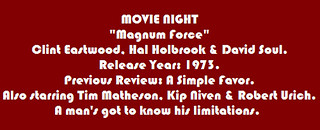
Magnum Force.

Review #1135: Magnum Force.
Cast:
Clint Eastwood (Inspector Harry Callahan), Hal Holbrook (Lt. Neil Briggs), David Soul (Officer John Davis), Tim Matheson (Officer Phil Sweet), Kip Niven (Officer Alan "Red" Astrachan), Robert Urich (Officer Mike Grimes), Felton Perry (Inspector Earlington "Early" Smith), Mitchell Ryan (Officer Charlie McCoy), Bob McClurg (the Cab Driver), and John Mitchum (Inspector Frank DiGiorgio) Directed by Ted Post (#518 - Hang 'Em High and #662 - Beneath the Planet of the Apes)
Review:
The original Dirty Harry was a great success as an action crime thriller upon release in 1971, having a great combination of talent and style to it, from Don Siegel as director to a screenplay written by Harry Julian Fink, R.M. Fink & Dean Riesner, with un-credited work from John Milius. This time around, the director is Ted Post, who had directed numerous television programs such as Rawhide (also starring Clint Eastwood) and The Twilight Zone along with a few feature films, with Milius doing the story and co-writing the screenplay with Michael Cimino (co-writer of the screenplay for Silent Running a year prior). It should be noted that there had been a draft for the original film written by Terrence Malick that had a vigilante who hunted wealthy criminals who had gotten free of justice, which certainly has a bit of similarity with the story that Milius came up with for the sequel - albeit with motorcycle cops. The original film certainly attracted attention (and controversy) with the way it portrayed its loose cannon main character and how he did business, but the movie was certainly a popular one due to how it reflected the time it was made. In any case, the sequel tries to follow that up with something fresh, with the villain being people more rogue than him. For the most part, Magnum Force does a fine job in generating entertainment and thrills enough to make for a decent sequel, although it certainly has its limitations. Eastwood is as tough and grizzled as ever, which certainly leads to a bunch of effective sequences, such as the one involving a pistol championship between the cops or a scene with the adversaries and Eastwood stating their differences. Holbrook does a fine job with the role, managing to not fall under the radar while providing a fair contrast between his character and the main with how they treat the system - made true with the last half. Soul and the other three cops are okay, but they pale when compared to the villain from the original, particularly since they feel a bit more disposable and not as creepy this time around - for better or worse. Perry makes an fair impression when with Eastwood as partners, for the most part. Ryan does okay with the raw bit of time he has on screen. The film certainly feels a bit long at 124 minutes (as compared to the original being 102 minutes), and it is likely due to occasional lulls in the middle. The climax does fine with helping the film end without stumbling too much, but it doesn't seem to have the kind of punch that stands out amongst other action thrillers. Milius wasn't a particular fan of the film, describing it as one he did not like much, saying "They changed a lot of things in a cheap and distasteful manner. The whole ending is wrong, it wasn't mine at all. All movies had a motorcycle or car chase at the time — except Westerns." the film certainly had its troubles, with Post and Eastwood having disagreements over how the film should be done, which led to a falling out. In any case, There certainly is a good amount of action that will satisfy people enough without being too brutal or too out of place. I can't say that this is a great film by any means, but it is at least fair entertainment and a fair sequel.
Overall, I give it 7 out of 10 stars.