Showing posts with label George Irving. Show all posts

July 29, 2023

Bringing Up Baby.

Review #2060: Bringing Up Baby.

Cast: 
Katharine Hepburn (Susan Vance), Cary Grant (Dr. David Huxley), May Robson (Elizabeth Carlton Random), Charles Ruggles (Major Horace Applegate), Walter Catlett (Constable Slocum), Barry Fitzgerald (Aloysius Gogarty), Fritz Feld (Dr. Fritz Lehman), Virginia Walker (Alice Swallow), George Irving (Alexander Peabody), Leona Roberts (Hannah Gogarty), Tala Birell (Mrs. Lehman), and John Kelly (Elmer) Directed by Howard Hawks (#951 - The Big Sleep, #1352 - His Girl Friday, #1399 - Rio Bravo, #1687 - O. Henry's Full House and #1773 - Red River)

Review: 
"I think the picture had a great fault and I learned an awful lot from that. There were no normal people in it. Everyone you met was a screwball and since that time I have learned my lesson and I don’t intend ever again to make everybody crazy."

In 1937, Howard Hawks read a short story in the magazine Collier's that had been written by Hagar Wilde. He laughed so much that he wanted to make a film of the story, which I'm sure you know was called Bringing Up Baby. He had time to spare, considering that he was being stalled out in making "Gunga Din" (which was worked out eventually by George Stevens). Wilde wrote the story and co-wrote the screenplay with Dudley Nichols (known for his structure work with films such as The Informer three years earlier) that retained a chase for a docile cat (panther in the story, leopard in the movie) in the wilderness of Connecticut. Look, sometimes you have to say audiences don't always know what the hell they want. This is especially true here for a film that only would make a small profit upon subsequent re-release. Perhaps most famously, Hepburn would be referred to as "box office poison" by the Independent Theatre Owners of America a couple of months after the release of this film in 1938, who referred her as having an excellent performance but also referring to it and another film in Stage Door as flops when closing out by saying "Sound judgment and good business sense are valuable assets in an industry that is far from being an art." Believe it or not, Hawks actually had Harold Lloyd in mind first for the lead role played by Grant. The studio rejected that suggestion and offered the role to a handful of others that rejected it. Lloyd apparently told Hawks that the film was the "best constructed comedy" he ever saw, which I'm sure has something to do with Grant and his portrayal that surely was modeled after Lloyd (right down to the glasses). Walter Catlett (a veteran of vaudeville and a number of films since the early 20th century) was brought in to help out Hepburn and her early jitters with doing comedy and ended up having a key role in the film as well. This was the second of four films with Grant and Hepburn after Sylvia Scarlett (1935), Holiday (1938) and The Philadelphia Story (1940), and it was her work in the latter of the four that resulted in Hepburn's first of four Academy Award wins, proving the old lesson that sometimes words on print really are worth less than toilet paper.

It is a profoundly silly movie, the screwiest kind of screwball movies that could only be done by a craftsman of energetic filmmaking. Hawks may have thought that the film had a few too many zany characters, but the main thing that is told here is that at the end of the day, it is better to enjoy life with free-spirited energy rather than try to stick with dignity. Hawks later stated that the way he achieved such vast pace is by pacing the actors "quickly within the frame rather than cross cutting fast". This results in a zany film filled with consistent energy from beginning to end that delivers everything you would think comes in these types of films without failing in the goal of worthwhile comedy. The 102-minute runtime is the ideal time to try and wrap these odd little characters for one wholly watchable feature that never plods in how it presents these two main people and the winding road they are tied to in amusing predicaments, complete with a select handful of ad-libs. Grant was already a comedic name on the rise with The Awful Truth (1937), because he really was quite the charmer who could hold his own with any kind of material and any kind of requirement, which in this case involves flustered panic. You can see pretty easily from the first sequence involving old bones and where his energies have to lie with such vaunted people. Hepburn is a free spirit of the highest order in impulse, one who has such a great chemistry with Grant that never leaves our mind from the very get-go. They make for such a great pair together, one zigging where the other is zagging without a false note detected among their interactions or ones where Grant is left trying to spin out of a spinning top of absurd situations, one of which involves a torn dress and a hat and another involving waiting to be heard in the middle of a convoluted explanation. They make a quality pair in both timing and, eventually, romance. Robson (a veteran of the stage who became a noted film presence at the ripe age of her seventies) amuses as the dignified straight one among the proceedings to be accompanied by Ruggles and his befuddled attitude among would-be hunters. They are swept up into probably the most interesting of all confounding situations when it comes to Catlett and the belief of just who is really who and the case of one (or two? or none?) leopard. It is the kind of film with quality animal performances (Nissa, the leopard who is used to play both the docile and circus leopard and Skippy, already familiar from The Thin Man) to go with quality timing that practically is as timeless as one would hope to expect in a comedy of screwy manners. The only real debate is just how damn good it is within the career of Howard Hawks and his immeasurable qualities in filmmaking.

Overall, I give it 10 out of 10 stars.

May 6, 2022

Thunderbolt (1929).

Review #1837: Thunderbolt.

Cast: 
George Bancroft (Thunderbolt Jim Lang), Fay Wray (Ritzy), Richard Arlen (Bob Moran), Tully Marshall (Warden), Eugenie Besserer (Mrs. Moran), James Spottswood ('Snapper' O'Shea), Robert Elliott (Prison Chaplain), Fred Kohler ('Bad Al' Frieberg), E. H. Calvert (Dist. Atty. McKay), and George Irving (Mr. Corwin) Directed by Josef von Sternberg (#1325 - Underworld and #1337 - Shanghai Express)

Review: 
It is interesting to consider what the turn of a decade or the turn of new technology can do to (or for) a director. In the case of Josef von Sternberg, going from silent films to sound would only keep him right where he needed to be to express his vision of filmmaking. This is his ninth feature film (three are lost, with two of them not even having a full release), one that started in 1925 that would span three decades over various studios; he had a distinct style that did not always lead to box office success, but most of his films generally still seem ripe for further research and curiosity, with the level of that depending on just what film of his you see, whether that was his debut with The Salvation Hunters (1925) or Underworld (1927) or The Last Command (1928, where he directed his lead actor to an Oscar) or The Docks of New York (1928). If you remember, Bancroft was the star in Underworld, and this film was the fourth and final collaboration between him and von Sternberg, with all of them featuring him getting swept up in crime (two as gangsters, one as a brawler, and one as a police captain) with two of them involving him trying to cope with the loss of his girl. He went from serving on merchant ships and a stint in the Navy to becoming an actor on Broadway and film, having a career in the latter for seventeen years, but it was the early parts of his career that saw him as a name star (complete with a nomination for an Academy Award for Best Actor with this film) before moving into supporting roles before moving into ranching full-time in 1942, which he did until his death at the age of 74 in 1956.

One can say that the transition into sound did not hinder the qualities shown by von Sternberg when it comes to making curious features of entertainment (there was a silent version of this film made for theaters without sound). He doesn't seem stilted by the addition of a microphone for sound, if only because he utilizes his sets and actors for interesting arrangements and dialogue that makes its 85-minute run-time go by fairly smoothly. The screenplay was written by Jules Furthman and Herman Mankiewicz while the story was done by Charles and Jules Furthman. So yes, the movie is about a guy named "Thunderbolt" and his attempts at trying to get what he wants from his girl and the law before a fateful climatic decision; the movie spends a good chunk of its time in a prison set with a small assortment of characters that used for a bit of humor, since a musical group does play in certain scenes, for example. As such, it is Bancroft who dominates the film with the way that he commands attention with his ego that makes him a curious figure to view in the lines of crime, because there are layers that come out in a rough exterior without falling into easy sentiments (granted, there is a dog that he has a soft spot for, but this isn't too distracting). Wray got into acting as a sixteen-year-old Canadian in 1923, which can't be forgotten in a six-decade career that saw her known for being a "scream queen". She does fine with what is needed here in terms of calm allure, one who seems perfectly fine with "normalness" without being wrapped in hokum. Arlen makes an ideal square without falling into mockery, looking just fine when paired with Wray for their scenes together (Besserer being paired as his on-screen mother is a bit amusing, if only because one doesn't usually see mother figures...for non-criminals in these kind of movies). Marshall proves a worthy foil for Bancroft in generating a bit of amusement as bumbling authority, such as letting a prisoner get out of their cell to subdue a prisoner who grabbed a gun...which results in a punch-out. No matter how much the climax could be thought of as inevitable, the movie does handle its final moments well without springing for maudlin overkill. As a gangster film, it proves okay when compared to his previous work Underworld was in terms of overall excitement, but even being a minor work in von Sternberg's lineup is still a nice compliment to hand it for recommendation, proving a useful curiosity with a suitable lead presence that makes for a relatively charming time.

Overall, I give it 7 out of 10 stars.

February 19, 2020

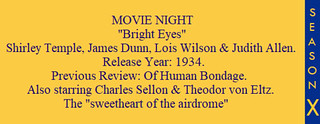
Bright Eyes.


Review #1342: Bright Eyes.

Cast: 
Shirley Temple (Shirley Blake), James Dunn (James "Loop" Merritt), Lois Wilson (Mary Blake), Judith Allen (Adele Martin), Charles Sellon (Uncle Ned Smith), Theodor von Eltz (J. Wellington Smythe), Dorothy Christy (Anita Smythe), Jane Withers (Joy Smythe), Brandon Hurst (Higgins), Jane Darwell (Elizabeth Higgins), Walter Johnson (Thomas), and George Irving (Judge Thompson) Directed by David Butler (#1334 - Just Imagine)

Review: 
When it comes to needing a charming and good-natured kid presence for a film or two, one can't really go wrong with Shirley Temple. Born in 1928, she had been enrolled at Meglin's Dance School with encouragement from her mother by the time she was three years old, and she was noticed by a producer from Educational Pictures, known for their one-reel comedies in the 1920s and 1930s. In 1934, she was given her first major breakthrough with Stand Up and Cheer!, a musical from Fox Film that served as a vehicle for various actors to sing. In that year alone, she made appearances in nine films (two of them without credit), with this being her last one released (done so on December 28), which happened to be the first one made specifically as a starring vehicle for her, which was written by director Butler and Edwin J. Burke. Her run was a quick but memorable one, starring in at least two films until 1940 while making appearances in thirteen further films before her last in 1949. Her main features were usually made on the cheap, with songs and dances to go alongside sentimental and melodramatic situations, which certainly must've proven to inspire plenty of hope when it comes to escapist fare for Great Depression audiences. In that sense, this proves to be an okay piece to look back upon with the age of nearly 85 years behind it. If one can get behind a kid singing "On the Good Ship Lollipop", one could probably get behind any sort of sugary stuff for 83 minutes. It isn't so much a predictable film as it is just one that will go exactly where it wants to go and nowhere else. Oddly enough, the best parts of the film are usually when Sellon or Withers (who would star in her own kid films) are on screen, delivering a good share of the laughs despite having cranky characterizations. This is especially true for the latter, who was defended by Butler from calls of being cut down by Temple's mother - the contrast between the two is importantly distinct and amusing, right down to one being slapped again and again. Temple carries the film enough, in that one really doesn't need much to go along with a nice kid for a film (barring a lack of personality of course), but she makes the experience worth it in her enthusiasm. Dunn goes along fine, carefully crafted to suit Temple when it comes to being a guardian of the clouds. The rest are here and there, lending help to try and make this fairly predictable tale of spunky kids cheering up old cranks and young people go without trouble. The film received one award for its main star in an Academy Juvenile Award, which was given out to twelve child performers until it was discontinued in 1960. Temple is (and remains) the youngest recipient to be honored by the Academy. The curiosity is fair, and it should prove fine for the young ones looking for some old-fashioned charms like Temple can provide.

Overall, I give it 7 out of 10 stars.

January 31, 2020

Coquette.


Review #1331: Coquette.

Cast: 
Mary Pickford (Norma Besant), Johnny Mack Brown (Michael Jeffery), Matt Moore (Stanley Wentworth), John St. Polis (Dr. John Besant), William Janney (Jimmy Besant), Henry Kolker (Jasper Carter), George Irving (Robert Wentworth), and Louise Beavers (Julia) Directed by Sam Taylor (#667 - The Freshman, #727 - For Heaven's Sake, #758 - Safety Last!, #864 - Hot Water, #903 - Dr. Jack, #918 - Why Worry?, and #938 - Girl Shy)

Review: 
"I am no longer in pictures for money. I am in them because I love them. I am not in vain. I do not care about giving a smashing personal performance. My one ambition is to create fine entertainment."

Mary Pickford was a star in a time of transition for Hollywood in 1929. Born in Toronto, Canada in 1892, she had grown up with the theatre from a young age, with her mother having taken the suggestion of one of her boarders, a theatrical stage manager to give her two daughters small roles in a production. Years of touring with her family in the theatre were soon changed in 1909 after encountering D. W. Griffith (of the Biograph Company at the time) for a screen test, which led to her being hired to appear (both in bit parts and lead roles) in the company's films; despite not being credited, she received notices from audiences. She left for Adolph Zukor’s Famous Players studio in 1912 and found continued success with films such as Tess of the Storm Country (1914) and The Poor Little Rich Girl (1917). Pickford was also an innovator when it came to studios, as she was one of the co-founders of United Artists in 1919 alongside Griffith, Charlie Chaplin and Douglas Fairbanks, which was formed on the premise of giving creative control to the actors and directors. The burgeoning of the sound era did not deter Pickford from acting. Although she had famously said that adding sound to film would be "like putting lip rouge on the Venus de Milo", Pickford was nervous but ready to debut her voice onto film (she had not appeared in a film since My Best Girl in 1927). When she heard her voice for the first time for a test, she remarked that she sounded like a pipsqueak (ironic for someone who had played numerous child characters since a teenager). She soon did voice training to try and get herself ready to play this southern role with equipment that would try to stick out from the stagey static sound films that encompassed the early sound films.

The film was adapted to the screen by John Grey, Allen McNeil, and director Taylor from the play of the same name by George Abbott and Ann Preston Bridgers, which had featured Helen Hayes in the main role. The play was about a flirty young woman who has to decide what to do after her father kills the man she loves. The manner of who commits suicide is actually the choice of the main character (who was pregnant), as opposed to the film, where it is the father who does so in the midst of his court trial, where his daughter struggles to try and save her father from a death sentence. As for the film itself, it is one that seems more appropriate to give slack for rather than one to give much credit for. It is a middling affair, helmed by a fairly confident Pickford and not much else. It is a fairly clunky affair, filled with plenty of stagy staleness begging to be drawn out more through a 76 minute time that somehow seems ten minutes too long. One would wish more from Pickford, only to realize that she is the key in keeping it from collapsing into being forgettable all together. She seems bright and vivid in a way that the rest of actors are left to act around her with a bit too much camp to go around. There would be plenty of stories to tell about flirtatious or quirky Southern folk to come, some classics and some not: this is one that twists in the wind of the latter category.

Pickford (a founding member of the Academy of Motion Picture Arts and Sciences) lobbied with a publicity campaign when it came time to awards season (whereas other nominees didn't even know they were nominated), the first of its kind that seems routine nowadays (with this case being inviting the judges for tea at her estate Pickfair). In any case, Pickford won for Best Actress at the 2nd annual ceremony. She would appear in four more films in the next four years before retiring from acting (although she would keep producing before selling her UA stocks in the 1950s). While the film may not hold itself too well after nine decades, it has not stopped Pickford from enduring as one of film's first and brightest stars, where the term of "America's Sweetheart" just seemed fairly appropriate for her.

Overall, I give it 6 out of 10 stars.

Next Time: As you could tell, Tribute to the Decades decided to go all out and actually try to cover each year for the 1920s. As such, it will continue for the 1930s.