Showing posts with label Leslie Banks. Show all posts

July 5, 2023

The Man Who Knew Too Much (1934).

Review #2032: The Man Who Knew Too Much.

Cast: 
Leslie Banks (Bob Lawrence), Edna Best (Jill Lawrence), Peter Lorre (Abbott), Frank Vosper (Ramon Levine), Hugh Wakefield (Clive), Nova Pilbeam (Betty Lawrence), Pierre Fresnay (Louis Bernard), Cicely Oates (Nurse Agnes), D. A. Clarke-Smith (Binstead), and George Curzon (Gibson) Directed by Alfred Hitchcock (#219 - Rope, #223 - North by Northwest, #446 - Spellbound, #447 - Psycho, #450 - Vertigo, #455 - Rear Window, #553 - Strangers on a Train, #800 - Shadow of a Doubt, #910 - Notorious, #963 - The Lodger: A Story of the London Fog, #964 - The Ring (1927), #965 - Downhill, #970 - Mr. and Mrs. Smith, #977 - Frenzy, #1343 - The 39 Steps, #1739 - The Birds#1828 - Rebecca, and #2014 - The Lady Vanishes)

Review: 
 "Let's say the first version is the work of a talented amateur and the second was made by a professional."

It isn't often you get to see films where the same director would do it again decades later, but here we are. The Gaumont British production was one of the most noted features released by Alfred Hitchcock in his years in England, and he would do an updated version of this film (each involve an international crime plan with kidnapped children for extortion) that ran for two hours and was done in VistaVision for a distinct feature in its own right. The initial idea with Hitchcock was for him to do an adaptation of a Bulldog Drummond story (as originally created by H. C. McNeile as adventure novel series), which apparently would've been called "Bulldog Drummond's Baby". When that fell through, they just kept the idea of doing a conspiracy film with parents and cribbed the title from a 1922 novel of the same name (as written by G. K. Chesterton) that Hitchcock had select film rights to. The film was written by Charles Bennett and D. B. Wyndham-Lewis (Bennett asserted that he wrote the film with little, if anything done by Lewis). while Edwin Greenwood and A.R. Rawlinson provided the scenario for a film that runs at 75 minutes. This was released in the wake of such previous Hitchcock films as Number Seventeen (1932) and Waltzes from Vienna (1934), which are not exactly as remembered as the films that quickly followed after 1934 with The 39 Steps (1935) and Secret Agent (1936). It certainly ranked as the most curious film Hitchcock did in the sound era since probably his first one with Blackmail (1929), that much is for sure.

Admittedly, for such a little thriller, it actually is quite a vibrant feature in all the little things it does around building tension with a compact amount of time and composition. Banks and Best may not be the most recognizable names among features, but they were solid regulars for dozens of films for good reason, because it sure is something to play to what Hitchcock wants within the ordinary-turned-extraordinary here. This becomes pretty apparent after the opening sequences (such as introducing themselves to the future threat or trying to do a shooting contest) dispense away from their time as just wry parents and goes right into vulnerable panic. The startup to that sequence involves a would-be dance turning into whispers and then panic to effective execution that all involves a secret message (but it isn't the real important thing when it comes to coming up with one's own plan). Hitchcock does find time to pass that might inspire a wry chuckle without seeming wasteful, though, one of which involves a meeting with a dentist or (lest we forget) a church of sunworshippers. Lorre isn't forgotten in the main run of course, choosing his words carefully in menace - he had exactly one other English-language film under his belt with M (1931), which had an English version (remember that he left Germany in 1933), but this was the one where numerous English productions would follow in its wake. He has the physical presence that others wish they could match as a threat, and its clear to see how that could be used for films down the line. By the time that the film lumbers to the climax at the Royal Albert Hall, it has made its setup with key distinctions in one sound that makes the overall execution of said scene all the more better in tension and release. The gun fight that follows was actually inspired by the Sidney Street Siege, a real shootout in the East End of London in 1911 (which was actually captured on camera from a news outlet, some of which featured rising politician Winston Churchill), although obviously the gunfight here ends up different than the actual siege (which involved a collapsed building that killed a fireman), which isn't exploitative or played out with false notes. As a whole, in a lengthy career of several decades, The Man Who Knew Too Much shows Hitchcock in a favorable position when it comes to directing tension that he would cultivate for further success in further productions with most of the right moves already present here in a pretty good time.

Overall, I give it 8 out of 10 stars.

January 14, 2022

Henry V (1944).

Review #1788: Henry V.

Cast: 
Laurence Olivier (King Henry V of England), Renée Asherson (Princess Katherine), Robert Newton (Ancient Pistol), Leslie Banks (the Chorus), Felix Aylmer (the Archbishop of Canterbury), Robert Helpmann (the Bishop of Ely), Vernon Greeves (The English Herald), Gerald Case (the Earl of Westmoreland), Griffith Jones (the Earl of Salisbury), Morland Graham (Sir Thomas Erpingham), Nicholas Hannen (the Duke of Exeter), Michael Warre (the Duke of Gloucester), Ralph Truman (Mountjoy, The French Herald), Ernest Thesiger (Duke of Berri, French Ambassador), Frederick Cooper (Corporal Nym), Roy Emerton (Lieutenant Bardolph), Freda Jackson (Mistress Quickly), George Cole (the Boy), George Robey (Sir John Falstaff), Harcourt Williams (King Charles VI of France), Russell Thorndike (the Duke of Bourbon), Leo Genn (The Constable of France), Francis Lister (the Duke of Orleans), Max Adrian (The Dauphin), Jonathan Field (The French Messenger), Esmond Knight (Fluellen, Welsh Captain in the English Army), Michael Shepley (Gower, Captain in the English Army), John Laurie (Jamy, Scottish Captain in the English Army), and Niall MacGinnis (MacMorris, Irish Captain in the English Army) Directed by Laurence Olivier.

Review: 
Admittedly, covering a war-time effort is an interesting story in talking about a film. Of course, we are talking about the directorial debut of one Laurence Olivier, who did five overall theatrical productions to go along with his more famous vocation as an actor. As one might expect, he started in the stage, specifically debuting as an actor for the All Saints Choir School at the age of nine. He dabbled in acting on numerous occasions as a growing child, and it was the encouragement of his father that led him to do the profession. He studied at the Central School of Dramatic Art before starting his professional line of work in theater in 1926 (doing so before he was even twenty). He added films to his line of work in 1930, but it wasn't until Wuthering Heights (1939) that he truly received international notice. He showed dedication to any craft he desired to do, whether as an actor or in the Royal Navy Fleet Air Arm when World War II approached. He took on theater operating afterwards, which included directing/starring in Shakespearian roles. We are also talking about the first adaptation of a William Shakespeare work that received wide-spread acclaim. Olivier was asked by BBC TV director Dalas Bower (a member of the Ministry of Information) if he could do a rendition of Henry V (written by William Shakespeare roughly around 1599) for film as part of boosting the morale of the public. Olivier had starred in As You Like It (1936), but he felt that it was a considerable challenge to make a film of a Shakespeare work (specifically with the Hollywood angle with directing actors for certain scenes with Shakespeare dialogue - that film along with A Midsummer Night's Dream (1935) and Romeo and Juliet (1936) were each considered flops). At any rate, Olivier stated that it was William Wyler who inspired him to direct the film himself, which would utilize England's lone Technicolor camera at the time (along with filming in Ireland for the battle and England studios...for the rest). Olivier received two of the four Academy Awards (the film was released in America in 1946), and he was rewarded with an Honorary Academy Award for his efforts in bringing the film to the screen. His next effort in Hamlet (1948) would be the first non-American film to win Best Picture and earn Olivier an Academy Award victory for acting (and producing). The next big effort to do the play into a film would not be done until 1989 by Kenneth Branagh, which received notice in its own right (as it contrasts this film with its own presentation of the material that was described as more realistic).

Certain aspects of the play were omitted, mostly in its presentation of the title character (who in one sequence in the play hanged a friend for crimes committed against the French); Olivier, alongside Dallas Bower and Alan Dent, did un-credited work in the writing in bringing Shakespeare's words to the screen. With its lavish sense of color and framing, it likely isn't a surprise that the film (eventually) was a noted international hit with audiences (one that would see the presentation of French royalty in this film as akin to certain current threats of the time), one that was set in both 1415-1420 and 1600, as it is presented as "THE Chronicle History of KING HENRY THE FIFTH with his battle fought at Agincourt in France BY Will Shakespeare" by a Chorus that tells its audience to let imaginary forces work to picture the production. It is all the things one might expect from 137 minutes of classic British cinema, warts and all. It is efficient in the ways intended with stirring passion for its subject matter that makes for a mostly grabbing effort from folks clearly interested in having Shakespeare resonate on the screen. Regardless of where it ranks in British cinema, it has a key place in entertainment value for its country. It is spectacle (with sweeping William Walton music) that grows on you, pure and simple. Olivier obviously was ready to direct a major motion picture along with act as its star, and he does so with confidence that builds through the film with brimming interest. He acts to the screen with the right timing that works for theatrical sensibility (i.e. it doesn't seem molded for only a stage), one with relentless drive that makes the whole experience (such as the St. Crispin Day speech) worth it. The rest of the cast have their own varying levels of presence, most notably with Leslie Banks as the Chorus or with the comic relief. As a whole, it is medieval pageantry that does what it is intended to in stoking the war effort that is both spectacle and curiosity without becoming dated or a Shakespearian misstep, acting dignified without becoming obstinate. It serves as a worthy debut for its actor/director/producer in all the ways, for what it is worth.

Next Time: Rome, Open City.

Overall, I give it 9 out of 10 stars.

June 14, 2015

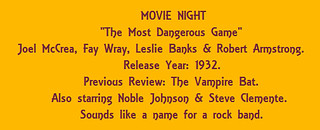
The Most Dangerous Game.


Review #709: The Most Dangerous Game.

Cast
Joel McCrea (Sanger "Bob" Rainsford), Fay Wray (Eve Trowbridge), Leslie Banks (Count Zaroff), Robert Armstrong (Martin Trowbridge), Noble Johnson (Ivan), Steve Clemente (Tartar), and Dutch Hendrian (Servant) Directed by Irving Pichel (#617 - Destination Moon) and Ernest B. Schoedsack (#283 - King Kong and #604 - Mighty Joe Young)

Review
The movie was filmed on the jungle sets of King Kong, with Wray and Armstrong being used for both films, while filmed at night. Strangely enough, this movie managed to be finished first, though it being only barely an hour long in length sure helped. As for the movie, it's pretty good. It has a good atmosphere, and I attribute that mostly to the sets, which make the movie look really nice. McCrea does a good job as the lead, maybe because he just gels well in the short time he has, especially with Wray, who as usual is good at being both a lead and screaming in terror. Banks is a decent villain, he isn't too over the top, and he does do well in the action scenes. In total, the movie is fine mainly because it just gets going quick, even beginning with a ship wreck. I like how it seems there will be three survivors who will be the main focus...and then two of them suddenly get swept away. I guess it means to never assume you've survived a ship wreck, which isn't the worst lesson I've heard. Anyway, the movie is enjoyable and quick, and if you like 30's cinema or thriller movies, you'll like this one.

Overall, I give it 9 out of 10 stars.