April 28, 2024
Missing in Action.
August 22, 2022
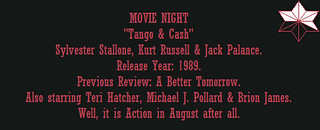
Tango & Cash.
May 4, 2022
Everything Everywhere All at Once.
December 7, 2020
Wayne's World 2.
Cast:
Mike Myers (Wayne Campbell), Dana Carvey (Garth Algar), Tia Carrere (Cassandra Wong), Christopher Walken (Robert G. "Bobby" Cahn), Kevin Pollak (Jerry Segel), Ralph Brown (Del Preston), James Hong (Jeff Wong), Kim Basinger (Honey Hornée), Chris Farley (Milton), Michael A. Nickles (Jim Morrison), Larry Sellers (The Weird Naked Indian), with Ed O'Neill (Glen), Gavin Grazer (Scott), and Aerosmith. Directed by Stephen Surjik.
Review:
It did not take long for folks to realize that Wayne's World was a success. To recap, Wayne's World began twofold: Mike Myers came up with the idea of Wayne that appeared in sketches for Citytv's City Limits and CBC Television's It's Only Rock & Roll in the mid 1980s before Myers joined Saturday Night Live in 1989 and starred in segments for the show with Dana Carvey that were featured from time to time for the next five years. The 1992 film of the same name, doubted by Paramount Pictures to be much of a hit, made nine times its $20 million budget, ranking as the most popular film based on a SNL sketch (which it still holds today). The sequel retains the main duo alongside a selection of cast members from the original alongside a sprinkling of cameo appearances (both musical and not), with Myers writing the film again with Bonnie and Terry Turner. However, the road to making a script for a sequel proved quite tough, in that the original idea by Myers wouldn't end up being used, which involved inspiration taken directly from Passport to Pimlico (1949), where the main duo would end up making their own country. Weeks before production was to start, this inspiration was pointed out by studio executives (who did not have enough time to negotiate the rights to the script and were thus incensed, with one threatening Myers personally) and they made Myers write an entirely new script. Conflicts between Myers and Penelope Spheeris over editing in the first film led to consideration of a new director in Stephen Surjik, who was known for his direction of segments for The Kids in the Hall (1990-1993).
The film was not quite a hit like the original, but it was a marginal hit with audiences as the last hurrah for these characters. When it comes to comedies, it is a mediocre follow-up that will nevertheless please those who seek another ride of goofy charm with hit-and-miss pace. Those who weren't really fans of the original won't exactly be swayed here, because sometimes it really does feel like a bit of a rehash from before - truly, it is the take-or-leave-it film for the comedy season. Myers and Carvey prove up to the task of creating some amusing moments, whether spent with themselves or playing against others; in the case of Myers, it namely involves a vision of Jim Morrison as some sort of spiritual journey (inspired by Myers and his own journey that he took upon the death of his father) that leads to a few interesting moments to those who don't see the Morrison bits as just a bit. Actually, the "fight" (involving dubbing) between Myers and Hong is kind of funny, too. For Carvey, the moments spent with Basinger playing a femme fatale prove quite involving (along with seeming tacked there to give him something to do besides linger with the look-alike played by Olivia d'Abo). The segment showing Myers and Carvey talk about "The Leprechaun" is a decent highlight to look at for a minute, in the sense that it is probably better done than the actual film made fun of. It is nice to see Carrere, even if her part seems like a re-hash from before (in other words, trying to do music in the face of slimy producers), but the highlight is the re-creation of a particular sequence from The Graduate (1967) near the ending. Walken does well with straight-laced slime that nevertheless can grab a chuckle (or be used for better work involving straight-laced humor). Pollak is used for a bit involving eyes that goes over fine, but it is Brown that takes up the supporting reins in pairing with Myers/Carvey, which he does in a take off the eccentric character he played in Withnail and I (1987). There are various cameo appearances throughout the film, ranging from Rip Taylor to Aerosmith to Charlton Heston, with some proving better than others (Charlton Heston over Jay Leno? Shock, shock, shock. Actually, I take it back, TV sentimental favorite Ed O'Neill's brief moment as the oddball Glen is the better one). In other words, 95 minutes is just enough to handle a few decent moments and a mostly-original run-through for a follow-up film that will fit just fine for what one desires to see in entertainment without being too disappointed. In other words, one can party on just fine with this film without hurling too much back at the screen.
Overall, I give it 7 out of 10 stars.
July 20, 2020
Big Trouble in Little China.
Review #1479: Big Trouble in Little China.Cast:
Kurt Russell (Jack Burton), Kim Cattrall (Gracie Law), Dennis Dun (Wang Chi), James Hong (David Lo Pan), Victor Wong (Egg Shen), Kate Burton (Margo Litzenberger), Donald Li (Eddie Lee), Carter Wong (Thunder), Peter Kwong (Rain), James Pax (Lightning), Suzee Pai (Miao Yin), and Chao-Li Chi (Uncle Chu) Directed by John Carpenter (#068 - Halloween (1978), #634 - Escape from New York, #712 - The Thing (1982), #732 - Escape from L.A., #1221 - Dark Star, and #1298 - They Live)
Review:
"I'm pretty happy with who I am. I like myself and what I'm doing. I don't need to be the world's greatest director or the most famous - or the richest. I don't need to make a whole lot of great films. I can do my job and I can do it pretty well. This is the realization I've come to, later in life. It's called growing up."
"I seem to have a knack for picking movies that go on to be cult favorites."
John Carpenter is a director that deserves further inspection, one that is far more than just his horror films. The 1980s are ertainly an interesting indicator of this diverting director, with eight of his eighteen directorial efforts being in that era (ranging from The Fog to They Live), comprised of success and flops that eventually alienated him away from Hollywood, but most of the features are generally well appreciated for their efforts in horror, science fiction and action, with some of those features also being composed or written by him as well. At the helm as star for some of those successes is Kurt Russell, who first rose to prominence as a child star in television and for Disney films before growing into further lines of work in the 1980s as an action hero (along with sentimental favorite in my view). The film had three different writers credited: Gary Goldman and David Z. Weinstein originally wrote it as a western that would combine Chinese fantasy elements one might find in a martial arts film within a western; subsequent attempts to turn it into something more filmable led to their firing and W. D. Richter (writer of films such as Invasion of the Body Snatchers (1978)) brought in to rehaul the screenplay into a contemporary tale that kept just basic elements like Lo Pan and Jack Burton, using Rosemary's Baby (yes, that one) as his template.
Ultimately, what we have here is a film that screams cult classic - it was a flop at the box office in the midst of a busy summer (to put it in perspective, the top films of that summer were Top Gun, The Karate Kid Part II and Aliens) and marketing that even Russell found not to his liking, with the studio not really understanding Burton's character (to the point where they had them do the opening scene about his heroism). It influenced Carpenter back to independent filmmaking as yet another painfully misspreciated film of his catalogue in the 1980s (with only his film The Thing (1982) being more unappreciated in its time, which also found a deserved following). For all of its obviousness, one can't help but enjoy its b-movie style - cheesy but with wonderful effects and a zippy charm to its cast that make a strange and stark delight to the action film. Russell proves quite enjoyable with brash brightness for a part that is part-hero and part-sidekick, lumbering through lines of screwball bravado, whether in engaging in some trucker lines on a truck, or showing confidence right before knocking himself out of a fight. Cattrall follows along the screwball aspects of the film at times with sharpness, making for a quirky time when paired with Russell. Dun proves well in keeping with the quick pace and timing required of our true hero with confidence that springs well with the action sequences. Hong (a prolific Chinese American actor of various mediums for six decades) proves a fair villain, inviting one with some creeping mystery (we are talking about a long-living sorcerer who wants a green-eyed bride/sacrifice, after all) that makes a satisfactory threat. Wong, Burton, and Li prove a decent supporting cast to a film that moves along for 99 minutes with an aim to make a snappy martial arts effects film and succeeding fairly well at it. With floating eyeballs, lightning effects, a underworld beneath Chinatown, and a big ugly monster, how could one resist such a film? To call it contrived or bumbling is missing out on the fun, particularly one with an interesting approach to the hero-sidekick dynamic. On the whole, it is a likable film with enough well-done staging in action and design to go with an amiable cast for a deserved cult classic and a fair piece in John Carpenter's line of work that is worth a watch.
Overall, I give it 8 out of 10 stars.
November 26, 2013
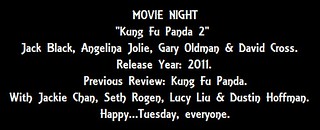
Movie Night: Kung Fu Panda 2.

Review #486: Kung Fu Panda 2.
Cast
Jack Black (Po), Angelina Jolie (Tigress), Gary Oldman (Lord Shen), David Cross (Crane), Jackie Chan (Monkey), Seth Rogen (Mantis), Lucy Liu (Viper), Dustin Hoffman (Master Shifu), James Hong (Mr. Ping), Michelle Yeoh (Soothsayer), Danny McBride (Wolf Boss), Dennis Haysbert (Master Storming Ox), Jean-Claude Van Damme (Master Croc), and Victor Garber (Master Thundering Rhino) Directed by Jennifer Yuh Nelson.
Review
Naturally, there is a sequel, given the first film's massive success. The film take a somewhat darker turn, but it works well to the film's advantage. Jack Black once again is effective, and he certainly leaves a good impression. The rest of the cast, especially Gary Oldman do good, and Oldman arguably does a better job portraying a villain then Ian McShane in the first film. The story is fine, and the animation is good, especially the animation during the flashback scenes. The action is good, and the comedy is nice, and this is a very effective film that leaves you yearn for more, especially with that ending, which is always welcome with me.
Overall, I give it 8 out of 10 stars.
November 25, 2013
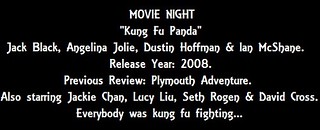
Movie Night: Kung Fu Panda.

Review #485: Kung Fu Panda.
Cast
Jack Black (Po), Angelina Jolie (Tigress), Dustin Hoffman (Master Shifu), Ian McShane (Tai Lung), Jackie Chan (Monkey), Lucy Liu (Viper), Seth Rogen (Mantis), David Cross (Crane), Randall Duk Kim (Master Oogway), James Hong (Mr. Ping), Dan Fogler (Zeng), and Michael Clarke Duncan (Commander Vachir) Directed by John Stevenson and Mark Osborne.
Review
This may sound a bit odd, but this is the 16th DreamWorks Animation film I've reviewed, perhaps in some way that makes a whole deal of sense, because the films always had a hook to keep my interest, and kept me intrigued. Well, most of the films (I'm looking at you, Shark Tale and Shrek the Third), not all, but a very big majority always had a sense of fun with fine animation. This I'm happy to say, continues that trend. Jack Black does a very fine job, but he's not the only one, even Dustin Hoffman gets in on the laughs, with him and Black having very effective scenes that contribute to a very fun film. The animation is breathtakingly nice to look at, DreamWorks Animation, no matter what decade, always did seem to keep up and look excellent (with one notable exception, of course). The villain is excellent, though seeing him not as much as everyone else is fine with me. This is a fun film that goes along extremely well, is fun for everyone, and overall, it's just a grand hallmark for DreamWorks Animation, once again. Now then, what's next?
Overall, I give it 9 out of 10 stars.
February 10, 2012
Movie Night: Blade Runner.

Review #100: Blade Runner.
Cast
Harrison Ford (Rick Deckard), Rutger Hauer (Roy Batty), Sean Young (Rachael), Edward James Olmos (Gaff), M. Emmet Walsh (Harry Bryant), Daryl Hannah (Pris Stratton), William Sanderson (J. F. Sebastian), Brion James (Leon Kowalski), Joe Turkel (Dr. Eldon Tyrell), Joanna Cassidy (Zhora Salome), James Hong (Hannibal Chew), and Morgan Paull (Dave Holden) Directed by Ridley Scott.
Review:
Welcome fellow viewers redirected to this review due to clicking the link from the review of the sequel, Blade Runner 2049. There have been some edits made to make it feel a bit more natural, as opposed to how it was back in 2012. The original review will be included on the bottom of this edit (in italics) for anyone curious to see the differences.
This is a film that is different from other 1980s entertainment flicks (such as The Empire Strikes Back, Raiders of the Lost Ark, and Aliens), in that it is a neo-noir that is certainly mysterious and alluring at the same time due to its visuals while also being an incredibly entertaining science-fiction film. The version that I watched is The Final Cut (with a 117 minute run-time), which Scott had complete artistic and editorial control, as opposed to the original release cut, which had voice-overs by Ford. In any case, he seems to just blend into this environment as well as one would expect from him that lends itself to making for a useful experience. The rest of the cast is also commendable, such as Hauer, particularly near the climax. The visuals are good, with fine cinematography by Jordan Cronenweth that certainly spans itself all over the film. It may not seem as fast as other films of its time, but it definitely resonates with you on numerous levels, whether emotional or intellectual. This is a classic that certainly stands out from other science-fiction or neo-noir movies, having a distinct style and influence that still stands today. The story is adapted from Do Androids Dream of Electric Sheep?, by Phillip K. Dick, who has had numerous stories of his adapted into movies (such as Next, Paycheck, The Adjustment Bureau, Total Recall, and Minority Report). This film has been changed from the original 1982 version (that was forced on Scott by the studio), and that's a good thing as this version is more of Scott's vision that shows how good a director he is.
This is a film that is different from other 80s flicks (Empire Strikes Back, Raiders of the Lost Ark, Aliens) as it relies on it's visual side and undertones to speak a story and not just action or...voiceovers (The version I was watching is The Final Cut) Anyway, the acting is good, especially from Harrison Ford. He really blends in, as he tries to do something different from previous films. I won't remember him as much as I do Han Solo or Indiana Jones, but I at least will remember him as an alright character. The visuals are good, with good cinematography all over the film. This is a classic that why it may not be exact and like every other film, it is still a good film. This film has lasted just about 30 years, and like Tron it has gotten better with age. The story is adapted from Do Androids Dream of Electric Sheep?, by Phillip K. Dick, who has made many books that have been adapted into films (Next, Paycheck, The Adjustment Bureau, Total Recall, and Minority Report) This film has been changed from the original version, and that's a good thing as this version is more of Scott's vision that shows how good a director he is. And so this ends the 100th Review. I thank all who have read these reviews, and I hope for 100 more.
And so this ends the 100th Review. I thank all who have read these reviews, and I hope for 100 more.
Overall, I give it 10 out of 10 stars.