Showing posts with label Dee Wallace. Show all posts

November 7, 2024

The Lords of Salem.

Review #2311: The Lords of Salem.

Cast: 
Sheri Moon Zombie (Heidi LaRoc / Adelaide Hawthorne), Bruce Davison (Francis Matthias), Jeff Daniel Phillips (Herman "Whitey" Salvador), Judy Geeson (Lacy Doyle), Meg Foster (Margaret Morgan), Patricia Quinn (Megan), Dee Wallace (Sonny), Ken Foree (Herman "Munster" Jackson), María Conchita Alonso (Alice Matthias), Andrew Prine (Reverend Jonathan Hawthorne), Richard Fancy (A.J. Kennedy), Camille Keaton (Doris Von Fux), Bonita Friedericy (Abigail Hennessey), and Nancy Linehan Charles (Clovis Hales) Written and Directed by Rob Zombie (#743 - Halloween (2007), #1590 - House of 1000 Corpses, #1751 - Halloween II (2009), #1756 - The Devil's Rejects, #1920 - 3 from Hell, #2090 - The Munsters)

Review: 
"50% of you will think this is the greatest thing ever, and 50% will hate it...I think I wanted to let everyone there know that it's OK to feel that way about a film like Lords. It's meant to make you unsure about what you just saw. That's the way the things that I like are—they're not for everybody. People have this delusion that everything has to be for everybody at all times. Every album must be liked by everybody, and every TV show must be liked by everybody, and every movie must be liked by everybody. Everything then becomes bland."

Those with a familiarity with history involving witches or Salem might know that people accused of being witches were not actually burned at the stake. In fact, of the hundreds accused of doing witchcraft in 1692-1693, the thirty that were found guilty suffered the hands of hanging or for the small few, torture (one was pressed until they succumbed to their wounds...and was an 81-year-old man) or death by filthy prisons. Naturally, there have been dozens of books and films that have used the trials as a key topic, whether that involves comedy such as I Married a Witch (1942) or allegories such as The Crucible (play or film). But I suppose it makes sense that one would go and make a film that plays around with the idea that yes, witches really could just be as real as you or me through the old tricks. It was reported in 2010 that Zombie, fresh off the debacle of Halloween II (2009) would get around to writing and directing this film while on his concert tour circuit for shooting in 2011. He apparently had came up with the premise a few years beforehand, but it eventually was tinkered with by Zombie in order to make a "strange, dreamlike movie" (as noted in interviews here, he took inspiration more so from European trials of witches than Salem, which he was misinformed about). He did the film in collaboration with Haunted Movies (so basically, Blumhouse), which at the time had done Insidious and The Bay, particularly because he had total control over the script and casting for a fairly low budget movie. The next Zombie production would come across with 31 (2016), which would go through crowdfunding for certain financing.

I sometimes wonder if I give Zombie a bit too much slack as a filmmaker for all of the fairly average stuff he does. What we have here is a slow burn movie that shows fascination with what Zombie finds interesting about both witchcraft and in "Satanic Panic" that is grim and unforgiving. It may be disjointed; it may not be all that one might think when it comes to the previous Zombie films in terms of stark strangeness in the unfinished cycle of violence but "mixed bag" seems aptly appropriate to try out once if you know what you are getting into. Some might find it basically cribbing from Rosemary's Baby (1968), but given how "fine" that movie was, sometimes you really can just crib from fine movies as long as you don't insult my patience with attempts at simplicity. As before, S.Zombie headlines a R.Zombie film. This time around, there is a passive nature to a character with such a strange and stunted job (it's a radio gig where they hang out about the same level as a couple of inebriated folks) before one eventually sees the logical conclusion of a downward withdrawn spiral. She handles the affair with subdued grace that is probably her most compelling performance for the films I've seen of her. Geeson, Wallace, Quinn play along in weird neighborly charm that is fun to see play out from scene to scene that has fun with self-help in the name of a certain kind of worship. Interestingly, Davison had previously been featured in The Crucible (1996); he was cast when Bruce Dern dropped out of this film due to scheduling conflicts. His curiosity (which went from being a shill for himself to actual curiosity) in the face of impending dread is entertaining to see play out, needless to say. Rounding out the cast is folks such as an unnerving Quinn along with understated presences in Phillips and Foree, who work out fine. The movie has some interesting imagery eventually play out through its trek of dread (such as strange visions or priests) that at least looks like the kind of movie Zombie wanted to just go out and do in having cruelty and uncertainty (for the audience) be the point. As a whole, it might not play well for everyone, but there is promise shown by Zombie in terms of odd duck dread that has a worthy enough cast to carry the waters for a cruel experience that might just work for those that know where to go with a director interested in making a movie to leave you unsure of what you just saw. I ended up going with it enough to say it is fine for one patient viewing, which is more than enough when trying to branch out for horror movies down the road.

Overall, I give it 7 out of 10 stars.
Next up: We close out our sixth week after Halloween with John Carpenter's The Fog.

November 2, 2024

The Hills Have Eyes (1977).

Review #2306: The Hills Have Eyes (1977).

Cast: 
Martin Speer (Doug Wood), Susan Lanier (Brenda Carter), Robert Houston (Bobby Carter), Brenda Marinoff (Baby Katy Wood), Virginia Vincent (Ethel Carter), Dee Wallace (Lynne Wood), Russ Grieve (Big Bob Carter), Cordy Clark (Mama), Janus Blythe (Ruby), Michael Berryman (Pluto), James Whitworth (Papa Jupiter), Lance Gordon (Mars), Peter Locke (Mercury), and John Steadman (Fred) Written and Directed by Wes Craven (#474 - A Nightmare on Elm Street, #558 - Scream, #633 - Red Eye, #939 - Swamp Thing, #1156 - Wes Craven's New Nightmare, #2135 - The Last House on the Left)

Review: 
"It soon became clear that I wasn't going to do anything else unless it was scary."

Sure, sometimes you just get pegged into a corner. Wes Craven was just looking to find a film to direct after the release of The Last House on the Left (1972), which generated controversy and shock from the people (read: a few losers among the bunch) you would expect. He tried writing scripts with Sean S. Cunningham (with decidedly non-horror tones), but they couldn't attract financial funding. Even trying to do a take on the "Hansel and Gretel" fairy tale didn't go for much. Craven took the advice of his friend Peter Locke to go out to the deserts in Nevada and just go make a film, particularly since Locke was interested to do an exploitation film. In trying to not just do another House of the Left, Craven took inspiration from the legend of Sawney Bean, who apparently was the head of a large clan in 16th century Scotland that murdered and ate over a thousand people in a quarter-century that eventually saw them captured and executed. Films such as The Texas Chain Saw Massacre (as directed by Tobe Hooper three years prior) and The Grapes of Wrath (1940) also have been stated to have played influence on this film (Craven once stated that his original script was to take place in the fall of 1984). After the film was released (to considerable success), Craven next went into television with Stranger in Our House (1978) before his next feature in Deadly Blessing (1981). In 1985, a sequel was made on the cheap with The Hills Have Eyes Part II by Craven (featuring Berryman and Blythe returning) that basically died in limited theaters that he later dis-owned. The 1995 HBO film Mind Ripper was apparently written originally with the idea to be a third Hills film (as co-written by Craven's son Jonathan) before that was changed prior to production, which was produced by the Cravens. A remake of the film was done in 2006 that saw Craven serve as a co-producer before it was followed by a sequel that saw it written by the Cravens.

Admittedly, the experience of the film probably does depend on when you see it. Craven also served as editor on this film (much like his previous film) and he clearly had an intent in mind with horror on the frontier. There is a rage that comes out in what you see from the two families in the film that aren't exactly as different as one might like to think about (one is a cannibal, but sure). Whitworth and Berryman (who actually was born with a condition where he has no sweat glands) probably stand out among the cannibals when it comes to unnerving presence that unsettles you from time to time, possibly because stumbling onto terror (one that can't be reasoned with in "normal timing") that could get you and just leave you there in the middle of nowhere is an unsettling one to consider. The effectiveness of the other side is in watching their degradation in terms of adjustment from the cheery family nature to abject terror (probably around the moment where one of them is crucified) in the 89-minute runtime is handled with commitment by the actors, mostly with Speer (incidentally, Wallace would be the one to get plenty more horror work in the next few years, while Houston became an Academy Award-winning documentarian). Consider Grieve in an early scene talking about his former job in such a "particular" way for a former cop about people. It is a fairly creepy movie that moves along with its abject creeping nature with worthwhile timing that hangs on every little weird note possible. The plight of survival is a horrific one when civilization isn't so easy to find out there and violence isn't just on the sidelines to hear about but instead is in your face. The ending (the true one, not the alternative one that ends with an epilogue of Ruby and the others) is a stark one worth highlighting when it comes to the final progression of revenge in savagery that lets it coat over the audience in its abruptness. As a whole, it is a smidge better than his first effort as a filmmaker in terms of execution with its visceral power for atmospheric entertainment. 

Overall, I give it 8 out of 10 stars
Next up: The Curse of the Werewolf

November 7, 2022

3 from Hell.

Review #1920: 3 from Hell.

Cast: 
Sheri Moon Zombie (Vera-Ellen 'Baby' Firefly), Bill Moseley (Otis B. Driftwood), Sid Haig (Captain Spaulding), Richard Brake (Winslow Foxworth 'Foxy' Coltrane), Jeff Daniel Phillips (Warden Virgil Dallas Harper), Danny Trejo (Rondo), Dee Wallace (Greta), Daniel Roebuck (Morris Green), Pancho Moler (Sebastian), Steven Michael Quezada (Diego), Jackie S. Garcia (Princesa), Bill Oberst Jr. (Tony Commando), Lucinda Jenney (Nebraska), Austin Stoker (Earl Gibson), Emilio Rivera ('Aquarius'), and Clint Howard (Mr. Baggy Britches) Written and Directed by Rob Zombie (#743 - Halloween (2007), #1590 - House of 1000 Corpses#1751 - Halloween II (2009), and #1756 - The Devil's Rejects)

Review: 
If you remember, Rob Zombie had directed two features involving a family of deranged weirdo killers in House of 1000 Corpses (2003) and The Devil's Rejects (2005). The 2003 movie is certainly a mixed bag if there ever was one, liked by folks who probably dug a musician and horror fan like Zombie making a pastiche of things he liked growing up. Sheri Moon Zombie, Bill Moseley, and Sid Haig made a quality trio, albeit on a small scale due to the variety of folks that were in that film. But I dug that movie as an average little ride of drive-in ghoulishness. The Devil's Rejects was a pretty good movie to those who admired the deranged sensibility that came from a trio of actors that were allowed to breathe a bit more with a couple of notable lines and sequences. It was even more of a drive-in movie, but it does so with such blood-soaked enthusiasm. The ending is a pretty good one when it comes to just going nuts with finding a way to run into oblivion. So yes, 14 years later, here is another Zombie film involving a killer trio, with this being the third of the "Firefly" trilogy. Sid Haig was meant to return alongside Zombie and Moseley for a big role. However, Haig was recovering from surgery that had him lose a considerable amount of weight that would make Zombie have to modify his plans. As such, he has one little scene in the beginning before he is given a sendoff; his one scene is nice, at least. Sadly, Haig died a couple of days after the release of this film at the age of 80. As such, it is Richard Brake who is the new part of the trio of Zombie and Mosley. The film had a special three-night showing in September 2019 before release on home video. This was the 7th feature film from Zombie, with his previous effort having been 31 (2016), a movie he has compared to the aforementioned Rejects film.

I would say that this movie is decent enough to justify being made, which I suppose means that Zombie has managed to make a movie that will be hit-or-miss depending on one's patience for his habits as a filmmaker in trying to aim for the drive-in throwback with his personal favorites of music and actors to go along with a few familiar story beats. It does repeat a few things from the previous feature, for better or worse, which means that one will find that Zombie's comfort zone lies within seeing the nature of chaos in a weary world where killers are more fun than folks interested in revenge or in authority (i.e., if one is big on Zombie, the chaos comes off as renewed rather than repetitive). Of course, the opening sequence is a key distinction, touching upon the family as akin to the Manson family with its public curiosity. Eh, only the explanation to how the trio survived a cadre of bullets is probably the only interest (personally, if the trio responded to the praise with mayhem, it might've been a darkly amusing payoff) before the movie gets a grip and pulls its location of Mexico. For 115 minutes, it also is a bit of a tight demand for some audiences, but I did end up finding it an appropriately grisly time that shows the main three in comfortable chemistry to appreciate. S. Zombie proves effective in showing the growing delusion of the character without needing to rely on hammy tricks, and since we have seen here in two previous films, the lingering characteristics that jump from film to film make it all the more captivating in mayhem. Moseley is just as effective in his marked servitude in the work of the devil that has charm just as before without copying every little schtick moment from before. Brake does just fine here, managing to hold his own in terms of charisma (you know, for a killer) that blends right in with the others that doesn't aim for a Haig impersonation while making for useful chemistry between him and Moseley in film sibling form. The others are merely just puppets for the trio to play around with, such as Phillips being held in captive terror or a mild adversary with Rivera or a wide progression of one-shot wonders (Howard playing a clown, Danny Trejo having the bare minimum to do, a smarmy Edson), you get the idea. It works to a point, although it probably makes the overall climax just a mild display of drive-in horror enjoyment. 

As a whole, it is firmly in the middle in quality when compared to the other two films, which means that those who like it and those who don't like it have equally compelling cases if asked by a curious horror fan what seems best to watch on a late night. I veer on the side of support, as long as one liked what they saw before. Regardless of if this is the final one of these films or if we see Zombie do further films involving drive-in horror ambitions, you will have some sort of curiosity with this film in the long run.

Overall, I give it 7 out of 10 stars.

Well, here is the end of another month (and one week) of horror. 28 films (and one redux) that ran the gauntlet of the 20th and 21st century. I hope you folks enjoyed the largest effort of Movie Night's 12th season for concentrated writing about horror. Suggestions are always welcome as we move on to other films, and it is almost time for another Thanksgiving celebration, if you know what I mean.

October 21, 2021

The Howling.

Review #1744: The Howling.

Cast: 
Dee Wallace (Karen White), Patrick Macnee (Dr. George Waggner), Dennis Dugan (Chris Halloran), Christopher Stone (R. William "Bill" Neill), Belinda Balaski (Terri Fisher), Kevin McCarthy (Fred Francis), John Carradine (Erle Kenton), Slim Pickens (Sam Newfield), Elisabeth Brooks (Marsha Quist), Robert Picardo (Eddie Quist), Margie Impert (Donna), Noble Willingham (Charlie Barton), James Murtaugh (Jerry Warren), Jim McKrell (Lew Landers), Kenneth Tobey (Older Cop), and Dick Miller (Walter Paisley) Directed by Joe Dante (#007 - Looney Tunes: Back in Action, #096 - Gremlins, #097 - Small Soldiers, #1494 - Gremlins 2: The New Batch)

Review: 
"We have a fondness for this kind of thing. They're our fairy tales. The trick, then as now, is to try to find a way to connect this material to people who are younger and don't have a background in the classics."

As the saying goes, everyone is entitled to one good scare. And as it turns out, there was plenty of room to expand on the legend of the werewolf, mostly because there had been quite a lull in meaningful story-telling since the most prominent wolf film came with The Wolf Man (1941). Of course, there had been a handful of werewolf films in the subsequent four decades, such as 1957's I Was a Teenage Werewolf (released by American International Pictures, an inspiration for filmmakers like Dante), but the 1980s seemed like the best time to let loose with a beastly tale for the times. 1981 ended having three major horror features with werewolves as the subjects for general release: The Howling (released in March), Wolfen (released in July), and An American Werewolf in London (released in August); while An American Werewolf in London was the most successful of the group, this film has managed to endure just as much in its own perspective on the werewolf that has worthy effects and cast to work well four decades after its release. To start with, this film is an adaptation of the novel of the same name by Gary Brandner, released in 1977 (the first of three in the series). However, production of the film resulted in various scripts and directors going through to the point where it became a loose adaptation, complete with Jack Conrad being replaced by Joe Dante while Terence H. Winkless was replaced as script-writer for John Sayles (who had worked with Dante on Piranha in 1978); a cursory glance of the source material notes similarities within stark differences: the circumstances of the opening attack (and occupation) are altered, alongside the fact that the setting was a town as opposed to a patient resort (complete with a certain connection); lastly, while both end with two characters getting out of the town, each have different ways of inducing an open ending (in other words, the last line is both a gag and bait). Strangely enough, Brandner would co-write the screenplay to Howling II: Your Sister Is a Werewolf (1985), the first of seven sequels to this film, which had loose continuities with each other that resulted in two theatrical releases and the rest direct-to-video (perhaps it was irony that this happened at all, since Dante apparently stated in a Q&A that he disliked the book...with Brandner in the audience). 

A movie with character presences like McCarthy, Carradine, AND Pickens? Shoot, sign me up for 91 minutes. Sure, the in-joke references added by Dante to stuff like previous horror films (or naming characters after horror directors) or with certain wolf names is fine, but the curiosity will vary depending on one's taste, much in the same way one wonders just what a werewolf desires from humans: cattle or prey. Of course, it really is about what it means to deal with one's animalistic desires in the guise of a werewolf movie that actually plays like a slasher for a significant amount of time (as devised by Dante, who wanted to bring in the supernatural elements slowly); having a protagonist that isn't a werewolf probably helps in freshening up the expectations, too. Wallace does fine in balancing the long and winding road that comes with seeing weirdos at every turn, whether that means "self-help" folks or lingering nightmares of reality, which she sells better in its second half. Macnee pops in from time to time with his take on dignified quackery that seems pretty relevant now when it comes to the line of what is the best way to spend time with desires of animals. Dugan does okay with a cursory role (one that in an older movie perhaps would have had him as the lead focus), at least until the climax anyway; Balaski is also fine, but anyone that can handle terror with wolves like a champ is worthy in my book. Honestly, it is the supporting folks that seem to generate more curiosity (although Stone and his stoic timing, wolf or not, is close), which comes out best with the ever-casual Pickens or the spry nut in Carradine, while Brooks captivates well in presence (without saying much) and Picardo makes a worthy adversary in looming creepiness. 

Rob Bottin was responsible for the werewolf transformation scenes (which involved humanoid creatures rather than the desire of the studio to use "large wolves", as quoted by Dante). If you remember, there was also another werewolf film in 1981 with An American Werewolf in London, and the effects man for that was Rick Baker, who had decided to help with the effects for this film as a consultant and designer (since London had been stuck in pre-development for nearly a decade); when the other film actually did start to ramp into being made, Baker left to do that film (while giving advice to Bottin). The effect involved air bladders (as suggested by Dick Smith), animatronics, and spirit gum that had the actor in the chair (Picardo) being there for ten hours (of course, there were also parts that had to be done with animation and stop motion, although it isn't as lengthy is usage); Bottin also helped to supervise the way his effects would be shot and lit, for what its worth. While Baker would end up being the winner of the first Academy Award for Best Makeup (while Bottin didn't even get a nomination, which instead went to Stan Winston for Heartbeeps), one can certainly appreciate each effects man for what they managed to do with making their mark count in conviction when it comes to matching the mood of what is required from each transformation: one that looks painful and one that looks prideful. As a whole, I admire the way the film handles the werewolf legend with atmosphere that lends attention for terror and satirical fun that makes for a worthy curiosity as one of the most curious horror features to come out in the 1980s. No matter which werewolf film of 1981 was better than the other, the important part to remember is that each one served as a worthy crawl in horror that weaved their own perspective on the creature with distinct effects that only seem to look better and better after four decades with conviction all the way around for the season.

Overall, I give it 8 out of 10 stars.

June 30, 2020

10.

Review #1461: 10.

Cast: 
Dudley Moore (George Webber), Julie Andrews (Samantha Taylor), Bo Derek (Jenny Hanley), Robert Webber (Hugh), Dee Wallace (Mary Lewis), Sam J. Jones (David Hanley), Nedra Volz (Mrs. Kissell), Brian Dennehy (Don, the bartender), and Max Showalter (Reverend) Written and Directed by Blake Edwards (#329 - The Pink Panther, #481 - The Party, and #899 - A Shot in the Dark)

Review: 
"For someone who wants to practice his art in this business, all you can hope to do, as S.O.B. says, is stick to your guns, make the compromises you must, and hope that somewhere along the way you acquire a few good friends who understand. And keep half a conscience"

Blake Edwards was a good director when one was in need of a laugh. He had started a career in film as an actor, working in small parts beginning in 1942 (having turned 20), but he soon found more interest in being behind the camera instead. After serving in the United States Coast Guard, he started writing with Panhandle (1948), which he co-wrote and co-produced with John C. Champion. He made his debut in directing with television in Four State Playhouse (1953) and film with Bring Your Smile Along (1955), while having also been behind the creation shows such as Richard Diamond, Private Detective (1957-60) and Peter Gunn (1958-61). With a string of hits and misses, Edwards is best known for The Pink Panther film series, which he directed/wrote eight of the nine original films (1963-1993); additional highlights include Breakfast at Tiffany's (1961), Day of Wine and Roses (1962), and S.O.B. (1981).

The original actor intended for the title role was George Segal, who walked off the set right as filming began, apparently because he felt that Edwards was using the film and Segal to help give Andrews a revival (with a song and dance sequence being included for her). Beyond the fact that it never hurts to have more of Andrews (in her third collaboration with Edwards, her husband and first film in five years), it is amusing to think that music prodigy-turned-comedian/composer Moore stepped in and found a bit more footing in Hollywood roles because of such a silly decision. As for the film itself, it is a fair charmer that works well as a comedy of human nature - in this case, a crisis about reaching middle age and wanting something you just can't have. In this case, it just so happens to be a younger woman, and Moore is quite amusing enough to make his quixotic pursuit a reliably amusing one, one with a fine sense of timing whether with others or when left to other devices that make a comedy of predicaments. Although Andrews isn't in the film as much, she makes for some reasoned moments, just as bright and quick to resonate with care and a bit of singing to go as well. Derek (in her second film role that gained her a following while known primarily as the star of  numerous films directed by her husband John) makes a worthy match in being the ideal alongside having a touch of humor for when she is given to do for the climax. Webber makes for a cheeky presence in parts while Dennehy proves an interesting presence to pair with Moore to fill out the highlights of a decently packed cast. The gags are fairly more hit than miss (whether involving telescopes, the beach or passerby cars-and-phone calls), which go with a casual 70's flair for a fair curiosity. The film does run a bit long at 122 minutes, with a first half that runs a bit sillier than the second one, but there is enough amusement and charm present to make a useful capsule for its time with some relevance today about getting old and trying to fling away from it all - for better or worse.

Overall, I give it 8 out of 10 stars.

The list for next month of the 1980s...stay tuned.

April 28, 2014

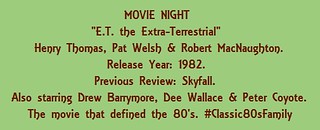
Movie Night: E.T. the Extra-Terrestrial.


Review #573: E.T. the Extra-Terrestrial.

Cast
Henry Thomas (Elliott), Pat Welsh (E.T.), Robert MacNaughton (Michael), Drew Barrymore (Gertie), Dee Wallace (Mary), Peter Coyote (Keys), K. C. Martel (Greg), Sean Frye (Steve), and C. Thomas Howell (Tyler) Directed by Steven Spielberg (#126 - Close Encounters of the Third Kind, #168 - Raiders of the Lost Ark, #169 - Indiana Jones and the Temple of Doom, #170 - Indiana Jones and the Last Crusade, #302 - Indiana Jones and the Kingdom of the Crystal Skull, #351 - Schindler's List, #480 - Jaws, #563 - The Sugarland Express)

Review
It's only fitting that I review this on my day off, E.T. is essentially a child's greatest fantasy come to life. It feels like if Spielberg bought the candy store that he went to as a kid and then made his own kind of candy. The movie feels like a time capsule back to the 80s (the Yoda costume, the same looking houses, playing RPG's...okay maybe it's not that old, Sesame Street...okay you could argue that's also a 70s/90s/00s flashback, faking sickness with a lamp - wouldn't be as easy to fake in this day and age), but also a trip back to youth itself, it makes anyone who watches it feel like a kid again. There are memorable moments such as when Gertie meets E.T., or most notably when E.T. and Elliott fly together on a bike. It seems that the kids are the only sensible ones in this movie, which I guess makes sense given the theme of this movie, which to me is all about friendship, about the bond of a kid and his alien. The effects on E.T. are good, it's not just some prop (Such as the ripoff Mac and Me), it's more than that. This is an emotional movie that pulls many punches and also pulls many parts of fun. I recommend this for everyone, as this is one of the better science fiction movies to watch and have fun with. Just don't play the video game based on this movie. For your own safety.

Overall, I give it 10 out of 10 stars.