Showing posts with label Anthony Zerbe. Show all posts

April 28, 2026

They Call Me Mister Tibbs!

Review #2531: They Call Me Mister Tibbs!

Cast: 
Sidney Poitier (Lieutenant Virgil Tibbs), Martin Landau (Logan Sharpe), Barbara McNair (Valerie Tibbs), Anthony Zerbe (Rice Weedon), Ed Asner (Woody Garfield), David Sheiner (Lieutenant Kenner), Jeff Corey (Captain Marden), Ted Gehring (Sergeant Deutsch), Juano Hernandez (Mealie Williamson), Norma Crane (Marge Garfield), and Beverly Todd ("Puff") Directed by Gordon Douglas (#663 - Them!, #686 - In Like Flint, #2320 - Viva Knievel!)

Review: 
Hey, remember In the Heat of the Night? To refresh my memory, because I only remember a few fragments...the movie was based on the 1965 novel by John Ball that involved a small Southern town in Mississippi rocked by a murder in the midst of the 1960s as an outsider detective comes in, deals with bigotry and solves the case. Sidney Poitier and Rod Steiger were big on doing the film together, which was filmed in Illinois (as directed by Norman Jewison) that probably had its most interesting scene when Poitier's character slaps someone back (as not originally envisioned). Or, well, the scene where Poitier's character, being asked what he gets called back in Philadelphia, responds, with, well, "They call me Mister Tibbs!". Ball actually did a handful more novels with the character of Tibbs with The Cool Cottontail (1966), Johnny Get Your Gun (1969), Five Pieces of Jade (1972), The Eyes of Buddha (1976), Then Came Violence (1980) and Singapore (1986). But this would be a movie that just went on its own way, with Alan Trustman (writer of The Thomas Crown Affair and co-writer of Bullitt [both 1968], interestingly enough). writing the story and co-writing the screenplay with James R. Webb (the Academy Award winning writer of How the West Was Won eight years prior). At the helm for director was Gordon Douglas, a regular presence in various genres, which included follow-ups to films such as Lady in Cement (1968). While not as big a success as the first film, it made roughly over $2 milllion in rentals in the first six months. Poitier returned as Tibbs for one more movie with The Organization (1971), with Don Medford serving as director.

We now have a film set in San Francisco as our title character is now wrapped up in the investigation of a dead prostitute as some sort of city referendum is coming up about urban renewal with a preacher on one side. This also goes with a few scenes spent in the household of his wife and children (what, a lonely detective in the big city?) that results in a few moments of strife because damned if there is even one bit of tension in the murder case. The 1970s would have a few movies with an interesting presence behind it in terms of crime action thrillers, but Shaft (1971) would be the one people think of as among the first to get the ball rolling rather than this film, that's for sure. Hell, Cotton Comes to Harlem, released a month before Tibbs, is more captivating because it just feels like a movie that yearns to actually do something beyond the mundane routines that come with an investigation that might as well be the equivalent of turning over a rock to see a bunch of ants on the bottom. You might say that there was something lost in the curiosity factor in the character played by Poitier, because now he just seems completely rigid as a board, as if someone wanted to make a Dragnet impersonation but gave up. His family life just sits there in a strange type of "I recognize the dynamic, but I don't care about these people". Landau was a nice actor who people loved in film and TV (such as, say, his Mission: Impossible run*) but he barely has anything to really give in this film, which seems shocking when you consider he is playing a street preacher. You would think that an investigation that you've got a pretty good guess on who the killer is would have some sort of way to drive interest but nope, it basically stays on autopilot for most of it. Zerbe is the more interesting presence, and he's playing for a pimp, for God's sake (to say nothing of putting a wig on Ed Asner and doing a routine car chase). You get little to nothing from folks such as Corey on the police side and you barely get a feel for the city as a whole, managing to resemble Generic Town USA even more than the average sequels that usually pass by on charm. But this one doesn't have enough charm to actually ride the wave for a complete winner for all of its 108 minutes, even with its ridiculous ending (calling it a shaggy dog procedural might be nicer). As a whole, They Call Me Mister Tibbs! is a downgrade from the previous film in most of the aspects that matter and just isn't enough of a film to call a winner, managing to be a disappointment that lies in the shadow of the decade that would give out better films to offer in procedures and thrillers.

Overall, I give it 6 out of 10 stars.


*What can I say, I watch old TV from time to time. The Wild Wild West is the other old show I'm on at the moment, I've done a whole bunch of TV watching on DVD such as The Fugitive, The Addams Family, The Munsters, Batman, Star Trek, The Twilight Zone, Lost in Space, and Get Smart.

September 28, 2016

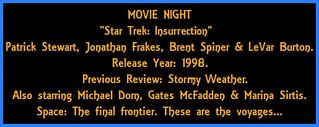
Star Trek: Insurrection.


Review #842: Star Trek: Insurrection.

Cast
Patrick Stewart (Captain Jean-Luc Picard), Jonathan Frakes (William Riker), Brent Spiner (Data), LeVar Burton (Geordi La Forge), Michael Dorn (Worf), Gates McFadden (Dr. Beverly Crusher), Marina Sirtis (Deanna Troi), F. Murray Abraham (Ru'afo), Donna Murphy (Anij), Anthony Zerbe (Admiral Dougherty), Gregg Henry (Gallatin), Daniel Hugh Kelly (Sojef), Michael Welch (Artim) Directed by Jonathan Frakes (#840 - Star Trek: First Contact)

Review
Given that I did First Contact on the 50th Anniversary of the original series, I decided to mark the anniversary of the first episode of Star Trek: The Next Generation (September 28, 1987) with the third installment in the Next Generation film series, Insurrection.

After the success (and tone) of First Contact, a decision was made to try and make the next film of the franchise lighter in tone, much like Star Trek IV: The Voyage Home (#492) had been, with its unconventional kind of story (that also had no villain to it). But all that Insurrection proves to be is a middle-of-the-road kind of Star Trek film that doesn't really have much to it. It is tough to say what is the main root of necessarily why it isn't all that enjoyable, because it feels more like splinters of why it manages to bungle itself. Perhaps the big splinter is the plot, with the crew fighting the Federation (read: an Admiral) over the forced migration of immortals (of 600, named the Ba'ku) from the planet (with immortalizing rings) they are on. But really, the dilemma of whether they should be moved or not in order to potentially save millions isn't presented as interestingly as it could have been. Instead of agreeing/disagreeing with the view presented by the movie, one is more likely to not really care about the people affected.

The Ba'ku aren't really presented with much characterization other than "we don't use technology", aside from Murphy, whose scenes with Stewart is fine, but they don't do the movie much in terms of enjoyment. Sure, the deal between the Federation and the Son'a  may have been a bit rash (in not asking them, even making a holodeck village in preparation), but I can't imagine this being unsuccessful for millions if it had been presented differently. Had it not been for the climax (and the "twist"), one could full-heartily be for the counterpoint and the people for it and not for the Ba'ku. Abraham (as the villain) is fine, but he only gets interesting around the climax, when he starts trying to destroy everyone, even if he is killed in a mild manner. The effects are fine, but not really anything noteworthy. As weird it may seem, I wish the Ba'ku had some makeup to them, to make them a bit more interesting looking. The Son'a are interesting, with their rubbery look fitting well with their characterization. The main cast is fine, even if they don't really seem to have as much presence with each other compared the other two films with the cast. In a way, it really does feel like a two-parter of the show, just not as good. At 103 minutes, it feels a bit too short, but at least it isn't too much of a slog. Compared to First Contact, it is a disappointment, but it's not like there isn't other things to watch (Like Descent, for example). Some might find the dilemma posed by the movie to more compelling than I did, but for me it just didn't work enough.

Coming soon by the end of the year: An explanation guide for the star ratings on this blog.

Overall, I give it 5 out of 10 stars.

February 9, 2013

Movie Night Redux: Licence to Kill.

Redux Review #290: Licence to Kill.

Cast
Timothy Dalton (James Bond), Carey Lowell (Pam Bouvier), Robert Davi (Franz Sanchez), Talisa Soto (Lupe Lamora), Anthony Zerbe (Milton Krest), Frank McRae (Sharkey), Everett McGill (Ed Killifer), Wayne Newton (Professor Joe Butcher), Benicio del Toro (Dario), Anthony Starke (Truman-Lodge), Pedro Armendáriz, Jr. (President Hector Lopez), Desmond Llewelyn (Q), David Hedison (Felix Leiter), Priscilla Barnes (Della Churchill), Robert Brown (M), and Caroline Bliss (Miss Moneypenny) Directed by John Glen (#281 - The Living Daylights)

Review
PART ONE: A Little History
I first reviewed this film back on November 23, 2012, having already reviewed The Living Daylights, Dalton's other Bond film. Was it good? It sure was memorable, and that was one of the main reason I decided to watch again more than two months later. I said a good deal of statements in my original review, such as this: "Honestly, the title Licence to Kill emphasizes the darker, edgier attempt at Bond. But another question is does that work? Yes...and no.", "The story is more back in reality, more then the last one, and even more then in On Her Majesty's Secret Service, which is admirable", "The violence is more prevalent, and it sometimes works and sometimes doesn't. It's a give and take kind of thing.", "Dalton is more improved here, more darker and yet still interesting" "While it isn't a great Bond film, it is still one of the stronger Bond films" Nevertheless, the film would be the last for six years, due to legal wrangling, with Dalton leaving during the hiatus. But does this rewatch help the film?

PART TWO: The Actors
Timothy Dalton once said this of the Bond films before him: "I think Roger was fine as Bond, but the films had become too much techno-pop and had lost track of their sense of story. I mean, every film seemed to have a villain who had to rule or destroy the world. If you want to believe in the fantasy on screen, then you have to believe in the characters and use them as a stepping-stone to lead you into this fantasy world. That's a demand I made, and Albert Broccoli agreed with me." Dalton was right, and it shows in his performance as James Bond, especially in this film. He read the books to try to more like the actual novel version of Bond, and I do like his efforts here. He is especially convincing in the action sequences, and he even did some of the stunts for this film. He sets his mark on the franchise, in a good way. Carey Lowell is our leading lady, and she is excellent. She manages to level with Bond and not being some lady to be rescued, which is a good thing, especially in this age. Then there's our villain, played none other by Robert Davi. He is a gem of a villain, and while he is evil, he manages to be memorable and very suave somehow. He works well with Dalton, which is a good thing. Talisa Soto is our other leading lady, and she is relatively okay. She has less to do than Lowell, but she does manages to work out well. But the actors I remember from this are David Hedison and Desmond Llewelyn. Hedison had already played Leiter in Live and Let Die, so he naturally has some experience than the other Leiters before him. He does convey the character more than just an ally of Bond. Llewelyn works here more than most of the films because his role is expanded a bit, which means more of Q, which is always fun. Zerbe and Newton aren't as great,but they manage to have enough skill to be passable. Robert Brown does a good job, reminding me of Bernard Lee's M, which is a good thing. McRae and del Toro are memorable in their own ways. The actors do a fine job overall.

PART THREE: Conclusion
John Glen directs his fifth and final Bond film, which he did from 1981 to 1989, the most by any director (the films being For Your Eyes Only, Octopussy, A View to a Kill, and The Living Daylights). He had a style that conveyed action and an attempt to change Bond to fit the 80s. Previously, Glen was the editor for three previous films, On Her Majesty's Secret Service, The Spy Who Loved Me and Moonraker. The action works well, especially in the truck sequence, which manages to be triumphant in its approach. It is double edged sword on Bond film on whether you like brutal Bond films without as much silliness or slightly silly Bond films with more of a lighthearted tone. The former works mostly and the latter works most of the time. But oh well. It's a shame that this is the last Dalton film as Bond, but at least he comes out on top. The story works for what it's worth, Dalton is excellent, the villain is good and the leading ladies work well enough. Take it for what it's worth.

Overall, I give it 9 out of 10 stars.