Showing posts with label Dina Meyer. Show all posts

December 21, 2024

Star Trek: Nemesis.

Review #2324: Star Trek: Nemesis.

Cast: 
Patrick Stewart (Captain Jean-Luc Picard), Jonathan Frakes (Commander / Captain William T. Riker), Brent Spiner (Lieutenant Commander Data / B-4), LeVar Burton (Lieutenant Commander Geordi La Forge), Michael Dorn (Lieutenant Commander Worf), Gates McFadden (Doctor Beverly Crusher), Marina Sirtis (Counselor Deanna Troi), Tom Hardy (Praetor Shinzon), Ron Perlman (the Reman Viceroy), and Dina Meyer (Romulan Commander Donatra) Directed by Stuart Baird (#1692 - U.S. Marshals)

Review: 
By the year 2002, Star Trek was in the midst of a long slog of what you might call its second phase of franchising. From 1987 to 2005, there was at least one Star Trek TV show on the air (before the dawn of streaming, one could watch shows in "broadcast syndication"). Of those, only The Next Generation (the one that started with a child prodigy that no one liked and a crappy-ish first two years that I liked as "pretty good" before Deep Space Nine challenged what that really meant) attracted attention enough to actually make movies with; in the winter of 2002, Nemesis, the fourth and final film with those Next Gen characters, was released, coming after the lone success of First Contact (1996) and two middling efforts with Generations (1994) and Insurrection (1998). The original story for this film came from the efforts of three people: John Logan, a previous co-writer of films such as Any Given Sunday [1999] and Gladiator [2000], Rick Berman, who previously responsible for co-writing the last three films...and Brent Spiner. Stuart Baird was hired to direct the film, having been previously known for his Academy Award-nominated work on editing for Superman [1978] and Gorillas in the Mist [1988] before becoming a feature director with Executive Decision (1996) and U.S. Marshals (1998); at it stands, this is the last directorial effort for Baird, who still edits well into his seventies. The movie was a financial failure at the time of release, and it spurred the end of any new Star Trek films for seven years.

It's funny to see this as the "final journey" of a crew when you consider Star Trek VI: The Undiscovered Country (1991). Those main actors were all past their fifties (some even in their seventies, whereas with Nemesis, the oldest was Stewart in his sixties), but there was something to the idea of "The wall coming down in outer space" that felt like a damn good way to end on a high note (the less said about Generations, the better?) in embracing change. Here I feel like I am watching B-roll footage of rejected Star Trek material. You have a person who looks and kind of talks like the captain to go along with some deadly plague and a plot to destroy the Earth and Data being Data (complete with the crew godawful dark uniforms because god forbid there is any color beyond undershirts); hell, Troi being mind-violated was actually done before with the episode "Violations", and that one didn't have the crew going "oh, I'm not letting you relieve yourself of duty." I don't think you can even say it falls on Baird, because, well, the last film in the series was directed by Frakes with the plodding Insurrection. Maybe it is cliche to say, but this is certainly a movie that looks "tired". Here, it just feels again that one is watching an overextended episode of the show that only lets Stewart, Hardy, and Spiner have anything to actually do. It is the ultimate experience of frustration: it provides a few familiar comforts that never has a terrible stumbling block or great moment. It fritters and dithers for nearly two hours like an old pet that forgot how to do tricks. Hell, it presents Remus (a planet right around Romulus, heh, get it) with little to no actual curiosity despite the whole *vampire slaves* thing (okay, they're sensitive to light, but didn't that sound better?). Baird seems trapped in actually making a movie with people in it, and it is funny to see that from a guy who had been wrapped in a film sequel (sort of) years earlier with U.S. Marshals (1998), which somehow seems more up his alley. The action scenes are hit and miss (we will not discuss the dune buggy sequence), with the battle for the climax at least serving serviceable, which is both the best mark for the film and a sad thing to say for a movie that ran itself into the ground before it even got halfway to the 117-minute runtime. 

You know, there were seven cast members for this show, but if you watched the four Next Gen films back-to-back, you could swear there was only three or so that actually did anything of note (poor McFadden might as well be a ghost, and it is perhaps great irony that Dorn, who had the pleasure of being a key cast member of more Star Trek episodes than anybody...has nothing do here in the last time he played Worf for years). Honestly, at a certain point, I think I stopped caring about Data when it came to this film. By the time the film tries its little rug pull moment, my mind was elsewhere (evidently, Spiner wanted his character killed off due to fears of aging in the last film, here he gets his wish with a cheap trick). Stewart (who called the film "particularly weak" in his memoirs) may be the most talented in going with sci-fi mumbojumbo, but is it really a compliment to be the best part of a sinking ship? The funny thing about Hardy is that the attempts to make him look like a younger clone of Stewart has the same effect as trying to pretend that Wooly Willy is fun after spending five minutes with it. As a whole, it is a sad experience to watch such a plain bad Star Trek movie, managing to prove that either one should make their script is all the way to go before making a movie or one shouldn't even try at all if the result is something like this. 

Overall, I give it 5 out of 10 stars.

October 9, 2024

Saw III.

Review #2269: Saw III.

Cast: 
Tobin Bell (Jigsaw/John Kramer), Shawnee Smith (Amanda), Angus Macfadyen (Jeff), Bahar Soomekh (Lynn), Donnie Wahlberg (Eric Matthews), Dina Meyer (Kerry), Leigh Whannell (Adam), Mpho Koaho (Tim), Barry Flatman (Judge Halden), Lyriq Bent (Rigg), J. Larose (Troy), Debra Lynne McCabe (Danica), and Costas Mandylor (Forensic Hoffman) Directed by Darren Lynn Bousman (#2102 - Saw II)

Review: 
"The Saw films are not just gore films. They actually have a story underneath it, and a lot of times, a very complex story. "Saw III" is a much more complex film than the other two, dealing with back stories and relationships and flashbacks, and all this other kind of stuff, and I think you cross over and you get those people as well. I think that a lot of people can find something to grab onto and relate to in the "Saw" films. It's crazy though."

If you remember correctly, Saw II (2005) was a film that had molded from a spec script named "The Desperate" by Darren Lynn Bousman into something worth following up James Wan's Saw (2004), albeit with a few suggestions by Leigh Whannell. The success of the film had rumblings of a sequel, but the three were not particularly keen on doing it. Gregg Hoffman, who had produced both films, died a few months after the release of Saw II, and it was his death that had led to the group deciding make the film for him. Whannell wrote the screenplay while co-writing the story with Wan; this was the last of the series that they would write for, while Bousman returned to direct the fourth film and Spiral (2021). Evidently, the filmmakers aimed to do a sort of "father-daughter love story" between our two main focuses in Kramer and Young (as played by Bell and Smith). This intercuts with the last two films to go along with about three different plot threads, taking moments in-and-out with Wahlberg (as seen first in II), the story involving MacFayden, and the story involving Soomekh having her life connected to the life of Bell.

Ultimately, it tries to bite off more than it can chew in being both sequel and prequel to events that really, really, really needed focus. The time spent with Soomekh in order to set up how she is mixed in with Bell and Smith, actually has an interesting idea: keep him alive and you stay alive, because if you fail or try to run away, boom you go. This is cut in with a "test" involving MacFayden, who actually has his own kind of interesting idea: when confronted with people who you associate with the death of your son, will you let death come to them in these contraptions? (one involves dumping guts onto a chained guy unless you burn stuff, which is grossly cool). You may or may not guess where the ending might have everything come together...but man this is a mess. You have three (or counting the Wahlberg stuff as "interesting", four) interesting ideas for a film all being jumbled into a film that tries to retroactively play with what happened in the first two films (and let's not forget, this was done before Saw X decided to play itself between I and II). It doesn't help with the quick cuts (for a "dynamic feel"), which has somehow managed to irritate me the most here, particularly with its 108-minute runtime (there are other versions of the film by the way, such as a two-hour director's cut and an "unrated cut"). 

It might seem weird to dwell so much on its story, but the film doesn't have enough tension to get away with its attempts at tricks (complete with baiting for a sequel). The attempt at framing these films as one involving a man coping with his impending death by deciding to become a man of tests and lend that legacy onto a chosen one could be a fun one, but it seems more framed that way to make up for a lack of cohesiveness in every other department. The most interesting lead presence not named Bell was Carey Elwes, and that was two films ago. Sure, Bell is still a highlight (to go along with a spry Smith), and Soomekh is fine, but it is a very played out movie. It baits itself for a follow-up feature despite, well, *killing* off important people in it! You'd think with that little montage of images in the climax that one would be finito, but nope (judging by the sheer fact that there were four further Saw films in the next four years, one could guess that the wheels of trying to connect the films even further in "flashbacks" were on steroids). In conclusion, there are moments of interest within getting to see a few grisly traps, but it is clear that the series has continued to have diminishing returns in a middling swansong from its original creators.

Overall, I give it 6 out of 10 stars.

October 8, 2023

Saw II.

Review #2102: Saw II.

Cast: 
Tobin Bell (Jigsaw / John Kramer), Shawnee Smith (Amanda Young), Donnie Wahlberg (Eric Matthews), Erik Knudsen (Daniel Matthews), Franky G (Xavier), Glenn Plummer (Jonas), Emmanuelle Vaugier (Addison), Beverley Mitchell (Laura), Timothy Burd (Obi), and Dina Meyer (Kerry) Directed by Darren Lynn Bousman.

Review: 
"When I watched the first Saw, it grabbed me because it showed real people put in real situations where they're forced to become monsters. This time, we really focus on Jigsaw, and the fans of the first film are going to get to see the man behind the madness."

As I'm sure you already know, the demand for a sequel to a successful film can lead to some interesting places. Saw (2004) was such a surprise hit that Lionsgate announced plans for a sequel for late October...2005. James Wan and Leigh Whannell were busy developing a film for Universal (the result was Dead Silence, which came out in 2007), but there was a way around that. Concurrently, Darren Lynn Bousman was pitching his script "The Desperate" to studios, but they did not bite on it due to the nature of violence present in the script to go with perceived similarities to Saw. David A. Armstrong, the cinematographer of the first film (who was being asked by Bousman to collaborate with him on said script), suggested that Bousman show the script to Gregg Hoffman, who had produced it with Mark Burg and Oren Koules. They felt that with a few modifications, this would serve as a good one to use for, well, you know. Of course, there was time to recruit Whannell into polishing the script (with input provided by Wan). The resulting success of Saw II was obvious, since Bousman would direct the next two sequels (2006, 2007) alongside Spiral (2021). 

I would say that the sequel is more of a newer model of the same slick machine that came with the first film, which was already a grab-bag of B-movie stuff that happened to have an interesting premise to go with a make-or-break climatic gut punch. It isn't exactly as good as the original, but as a pastiche of a different kind that isn't so reliant of say, Seven (1995), it is a gruesomely effective film in lending perspective with more time spent with Bell that makes for a useful curiosity upon the nature of those who really believe what they say when it comes to making others learn what it means to value life. Granted, the film jumps between him, Wahlberg, and the pursuit of a group of folks trying to make their way out of the house of traps and their own unsavory selves, but the 93-minute runtime seems just about right for the material needed. Actually, I kind of like seeing Wahlberg here, if only because he makes for an obvious mark to play contrast to Bell when it comes to pursuer and the pursued, for which he handles it with that raw sense of pathetic tough-guy quality that actually seems quite amusing. Bell may be confined to sitting around for his scenes (well Jigsaw does have a reason for that), but he still makes the most of it in proving the chilling quality required of someone who believes the only thing he has to lose is not trying at all to live, because having that killer survival instinct is all that matters in the end. The actual dwellers in the house, well, they are basically cut-and-dry, but that seems about on point in a B-movie sense, because the only familiar one obviously ends up being Smith (the key presence returning from the previous film-okay, there is Meyer too, but who do you remember more, a cop figure, or someone who survived a reverse bear trap?), although Franky G does make a quality brute adversary to the proceedings. The traps do prove interesting in the squeamish sense, probably best represented by a pit of syringes. At any rate, it is a leisurely good time for those who were totally fine with where the first film went with traps and the people that inhabited it because of their perceived failings in instinct or above, complete with a climax that straddles the line of clever and "okay, maybe a bit too clever" that would set the stage for what I'm sure would be another sequel of more elaborate ways of offbeat ways to show people at the weirdest when it comes to traps or twists. Well, as long as you don't pull the rug away, you have my interest.

Overall, I give it 7 out of 10 stars.
Next up: Dr. Jekyll and Mr. Hyde, 1931.

November 17, 2022

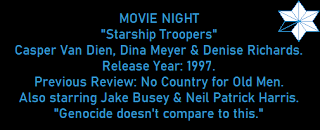
Starship Troopers.

Review #1922: Starship Troopers.

Cast: 
Casper Van Dien (Johnny Rico), Dina Meyer (Dizzy Flores), Denise Richards (Carmen Ibanez), Jake Busey (Ace Levy), Neil Patrick Harris (Carl Jenkins), Clancy Brown (Sgt. Zim), Seth Gilliam (Sugar Watkins), Patrick Muldoon (Zander Barcalow), and Michael Ironside (Jean Rasczak) Directed by Paul Verhoeven (#002 - RoboCop and #632 - Total Recall)

Review: 
You know, this is a strange movie to think about with its reputation in the 25 years that have passed since its release. Edward Neumeier started writing an original script called "Bug Hunt at Outpost Nine" in the time that followed RoboCop, which he co-wrote (with Michael Miner). The script was a bug movie that also happened to be a teen romance movie. However, when Jon Davison noticed the similarities to Robert A. Heinlein's Starship Troopers, the script was kindly modified to fit as an "adaptation" of the book in order to sell better to any interested studios. It was a film made for over $100 million that made its budget back by a slight amount. The reputation of the film has handily improved in later years to where it is considered a "cult classic". Incidentally, there have been four sequels, all released direct-to-video (the lead star in Van Dien reprised his role in two of the films while Ed Neumeier wrote three of them while directing one). If I am being honest, I wonder how a straight adaptation of the novel would have been rather than this ended up. A cursory glance at the plot of the original work notes that they share a similar structure: a young lad (in the book a Filipino) enters the military because of a woman, makes an error but decides not to leave, sees family members in Buenos Aires get nuked, participates in a futile battle on the alien Arachind before seeing a successful raid on the brain caste and queens while seeing a platoon named after him. But the work is more involved in discussing the nature of what a world would look like if only veterans of the military were allowed to vote (also Rico ends up serving alongside his father in the book). Of course, fascism in the eyes of people wanting to label something fascist may just be their personal boogeyman rather than based on facts (but hey, the book is totally about fascism, trust a person on the Internet telling you this). With all of that in mind, the movie is massively average. Satire or not, I found it just a mild movie. It doesn't shock me or enrage me one bit, but maybe that falls to how many movies one has seen over the years. You might think that the fact that folks being unable to "recognize true propaganda" is a bad thing, but you know, Dirty Harry (1971) was labeled a fascist movie, and I don't see people getting weird about it being average in the "entertainment" department. "Joke" or not, an average movie is still average.

Hey, do you want a movie that tells you that violence is the way to solve problems (satire)? Okay then, enjoy a cadre of teen romance cliches sprinkled in for probably longer than you actually think it will be present. Take my perspective on it: Things in this movie only seem interesting when it involves the Arachnids. The movie may think it is pretty funny for itself when talking about "fascism", but my god, sometimes you should just embrace the cliches that people really care about when it comes to "sci-fi action film". Oh, but RoboCop (1987) is a sci-fi satire that was handled great by Verhoeven, you might say. Well, one realizes pretty quickly that RoboCop would be as convincing as a ball of mud trying to be tinfoil if "teenagers" were the lead focus. That isn't to say I despised the characters (because hey, they mostly act like folks who don't think they are bad guys), but there was never a time where I felt this material was anything better than the general schlock you might see from a 1950s sci-fi film about dealing with marauders from abroad or being anything better than the unintentional amusement found in Top Gun (1986). The attempt to turn the idea of a military elite-ruled world (reminder: Verhoeven didn't even finish the novel because it apparently depressed him) into a mockery of politics and culture of modern America is just basically "Beverly Hills 90210 meets Vietnam War". I don't think Heinlein really wanted a government where the military was the head honcho, I just think he wanted to show how one might operate in some twisted way. Hell, consider this quote from Heinlein: "War is not violence and killing, pure and simple; war is controlled violence, for a purpose.” In response to that, Verhoeven and Neumeier have turned his curiosity into mockery, and I guess this is meant to be clever only because it happens to be an adaptation of a particular novel. Keep in mind, I did like the movie fine, but it isn't worth the discussion as some sort of hidden masterpiece. It is a bug movie on par with schlock movies of the past that happens to be made on a large budget with characters that were pulled from a soap opera mixed in with stock characters (who are ungodly more interesting) that results in a silly effects show. The parts involving a possible "Brain Bug" is quite interesting, if only to suggest the idea of fighting an enemy that isn't just an ugly dumb bug, even if more time is spent wondering just how dumb our lead is before he gets the idea of who wants to bone him. It is the B-movie spectacle that I care most about in the long run of 129 minutes, and Verhoeven does stage his adventure with the basic stops one does see coming without trying to pull an anti-climax. Van Dien maneuvers the dialogue of wood with general interest (whether in on the joke or not), but honestly Ironside and Brown are the highlights for me, if only because they are the seasoned pros of hardlined patience that the movie does best. Patrick Harris and Richards end up overshadowed by Meyer, who naturally doesn't get to enjoy all of the climax. Actually, Busey makes a pretty good heel for a time, so there's another little compliment amongst what seems to be me gritting my teeth. At any rate, I wish I liked the movie more than I did. It does just fine in the presentation of spectacle in all of its weird and cheap forms while barely making headway in any other department, working best for those who dig over-the-top movies that may or may not read as "effective" satire. 

Overall, I give it 7 out of 10 stars.

October 29, 2021

Saw (2004).

Review #1750: Saw.

Cast: 
Cary Elwes (Lawrence Gordon), Leigh Whannell (Adam Stanheight), Danny Glover (David Tapp), Ken Leung (Detective Steven Sing), Dina Meyer (Detective Allison Kerry), Mike Butters (Paul), Paul Gutrecht (Mark), Michael Emerson (Zep Hindle), Benito Martinez (Brett), Shawnee Smith (Amanda Young), Makenzie Vega (Diana Gordon), Monica Potter (Alison Gordon), Alexandra Bokyun Chun (Carla), and Tobin Bell (Jigsaw/John Kramer) Directed by James Wan (#1175 - Aquaman and #1556 - Insidious)

Review: 
"It changed our lives. Sure, it really wasn’t the film I set up to do, yet it ended up being this cultural phenomenon that we never expected. I never expected that my first little, as I refer to it, my student film would ultimately go on to have such a cultural impact."

If any horror film could help to help define the first few years of the 21st century, you could likely make a great case for Saw to be in the argument. Oh sure, the quality of each feature has varied from film to film (for which there were six sequels in the next six years before the supposed finale was followed by two standalone movies), but one can't deny the lingering legacy that arose from an interesting presence from two soon-to-be known directors from Australia. James Wan and Leigh Whannell met each other when each were attending the Royal Melbourne Institute Of Technology, for which they bonded over their shared interest in horror. Years later, they wanted to make a film for as cheap ($5,000) and simple as one can make when having to work dead-end jobs; Wan and Whannell each suggested ideas to each other, but one idea by the former really stuck through: two guys in a room that had a dead body lying on the floor with a gun and a tape player. Whannell ran with the idea and expanded on it to what became Saw (for which he came up with the title); since they wanted to prove that they could actually do it, they took one scene from the film and shot it as a short (picking the scene involving the reverse bear trap for Whannell to act). Shot in Los Angeles in 2003, the short attracted attention from a variety of interested funders, with Evolution Entertainment being the one that Wan and Whannell went with because of the freedom granted to do the film their way (with a shooting budget of roughly $700,000 for eighteen days of shooting). 

Sure, it is gruesome, but it has a few fair merits to consider beyond just classifying it as the starting point for so called "torture porn." Pffft, I say, as this term seems to exist just for "higher-minded critics" to degrade horror films that just happen to make folks uncomfortable while being different from the usual fare (in other words, some folks are squeamish for stuff that seems tame to others). Besides, it would be the sequels that would up the ante in gore (which even got the 3D treatment with the seventh film), while this film is actually more reminiscent of Seven (1995), what with the exploration of a hunt for a killer that dabbles in sins. Undeniably, that film is superior in pretty much every way when it comes to its psychological aspects and main detective pair, but at least Saw manages to accomplish a portion of the terror that can come from the simple act of having two folks in a room with tension over trying to stay alive in a macabre mystery-thriller. Honestly, I thought it was a fine movie, all things considered. For 103 minutes, it balances itself out with a few elaborate traps and a few semblances of plot (in flashbacks, complete with red herrings) that hold up the interesting premise long enough to stick the ultimate landing, which likely will provide curiosity to those who prefer to sit through their films time and time again; its quality may vary from person to person like a puzzle game, where if one likes the process they'll go back to it and look to scramble it all over. Undeniably, the acting isn't the strong suit of the film, but I was fond enough of the presences captured anyway (although this is more because of the familiar faces more than anything, which can boomerang the other way around if in a lesser film); sure, Elwes may overact a bit with the material, but he makes the most of it with reasoned interest, since he has the overall story to work with (as opposed to Whannell, although expecting him to have great acting isn't exactly feasible). Glover and Leung do okay in the procedural aspect, albeit in the sense that it goes about as well with the film as it would on a buried script of a TV procedural. Bell is mostly utilized for his voice more so than physical presence for most of the film, but he gives it his effort for a role that could have veered into one-note (puppets don't count). The final turn of the screw for the closing is on the money, at least when it comes to not insulting its audience completely while being quite definitive in its lasting note on a killer that tests the will of survival of his would-be victims with traps that makes for a stone cold time. As a gritty feature with sparse features (such as in its shots and design), I would say it is a worthy accomplishment for what Wan and Whannell wanted to do in filmmaking, one that accomplished its ride of curiosity without stumbling over the clichés. It might not be a great piece in horror filmmaking, but it sure made its mark count with its interesting premise and execution that opened the door for further grips into terror in puzzle traps, for better or worse.

Overall, I give it 8 out of 10 stars.
Next Time: Halloween II (2009).