Showing posts with label Lynn Bari. Show all posts

September 17, 2025

The Amazing Mr. X.

Review #2420: The Amazing Mr. X.

Cast: 
Turhan Bey (Alexis), Lynn Bari (Christine Faber), Cathy O'Donnell (Janet Burke), Richard Carlson (Martin Abbott), Donald Curtis (Paul Faber), Virginia Gregg (Emily), and Harry Mendoza (Detective Hoffman) Directed by Bernard Vorhaus.

Review: 
Sure, let's do one of these movies. This is one of those films that you find in the bargain bin, the kind that could be seen at any time on the Internet because it slipped into the public domain and therefore is readily available to varying quality. Apparently, the movie actually had a different title: It was known as "The Spiritualist" but somehow the movie was re-issued and put on television as the title you see today in...The Amazing Mr. X. Debate for yourself over which title fits the movie better. Crane Wilbur (the former actor-turned-writer of works such as The Monster) wrote the story that became this movie, which went from being a possible production for him to oversee with Producers Releasing Corporation to being a production led by Bernard Vorhaus at Eagle-Lion Films that had Muriel Bolton turn the story into a script. Vorhaus, not liking the script, asked for a re-write and got the services of Ian McLellan Hunter*. The movie apparently was shot in three weeks that went from January filming to being released in July. Vorhaus was an experienced director for several years, having gone from screenwriting to making quota quickies (i.e. fast and cheap) in England that resulted in movies such as The Last Journey (1936). Apparently, he was a young mentor to David Lean. He returned to the States with Republic Pictures, directing a handful of B-movies and later stuff for the war effort. It was among his last films as an American, as the House Un-American Activities Committee investigation on alleged Communists led to him being blacklisted. He didn't participate in the HUAC hearing and retired to England, where he operated a firm converting houses to offices and shops. He lived there for the remainder of his life, where he died in 2000 at the age of 95.

It helps to have John Alton as a cinematographer, doesn't it? He was the cameraman behind a number of noirs such as He Walked by Night (1948), Raw Deal (1948) and The Big Combo (1955), and he helps the effort here with a movie that at times seems eerie with its angles that make the film interesting to view beyond just a shabby little noir/thriller (well it isn't really any one genre, but whatever).* The 78-minute runtime is fairly satisfying for a movie that doesn't hesitate to just let its audience have a fair shot at following its attempts at showing the troubles of those who may very well believe what they see. You get an odd little caper that mostly is held up with Bey at hand. Bey had been playing a handful of roles on film ever since he had come to the States from Austria but the only reason he was with Eagle-Lion is because his contract had been sold due to struggles with Universal. This was the third of four movies he did for the studio before his career dwindled down, but he at least seems game to be a charming snake in the grass here, selling the audacity required in being involved with trying to play with things that aren't easy to quantify or understand. Bari makes for a quality type to get into the whirlwind of seeing and hearing things that may not be all the way there, mainly because it still seems pretty real now to see people fooled by things they want to hear, particularly since Carlson is probably too ordinary to really contrast the interest obviously generated by Bey, and O'Donnell is merely just fine. In general, it may be an average movie on a first impression, but it eventually finds its footing with stark imagery, sly charm by Bey and a general respect for wanting to keep the audience interested in its arrangement of emotional cons that at least shows you could find a good time with "old movies" if you know where to go.

Overall, I give it 7 out of 10 stars.

*Coincidentally, Vorhaus did uncredited work as an assistant director on Roman Holiday (1953), the movie that notably saw Hunter's name listed on the credits as a writer as a front for the actual work of Dalton Trumbo, which resulted in an Academy Award.
*Interestingly, Alton also wrote a book on the subject of cinematography with Painting with Light in 1949.

July 6, 2022

The Kid from Cleveland.

Review #1857: The Kid from Cleveland.

Cast: 
George Brent (Mike Jackson), Lynn Bari (Katherine Jackson), Russ Tamblyn (Johnny Barrows), Tommy Cook (Dan "The Kid" Hudson), Ann Doran (Emily Barrows Novak), Louis Jean Heydt (Carl Novak), K. Elmo Lowe (Dave Joyce), John Beradino (Mac), with Bill Veeck, Lou Boudreau, Tris Speaker, Hank Greenberg, Larry Doby, and many more. Directed by Herbert Kline.

Review: 
Let's be honest: the baseball material is the only drawing point of curiosity. That isn't to say that detailing the history of a young role for Russ Tamblyn is a bland experience, but one really does have to strain hard to not just immediately ask about how the Cleveland Indians (now known as the Guardians) got their own feature film. Well, I'm sure the answer is simply just Republic Pictures thinking that the 1948 club, who won the World Series over the Boston Braves, would possibly draw in a few local profits, complete with select footage utilized from the Series and bit lines from the stars on that team (along with certain moments with the 1949 team, who finished 3rd). Truthfully, the only reason I picked this movie was to talk about the 75th anniversary of Larry Doby making his debut in Major League Baseball, the second African American to play in the league and first in the American League. The Camden native had played five seasons for the Newark Eagles in black baseball before Cleveland owner/club president Bill Veeck signed him to a contract. The day of July 5, 1947 was three months after the debut of Jackie Robinson, and Doby's debut was serving as a pinch-hitter that saw him strike out on four pitches (contrary to Veeck's statement at the end of this film, Joe Gordon did not strike out after Doby to save face for his teammate, as Gordon was on base when Doby struck out). The next day, in the second game of a double-header, Doby started his first game in MLB at first base at Comiskey Park in Chicago, collecting his first hit and RBI. Doby had a tough first year, but he bounced back in 1948 to bat .300, and he was the first black player to hit a home run in the World Series in Game 4. Combining his statistics from his first season in 1942 to his last in 1959, he collected 273 home runs with 1,094 runs batted in while being named an All-Star eight times; after a long wait, Doby was named to the Baseball Hall of Fame in 1998, finally cementing his place as one of the best players of his era and certainly the most underrated player. 

The film was written by Herbert Kline and John Bright (a founder of the Screen Writers Guild). Born in Iowa, Kline started his career as an editor for a magazine called New Theater before moving to New York to join the Photo League. Over time, he did manage to make a couple of features alongside documentary work, such as his work involving covering political crises in Europe such as the Spanish Civil War; he once described himself as a "foreign correspondent of the screen". The Fighter (1952) and the aforementioned Cleveland film are likely his most noted features, owing to his blacklisting in the 1950s due to the House Committee on Un-American Activities. The movie went by "The Cleveland Story" and "Pride of the Indians" before finally settling on the title we know now, which is a pleasant snooze in all of the average ways possible. Did I mention that this is a movie about a troubled teenager that finds help from the baseball team? This seems like it could have been made about any random sports team, even with all of the location shots of Cleveland Stadium and bits of League Park sprinkled in (which only begs the question if someone would have gone with "The Kid from Boston" if the Braves had won the Series instead?). For me, I would rather be sitting at Cleveland Stadium watching six future Hall of Famers try to play actor (to go with more interesting baseball footage) than watching Tamblyn trying to play juvenile delinquent. This was his first credited role for the Los Angeles native, who was fifteen years old when this film came out, although it would be a couple of years before he didn't have to go by "Rusty" Tamblyn. At any rate, his performance isn't much to write home about, probably fit for a morality play or an unintentional comedy than this hodgepodge. Brent and Bari don't exactly lend a hand to help either, since neither really elevate the drama beyond first gear nor generate interest in the material that a broomstick would do. Doran and Heydt don't exactly move the needle either in parental figures to Tamblyn. One knows exactly what they are going for in 89 minutes with no real particular surprises present, no matter how they try to play the juvenile angle or the inevitable custody battle.

The reason to maybe see the movie is to see the Cleveland of yesteryear, to see a winning ball club that had star power with distinct names and faces, whether that involved player/manager Lou Boudreau, or star batter Joe Gordon, or Doby, or star pitchers Bob Feller (a Hall of Famer and also a guy who devised a sign-stealing plan with fellow legend Bob Lemon involving a telescope) and Satchel Paige (who is seen depicting his hesitation pitch for one scene). Of course, they come off pretty stiff when a camera is focused on them besides baseball, but maybe the curiosity factor about their baseball stories can forgive some of that. Bill Veeck, the revolutionary showman owner, is probably the most curious presence in the film, even if one knows they are watching a showman rather than an actor. As a whole, it is more interesting to talk around the movie known as The Kid from Cleveland than it is to actually watch it, which is not a ringing endorsement unless one is a sentimental Clevelander. Average may be better than a portion of bad movies, but it still isn't enough to recommend over other (better) baseball movies.

Overall, I give it 6 out of 10 stars.

December 20, 2014

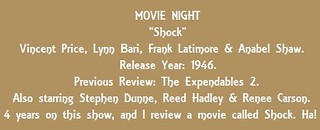
Movie Night: Shock.


Review #676: Shock.

Cast
Vincent Price (Dr. Richard Cross), Lynn Bari (Elaine Jordan), Frank Latimore (Lt. Paul Stewart), Anabel Shaw (Janet Stewart), Stephen Dunne (Dr. Stevens), Reed Hadley (O'Neill), Renee Carson (Mrs. Hatfield), and Charles Trowbridge (Dr. Franklin Harvey) Directed by Alfred L. Werker.

Review
I guess I'm shocked this show managed to get to its fourth year anniversary, so logically this movie makes sense for today's focus. It's a delight to review a film with Vincent Price in it, especially when it's a film noir. And hey, it's a 70 minute one, which I guess is a selling point if you want something quick and cheap (made on a budget of $350,000), but that would also work for fast food, so make up your mind on that one. The movie itself is fine, even if it is devoid of mystery. Really the movie is more about waiting for the characters to catch up to Price's schemes. Speaking of Price, he does a fine job; he doesn't just play an evil doctor, which is a good thing, he does a pretty good job portraying the complexities of his predicament. The other actors are fine, they don't overact their roles, though this is more a movie for Price to shine, even over the patient afflicted with shock (Anabel Shaw). It at least looks good to watch, and it has its moments, especially near the end, which manages to be pretty effective in suspense. For this film, anyway. Well I'm glad Movie Night still has new reviews after four years, and I do hope for more fun and entertaining films in the next year or so. Thank you.

Overall, I give it 8 out of 10 stars.