Showing posts with label Harrison Ford. Show all posts

June 13, 2026

Redux: Raiders of the Lost Ark.

Redux Review #168: Raiders of the Lost Ark.

Cast: 
Harrison Ford (Indiana Jones), Karen Allen (Marion Ravenwood), Paul Freeman (René Belloq), Ronald Lacey (Major Arnold Toht), John Rhys-Davies (Sallah), Denholm Elliott (Marcus Brody), with Alfred Molina (Satipo), Wolf Kahler (Colonel Dietrich), Anthony Higgins (Major Gobler), Vic Tablian (Barranca / Monkey Man), Don Fellows (Colonel Musgrove), William Hootkins (Major Eaton), Bill Reimbold (Bureaucrat), Fred Sorenson (Jock), Patrick Durkin (Australian Climber), Pat Roach (Giant Sherpa / 1st Mechanic), and George Harris (Simon Katanga) Directed by Steven Spielberg (#126 - Close Encounters of the Third Kind).

Review: 
"Indiana Jones was never a machine. I think one of the things we brought to the genre—and we didn’t coin the genre; it’s been around a lot longer than we’ve been around—but one of the things that George [Lucas] and I and, originally, Larry Kasdan, the writer of Raiders of the Lost Ark, brought to the genre, was the willingness to allow our leading man to get hurt and to express his pain and to get his mad out and to take pratfalls and sometimes be the butt of his own jokes. I mean, Indiana Jones is not a perfect hero, and his imperfections, I think, make the audience feel that, with a little more exercise and a little more courage, they could be just like him. So he’s not the Terminator. He’s not so far away from the people who go to see the movies that he’s inaccessible to their own dreams and aspirations."

What is it about Indiana Jones that drives so much fascination after 45 years? As the story goes, George Lucas, fresh off American Graffiti, had ideas in mind about wanting to do a movie like the ones he used to see a kid. He thought of doing an adventure with a college professor who basically was like James Bond on as "a bounty hunter of antiquities" that liked the nightclub. A little collaboration with his friend Philip Kaufman (director of films such as The Great Northfield, Minnesota Raid [1972] and The White Dawn [1974]) led to the ditching of the nightclub but also led to the pursuit of the Ark of the Covenant. Lucas paused on the idea when Kaufman was off to direct The Outlaw Josey Wales (1976) to focus on, well, Star Wars (1977). Incidentally, one person who wanted to do a Bond type of adventure thriller was Steven Spielberg; the success of Star Wars in May 1977, with Lucas and Spielberg each on vacation in Hawaii, spurred things along for an eventual collaboration (after months of Lucas waiting to see if Kaufman would do it fell through). Spielberg brought in Lawrence Kasdan, who Spielberg suggested because he had just convinced Universal Pictures to purchase Kasdan's script for Continental Divide. They spent several days in 1978 doing a pitching session that argued and paced out what would happen in the story (which you can find here, because it was taped). Kasdan was once quoted as stating that everything in the film "resonates from other movies", specifically adventure films like Seven Samurai to The Great Escape, where they chased that feeling while the film did not take itself too seriously*. Filmed in 1980, Raiders was Spielberg's sixth feature film as a director, falling right between 1941 (1979) and E.T. the Extra-Terrestrial (1982). It was released on June 12, 1981 with mild expectations because of the impending release in America of Superman II that was coming on June 19 (incidentally, audiences could also choose between Raiders or Clash of the Titans, or History of the World, Part I); the result was a massive hit that reportedly saw over 70 million tickets be sold in a time when people could see a movie in theaters for a year. It was nominated for nine Academy Awards that went down from Best Picture to Cinematography, winning for art direction, editing, sound, visual effects, and a special one for sound editing (that year, Chariots of Fire, a movie that I'm sure everyone knows beyond that one song, won Best Picture*). There were four sequels of varying quality (Temple of Doom - really good, actually; Last Crusade - a charmer; Kingdom of the Crystal Skull - better the next time around; Dial of Destiny - fine the one time I saw it) and a television show with The Young Indiana Jones Chronicles.

It's easy to go on and on about the influences that shaped Indiana Jones (matinee serials, China [1943], Secret of the Incas [1954], others) or just go point by point about the beauty of the film from its cinematography by Douglas Slocombe or the tremendously diverting score by John Williams all the way down to Harrison Ford being the one to lead it over, say, Tom Selleck. It was released in a time where you could show multiple people get shot (along with the whole Ark thing), snakes going around dead bodies, blood splatter right as a dude gets chopped by a plane blade...and get a PG rating. The easiest way to describe the movie is that it is an adventure with tremendous respect for its viewer that has something for everyone in a manner that seems effortless but is actually the result of so many worthy things going so well. It is the kind of movie that benefits from re-watches in what you view from certain scenes the second time around, because there are moments that really are just allowed to breathe without needing dialogue, when you think about it (this may come from the fact that the movie was extensively storyboarded, because he felt he needed every storyboard to stay on schedule). You enjoy the people that enter the sphere around Jones in what they bring to the table in their own pockets of time, whether that involves a trained monkey spy or the worthy menace brought by people such as Lacey. It's a wonderful movie to look at, right down to what is right there on screen and what actually is say, a matte painting. It all rests on Ford being something beyond the matinee hero: an academic and an adventurer (okay that was paraphrasing what he once said about the character, but still). He balances the tightrope of strength and wit that can be just as vulnerable as he can be funny in an adventure that basically is a ride of humility (contrary to Han Solo, the character of Jones doesn't start out as, well a conman).

It's not all about rescuing and getting the girl on the way to glory, it is a movie where you really do have to close your eyes to see beyond what you think you know about the world. Allen is just simply charming in that sort of independence that we gravitate to even in without as much backstory to really sink into (which is where imagination comes to play when thinking about looking at the interactions between her and Ford as compared to the ones between her and Freeman). Freeman is a capable shadow of Ford, a disturbing presence in how sly one can be when collaborating with the worst of humanity because he believes in himself so highly as a fallen angel of archaeology. A fly could buzz around his mouth and all he cares about is where he looms on the chessboard. You get the delightful elegance, charm or otherwise, with Rhys-Davies (cast as a mix between his role in Shōgun and John Falstaff*) and Elliott (the always beloved British actor), did I forget that? Wrapped within its 115-minute runtime is a movie that breezes along in finding the pieces of the puzzle in its adventure ride that respects its audience in allowing it to breathe and experience the action sequences or its effects spectacle (spooky ghosts always gets a vote) that I probably appreciate even more than when I first saw it as a teenager. It's hard to really say just what is the best sequence of the whole film between, say, the opening sequence or the Map Room - you just have to see it (and I mean see it) to really believe it, where a B-movie feel leads to going along with its rhythm quickly. It's the kind of movie that makes you feel young again, and it is the kind of movie that scratches the itch every now and then to crave adventure and maybe get something from the pursuit of history. The second one plays to the lizard brain interests for intensity and comedy, the third and fourth ones pursued a family tale with leaps of faith and the fifth, well, plays to having at least one more good time in old age, so there's that as well. It is sincerity without becoming devout in the best ways imaginable. 45 years later, it is the movie with the best type of qualities: the milage of craftsmen at work all coming together for a true return to the great adventure.

Overall, I give it 10 out of 10 stars.


*Because of his work in the script, Kasdan was approached by Lucas to work on The Empire Strikes Back (1980).
*Nobody really dwells on a Welsh actor playing Sallah and neither do you.
*Of all the times to give an Academy Award to the British, good lord. I do wonder if Reds holds up enough that Warren Beatty deserved a Best Director award. 
*Incidentally, Steven Soderbergh did a cut of the film in 2014 that aimed to show how the film really shined in the staging, which he did by taking out the audio and converted it to black-and-white

June 30, 2023

Indiana Jones and the Dial of Destiny.

Review #2027: Indiana Jones and the Dial of Destiny.

Cast: 
Harrison Ford (Indiana Jones), Phoebe Waller-Bridge (Helena Shaw), Mads Mikkelsen (Jürgen Voller), Antonio Banderas (Renaldo), John Rhys-Davies (Sallah), Toby Jones (Basil Shaw), Boyd Holbrook (Klaber), Ethann Isidore (Teddy Kumar), Shaunette Renée Wilson (Mason), Thomas Kretschmann (Colonel Weber), Karen Allen (Marion Ravenwood), and Olivier Richters (Hauke) Directed by James Mangold (#912 - Logan and #1302 - Ford v. Ferrari)

Review: 

Before one gets to the inevitable, why don't I address the easiest question out of the way? Just which sequel to Raiders of the Lost Ark is the best one? (If you just want to get right down to the film, skip the paragraph or enjoy a rundown). Let me look at the three sequels that followed up the classic 1981 feature film in a brief rundown while stating the obvious: Raiders of the Lost Ark, in the tradition of many franchises, is by default the most original of the films, which is saying something as a film that is a tribute to the old adventure serials that George Lucas had enjoyed in his younger days. He worked with Philip Kaufman on the original script before years of waiting eventually led to collaborating with Steven Spielberg, who used his rejection of not being allowed to do a James Bond film to influence his directing (complete with Lawrence Kasdan writing the screenplay). Needless to say, the resulting film is one of the best of its time, probably even the best film of its year (no human being seriously believes Chariots of Fire is a memorable Best Picture winner unless they happen to be born in England- think about it). The sequel film, as directed by Spielberg in 1984 as Indiana Jones and the Temple of Doom is thought of as the lesser of the 80s films, and that may be true, but I enjoyed the hell out of it the second time around. Honestly, the complaint of it being too dark is a lazy one, because what the hell is wrong with that? Adventure serials were not chipper and friendly features, you know, and the last film had people's faces being melted off because they looked at the Ark, so don't tell me that one suddenly decided to get squeamish just because they saw a heart ripped out. I enjoyed it far more than I expected to when seeing it the night before seeing Destiny, to the point where I would argue that a 9/10 rating is more appropriate than the 8 I originally gave it. It was a film with all of the fun you could hope from trying to spook your friends on a thrill ride to counter the original in spectacle, and I will go to my grave saying that. Last Crusade (1989) is undeniably just as good as the first film, one that shows the power of adventure goes hand in hand with family and its touches of faith beyond being just an adventure for another artifact. The ending with father and son on horseback with friends into the sunset is probably the highest point of the whole series, and one would be forgiven for thinking that the series could have just ended right there. Lucas felt that the series was finished and thus focused his time on The Young Indiana Jones Chronicles, which ran from 1992 to 1993 that detailed a handful of young adventures, and it was shooting Ford for a guest spot in one episode that had got him to think of ideas for a possible fourth film that theoretically would be set in the 1950s (his "saucer men from mars" script isn't exactly a treat to hear about, but I digress). Eventually, he got Spielberg into doing something that would involve "interdimensional beings" (so no, not really just aliens) within a sci-fi B-movie tribute, albeit one with a bit of computer-generated imagery (such as in the jungle or with the alien). Fifteen years later, screw it, I actually think it is a fine movie, so spare me the complaints about "nuking the fridge, or space aliens or CGI monkeys" (okay the last one is corny). It is a nitpicker's dream movie, to put it mildly, but sometimes, even folks like me just let loose and take stock at the fact that a movie can sometimes be "fine" anyway. It captures some of what one might call a "lizard brain" energy required to make a tribute to older films with ridiculous execution, and as long as one respects the intelligence or patience of the viewer, you can get through with a number of things (Doom, if you recall, had a stunt where folks survived a freefall on an inflatable raft). Really, it only seems to flounder when a certain individual next to Ford is on screen that results in a 7/10 experience that was better than I remembered. But we are here to talk about a film from 2023, not just ones from 1984, 1989, or 2008.

Perhaps it is not surprising that four writers are credited here: Jez Butterworth, John-Henry Butterworth, David Koepp, and James Mangold (you may remember Koepp as a co-writer on Crystal Skull and the Butterworths for their work on Edge of Tomorrow). Plans for a fifth film technically started in 2016 with pre-production that had a target of 2019, which originally had Koepp write for Spielberg as intended director before both left (the latter is instead executive producer), which is where the Butterworths and Mangold come in. The first and immediate thought that came out after seeing the credits end was one of laughter. It is just as average as the film from fifteen years ago, with the only difference being that Ford is now 80 rather than 65 years old. Think about it: both films feature a secondary lead that takes up a good chunk of action stunts (for evident reasons) that have some relation to Ford that was just established in this film (secret son, goddaughter, whatever) while dealing with some sort of mystical/magical allure that mines the well a bit for nostalgia. Mangold may claim that the last film didn't really know what it was about when it came to an older Indy, but, respectfully, what the hell has he really done to improve on that? At 154 minutes, it is the longest of the five films, and I honestly don't know how they got to that point aside from the lengthy opening sequence involving a de-aged Ford in the 1940s. You know, sometimes, the old trick of using a lookalike or just a brief recasting (you know, like the opening to Last Crusade?) really is better than the alleged best new trick. Roughly 25 minutes spent with a CG face morph and action spent mostly in the dark (with some decent dialogue, but alas) is such a baffling way to get things going in establishing things to come back in play for the real ideal setting: the summer of 1969, right after man has walked on the Moon...and a nearly divorced and retiring Indiana Jones that seems ready to fade away with his joys and regrets. This is single-handily the most uneven film of the series, one that is technically fun when it comes to the overall entertainment level but as a whole is just a reminder that sometimes, you just have to let it go. People who think Temple of Doom is the "dark" one of the series will now get to eat a heap of humble pie with a film in Dial of Destiny that seems to want to top it in being the bleakest of the five in its initial trappings, where only the climax can provide a respite to what you damn well know is going to happen. I suppose if you never should see your heroes grow old, you surely don't want to see them end up the same place as everything else: vanished from the line of sight. 

The interesting thing is that there are no real bad performances in an Indiana Jones movie, with this one being no different. Ford obviously enjoyed the idea of doing this role one more time to wrap things in peace, one that seems him at odds with just where he should be in his life, and I enjoy it. He is still most of the measured force of dignity in the face of harrowing adventure, regardless of how many stunts he gets involved in. Waller-Bridge makes a quality presence to go along with Ford when it comes to generating amusement as basically a lingering grifter, one who matters to the story when it comes to asserting what matters most when interacting with people beyond cash. That involves a degree of humor, because Isidore is present as essentially the third part of a trio that comes there in the middle of the film to go with the two, which results in a mildly compelling rogues gallery that hit and miss at times. Mikkelsen (speaking of irony relating to Bond and Indy, he's now played a villain in both franchises just like Julian Glover) is a semi-compelling threat in the idea that being the flipside of the coin with Ford in the art of trying to re-write what made them who they were, which is inspired by Operation Paperclip in the actual relocation of German scientists, engineers, and technicians from the former Nazi Germany to America after World War II. As such, he calmly waltzes his way to what he feels is something he earned, something where cold and calculated victory is all that matters at his age with strength behind him to try to rewrite the lost cause.  Honestly, I think it is the final fate that I wish was handled better, because think about it, do you remember the villains in the series for who they are, or in how they are vanquished? Food for thought. Rhys-Davies turned down a cameo in the fourth film because he stated that "the character of Sallah is worth more to the audience than that." This seems ironic now, because he is in a grand total of two scenes (one that is basically right in the trailer anyways, but at least it is beneficial to the plot, so "eh"), so the cynic wiseass in me thinks "worth more" means "more money". But hey, he is just fine here in that aged warm presence. Banderas is basically a gloried cameo, but hell, that was the case with Rhys-Davies in those previous movies, but you still see him make a chuckle anyway. Jones closes it out with mild obsessive paranoia that is, well, one that comes and goes fine. When the film at last gets to its climax involving one particular revelation, I think that is where the film handles things at its best in not taking the complete easy out in paradoxical clumps that made me chuckle, right down to the meaning of "stacked deck".

There are various sources that make up the "MacGuffin" of the five films, whether that involves the Book of Exodus in an Ark, an off-shoot of Hinduism in stones, Arthurian legend about Christ and a Grail, alleged pre-Columbian Mesoamerican skull artifacts, or an ancient Greek discovery (which is actually referred to as an Antikythera mechanism). I would like to give credit for the big device of the film for reminding me of an egg timer. If one finds pieces of the egg timer and fixes it up, they could use it to help them figure out how much time is needed to cook (or go through time), and boom, you have made a plot device that amuses me to where I think, well, one will never top the search for the Holy Grail, but a search to maybe loop back to somewhere with an eggtimer-sorry, dial of destiny, is fine. The action is handled just fine in the kinetic sense, making for a modern ride through the past work in a way that will at least make you think Mangold wanted to make something that was not just a faux Spielberg hack. So yes, there is the basic thrill required within the inevitability that comes in the adventure. The world has outgrown Indy in 1969, but that doesn't mean his end is going to be a futile oblivion without some sort of fight. As a whole, the enjoyment of the film will depend on how you view your expectations when it comes to what you saw before in the last couple of films. If you desire one more return of the grand adventure with some of what you have seen before, you will do just fine here. The one thing that can be said about the Indiana Jones series is that five films are fine enough for anyone to view for themselves in curiosity without desiring a glut of more (anyone who tries a spinoff will probably be mocked into oblivion, please note). This is a movie that will surely inspire a barrage of discussion over just what modern Indy film was the more interesting adventure to try and forge their way of destiny that reminds me of a tired runner trying to make one more push for the finish line. It might wheeze and make an offbeat move, but I liked it enough to see it cross without waiting to tear them to shreds. With a franchise that inspires so much discussion over what it means to the viewer, you can take that for what it is worth and decide for yourself. 

Overall, I give it 7 out of 10 stars.

June 5, 2022

Patriot Games.

Review #1847: Patriot Games.

Cast: 
Harrison Ford (Jack Ryan), Anne Archer (Cathy Ryan), Patrick Bergin (Kevin O'Donnell), Sean Bean (Sean Miller), Thora Birch (Sally Ryan), James Fox (Lord William Holmes), Ellen Geer (Rose), Samuel L. Jackson (Lt. Commander Robby Jackson), Polly Walker (Annette), J. E. Freeman (Marty Cantor), James Earl Jones (Admiral James Greer), Richard Harris (Paddy O'Neil), Alex Norton (Dennis Cooley), Hugh Fraser (Geoffrey Watkins), Alun Armstrong (Sergeant Owens), and David Threlfall (Inspector Robert Highland) Directed by Phillip Noyce.

Review: 
In 1984, Tom Clancy wrote The Hunt for Red October, the first novel in what became his most notable line of books with the character of Jack Ryan, one that saw him take a "play by the rules" approach to showing and getting certain details correctly that he felt was a moral obligation to his readers that made him one of the noted espionage writers of his time. Up until his death, he wrote sixteen further novels in what is referred to as the "Ryanverse" (Patriot Games, published in 1987, happens to serve as a "prequel", oddly enough); the book series has been continued by further writers with the support of the Clancy estate. That first book was adapted into a film in 1990 with Alec Baldwin as the lead character and John McTiernan as director that was most noted for its other main star in Sean Connery. At any rate, the success of the film meant that the filmmakers (producer Mace Neufeld, who optioned the first novel after reading proofs in 1985) wanted to make another feature quickly. However, Baldwin elected to star in a Broadway production of A Streetcar Named Desire rather than reprise the title role (which he did not regret, as Paramount producer David Kirkpatrick forced him to pick between the two, for which Baldwin later described him as a "beady-eyed, untalented fool"). Phillip Noyce was recruited to direct the film to replace McTiernan, who wanted to adapt Clear and Present Danger with a script by John Milius; he apparently felt uncomfortable as an Irish American directing a movie with IRA characters (he proceeded to direct Medicine Man instead). He was known for films such as Newsfront (1978) and Dead Calm (1989), but Ford's appreciation of seeing the former film is what got him to endorse Noyce. W. Peter Iliff and Donald E. Stewart (who had wrote the screenplay of the first film) wrote the film, with later un-credited rewrites done by Steven Zaillian. A cursory reading will reveal gradual differences: for one, the assassination attempt involved the Prince and Princess of Wales rather than a fictional lord (complete with Ryan getting a knighthood) that sees him deal not only with a splinter group of the Provisional Irish Republican Army but also "the Movement" (a black domestic terrorist group). I guess having a climax involving Ryan and company (including the Prince!) fighting a kidnap attempt at his house that sees the authorities round up the remaining terrorists for arrest seemed just a tad much (the earlier movie was mostly faithful despite considerable technical changes). 

Before release, Clancy denounced the changes made from adapting his book to film but seeing a rough cut had him say that there was “some good things in the movie"; on June 5, 1992, the movie came out to considerable box office success, which meant that Noyce and Ford would return for Clear and Present Danger (1994). Whether one has watched The Hunt for Red October or not doesn't really matter much, as one would hope from a film series with a sense of calmness and tension about international affairs (a professor and analyst played by Ford? No sweat). For a 117-minute trip, it generally works out for the best with a useful cast and semi-solid plot foundation. If you didn't know, the character of Jack Ryan in his appeal is the fact that he is an everyman kind of lead focus, an analyst rather than an action hero who only gets involved because his family is involved (the assassination attempt in the beginning of the film happens to occur when Ryan is with his wife and kid, for example). In that sense, Ford (approaching the age of fifty at the time of production) is appropriate here, because he gets to play family man alongside the occasional action beat without seeming hamstrung by boredom, while Archer and Birch make for fair contributors to a solid family triangle. Bean makes a decent adversary to go alongside him, filled with fanatical energy that (intentional or not) overshadows anything done by his adversary partner in Bergin or with Geer. Others are there for cursory moments here and there, whether that involves a young Jackson or Jones returning from the previous 1990 film or Harris, a bewildering choice. The use of technology with survey satellites and heat-sensitive photography when scouting the camp is fairly interesting to see play out among other scenes of "analysis" and thriller parts (the assassination scene along with the rescue of Bean from a van are noteworthy, even if the latter might be privy to realism). Of course, the climax is a bit forced, because the studio had them change the original intended climax of an underwater fight near rocks to what became a boat chase, which is only slightly easier to see when one is fighting someone in a rainstorm. Really it just reminds me that even Thunderball (1965) knew better than to have a boat-fight be in the dark. At any rate, the movie doesn't lose its footing when sticking the general landing, setting the stage for other possible peeks into the Ryan window without begging for anything.

Overall, I give it 7 out of 10 stars.

June 29, 2020

Apocalypse Now.

Review #1460: Apocalypse Now.
Cast: 
Marlon Brando (Colonel Walter E. Kurtz), Martin Sheen (Captain Benjamin L. Willard), Robert Duvall (Lieutenant Colonel Bill Kilgore), Frederic Forrest (Jay 'Chef' Hicks), Sam Bottoms (Lance B. Johnson), Laurence Fishburne (Tyrone 'Clean' Miller), Albert Hall (Chief Phillips), Harrison Ford (Colonel Lucas), Dennis Hopper (Photojournalist), G.D. Spradlin (General R. Corman), Jerry Ziesmer (Jerry, Civilian), and Scott Glenn (Lieutenant Richard M. Colby) Directed by Francis Ford Coppola (#592 - Dementia 13 and #1139 - Supernova)

Review: 
"We were in the jungle, there were too many of us, we had access to too much money, too much equipment, and little by little we went insane"

The 1970s were a tremendous decade for Francis Ford Coppola, so it only makes sense to cover the last film of that era, one characterized by the highs and lows of the "New Hollywood" movement.
He had a hand in six films for the decade: Patton (1970, co-wrote the screenplay), The Godfather (1972, director and co-writer), The Conversation (1974, as writer, producer, and director), The Great Gatsby (1974, screenplay), and The Godfather Part II (1974, co-writer, director, producer), and this film. Coppola was born in Detroit but raised in Queens, New York as the son of music composer Carmine Coppola (who would work with his son on a couple of his films). He graduated from both Hofstra University and the UCLA Film School (the former in theater arts and the latter in film), with one notable influence on Coppola being Dorothy Arzner, a former film director who was on the staff at the time. Coppola's career in film started in 1962 with three films: The Bellboy and the Playgirls, Tonight for Sure, and Battle Beyond the Sun (the first and latter were English edits), with his next feature being the cult classic Dementia 13 (1963). He spent the next few years doing a few scripts and further directorial efforts (such as the hit You're a Big Boy Now) before the aforementioned luck in the 1970s, where he won a total of five Academy Awards on fourteen nominations.

This was inspired by Joseph Conrad's novella Heart of Darkness, written in 1899 under the inspiration of his travels on a river steamer sailing up the Congo River (both focus on a character named Kurtz). The screenplay was written by John Milius and Coppola, with narration by Michael Herr (a war correspondent most known for his book Dispatches that detailed his experiences in Vietnam). The initial director in mind to do the film was George Lucas. He worked for years with Milius to develop the project while busy with other scripts, and he had wanted to do it after THX 1138 (1971) with the intent to shoot in both California and South Vietnam on a modest budget of $2 million with 16mm cameras and real soldiers, although this did not come to pass. Coppola was eventually drawn to the script and initially aimed to produce the film before eventually pressing on to do it himself, which he had described as a "comedy and a terrifying psychological horror story". It would take years to ultimately plan and shoot the film, since it was originally set to be a four month shoot in the Philippines for release in 1977. There were of course a few obstacles that made this impossible. The original choice for the Willard character was Harvey Keitel (since others like Steve McQueen did not want to leave America for a significant amount of time), but Coppola soon found that Keitel was not quite right for the role, which led to Sheen being brought in. Describing the amount of production quirks almost sounds like a routine of dark humor. A typhoon wrecked a majority of the sets not long after production started. Sheen had a heart attack that took him off filming for a month (with his brother Joe filling in as a double and voice over at times). Brando showed up to the set severely overweight and hadn't read the script or the book. The film premiered in May 1979 at the Cannes Film Festival while not fully finished at three hours (where Coppola famously stated that his film was not about Vietnam but rather was Vietnam). Nowadays there are multiple editions to possibly view, such as the original 153 minute version, Apocalypse Now Redux (2001, which re-inserted deleted footage that runs at 196 minutes), and Apocalypse Now Final Cut (2017, which was trimmed to 183 minutes).

For a film that runs at a significant length and with such production quirks, it is amazing how well the film works as a look upon the dark parts of a man's soul when it comes to the horrors of war with such tenacity and depth to make for one of the most seminal films of its era and for epic war films as a whole. It is an experience like no other in ways that other films could only dream to do in terms of haunting timelessness, because it is something that can linger in our mind now more than ever. For a man who had his quarrels with Coppola and takes his time to show up in full detail, Brando generates a tremendous performance of stature, a poet warrior's voice from the dark that is intently fascinating to view in those moments for the clear-minded-but-darkened-soul that doesn't have to say much (Coppola edited down a rambling monologue by Brando to only a few minutes) to generate awe. Sheen follows along with great ambiguity, a passive presence that we have absolutely no trouble in following along with in a path of weariness as a changed man of war, right from the very first scene where he punches a mirror with his bare hand. Duvall makes for quite a fanatical presence in such a quick amount of time, a man that we can smell the napalm with in clear detail. The others in the cast prove worthy to travel along with, including a young Fishburne and a dazed Bottoms to go with the eccentrically on-point Hopper and bit highlights for Spradlin and Ziesmer. This is not a film that tests one's patience as much as it is one that probes into your patience, filled with a tremendous look by Vittorio Storaro in cinematography that makes a devastating classic worth checking out as a portrait of what can drive a man to certain actions in war under the guise of morality that leaves its audience fully stunned and ultimately satisfied for having watched it.

Overall, I give it 10 out of 10 stars.

August 14, 2019

K-19: The Widowmaker.


Review #1258: K-19: The Widowmaker.

Cast: 
Harrison Ford (Captain 2nd Rank Alexei Vostrikov), Liam Neeson (Captain 3rd Rank Mikhail "Misha" Polenin), Peter Sarsgaard (Lieutenant Vadim Radtchenko), Joss Ackland (Marshal Zolentsov), John Shrapnel (Admiral Bratyeev), Donald Sumpter (Captain 3rd Rank Gennadi Savran), Tim Woodward (Vice-Admiral Konstantin Partonov), Steve Nicolson (Captain 3rd Rank Yuri Demichev), Ravil Isyanov (Captain 3rd Rank Igor Suslov), Christian Camargo (Petty Officer Pavel Loktev), and George Anton (Captain-Lieutenant Konstantin Poliansky) Directed and Produced by Kathryn Bigelow.

Review: 
I could make up a sentence about how tense submarine dramas can be when done right, but I can't really say I have watched many of them. Sure, I have watched films with submarines before (like Fantastic Voyage), but the only submarine film I have covered was The Hunt for Red October (1990). Honestly, the urge to watch this film has never really been high, but sometimes you just have to get rid of the non-obvious picks so it never ever needs to linger on the shelf uncovered, especially for such a meh month like August. Is there anything interesting one could say about this film? Well...at least you can see the ambition (i.e money spent) jump at you on screen. As annoying as it may seem to note its box office failure (making only $65 million on a $90 million budget, with one production company being the National Geographic Society), it does become evident not too long into its run-time why this wasn't a big hit. Ford and Neeson can only do so much with a film that just does the bare minimum with garnering tense entertainment. It weebles and wobbles for 138 minutes, playing a game of tension and reaching stalemate more times than garnering overall victory. There are other ways of spending two hours, and this ranks as a middling option. One can be really wishy-washy about a film that just isn't energetic enough to really heap praise over nor crow about.

One thing I can note is the fact that the set of the sub is actually the same size of the real K-19 sub this film is loosely adapting from, complete with narrow corridors. Even if the film isn't completely accurate to historical facts involving the real K-19 (whose nickname upon the accident was actually Hiroshima), at least it can be said that this isn't a complete embarrassment to the real crew members that were on the ship, who had objected to the initial script (with the resulting script revisions also resulting in changing the names of the crew). At least the sub action seems pretty authentic, which can go hand in hand with the radiation effects. Ford and Neeson play off each other fairly well with what they are given - you may not get to really know these two beyond just being the heads on a cursed ship, but at least they seem fairly interested to be there - with ensuing attempts at Russian accents seeming okay. The other members of the cast are fine, if not really anything to write home about more than a sentence or two, with Sarsgaard showing fair promise at least. If one knows about a historical event (and its participants) more than just a search on the Internet, does it help in the enjoyment (or the opposite) of the film adaptation? It certainly seems a bit interesting to take a subject that didn't really have much notoriety due to the crew not being able to speak on the matter for decades and try to make something worthy for film, for better or worse. There isn't any shoehorned characters there for the sake of being there, and it holds itself up as a film without being too contrived even during its climax and epilogue scene. If the film makes you care what could happen to these characters in the sub, then it surely has done the job of making worthy entertainment. If the shoe fits, surely you could have a fine time with this one. If it doesn't do that (as is the case with me), try another film.

Overall, I give it 6 out of 10 stars.

January 28, 2019

Witness (1985).


Review #1185: Witness.

Cast: 
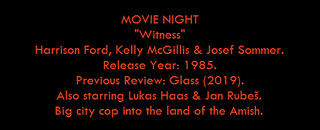
Harrison Ford (Det. John Book), Kelly McGillis (Rachel Lapp), Josef Sommer (Chief Paul Schaeffer), Lukas Haas (Samuel Lapp), Jan Rubeš (Eli Lapp), Alexander Godunov (Daniel Hochleitner), Danny Glover (Lt. James McFee), Brent Jennings (Sgt. Elton Carter), Patti LuPone (Elaine), Angus MacInnes (Fergie), Frederick Rolf (Stoltzfus), Viggo Mortensen (Moses Hochleitner), and Timothy Carhart (Zenovich) Directed by Peter Weir (#960 - The Year of Living Dangerously)

Review: 
Witness is an interesting crime thriller, standing out for its well-done structure and story (which won an Academy Award for Best Original Screenplay) with plenty of entertainment value and a game cast. The story was written by Pamela Wallace, Earl W. Wallace and William Kelley, with the latter two doing the screenplay. Kelley had contributed to scripts for Gunsmoke in the 1970s while Wallace served as executive story consultant, and it was the development of an outline for the show that resulted in a film script, originally named Called Home. The script (consisting of 182 pages originally) languished for years, with 20th Century Fox rejecting it due to the fact that they didn't make rural movies. A re-write of the screenplay resulted in Ford expressing interest in doing the movie, and eventually the film found its studio in Paramount Pictures. Weir was hired to do the film after funding for The Mosquito Coast (which was made the following year with Ford) fell through, and this was his first film made in America after several features made in his native Australia.

In any case, it is interesting to see a movie set within the community of the Amish, particularly with the differences shown between the kind of life lived by Ford's character as opposed to the Amish characters and how he adapts to spending some time there. It comes off as more than a crime thriller at times, having moments of passion and romance between Ford and McGillis that helps give the film plenty of energy to go around. Ford is superb, playing his role as if he was in a modern Western drama (and not in a usual action kind of film), resourceful in his pursuit for justice while also taking note of the people around him and how he stands out quite clearly from them. This is particularly notable in one scene near the climax, where he stands up for one of his fellow Amish when they are harassed by town-folk who seem to view them as a curiosity or something to pick at, particularly when mocking their committal to nonviolence in war. McGillis shines as well, being a warm graceful presence with a degree of curiosity, whether when interacting with Ford or with Haas, who does fine for his scenes. The other members of the cast have their moments to shine, such as Sommer and his quiet but lurking presence or Rubeš and his wise and thoughtful presence. It is interesting to see Glover playing against type, although he doesn't have too much on screen. The film never feels flat at 112 minutes, having a fine balance between drama and action that never feels overwrought or disrespectful. You never get the sense of boredom at any real point, with each scene having a real sense of purpose and a well-made look from cinematographer John Seale. The movie has its fun moments, such as the barn-raising sequence or when Ford is trying to get the kid to identify the suspect through a ride-along. The climax is certainly effective enough with a quiet ending that wraps things up just fine. On the whole, this is a gripping tale that has its elements of thriller and romance wrapped within a community story that makes it stick out from other films in an captivating and entertaining way that is a solid pick worth recommending.

Overall, I give it 9 out of 10 stars.

December 6, 2018

Firewall.


Review #1168: Firewall.

Cast: 
Harrison Ford (Jack Stanfield), Paul Bettany (Bill Cox), Virginia Madsen (Beth Stanfield), Mary Lynn Rajskub (Janet Stone), Jimmy Bennett (Andy Stanfield), Carly Schroeder (Sarah Stanfield), Robert Forster (Harry Romano), Robert Patrick (Gary Mitchell), Nikolaj Coster-Waldau (Liam), Kett Turton (Vel), Vince Vieluf (Pim), Vincent Gale (Willy), and Alan Arkin (Arlin Forester) Directed by Richard Loncraine.

Review: 
Sometimes the most frustrating films to write words about are the ones that are middling and uninspired in terms of execution and action, where they aren't so much terrible to watch as they are just ones that are neither films that are just fine or just awful - they are okay to watch when bored or without many choices on a weekend, but they aren't something that will fall as anyone's version of a classic to love or mock. Trying to rip into a film like this is basically like trying to be angry at an old dog who kinda messes with how the house looks by putting a bunch of hair on the couch. Firewall passes just as quickly, having nothing too particularly interesting to note besides some mediocre action and okay acting. Supposedly the film was originally going to be called "The Wrong Element", which is certainly a bit of a ridiculous title to say out-loud, but it also seems like a title cliche enough for a film in the 1970s.

Ford is okay, but he doesn't really give too much enthusiasm towards the role besides a slightly gruff frustration, but you would be better off with other Ford movies (as long as it isn't Hollywood Homicide (2003), anyway) at least. Bettany isn't too particularly threatening, playing the villain with a bare presence of menace, particularly since he harms more of his own henchmen than the actual family he's holding in their own house. Actually, the whole group of henchmen aren't really menacing to begin with, and the fact that the one moment where a family member is in danger is because of an allergic cookie makes this especially apparent. I imagine that an actor with a bit more menace (or an improved script that gives off more suspense) would've helped make this seem better. He and Ford don't really play off too greatly together, and their fight at the end isn't really anything too special. The cliches of the tough henchman and sympathetic henchman, along with the kids, are what you would expect. Madsen (playing an architect, which doesn't really have too much impact on the plot - surprised?) is okay, but she seems more annoyed at the presence of these henchmen than anything. The other actors are okay, but no one really stands out too interestingly. At 105 minutes, it isn't a painful chore, but there are certainly better ways to use your time up than this, particularly since the climax is just okay at best. The plot goes through the typical motions one would see coming for a heist film while having a few twists that come and go just as quickly. Strangely enough, the film was slightly edited upon release to DVD. One notable edit was different angles and shots for the ending, while adding two cop cars that arrive at the end of the film. I suppose this is to make the ending seem less abrupt, although it doesn't really change that fact too much. Once the final fight happens (and ends) between Ford and Bettany, that is pretty much it for the movie - I'm sure that would've been just fine in an older film, but it just feels amusing that the film kinda just ends. It isn't the kind of movie that will inspire long rants or long defenses of where it goes, being the kind of filler film or footnote in someone's career. On the whole, the film isn't too particularly exciting nor suspenseful, but it is at the very least tolerable enough to pass without torturing the senses too much.

Overall, I give it 5 out of 10 stars.

April 23, 2018

Hollywood Homicide.


Review #1075: Hollywood Homicide.

Cast: 
Harrison Ford (Detective-Sergeant Joseph "Joe" Gavilan), Josh Hartnett (Detective K. C. Calden), Lena Olin (Ruby), Bruce Greenwood (Lieutenant Bernard "Bennie" Macko), Isaiah Washington (Antoine Sartain), Lolita Davidovich (Cleo Ricard), Keith David (Leon), Master P (Julius Armas), Gladys Knight (Olivia Robidoux), and Martin Landau (Jerry Duran) Directed by Ron Shelton (#381 - Cobb)

Review: 
If you have a film with two actors who seem to want to make the best of their time on screen and elicit some sort of chemistry with each other, you'll likely have a good time. It's a shame that is not the case with this movie, however. Ford and Hartnett manage to star in a film where they don't seem to share any kind of chemistry with each other, not eliciting many particularly amusing moments nor anything that seems remotely connecting. Ford does a decent job performance wise, but he doesn't seem to be the best type for this role, seeming a bit out of place that might've been better suited for someone like John Travolta (who originally was meant to star in the role), particularly with the real estate "dealmaking" parts. Hartnett doesn't fair much better, somehow looking too young to play this detective role while also seeming to be the wrong fit to go along with Ford, seeming a bit too relaxed for this part - and the parts with him playing a would-be actor also not hitting the notes correctly either. In any case, they don't make for a particularly inspiring duo. Washington doesn't particularly inspire much as the villain, mostly because the plot-line doesn't give him much room to actually seem compelling (especially with the climax), whereas Greenwood sells his adversarial role and scenes with Ford. Olin does a kooky but serviceable job, with her parts with Ford being nothing too special. The other members of the cast are all okay at best. It might interest you to note this was written by Shelton and Robert Souza, a former homicide detective in the LAPD Hollywood Division who also happened to moonlight as a real estate broker in his latter years. I'll give the film credit for having some sort of semblance of reality, but I didn't find the end product to be too particularly effective. The numerous subplots and how things seem to just connect out of thin air makes for a convenient but somewhat tiresome pace, complete with a somewhat long but somewhat effective climatic chase sequence. There isn't too much to the action, but it will likely be pleasing enough. The film never seems to get itself into high gear, seemingly stuck in a loop of a mediocre story and a buddy duo that doesn't live up to carrying the movie. The end product is something that can be mildly enjoyable as a late night flick watch, but it won't be anything regarded as anything too good in its action or comedy. Take this misfire for what it's worth.

Overall, I give it 5 out of 10 stars.

October 7, 2017

Blade Runner 2049.


Review #997: Blade Runner 2049.

Cast: 
Ryan Gosling (K), Harrison Ford (Rick Deckard), Ana de Armas (Joi), Sylvia Hoeks (Luv), Robin Wright (Lt. Joshi), Mackenzie Davis (Mariette), Carla Juri (Dr. Ana Stelline), Lennie James (Mister Cotton), Dave Bautista (Sapper Morton), Jared Leto (Niander Wallace), Edward James Olmos (Gaff) Directed by Denis Villeneuve (#753 - Sicario)

Review: 
It has been over five years since I reviewed Blade Runner (#100, The Final Cut edition), and I will admit that I never actually thought a sequel would happen. Well, here we are with a sequel 35 years later (and 897 reviews after I did the original, which seems fitting). I even watched the original film hours later I saw this, mainly so I could process my thoughts for this film a bit better. In any case, that film still manages to hold up quite well, but I still never dreamed that there would ever be a follow up, because of how the film built itself, owing to its direction but also its screenplay by Hampton Fancher and David Peoples; I mention this due to Fancher returning to write the screenplay for this film (with Michael Green serving as co-writer).

Honestly, this was a pretty great movie. For fans of the original, I would say that it was worth the wait, and its shining achievement is in how it is not a retread of the first film, managing to utilize elements from it that make for a capably clever narrative. Like the original, it is a bleak, shocking kind of science fiction film, and it certainly is a movie made to tell a story with numerous threads to it, owing to the 163 minute run-time (which is probably the longest for a film I've seen in quite some time), but it never bored me as it earns every minute of its time, although it admittedly could take a while to really kick in. Roger Deakins, who had done the cinematography for Skyfall (#572), Sicario (#753), and Fargo (#765) (along with several other films) does a tremendous job in this film, utilizing light and shadow all throughout the movie with a wonderful touch. Gosling does a fine job, carrying the film with the right kind of tone and feel that you would expect. It isn't too much of a spoiler to say that it takes quite a while for Ford to show up but when he does it certainly seems like the best time for him to appear, with the film having built itself enough tension already. Ford also does a fine job, being quite useful for the narrative while also showing some emotional prowess; likely the best scene with him in it involves him and Leto, mainly because of the exchange that they have. de Armas does a fine job in a role that certainly is unique while also being fitting for a film all about it means to be human. Hoeks steals the show, being quite chilling and incredibly stealthy in her role. Wright also does a fine job in the time she has on screen, as does Davis and Juri. Leto has a few scenes that certainly come off as a bit strange...so of course it makes sense in the context of the film, which he pulls off pretty well. Even if I wanted to, it is hard to really talk much about the film's plot because of how it builds itself with imagination that certainly will leave the viewer with some sort of emotional response (and some questions) by the time the film gets to its end.

Watching this film is not so much an endurance as it is an experience (which I hope does not come off as sounding pretentious), and it is one that I would recommend for someone looking for a film that challenges you to follow every step it ventures to take with its tone and characters. Whether there is a sequel to this film or not, this is a movie that stands on its own as a fine piece of entertaining science fiction, doing what it sets out to do without any kind of restrictions or bounds. It isn't a perfect film, but it is definitely an exceptional one at least.

Overall, I give it 9 out of 10 stars.

April 1, 2016

Redux - Special Edition: Return of the Jedi.


Review #115: Return of the Jedi.

Cast
Mark Hamill (Luke Skywalker), Harrison Ford (Han Solo), Carrie Fisher (Princess Leia Organa), Billy Dee Williams (Lando Calrissian), Anthony Daniels (C-3PO), Kenny Baker (R2-D2), Peter Mayhew (Chewbacca), David Prowse (Darth Vader (voiced by James Earl Jones), Sebastian Shaw (Anakin Skywalker), Ian McDiarmid (The Emperor), Alec Guinness (Obi-Wan Kenobi), Frank Oz (Yoda), Denis Lawson (Wedge Antilles), and Timothy M. Rose (Admiral Ackbar, Sy Snootles and Salacious Crumb) Directed by Richard Marquand.

Review
In my original review (#115 - April 1, 2012), I had given the movie a 9/10 rating, and while I stand by the rating, I regretted not saying more about the movie, with regards to the characters, action and effects. Because of this, I decided to finally make a Redux - Special Edition (which I had done for A Christmas Story, Halloween, Licence to Kill, and On Her Majesty's Secret Service). 

Now, with May 25, 2023 on the horizon, it is time for a bit more editing. Don't worry, it's just the addition and subtraction of certain sentences to give better clarity. Enjoy.

Decades after its release, Return of the Jedi always seems to be lumped in as the lesser of the three films of the so-called Star Wars Original Trilogy. On an emotional level, the movie is a bit too safe, particularly with the ending. Granted, The Empire Strikes Back is a tough act to follow, because that film basically saw the series grow up a bit when it came to the stakes being even higher in terms of space opera while separating its characters into neatly defined plots. I maintain of course that the original 1977 film is the one with the most punch in terms of "first-time joy", but with Return of the Jedi, it does have the benefit of closing its door of a story not one of simple rebellion, but of one with father and son. Howard Kazanjian replaced Gary Kurtz as producer. The director would be Richard Marquand, who had directed The Legacy (1978), Birth of the Beatles (1979), and Eye of the Needle (1981), with the latter being cited by Lucas as key to hiring. This time around, Lawrence Kasdan and George Lucas wrote the screenplay with Lucas providing the story (Kasdan used tape transcripts of him, Lucas, Marquand, and Kazanjian in conference discussing ideas to help make the script). The film was a tremendous success, although for Marquand, having to direct with Lucas looming on set frequently when it came to handling effects certainly must have been a challenge. Marquand directed three further films after Jedi before his death in 1987 at the age of 49 following a stroke. 

Of all the cast in the movie, the one actor with the most impact is the one with little screen time and only 24 words, Sebastian Shaw, who manages to evoke the dying words of a redeemed but withered man with such little time and be one of the more memorable aspects of the film. The Emperor, after being seen briefly in Empire Strikes Back (voiced by Clive Revill in 1980 but replaced by Ian McDiarmid with computer-generated imagery for the 2004 alteration), is given his time to showcase his power over the Empire and Vader himself. McDiarmid plays this master of deception with an unsettling tone of voice that makes the villain more than just a hammy bad guy, compelling even without much revealed about him (until the prequels, anyway, which let him play a double act). Hamill's best scenes are with McDiarmid & Jones, and they make for compelling entertainment, with the lightsaber duel being a key highlight. While the trio of Hamill, Ford & Fisher doesn't really cover any new ground, it is nice to see them again. It's interesting that Ford wanted his character to die as a "self-sacrifice" for a character that progressed from a rogue who didn't particularly care about the Rebellion (while caring mostly about himself) all those years ago to one who decides to die for his friends; Kazanjian had got Ford to return to the role and actually agreed with Ford's suggestion to kill the character off, but Lucas refused. The reveal of Leia being Luke's sister isn't a bad scene, but after everything the two characters had gone through (such as the kiss in Empire to make Han jealous - at least I hope so), it comes off as somewhat strange, especially with Leia stating that she apparently always knew. Circle of life and all. The movie ends with everyone happy (complete with celebratory music in both the original and Special Editions), but does an Empire truly end just because you take down the leader? By this point, Lucas wanted to end the trilogy and curtail any plans he (supposedly) had for Episodes VII-IX and just end it, even if it wasn't as poignant as it could've been. My thoughts on the film have shifted the tiniest bit when it came to the Ewok battle on Endor, since a group of teddy bears that believed a golden robot was a deity manage to take down Empire soldiers with logs and...overpowering them seems more and more amusing when considering the idea of a technological empire losing to a primitive tribe was evidently Lucas deciding to evoke the Vietnam War. Hell, he calls the Ewok sequences a "distraction", not a win, so keep that in mind. The opening rescue sequence on Tatooine with the loathsome Jabba the Hutt is a delightful way to spring adventure from the get go.

Of course, the space dogfight is as fun as ever, probably more so when considering how the series would do them in later years (to say nothing of the Special Editions, which are most apparent here, from the ridiculous song in the first half to the ending); Richard Edlund, Dennis Muren, Ken Ralston and Phil Tippett were each given a Special Achievement Academy Award for their work in the film in effects. Once again, the music by John Williams is excellent, being entertaining (any of the themes from the Battle of Endor, with one of my favorites being "Into The Trap", but "Emperor's Throne Room" is also a chilling brilliant one). For all I said about how it seems too safe at times, Return of the Jedi an enjoyable film, full of spectacle that has enough fun to mostly overcome its emotional shortcomings. Is it slicked in more commercial flavor than the other two? Sure, but it still an enjoyable adventure, one that showed what is fun about making space adventure that turns old cliches into new enjoyment for all to see.

32 years later, Star Wars: The Force Awakens bridged its continuation to the old and new generations of fans, doing a fine job as a beginning of a new trilogy. Time will tell how the new trilogy (and spin-off films) will go, but as someone who saw Episode VII on opening day and enjoyed himself, I sure can't wait.

Overall, I give it 9 out of 10 stars.

March 31, 2016

Redux - Special Edition: The Empire Strikes Back.


Review #114: The Empire Strikes Back.

Cast
Mark Hamill (Luke Skywalker), Harrison Ford (Han Solo), Carrie Fisher (Princess Leia Organa), Billy Dee Williams (Lando Calrissian), Anthony Daniels (C-3PO), David Prowse (Darth Vader (voiced by James Earl Jones), Kenny Baker (R2-D2), Peter Mayhew (Chewbacca), Frank Oz (Yoda), Jeremy Bulloch (Boba Fett), Alec Guinness (Obi-Wan Kenobi), and Denis Lawson (Wedge Antilles) Directed by Irvin Kershner (#004 - Robocop 2)

Review
In my original review (#114 - March 31, 2012), I had given the movie a 10/10 rating, and while I stand by the rating, I regretted not saying more about the movie. I barely mentioned the characters and effects at all, among other aspects that I should have talked more about. Because of this, I decided to finally make a Redux - Special Edition (which I did for A Christmas Story, Halloween, Licence to Kill, and On Her Majesty's Secret Service). Enjoy.

The Empire Strikes Back
is often called the best installment of the original trilogy and one of the best sequels of all time, and with good reason. It raises the stakes along with the mood and tension in a degree that makes for an entertaining movie that eclipse the excitement and depth of the original film in some aspects. It's interesting that the beginning of the movie starts not only with a large-scale battle, but one that our heroes technically lose (in that they retreat). Sure, they had destroyed the Death Star, but the story (and the war) didn't end just because you can blow up a base (or two). It has been three years since they destroyed the Empire's space station, but the Rebels has moved on from celebrating in Throne Rooms to having to deal with getting a new base and adapting to the cold and the fear the Empire would find them. The music by John Williams is once again fantastic, ranging from tense (The Battle of Hoth) to mysterious (Yoda's Theme) to one that inspires dread (The Imperial March) to one that fits for the climax (The Clash of Lightsabers), with the music fitting the movie just perfect.

Of the (now seven) films, Empire Strikes Back is the only one that introduces key characters while not having any major ones die, and the movie still manages to be emotionally satisfying. Williams is certainly a welcome addition to the band of heroes, managing to have a certain aspect of intrigue along with conflict about the decisions he has to make. Yoda is an interesting case, depending on when you see him (prequels/originals), but in this he certainly has a mystique that evolves from seeming like an strange little hermit (in our first encounter watching him first meet Luke) to a wise master that seems to have more secrets than he lets on. I love the puppetry for Yoda because it never seems fake or off-putting to watch. The way it moves around along with the voice (by Frank Oz) fits well with a character as grand as Yoda.

It's interesting how popular Boba Fett (voiced by Jason Wingreen originally, though replaced by Temuera Morrison after 2004) became even though he doesn't have many lines to say (though he does have a crucial role), though his armor is admittedly interesting to look at.  The Emperor (voiced originally by Clive Revill but replaced by Ian McDiarmid in the newer editions starting in 2004) has only one scene in the movie, but he manages to have an important presence even when he isn't seen because even though Vader seems to be more in control (as opposed to Tarkin essentially having Vader on a leash in the previous one) of the Empire's wrath, he still has a Master to look to. Of course, one can't mention the movie without saying something about the Han-Leia dynamic, and the way their romance doesn't seem to override the movie or take away from it - because it seems natural and it makes the movie more interesting than it already is. Even the line of "I know" to Leia saying "I love you" works because it doesn't bog the movie down in melodramatic form of romance (which is something the prequels, in particular Episode II failed to do).

Once again, the effects (visual and sound) are impressive, but the fight between Vader and Luke is also a key highlight, with the lighting and steam creating a subdued atmosphere, for a fight sequence that is a key improvement over the last film in terms of tension and stunt choreography. The reveal of Darth Vader being Luke's father is a moment in which the movie manages to culminate all the emotional buildup of Luke having believed that his father was killed by Vader only to find out a harrowing truth (or was it?...of course it was) into a powerful moment that still is a great scene even when you've already seen the movie or know the mythology because it still manages to be a memorable and effective scene, serving as a great climax for the film. Ultimately, The Empire Strikes Back manages to be a dark, but entertaining movie that serves a great sequel to the original Star Wars film that while not ending on a high note for the characters, still has a hopeful outlook to continue onto more adventures.

Next up on Redux - Special Edition is the film that ended the story of our heroes...for a while on a peculiar note...

Overall, I give it 10 out of 10 stars.

March 30, 2016

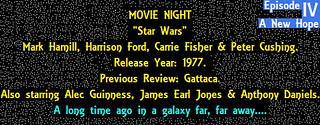
Redux - Special Edition: Star Wars (1977).


Review Special Edition: #113: Star Wars.

Cast
Mark Hamill (Luke Skywalker), Harrison Ford (Han Solo), Carrie Fisher (Princess Leia Organa), Peter Cushing (Grand Moff Tarkin), Alec Guinness (Obi-Wan Kenobi), David Prowse (Darth Vader (voiced by James Earl Jones), Anthony Daniels (C-3PO), Kenny Baker (R2-D2), Peter Mayhew (Chewbacca), Phil Brown (Owen Lars), Shelagh Fraser (Beru Lars), Jack Purvis (Chief Jawa), Denis Lawson (Wedge Antilles), and Garrick Hagon (Biggs Darklighter) Directed by George Lucas.

Review
In my original review (#113 - March 30, 2012), I had given the movie a 10/10 rating, and while I stand by the rating, I regretted not saying more about the movie. I barely mentioned the acting at all, among other aspects that I should have talked more about. Because of this, I decided to finally make a Redux Review (which I had done for A Christmas Story, Halloween, Licence to Kill, and On Her Majesty's Secret Service). Enjoy this "Special Edition" version, if you will. 

Star Wars (also referred to as A New Hope) is a mythical tale that has entertained audiences all around the world for over 40 years, and the scope of its influence on cinema (and filmmakers) can't be understated. It's interesting how a space opera like this had been influenced by other movies such as The Hidden Fortress and Flash Gordon serials, but also works by Edgar Rice Burroughs. Star Wars at its heart is a fairy tale with the mythical nature of the characters, legends in an epic that is not set in the beginning, but rather the middle. You don't have to watch the prequels before seeing this because this film s manages to introduce itself and its story extremely well, right from the opening crawl. I remember watching this when I was around 13 years old, and I can recall that I didn't know much about Star Wars at the time (aside from the name), but the Battle of Yavin (amidst other scenes) managed to stick out the most in my head, even years later. Perhaps it was the memorability of the characters, or the music (by John Williams) being so in tune to the movie, with Binary Sunset being especially memorable, but other music works extremely well to the atmosphere of the film (Cantina Band) or with adventure with the Yavin sequence at the end.

The characters are interesting to watch interact with each other (particularly our main trio), which is more interesting than the actual acting with regards to the dialogue. While admittedly Hamill can come across as slightly whiny, the progression of his character throughout the trilogy means that it is worth it in the end. Ford is a charming rouge who (along with Chewbacca) manage to be entertaining from the first scene they are in, primarily because of the sheer magnetism of the duo. Fisher also does a fine job, alongside Cushing and Guinness (both already well-established actors of film), who are both memorable in their own ways. Cushing is the perfect actor to play a role that really is the main enemy of the film (as he is the one that commands the Death Star, orders the destruction of Alderaan), even with a Sith Lord at his side. Guinness manages to seal the mysterious wise aspects of an old warrior in his first few scenes while putting Luke onto the path of adventure (even if what he says is true from a certain point of view) and realizing what he must do to play his part in trying to bring down the Empire. It's interesting how David Prowse plays the physical aspects of Darth Vader, and he sure fits the imposing frame of a villain perfectly, with James Earl Jones' voice being quintessential for the character.

Even though the movie has had fixes over the years (most notably the "Special Edition" version), the effects are still impressive to me in the sense that I love the effort it must have taken to get the look and action right, such as the TIE fighter attack and how it was based off of dog fights from World War II. The fun isn't in the themes or the dialogue, but in the adventure that ensues, and how it satisfies you by just being a charming movie that doesn't need slogs of backstory to be enjoyable. You can watch this first instead of the prequels and still not be too confused because it isn't one to try and fill background information, rather it is one that has a story of its own with a mythos that would only get expanded upon in future installments.

Next up on the Redux Review / Special Edition: The sequel that many argue is one of the best sequels of all time...

Overall, I give it 10 out of 10 stars.

December 18, 2015

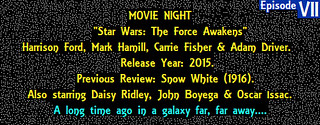
Star Wars: The Force Awakens.


Review #769: Star Wars: The Force Awakens.

Cast
Harrison Ford (Han Solo), Mark Hamill (Luke Skywalker), Carrie Fisher (General Organa), Adam Driver (Kylo Ren), Daisy Ridley (Rey), John Boyega (Finn), Oscar Isaac (Poe Dameron), Lupita Nyong'o (Maz Kanata), Andy Serkis (Supreme Leader Snoke), Domhnall Gleeson (General Hux), Anthony Daniels (C-3PO), Max von Sydow (Lor San Tekka), Peter Mayhew (Chewbacca), Gwendoline Christie (Captain Phasma), Kenny Baker (R2-D2), and Tim Rose (Admiral Ackbar) Directed by J. J. Abrams (#009 - Star Trek, #150 - Super 8, and #665 - Star Trek Into Darkness)

Review
As I went to my local theater for the 17th time (over the course of this show) to see my first Star Wars movie in a theater, I wondered how it would go. I wondered it because though I adored the original trilogy, the prequel trilogy was not quite up to the charm and fun of the originals. But I realized that I didn't need a perfect movie to be happy, I just needed what I need in any film: A good experience. The anticipation of waiting for a movie to start is a good sign, especially being there an hour early and having a house that looks 80-85% crowded. Naturally, there was a bit of hollering when the movie started up, and even I felt a bit giddy.

And the movie was good, too. Like I said, I wanted a good experience, and I sure got one. I enjoyed every minute of it because it was a movie not bogged down by weight or its own characters, rather it was a movie that utilizes elements from the original trilogy with elements of its own to make a new mesh that works pretty well for itself. Instead of waiting for the old cast to get into the picture, you're instead invested into the new characters because they actually are pretty compelling. Interestingly, my favorite from this movie was BB-8, the new droid who really is so adorable and really fun to watch. Ridley and Boyega are interesting to watch, because they aren't rehashes of the past (per se), they are something Star Wars needed: new blood, to carry the torch on. But of course, Ford is fun to watch again, especially with Leia. (I can share one quote: "When have you ever been helpful? And don't say the Death Star." It makes sense in context to the banter) There's no point in saying anything about the plot, because you really should see it for yourself. The effects look really well because they don't seem too artificial because you actually care about the effects this time around. The movie works because you actually care about where it will go next (after all, Episode VIII and IX will be around the corner soon enough) and care about these characters. It has a good share of humor and fun, laced with finely tuned action and around the same charm you'd expect from a Star Wars film. Will you like it as much I liked it? I don't know. But I'd recommend seeing it.

Believe the hype. And may the force be with you.

Overall, I give it 9 out of 10 stars.

July 4, 2013

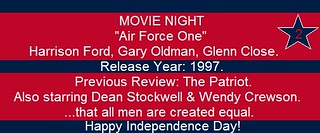
Movie Night: Air Force One.

Review #414: Air Force One.

Cast
Harrison Ford (James Marshall), Gary Oldman (Egor Korshunov), Glenn Close (Kathryn Bennett), Wendy Crewson (Grace Marshall), Dean Stockwell (Walter Dean), Liesel Matthews (Alice Marshall), Elya Baskin (Andrei Kolchak), Levan Uchaneishvili (Sergei Lenski), David Vadim (Igor Nevsky), Andrew Divoff (Boris Bazylev), Ilia Volok (Vladimir Krasin), Paul Guilfoyle (Lloyd Shepherd), William H. Macy (Major Caldwell), and Xander Berkeley (Agent Gibbs) Directed by Wolfgang Petersen.

Review
In keeping with Independence Day, I decided to get another film off my back burner, which was this film. That and it is always fun to watch a film with Harrison Ford (Such as Blade Runner, American Graffiti, Star Wars Episode IV-VI, Raiders of the Lost Ark-Kingdom of the Crystal Skull, The Fugitive, and 42), so why not? And...it's pretty good. Ford once again manages to do an impressive job, reserved, but a stand out nonetheless. Gary Oldman (Who has been in 8 films reviewed here) is a decent villain, and as a contrast to The Fifth Element, he actually meets the main hero character, so I guess that's something. Glenn Close is alright, improved from her performance in (#383) The Natural. The rest of the cast is decent. The film flows well, not veering off too much in the silliness factor or the absurd zone, though I do wonder if the real Air Force One has escape pods for that situation. Petersen does an alright job directing a film such as this, and it is entertaining along with having a bit of drama to make a balanced, useful film for all.

Overall, I give it 8 out of 10 stars.

original: 

May 5, 2013

Movie Night: 42.


Review #372: 42.

Cast
Chadwick Boseman (Jackie Robinson), Harrison Ford (Branch Rickey), Andre Holland (Wendell Smith), Christopher Meloni (Leo Durocher), John C. McGinley (Red Barber), Lucas Black (Pee Wee Reese), Alan Tudyk (Ben Chapman), Nicole Beharie (Rachel Isum Robinson), Brett Cullen (Clay Hopper), and Ryan Merriman (Dixie Walker) Directed by Brian Helgeland.

Review
On a day like this where baseball is around to entertain us as the week begins, history is once again turned into a movie and once again I'm reviewing a film about Jackie Robinson, the first one starring himself (#365 - The Jackie Robinson Story), which wasn't bad, but not too special. This is first film reviewed here from 2013, and trust me there will be more soon enough from 2013. This film...manages to be entertaining. While it may have some inaccuracies that some have found, I don't mind. It seems sweetening and easy to figure, but it manages to capture a tone of the 1940's, which given the mood back then, makes sense, I suppose. Boseman is a surprisingly good actor for someone I haven't watched before, leaving an impression, looking the part. But the actor I think is the best out of all of them is Harrison Ford, who surprised me because he does radical change to be Rickey and does a great job, making me smile. The rest of the cast (Examples being Meloni, Holland and Beharie) do a fine job, keeping the film at pace as well. The baseball action works well, and it captures an old feel of life, baseball and more. It has its moments, and it certainly is a good biopic. Essentially, 42 hits a ball that goes deep into right field, narrowly missing the foul pole but still going fair.

Overall, I give it 9 out of 10 stars.

December 6, 2012

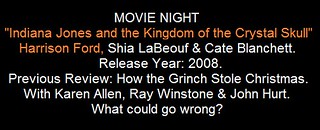
Movie Night: Indiana Jones and the Kingdom of the Crystal Skull.


Review #302: Indiana Jones and the Kingdom of the Crystal Skull.

Cast
Harrison Ford (Indiana Jones), Cate Blanchett (Irina Spalko), Karen Allen (Marion Ravenwood), Shia LaBeouf (Mutt Williams), Ray Winstone (George "Mac" Michale), John Hurt (Professor Oxley), Jim Broadbent (Dean Charles Stanforth), and Igor Jijikine (Dovchenko) Directed by Steven Spielberg (#126 - Close Encounters of the Third Kind, #168 - Raiders of the Lost Ark, #169 - Indiana Jones and the Temple of Doom, and #170 - Indiana Jones and the Last Crusade)

Review

When I first reviewed the Indiana Jones films, I actually considered watching this film, having four films all reviewed together. And yet there was some sort of opposition to the thought of watching this, so I relented and didn't review it. But guess what? I've decided to review this anyway to either bring the (so-called) level of happiness from the big milestone yesterday or to just finish the (possibly) the final chapter of the Indiana Jones franchise. So how is it? Well...Let's get to the pros and cons first. Harrison Ford does his best, once again having a good performance, 19 years removed from the character but still a good one. As such, the film decides to segue into the 1950s (Indy couldn't always fight the same kind of enemy, so I'll give this a small praise), and it works in some ways...and not in others. And then there's Shia LaBeouf. He is...Not very developed, unless you count "Indy's son", "Guy with jacket", "So called rebel" as development. Perhaps they meant to make it a parallel to Last Crusade, with the old father and young son working together, but it doesn't work as well, as LaBeouf doesn't connect well with Ford.

I do like Cate Blanchett as the villain, she is far different from the other villains in previous installments, but she gives a strange unrecognizable allure that works for the most part. What I don't care for is the character of Mac (though played decently by Ray Winstone), and his "triple-agent" outline. It's pointless and not very useful. The rest of the acting and characters are alright. Allen returns to the role of Ravenwood after 27 years, and she does a fine job, even though I wish the dialogue between Ford and Allen would've had more time to develop, as it is as good as the two were in 1981. The action is mildly decent, having some enjoyment. And then there is the rest of the film. First off, there's the Fridge scene. While it does raise questions on how you could escape an explosion with a fridge, think back to when Indy escaped death by jumping off a plane with a raft and landing on a mountain side along with falling off the side and landing into a river. That sounds a bit more unrealistic, though the other questions don't escape this film. Such as why the sudden plot explosion after Mutt is introduced? Why the reveal of the beings (that I won't spoil) to begin with? Why do they look weird and not trying to resemble the era they're from to begin with? Why is Mutt even in here? Why is there no Sallah? Why is not as recognizable as the other three? That question I can answer. Because while it tries to capture the spirit of the trilogy, it stumbles in some ways even with some slight advantages to make an uneven disappointment.

Overall, I give it 6 out of 10 stars.