Showing posts with label Chill Wills. Show all posts

August 12, 2022

Hell's Outpost.

Review #1871: Hell's Outpost.

Cast: 
Rod Cameron (Tully Gibbs), Joan Leslie (Sarah Moffit), John Russell (Ben Hodes), Chill Wills (Kevin Russel), Ben Cooper (Alec Bacchione), Kristine Miller (Beth Hodes), Jim Davis (Sam Horne), Taylor Holmes (Timothy Byers), Barton MacLane (Sheriff Olson), and Ruth Lee (Mrs. Moffit) Produced and Directed by Joseph Kane.

Review: 
Admittedly, the action movie is in more forms than just big-budget adventure or costume drama. No, one can also encounter action flicks in cheap B-movie form, courtesy of studios like Republic Pictures. Republic, if you were wondering, was the motion picture company behind many, many Westerns, serials, and B-films (with occasional A-features like The Quiet Man), which just happened to have a select number of films that featured John Wayne, Gene Autry, or Roy Rogers. It came about in 1935 as the result of merging six Poverty Row studios together, as devised by founder Herbert J. Yates that was focused on low-budget product with his laboratory to counter the lack of need from major studios to have his lab. As for the director for this film...Joseph Kane naturally ended up behind the chair because of his experience with Republic. The San Diego native actually went from an interest in cellist to directing, and he took up jobs with Mascot Pictures and Republic Pictures with serials in 1935, and he would stay with the latter studio until its demise in 1958, serving as an associate producer on numerous films along with editor and screenwriter. While he did not get to serve as primary director much in the years after the 1950s ended, he continued with second-unit work until his death in 1975 at the age of 81. 

Sure picked a winner, huh? Technically, it is more of a noir than an action movie, but at least there are a few fistfights (lasting less than five minutes each) to go along with a little bit of action involving loony rich guys and oddball heroes writing false letters in which both actors look like more famous ones if you squint a bit. There really isn't anything particularly great about the movie in any sense or form, and it definitely seems a bit too packed at 89 minutes, but one interested in B-movies or things to pass by on a long summer day could tolerate it. The only thing that sounds fun is the fistfight, because who doesn't want to hear about it? It happens, naturally, in the dark, and one hopes you have a good eye to see with the print (or video, if you like easy-to-find old movies). It isn't anything too special, but again, it satisfies the basic requirement when it comes to stomaching the rest of medium product that makes only the slightest of sense (rich guy decides to fight a guy, agrees to giving him $10,000 in a loan if the other guy wins and then does wild things to stop him enjoying using the money for a mine). This was based on a Luke Short's book Silver Rock, with Kenneth Gamet serving as screenwriter. Truly it fun to be talking about tungsten mines and guys trying to circumvent the other while middling relationships lurk in the background. Cameron (born in Canada but raised in New Jersey) kind of looks like if an old studio executive tried making a discount Randolph Scott, particularly since he did plenty of Westerns to go with other genres you might expect in cheapie fun; beginning in 1953, he ended up doing syndicated television over the course of three different shows in the span of eight years that made him a nice amount of money. He grits his teeth like it was a modern Western rather than the action crime drama hodgepodge, and it doesn't really gel greatly for anything besides mild stares and the occasional attempt to make a gray-shaded hero but having a guy who makes a few false letters isn't really as interesting as it could be for hustle quality. The sillier a movie like this, the better it seems...so it doesn't quite work with a stiff lead. Hey, what do you know, the villain is also a television presence: Russell is best known for his starring role on two shows that ran in the late 1950s involving adventure. He is mildly effective here in chewing the bland ham thrown to him in dastardly ideas, looking more like a guy trying to convince himself to pick apart the wings of baby birds because of boredom. Honestly, Wills might be the only name that sticks out today, albeit one who didn't grow to acting by Westerns, since he had his own singing group in the 1930s that he quit to go for acting, and his deep rough voice certainly wishes for something with riveting material to bite on rather than the mush here. To be nice to Leslie, one hopes that the assignment was a decent experience for them. As a whole, all one might enjoy is the occasional action bit, whether that involves drunken antics or the final sequence involving dynamite that goes...kind of the way you would expect from a cheapie needing to end quickly. It's a humble movie, where names go in one ear and out the other for nothing too special for a mediocre result. But, as a comparison to say just how action movies stack up from different eras when it comes to mushy foundations trying to hold it together with middling actors or effect, it fits the bill adequately.

Overall, I give it 6 out of 10 stars.

I know sometimes it is ideal to say what is next for a themed month but cobbling together a list is easier said than done...That said, next up is Motorpsycho.

June 4, 2021

The Deadly Companions.

Review #1685: The Deadly Companions.

Cast: 
Maureen O'Hara (Kit Tilden), Brian Keith (Yellowleg), Steve Cochran (Billy Keplinger), Chill Wills (Turk), Strother Martin (Parson), Will Wright (Doctor Acton), Jim O'Hara (Cal, General Store), Peter O'Crotty (Mayor of Hila City), and Billy Vaughan (Mead Tildon Jr) Directed by Sam Peckinpah (#590 - Ride the High Country, #591 - The Wild Bunch, #944 - Pat Garrett and Billy the Kid, and #1439 - Straw Dogs)

Review: 
"It wasn’t the best deal in the world: I wanted to make a picture and this guy wanted to push me around. The script needed lots of work, but I’d get told to go back in my corner. Brian knew we were in trouble, so between us we tried to give the thing some dramatic sense. The result was that all of his scenes worked, while all of hers were dead. I found out about producers, all right."

Would you believe that this is the directorial debut of Sam Peckinpah? One might find themselves in for a bit of a surprise with how the film career of this esteemed director began, because it started in the realm that he was already quite familiar with: the western. In the sixty years that has followed the film's release, it is likely the least known of his fourteen directorial efforts for the man soon to be known as "Bloody Sam". One doesn't have to repeat themselves in describing the background of one of the most polarizing directors to come out of the Western landscape to just say that he was a man who lived on his own terms, hard but fierce in his vision that matched a Marine background and a childhood spent on the ranch. When asked what type of movies he liked, he once stated that the only movies he wanted to like are his own movies, one that detested every good filmmaker (of course, Peckinpah also stated that Ross Hunter was his idol because he matched the innocuous directors he didn't detest, so there's that). The Fresno native had drifted between film and television in minor but key roles before getting into the writing circuit in 1955 with Gunsmoke, the definitive television series of the Western that ran for 20 years. At any rate, Peckinpah wrote the gamut in the era of the Western television series (Have Gun - Will Travel, The Rifleman, Dick Powell's Zane Grey Theatre, you get the idea), and he even submitted a script that would be cobbled together into One-Eyed Jacks (released the same year as this film and one that Peckinpah blamed Brando for messing it up). However, it all came to a head with a show that he would create with The Westerner in 1960, which came from an episode that Peckinpah had directed and written for the aforementioned Theatre show (essentially serving as a pilot). The show starred Brian Keith, who dabbled in television alongside character roles in film (interestingly, his most famous roles wound up being family affairs with The Parent Trap (1960) and Family Affair (1966-71)). He would direct six of the episodes while also writing for five of them. The series would last thirteen episodes (two months), killed due to bad ratings, but he received good notices for his efforts (when recommended for Ride the High Country, the producer watched the show and liked what he saw). At any rate, it was the good word that Keith put in for him that helped the 36-year old Peckinpah when it came time for the production of this film. Enter O'Hara. This was a family affair for O'Hara, since her brother Charles B. Fitzsimmons served as producer. He was the younger brother of O'Hara (who in that Hollywood tradition had gone another name) that dabbled in acting for a decade after having studied law and acting in the theatre in his native country before deciding to go into producing, with this being his debut. The source material used for the film was a novel called Yellowleg by A. S. Fleischman (he was born Avron Zalmon Fleischman before changing his name to Albert Sidney Fleischman), for which Flesichman adapted to the screen himself. He was familiar with Hollywood ever since his work Blood Alley (1955) was turned into a film, for which he wrote for. Technically this is an adaptation, as the novel had been written during pre-production, selling hundreds of thousands of copies in a few months.

The easiest thing to get out of the way is that this is widely available to watch because it is in the public domain, because the copyright notice was somehow not put onto the film. Making sure to find a good quality copy is always key, so imagine how that feels for a Western. The next thing to say is that this was one of the few films the director would make where he had no say in the writing (a process he was quoted later as hating) or final cut privilege. O'Hara, the last surviving actress of the cast, noted in her autobiography about the strange time she had with the director, calling him "one of the strangest and most objectionable people I had ever worked with." It certainly seems like the kind of unassuming kind of movie to think about briefly in the careers of its main stars and group, but one might find something worth diving into when it comes to a movie that is fairly solid in building a tense little thriller with a quartet not usually put together like this for the kind of film seen in its day. This is of course a film that involves a trip to bury a child in native territory that died because of a failed bank robbery. Peckinpah was quoted as loving outsiders, ones that are independent to the frontier, a sort of "weakness for losers on a grand scale", if you will. There are shades of that present within what you see from each of the four main actors to focus on, whether that means a man with quiet guilt and a ulterior motive, or a deserter with grand delusions, or a offbeat gunslinger, or a widow that is stubborn enough to persist through to the end goal. For a film that was basically a low-budget O'Hara + Keith vehicle, the latter seems to have a bit more to do when it comes to generating presence beyond something you might read in a short novel, but each do what they need to do as the main duo that spend quite a bit of time with each other. Wills was a regular character presence for numerous years, but it is interesting to see him with a adversarial role here, one that has odd designs for an army of his own to go with Freedonia, but he still seems like a good threat when paired with the showy Cochran (who made just three more movies before his life was cut short at the age of 48 in 1965), who makes for a worthy ooze presence. It doesn't play for any obvious clichés when it comes to adversaries (whether threats from internal strife or natives), so one shouldn't expect any sort of fantastical movements or rapid pacing. It takes its 93 minutes carefully for a look into the lives of flawed people in the West that Peckinpah would hone to greater results within his career. It may not be a great understated gem, but it certainly merits a look into what makes a director come into their own, if not at least before one goes on to see just what Sam Peckinpah could do when he had the freedom to tell the story he wanted to show. 

Overall, I give it 7 out of 10 stars.

May 14, 2020

McLintock!

Review #1414: McLintock!

Cast: 
John Wayne (George Washington McLintock), Maureen O'Hara (Katherine McLintock), Patrick Wayne (Devlin Warren), Stefanie Powers (Becky McLintock), Jack Kruschen (Jake Birnbaum), Chill Wills (Drago), Yvonne De Carlo (Louise Warren), Jerry Van Dyke (Matt Douglas Jr), Edgar Buchanan (Bunny Dull), Perry Lopez (Davey Elk), Strother Martin (Agard), and Gordon Jones (Matt Douglas) Directed by Andrew V. McLaglen.

Review: 
“The only one who could stand up to my father, and stand toe-to-toe with my father, and match him in everything.”

It never hurts to make a film that fit into numerous genres. In this case, why not have both a Western and a comedy? With famed stars in Wayne and O'Hara, who could go wrong? At the helm for the film was Andrew V. McLaglen, a British-born American director that grew up with his father Victor (a prolific character actor in numerous John Ford films, where he won an Academy Award for The Informer in 1935) around films, and he eventually found work for himself such as production assistance and assistant directing, with one notable film credit being The Quiet Man (1952, where he did the latter category). In 1956, he started his career in directing, doing Gun the Man Down while also starting work in television with programs such as Gunsmoke and Have Gun - Will Travel, and he directed over 90 episodes of each show over the course of nine and six years respectively. McLaglen would direct a variety of subjects over the course of 35 years in film and television (ranging from Western to war films) with a variety of stars like Wayne (who he would work with five times), James Stewart (four times), and Roger Moore (three times). Familiarity is the name of the game when it comes to this film, since James Edward Grant (who wrote several films with Wayne in them, such as The Alamo) served as writer for a film that was inspired by William Shakespeare's The Taming of the Shrew; Wayne acts alongside his third son while having his eldest son serve as producer and this was the fourth of five Wayne-O'Hara films, which were noted for their clear chemistry between their stars. One shouldn't forget about O'Hara in all of this, a figure of the Hollywood Golden Age that came from Ireland and theater acting at a young age to stardom in a variety of genres such as Westerns, melodramas, and adventure films. Speaking of actors nicknamed the "Queen of Technicolor", De Carlo (star of film and future star on television) was given a role in the film because of Wayne's sympathy in light of her husband being permanently crippled while doing stunt-work on How the West Was Won (1963, which had Wayne as star).

While the film is certainly a bit different from the usual Wayne fare, he also made this film as a way to express his belief (and disapproval) on certain topics, where his character yearns to tame both his wife and the West at the same time. There are quite a few moments of amusement within a story that moves at its own careful pace of 127 minutes, one with a casual story rather than tension that takes a familiar story to make a controlled film that sticks out from the usual Wayne experience without becoming a parody of itself. This is a film with a climax involving a paddling with a coal scuttle shovel, after all. The mud brawl proves to be a big highlight, one with plenty of fist-fighting and amusement, complete with the usage of bentonite (a type of clay that looks like syrup) for mud. Wayne seems to be having a fine time here, a clear-cut blunt performance that has a sense of honesty and humor without becoming too obvious about it. One can see the chemistry between him and O'Hara even when he's drunkenly falling down the stairs with her, really. O'Hara makes for a fiery presence with her own sense of humor that makes for plenty of smiles with those expressive eyes. The younger Wayne and Powers prove a fair pairing with others and themselves, while Kruschen, Wills and De Carlo provide capable careful chuckles that resonate with the trappings of the plot. There isn't the usual villain to make a showdown, but at least there are adversarial presences to drive things (however obvious things get). In the long run, this is a fair little mixture of Western and comedy, buoyed by Wayne, O'Hara and company to make a useful time worth having, particularly since it is readily available in the public domain (bless those failures to copyright) for anyone to stoke their curiosity in familiar territory for all in the 1960s.

Overall, I give it 8 out of 10 stars.

June 8, 2017

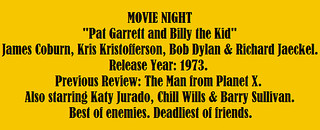
Pat Garrett and Billy the Kid.


Review #944: Pat Garrett and Billy the Kid.

Cast:
James Coburn (Sheriff Pat Garrett), Kris Kristofferson (Billy the Kid), Bob Dylan (Alias), Richard Jaeckel (Sheriff Kip McKinney), Katy Jurado (Mrs. Baker), Chill Wills (Lemuel), Barry Sullivan (Chisum), Jason Robards (Governor Lew Wallace), R.G. Armstrong (Deputy Sheriff Bob Ollinger), Luke Askew (Eno), John Beck (John W. Poe), Richard Bright (Holly), Matt Clark (Deputy Sheriff J. W. Bell), Rita Coolidge (Maria), Jack Dodson (Lewellen Howland), Jack Elam (Alamosa Bill Kermit), Emilio Fernández (Paco), Aurora Clavel (Ida Garrett), Paul Fix (Pete Maxwell), L.Q. Jones (Black Harris), and Slim Pickens (Sheriff Colin Baker) Directed by Sam Peckinpah (#590 - Ride the High Country and #591 - The Wild Bunch)

Review:
It is easy to say that this is a movie that does not skew for morality within its main characters, who seem to have interesting chemistry with each other. Not only is it a Western, it also serves as a sort of tragedy, where former friends are now pitted against each other. This is a bittersweet movie, filled with grit and action that make for a movie that can be rewarding if one has the patience for it. Everywhere you look in this film has a raw connection in someway to violence, where even lawmen are not so different from the outlaw that they hunt down; this is a bitter film, but it is also a film that accomplishes in expressing the nature of what the Old West looked and felt. Watching this movie feels like a eulogy for the times and myths that have gone by, and while the movie may drag itself under its own weight at points, it definitely hits more than it misses.

Coburn and Kristofferson are a fine tandem when on screen together, with the former having a reliable cool nature and the latter having a good amount of charm to him; right from the first scene they just seem to have an easy connection, where it doesn't look like we need a dump of exposition in order to set the stage. Dylan (who also contributed to the music) plays a strange cipher of a character (being more of an observer than a participant in the bloodshed going on), but he definitely is noteworthy to watch, even when he is reading food cans on the shelf. The music in the movie is pretty effective with the tone of the movie, with "Knockin' On Heaven's Door" being a key highlight. The rest of the cast (some who make only brief appearances) are pretty effective, managing to serve the film well when needed. The opening of the film (in the special edition and Peckinpah's cut, but more on this later) where Garrett's death and the shooting of chickens by Billy and his gang intersplice with each other is quite interesting, having a strange violent beauty to it. This was filmed in the Mexican state of Durango (in part due to conflicts with MGM), and the sets contribute into making this a visual achievement; it's not so much that the Old West is glorified, but it definitely becomes a character in a movie that isn't above myths and showing the clash of the times, where freedom and safety (within profit) interact violently. There is a spirit to this movie that is unyielding in its passion, and it definitely works even after over forty years.

This was a movie that went through production turmoil, which resulted in Peckinpah's version not being seen for years due to conflicts with MGM (and more importantly James Aubrey, President of the company at the time) over budgeting and scheduling. After the film finished 21 days behind schedule and more than a million dollars over budget, Aubrey had the film cut from a preview version of 124 minutes to 106 minutes with numerous scenes cut (including the beginning scene) and six editors being credited (this edition was disowned by cast and crew). In 1988 (four years after Peckinpah's death), a preview version of the film was released by Turner Home Entertainment, which lasts 122 minutes. In 2005, Warner Bros released a special edition version, which incorporates elements of the two movies along with additional scenes, which lasts 115 minutes. In any case, the movie has gained a new status among respective audiences, in large part due to the versions that have come out in the past few years.

On the whole, what more is there to say? Watch the film in the right state of mind, and you may very well have a good time with a film that has only become a mistreated classic in the years following its original release. Is it for everyone? No, but it definitely has its own kind of appeal that outweigh nearly everything else.

Overall, I give it 9 out of 10 stars.

July 16, 2016

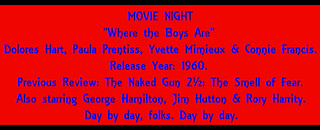
Where the Boys Are.


Review #822: Where the Boys Are.

Cast
Dolores Hart (Merritt Andrews), Paula Prentiss (Tuggle Carpenter), Yvette Mimieux (Melanie Tolman), Connie Francis (Angie), George Hamilton (Ryder Smith), Jim Hutton (TV Thompson), Rory Harrity (Franklin), Frank Gorshin (Basil), Chill Wills (Police Captain), and Barbara Nichols (Lola Fandango) Directed by Henry Levin.

Review
Where the Boys Are is a movie that is moderately entertaining while also handling its plot threads fairly enough. Hart is a fine lead, managing to have chemistry with the others in the cast, especially Hamilton, and their scenes (the first starting with the latter marking a ? mark in the sand) are nice enough. As for the other three leads, Prentiss is alright, with her scenes (especially with Hutton) being relatively fine; Francis, while not given too much to do is at least okay, and she even sings the title song; Mimieux is fine, with she doing well in the climax that certainly surprises but also feels realistic, as shocking as it is. From his first scene (mentioned above), Hamilton has a certain type of watch ability that never really wavers. Hutton is goofy at times, but he is certainly is likable enough. There is at least some humor in it, with one scene involving somebody getting into a water tank, which as it goes on gets to be pretty amusing. It's not exactly anything great, but it is a nifty 60's movie that has enough beach and a semblance of decently crafted plot to be fairly entertaining.

Overall, I give it 7 out of 10 stars.