Showing posts with label Taylor Holmes. Show all posts

June 26, 2026

Gentlemen Prefer Blondes (1953).

Review #2549: Gentlemen Prefer Blondes.

Cast: 
Jane Russell (Dorothy Shaw), Marilyn Monroe (Lorelei Lee), Charles Coburn (Sir Francis "Piggy" Beekman), Elliott Reid (Ernie Malone), Tommy Noonan (Gus Esmond Jr), George Winslow (Henry Spofford III), Marcel Dalio (the magistrate), Taylor Holmes (Mr. Esmond Sr), Norma Varden (Lady Beekman), and Howard Wendell (Watson) Directed by Howard Hawks (#951 - The Big Sleep, #1352 - His Girl Friday, #1399 - Rio Bravo, #1687 - O. Henry's Full House#1773 - Red River, #2060 - Bringing Up Baby)

Review: 
Sure, Howard Hawks made a musical. Apparently, Hawks had one more film he owed to 20th Century Fox, so it fell to this. The film is based on the 1949 Broadway musical of the same name (with the book by Joseph Fields and Anita Loos, lyrics by Leo Robin, and music by Jule Styne), which in turn was based on the hit 1925 novel (originally serialized as sketches in Harper's Bazaar) that had been written by Anita Loos about, well, a blonde gold-digger and a flapper. Sure, the film was not going to retain the original Broadway duo of Carol Channing and Yvonne Adair as the two stars, because Fox wanted Betty Grable and Ginger Rogers, but what they saw from Niagara (1953) with Monroe led to them going with her. Hawks stated he did none of the production numbers on purpose, which were staged by Jack Cole, once called the "the Father of Theatrical Jazz Dance"; he ultimately worked with Monroe on several films all the way to his last with Let's Make Love [1960]. In his book Hawks on Hawks, he described Monroe as "the most frightened little girl who had no confidence in her ability", with filming basically relying on the patience of Hawks and Russell, although he said he did have fun on the film. In 1955, United Artists released Gentlemen Marry Brunettes (as based on, what else, an Anita Loos novel) that had Russell in a different role paired with Jeanne Crain that had Cole involved but with Richard Sale as director, which did not end up as a major success.

This is one of those movies that I find myself waffling over how good it is, mainly because my patience for musicals is not nearly as great as I wish it was (I think when I was younger I never really got off the high of Singin' in the Rain). With this movie, it rides well on the shenanigans from a fairly game duo of leading women that make worthwhile friends from the jump that is far more curious than, say, seeing where the actual ending goes. It zips along with a few musical numbers of varying quality (mostly good, but I think we know which one is the most discussed) that has some glamour (along with mostly authentic singing* from the actual stars) for 91 minutes. To be honest, for me, Russell is the more interesting of the two leads when it comes to timing*, because she is quite funny without having to strain at actually having fun with the people around her or the good friendship with Monroe, because they exchange the type of pleasantries and hijinks that is alluringly curious. Monroe is just as fun, a real go-getter with the natural ability to just exude bubbly charm without being swallowed up in ditzy generalizations, which helps when considering the ditzy qualities that actually around with the prominent men in the film (Reid, Coburn, Noonan, although at least Holmes is supposed to be stuffy and Winslow, well, he's a kid). Basically, both Russell and Monroe glide through the film as if they were laughing the whole way through. Hell, they both get to do renditions of "Diamonds Are a Girl's Best Friend" (Russell in a wig for a delightfully funny scene near the end and, well, you know the sequence with Monroe in a pink dress), what's not to like? The diamonds may be somebody's best friend, but it's the dynamic between the two in that authentic sense of self that makes it all go together far more than wondering what the fuss about tiaras are about. As a whole, it's basically a movie that freewheels on the charm of Russell and Monroe with a few fine songs and some sparkly glamour to basically ride to the finish line with excitement for those who buy into its charms.

Overall, I give it 8 out of 10 stars.


*Yes, the last musical I saw in theaters was Cats (2019), why do you ask?
*Varied claims say that Gloria Wood and Marni Nixon provided a bit of help with "Diamonds Are a Girl's Best Friend"

April 30, 2025

Boomerang! (1947)

Review #2372: Boomerang! (1947)

Cast: 
Dana Andrews (State's Attorney Henry L. Harvey), Jane Wyatt (Madge Harvey), Lee J. Cobb (Chief Harold F. "Robby" Robinson), Cara Williams (Irene Nelson), Arthur Kennedy (John Waldron), Sam Levene (Dave Woods), Taylor Holmes (T. M. Wade), Robert Keith ("Mac" McCreery), Ed Begley (Paul Harris), and Karl Malden (Det. Lt. White) Directed by Elia Kazan (#104 - East of Eden, #109 - A Streetcar Named Desire, #110 - On the Waterfront, #1375 - Panic in the Streets, #1406 - Splendor in the Grass)

Review: 
"I really will be able to do this picture the way I think pictures should be made. It was our neo-realism."

Sure, it's easy to forget that some movies really can play fast and loose with facts. Here we have Elia Kazan's third feature film as a director, which came in the wake of his debut two years prior in A Tree Grows in Brooklyn (1945). 1947 actually brough three different movies for Kazan as a director: The Sea of Grass (1947) was an MGM Western featuring Spencer Tracy and Katherine Hepburn that for some reason managed to have Kazan express his dislike in later years. Gentleman's Agreement, released in November of 1947, wound up winning Kazan an Academy Award for directing. But Boomerang! (which as with Gentleman was released by Fox) was the second movie to come through for audiences, being released in March of 1947. The movie took its material from a 1945 article in The Reader's Digest called "The Perfect Case", which had been written by Fulton Oursler based on an actual crime that happened in 1924; Richard Murphy wrote the film script. In that year, in the city of Bridgeport in Connecticut, after eight days of anguish over the murder of Father Hubert Dahme, Harold Israel, a vagrant, was arrested and charged for the murder. Israel had given a confession and had been found with a revolver, but through the efforts of state attorney in Fairfield County Homer Stille Cummings, Israel was found innocent, and the indictment was dropped*. Cummings in general was a fascinating person: the Yale graduate actually had served as Mayor of Stamford, Connecticut for four years in the 1900s and he later served in committee work with the national Democratic Party. And, true to the end of the movie, Cummings actually did become U.S. Attorney General, serving six years from 1933 to 1939 (among the things he did in office was make bank robbery a federal crime). Israel essentially faded away into history, dying in the mid 1960s, although he was reported as having been married with children years after being freed, although the case was never solved. He wasn't particularly big on the first two movies he did when it came to their production style (done entirely on sound stages), but the chance to do shooting in Stamford, Connecticut interested him, since Kazan stated that at the time, he "shared the appetites" of neorealist filmmakers (such as Vittorio De Sica with Shoeshine, for example); a few non-professional actors are present in some shots. Kazan's next movie would be Pinky (1949); of his first five films, apparently, he was only big on A Tree Grows in Brooklyn.

Technically the movie is cited as being a "semi documentary", which is probably helped by the narration heard every so often from Reed Hadley, who had been used to narrate prior films such as The House on 92nd Street (1945) (the narrative touch was big with producer Louis de Rochemont, who was involved with documentary stuff). This is the kind of movie that probably would be interesting to compare with Kazan's subsequent Panic in the Streets (1950) in straight to the bone procedurals. Kazan wasn't as fond of Boomerang! in his later years, basically calling it "the same studio machine - brought outdoors", but he at least stated his learned certain little tricks and techniques because of making the movie (he also once stated he could do a film anywhere and didn't need sets or movie stars). Sure, maybe the actors are still "movie actors", but at least there is an interesting atmosphere of doubts and failings, where a murder investigation turns itself into a city-wide infection that leaves only the reporters with any sort of satisfaction at the end of things. The police** don't win in the end and even the people that knew the victim don't win any sense of peace in the end, suffice to say. Andrews is pretty reliable in uncomplicated feelings that arise in not rolling with just being a cog in the machine of others around them, which works out for the usual reliable presence you would hope for. Cobb probably sticks out just as much in what he gets from his routines, one who shows the weary nature that comes from pressure that probably works the best among the cast, although Kennedy makes for a useful near-sacrificial lamb in worried nature. Of course, the 88-minute runtime does mean there are moments spent with other people about stuff tangentially related to the murder, specifically with Begley and the conniving nature that comes in bits and parts before it literally shoots itself for the climax. Sure, it doesn't have as much power as it likely could have (Williams comes to mind in that regard), but the routines with the ins and outs of the world of people is interesting enough to hold the movie down to at least some fascination. Sure, Kazan may be a bit hard on himself with his own assessment, but it is at least a solid movie to recommend for those who like an old-fashioned yarn.

Overall, I give it 7 out of 10 stars.
*Strangely, I am reminded of another actual case involving coerced confessions and Connecticut with Peter Reilly, who in 1973 was convicted of murder at the age of 18 when cops essentially lied to and coerced him to confess by refusing to let him sleep in a long interrogation - this was a case that happened in the 1970s, mind you.
**Remember: don't fuck around if in the web of a cop, whether that means knowing your rights and asking for a lawyer. Peter Reilly became a reform advocate, particularly for a bill in his state named SB1071. This was a bill trying to curb on deceptive tactics by cops for people under the age of 18, and go figure, not every state has this on their books, but Connecticut now does. See, I don't hate cops, I just know they can give you bad juju if something is in the wrong place.

August 12, 2022

Hell's Outpost.

Review #1871: Hell's Outpost.

Cast: 
Rod Cameron (Tully Gibbs), Joan Leslie (Sarah Moffit), John Russell (Ben Hodes), Chill Wills (Kevin Russel), Ben Cooper (Alec Bacchione), Kristine Miller (Beth Hodes), Jim Davis (Sam Horne), Taylor Holmes (Timothy Byers), Barton MacLane (Sheriff Olson), and Ruth Lee (Mrs. Moffit) Produced and Directed by Joseph Kane.

Review: 
Admittedly, the action movie is in more forms than just big-budget adventure or costume drama. No, one can also encounter action flicks in cheap B-movie form, courtesy of studios like Republic Pictures. Republic, if you were wondering, was the motion picture company behind many, many Westerns, serials, and B-films (with occasional A-features like The Quiet Man), which just happened to have a select number of films that featured John Wayne, Gene Autry, or Roy Rogers. It came about in 1935 as the result of merging six Poverty Row studios together, as devised by founder Herbert J. Yates that was focused on low-budget product with his laboratory to counter the lack of need from major studios to have his lab. As for the director for this film...Joseph Kane naturally ended up behind the chair because of his experience with Republic. The San Diego native actually went from an interest in cellist to directing, and he took up jobs with Mascot Pictures and Republic Pictures with serials in 1935, and he would stay with the latter studio until its demise in 1958, serving as an associate producer on numerous films along with editor and screenwriter. While he did not get to serve as primary director much in the years after the 1950s ended, he continued with second-unit work until his death in 1975 at the age of 81. 

Sure picked a winner, huh? Technically, it is more of a noir than an action movie, but at least there are a few fistfights (lasting less than five minutes each) to go along with a little bit of action involving loony rich guys and oddball heroes writing false letters in which both actors look like more famous ones if you squint a bit. There really isn't anything particularly great about the movie in any sense or form, and it definitely seems a bit too packed at 89 minutes, but one interested in B-movies or things to pass by on a long summer day could tolerate it. The only thing that sounds fun is the fistfight, because who doesn't want to hear about it? It happens, naturally, in the dark, and one hopes you have a good eye to see with the print (or video, if you like easy-to-find old movies). It isn't anything too special, but again, it satisfies the basic requirement when it comes to stomaching the rest of medium product that makes only the slightest of sense (rich guy decides to fight a guy, agrees to giving him $10,000 in a loan if the other guy wins and then does wild things to stop him enjoying using the money for a mine). This was based on a Luke Short's book Silver Rock, with Kenneth Gamet serving as screenwriter. Truly it fun to be talking about tungsten mines and guys trying to circumvent the other while middling relationships lurk in the background. Cameron (born in Canada but raised in New Jersey) kind of looks like if an old studio executive tried making a discount Randolph Scott, particularly since he did plenty of Westerns to go with other genres you might expect in cheapie fun; beginning in 1953, he ended up doing syndicated television over the course of three different shows in the span of eight years that made him a nice amount of money. He grits his teeth like it was a modern Western rather than the action crime drama hodgepodge, and it doesn't really gel greatly for anything besides mild stares and the occasional attempt to make a gray-shaded hero but having a guy who makes a few false letters isn't really as interesting as it could be for hustle quality. The sillier a movie like this, the better it seems...so it doesn't quite work with a stiff lead. Hey, what do you know, the villain is also a television presence: Russell is best known for his starring role on two shows that ran in the late 1950s involving adventure. He is mildly effective here in chewing the bland ham thrown to him in dastardly ideas, looking more like a guy trying to convince himself to pick apart the wings of baby birds because of boredom. Honestly, Wills might be the only name that sticks out today, albeit one who didn't grow to acting by Westerns, since he had his own singing group in the 1930s that he quit to go for acting, and his deep rough voice certainly wishes for something with riveting material to bite on rather than the mush here. To be nice to Leslie, one hopes that the assignment was a decent experience for them. As a whole, all one might enjoy is the occasional action bit, whether that involves drunken antics or the final sequence involving dynamite that goes...kind of the way you would expect from a cheapie needing to end quickly. It's a humble movie, where names go in one ear and out the other for nothing too special for a mediocre result. But, as a comparison to say just how action movies stack up from different eras when it comes to mushy foundations trying to hold it together with middling actors or effect, it fits the bill adequately.

Overall, I give it 6 out of 10 stars.

I know sometimes it is ideal to say what is next for a themed month but cobbling together a list is easier said than done...That said, next up is Motorpsycho.

April 1, 2020

Quicksand (1950).

Review #1374: Quicksand.

Cast: 
Mickey Rooney (Dan), Jeanne Cagney (Vera), Barbara Bates (Helen), Peter Lorre (Nick), Taylor Holmes (Harvey), Art Smith (Mackey), Wally Cassell (Chuck), Richard Lane (Lt. Nelson), Patsy O'Connora (Millie), John Gallaudet (Moriarity), and Minerva Urecal (Landlady) Directed by Irving Pichel (#617 - Destination Moon and #709 - The Most Dangerous Game)

Review: 
Every decade has its dawn and characteristics that distinguish it from the one before it, particularly for film. The 1920s served as a prosperous time for silent film while the 1930s cultivated sound into a permanent trend alongside finding ways to entertain Great Depression audiences and the 1940s
found war along with film noir and the beginning of the end of the studio system. With the beginning of the Atomic Age, one could only wonder how different things could get for film and the world at large. With scares of the television and red kind, stars and directors found themselves at a crossroad over where to go with a choice beyond studio loyalty in free-lance work. In this case, this film served as a crossroad for its stars and director. Rooney, to put it lightly, had one of the most distinguished careers in acting. He had his debut in film at the age of six, having started in vaudeville with his parents before they separated and his mother moved with him to Hollywood. The following year, he starred in the short film series Mickey McGuire, doing 78 films in seven years. He would find himself into stardom in the latter half of the 1930s with films such as A Midsummer Night's Dream (1935), A Family Affair (1937), and Boys Town (1938). He had reached the peak of his career by the time of his 30s (including an Academy Juvenile Award at the age of 18), but he kept on in a variety of media for 88 years until his death in 2014, whether it was a big or small film role, television, or even Broadway. Lorre had come from the stage to film through Fritz Lang's M (1931) before settling in Hollywood four years later. He had a career of B-movies and character roles that allowed for some highlights, such as Mad Love (1935), The Maltese Falcon (1941), and The Beast with Five Fingers (1946). His career had slowed down in the late 1940s, but he continued on until his death in 1964. Pichel had his start in the theater after graduating from Harvard, soon finding himself into directing alongside character roles in film in the 1920s and 1930s. He had his debut in film direction with The Most Dangerous Game (1932). His career slowed down in the 1950s as a victim of blacklisting (a consequence of fear over certain activity of American writers and directors), with a subsequent heart condition leading to his death in 1954.

This is a decent little film noir, one with a quiet presence of careful pace and a standout performance from Rooney that makes this ever-growing web of seediness and naivety work out fine. Rooney makes things work as well as they do because we can see ourselves in this everyman though his various moments with others in an attempt to play against type, playing tension with grace. Cagney does well with in a role oozing alongside a descent, while Bates serves as a decent contrast, although both have just slight chemistry with Rooney. Lorre is nice to see with his careful seedy presence, but he disappears from the film after the first half (speaking of sudden appearances, Bates really only becomes a presence in the last 25 minutes), since the real villain of the film is ill-advised decision making. Noirs can find themselves in binding twists and turns, and this one (written by Robert Smith) moves along for 79 minutes with an aim for descent that one can at least think is possible (where one mistake can lead to several others) without shaking their heads too much, particularly with its ending, where crime may not pay, but that doesn't mean one mistake is too much to overcome with time. Ultimately, this is a fairly competent little noir from Pichel as a useful curiosity through Rooney and Lorre that serves itself well in the public domain to view at some point in time.

Overall, I give it 7 out of 10 stars.

November 10, 2014

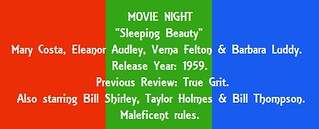
Movie Night: Sleeping Beauty.


Review #660: Sleeping Beauty.

Cast
Mary Costa (Princess Aurora / Sleeping Beauty), Eleanor Audley (Maleficent), Verna Felton (Flora - The Red Fairy and Queen Leah), Barbara Jo Allen (Fauna - The Green Fairy), Barbara Luddy (Merryweather - The Blue Fairy), Bill Shirley (Prince Phillip), Taylor Holmes (King Stefan), Bill Thompson (King Hubert), and Marvin Miller (The Narrator) Directed by Clyde Geronimi (#178 - Peter Pan, #373 - Cinderella, and #573 - The Three Caballeros), Les Clark, Eric Larson, and Wolfgang Reitherman (#250 - The Many Adventures of Winnie the Pooh and #598 - The Rescuers)

Review
Sleeping Beauty was given such a middling reaction (and little profit) that it was the last fairy tale Disney film made for 30 years. But now the movie has a legacy and is now called a classic (being re-released a few times does help), so time does change. The movie is astonishing to say the least. The movie looks beautiful to watch, the way that it is animated and how the backgrounds look so colorful and detailed. I like how the three fairies are colored, it's not just a simple red-green-blue schemes, the way that it is colored makes the difference. The cast is pretty decent, with Audley standing out, mostly because of the character she plays. Sleeping Beauty herself is alright, but her screentime is limited, focusing more on the villain/fairies. Speaking of which, Maleficent is awesome. Her design and her voice are so delightful to watch, she manages to be more interesting than Sleeping Beauty herself, which is probably why they made a movie about it...55 years later (not exactly late for Walt Disney Studios), but at least the movie is still fun to watch. The songs are alright, and the movie flows quickly enough at 75 minutes to never really drag on, it's easily watchable and easily enjoyable for anyone, with a cool villain to headline it all.

Overall, I give it 8 out of 10 stars.