Showing posts with label George A. Romero. Show all posts

October 29, 2023

Creepshow.

Review #2128: Creepshow.

Cast: 
Wraparound story: Joe King (Billy Hopkins), Tom Atkins (Stan Hopkins), Iva Jean Saraceni (Mrs. Hopkins), Marty Schiff (Garbageman #1), and Tom Savini (Garbageman #2) 
"Father's Day" segment: Carrie Nye (Sylvia Grantham), Viveca Lindfors (Bedelia Grantham), Ed Harris (Hank Blaine), Warner Shook (Richard Grantham), Elizabeth Regan (Cass Blaine), and Jon Lormer (Nathan Grantham)

"The Lonesome Death of Jordy Verrill" segment: Stephen King (Jordy Verrill) and Bingo O'Malley (Jordy's Father/Doctor)
"Something to Tide You Over" segment: Leslie Nielsen (Richard Vickers), Ted Danson (Harry Wentworth), and Gaylen Ross (Becky Vickers)

"The Crate" segment: Hal Holbrook (Henry Northup), Adrienne Barbeau (Wilma "Billie" Northup), Fritz Weaver (Dexter Stanley), Robert Harper (Charlie Gereson), and Don Keefer (Mike the Janitor)
"They're Creeping Up on You" segment: E. G. Marshall (Upson Pratt) and David Early (Mr. White) Directed by George A. Romero (#738 - Night of the Living Dead (1968), #1155 - Dawn of the Dead (1978), #1588 - Day of the Dead, #1901 - The Crazies)

Review: 
To put it lightly, hell yes, I was ready to do this film for quite a while. What better combination could one have for an anthology film than a director as damn good as George A. Romero and a writer in Stephen King? What better way to do it than to have five stories and a runtime of two hours too? Three of the stories were done by King straight for the film while the other two are based on short stories King had previously done before. It is made as a homage to those EC Comics of yesteryear such as Tales from the Crypt, complete with animation utilized to depict it as a comic book (Jack Kamen, who did story art on a handful of Crypt stories, contributed the comic book artwork). It came out in the middle between Knightriders (1981) and Day of the Dead (1985) for Romero, which one would say is a good place to cite for a director as dedicated to delivering enduring films. Two sequels followed, albeit with less fanfare. The second film (released in 1987) had Michael Gornick (cinematographer of the first film) serve as director while Romero wrote the screenplay based on three stories as done by King, while the third film (released in 2006) had none of these aspects. In 1983, Romero and Richard P. Rubinstein went to work on an anthology TV series that was loosely based on the film (of course since Warner Bros. released Creepshow, one couldn't just keep the framing device from before): the result was Tales from the Darkside, which ran for four years and even had two King stories serve as episodes while Romero also wrote a few episodes. In 2019, Shudder (a streaming service) premiered a show based on the film,  which has run for four seasons.

Anthologies are hard to do right, particularly for horror, as demonstrated by ones given general praise such as Dead of Night (1945) or the ones with even better quality such as Kwaidan (1964). Creepshow is a damn good showing of the macabre with clear enthusiasm shown for each and every story that makes a good effort in capturing the feeling of reading something cribbed from a book or someone with a really amusing sense of dark amusement in the campfire. The frame device is what else but a dad giving his son crap for reading a weird-looking book of horror that can only go one way when you've got a kid that believes those paper ads really are helpful. Interestingly, Joe King (Stephen King's son and actor here) really did become a horror writer as an adult. The first story in "Father's Day" (17 minutes) is fine. It involves a family awaiting a relative coming for cake on (what else?) Father's day, which is ironic since no fathers are actually there to eat it. Most of it is actually a yarn told about this relative who may or may not have offed her old father after he had apparently killed her lover. The folks here all get a surprise when somebody else shows up for cake...yeah, it's a decent story to get you started with eventual grisly conclusions (and one fun effects moment involving critters). Next up is "The Lonesome Death of Jordy Verrill", which runs  the shortest (next to the wrapround anyway) at 14 minutes. This is the one with Stephen King overacting a bit while playing a yokel that touches and waters a meteorite that lands on his farm. Daydreams and all, some sort alien vegetation starts growing all certain places...it makes for a decent story, even if King is probably an unusual choice to headline a story alone (for the most part). The ending is a good one in the allure of terror brought on already when it comes to things that latch onto you at night.

"Something to Tide You Over" (25 minutes) is probably the highlight of the film, if you think about it.  It has Nielsen (who I should remind you had dabbled in serious roles on TV and film for decades before Airplane! (1980) gave him his calling in comedy) in an interesting role as a man bent on letting a guy dig himself into a hole on the beach with the tide coming in. There's something enchanting about the cold energy he brings to such a deluded role, and amusingly it is being played off against Danson for that weird mix of cold blooded humor. Of course, it's the ending that makes it count, and I enjoyed seeing it from the perspective of Nielsen when it comes to what you see and can't see even with camera all around. "The Crate" (39 minutes) runs the longest for some odd reason. All it involves is something that apparently has resided in a crate for over a century that comes to the attention of Weaver and later Holbrook, who finds it a good way to interact with his onscreen wife Barbeau. It's more an offbeat amusing story than anything, complete with fantasies of offing an annoying wife, but it makes for a good tale of curiosity over just what happens with a hairy beast and open spaces. "They're Creeping Up on You" (16 minutes) closes out the proceedings with a good ol' shock story time. Marshall plays a real s.o.b. who is really obsessed with cleanliness in his place, complete with taking calls and saying as such even when they are trying to talk to him about other things (you know, business, probably leading to a guy's death...). Things just get weird when, well, something really does creep up on him to a massive extent. Not ideal for those who just ate food they know didn't have anything on it before they swallowed.  The visual stylization that occurs for each story is a neat touch, and in general the film works at giving you useful payoff without just being a starstudded mishmash. As a whole, Creepshow is a horror fan's dream when it comes to giving you a couple of good little stories that give you good payoffs to go with spirited filmmaking from Romero and company that justifies its two-hour runtime with worthy entertainment value that holds well in its time by a hard margin.

Overall, I give it 9 out of 10 stars.
Next up: Tales from the Darkside: The Movie.

October 12, 2022

The Crazies.

Review #1901: The Crazies.

Cast: 
Lane Carroll (Judy), Will McMillan (David), Harold Wayne Jones (Clank), Lloyd Hollar (Colonel Peckem), Lynn Lowry (Kathy), Richard Liberty (Artie), Richard France (Dr. Watts), Harry Spillman (Major Ryder), Will Disney (Dr. Brookmyre), and Edith Bell (Lab Technician) Directed by George A. Romero (#738 - Night of the Living Dead (1968), #1155 - Dawn of the Dead (1978), and #1588 - Day of the Dead)

Review: 
If I gave you a couple of guesses as to what George A. Romero directed after Night of the Living Dead (1968), you probably would struggle a bit before giving up. Go figure, the two films that followed them were not horror films. There's Always Vanilla was released in 1971 as his only romantic comedy, and Season of the Witch was released in 1972 as a feminist film that got cut into a softcore porn film (never doubt the gall of independent releasers). And then of course this film followed those, a horror film that was shot for $275,000 in the towns of Evans City and Zelienople in Pennsylvania. The film is based on a screenplay called "The Mad People" that Paul McCollough had written. There was interest from both the producer and Romero to make the film, albeit with changes made by Romero. The screenplay did have a bioweapon released on accident in a small town with a coverup and revolt, but apparently the screenplay was more existential than horror, since it focused on the townspeople rather than the military. I can definitely see where the interest may lie better with trying to cut to the chase in chaos rather than focusing on implications. There was a mix of both professional and nonprofessional actors (such having the special effects technician play the husband acting against the kids of the cinematographer in the opening sequence) that did their own stunts while a good deal of the audio mixing was done in post-production. The movie was a failure at the box office, owing in part due to ineffective marketing (the movie was released as "Code Name: Trixie" in some markets). A remake was commissioned in 2010, released in the middle of other movies involving threats of sickness in Outbreak (1995) and Contagion (2011), and Romero served as an executive producer. Romero followed this film with the thriller The Amusement Park (premiered in 1975 to one festival and nothing else) and two horror films with Martin (1978) and Dawn of the Dead (1978). 

It is the raw immediacy of the film when it comes to mixing both social subtext and horror that makes it a curious cult classic, one that looks better and better for what it reaches for in the horror of chaos rather than something made with glossy or lofty ambition. It certainly helps that the ending doesn't play it particularly safe by the time it finishes its 103-minute runtime. In crisis, you really can't tell who the crazy one is, as one sees in a movie wrapped in paranoia and perhaps a bit of dark comedy, where people will either recess into their darkest desires or end up shooting at tons of folks in the name of order. One can look at it something quite relevant to now or look upon the possible comparisons to the Vietnam War, at least when you think about the fact that one of the characters is depicted lighting themselves on fire. It inspires flashes of debate over what side you find yourself on in perspective when it comes to people trying to do their job with plenty of resistance versus townspeople who are thrust into chaos with a lack of timing and everything (so yes, do you find favor with folks who get stabbed by old ladies or people who get shot if they resist and run?). In a nutshell: When things go to hell, they really can go to hell in a hurry. As with Living Dead, the acting is fairly suitable in mild expression when compared to the surrounding terror. McMillan, Carroll, and Jones make up the key trio that meet their task head on in frantic timing that works to the pacing of the movie rather than bog it down, where their drama does seem to matter. The beleaguered Hollar is one of the highlights, one that carries tension on his shoulders with righteous timing to make a quality tragic role. France (an occasional actor when not writing plays or reviews) generates the irritated confidence required here as the sane man in hell, while Liberty and Lowry close out the general focus decently. The climax is bittersweet and utterly dead-on with leaving things where they are for the audience to use their imagination (cynical or not) rather than play it easy. It does play a bit loose with its pacing at times, but the moments of horror (blood or not) do help to keep things with steam, and I think it qualifies as something that works the right angle in wry observation without pandering or cheap tricks. It may have been under-appreciated in its time, but a near half-century since the release of this film has only served to make it better and better to look upon in the documents of horror, imperfect or not. 

Overall, I give it 9 out of 10 stars.

November 5, 2020

Day of the Dead.

Review #1588: Day of the Dead.

Cast: 
Lori Cardille (Dr. Sarah Bowman), Joseph Pilato (Captain Henry Rhodes), Terry Alexander (John), Jarlath Conroy (William "Bill" McDermott), Richard Liberty (Dr. Matthew "Frankenstein" Logan), Anthony Dileo Jr. (Pvt. Miguel Salazar), Sherman Howard (Bub), Gary Howard Klar (Pvt. Steel), Ralph Marrero (Pvt. Rickles), John Amplas (Dr. Fisher), and Phillip G. Kellams (Pvt. Miller) Written and Directed by George A. Romero (#738 - Night of the Living Dead (1968) and #1155 - Dawn of the Dead (1978))

Review: 
"I just wanted to make a film about something extraordinary that is happening and the people are unable to grasp it. They continue to argue about stupid things instead of recognizing that there’s something really awful going on. So that’s what I wanted, and I thought, ‘What if the dead don’t stay dead and what if they were going around eating people?’ That was my idea of something awful!”

When it comes to the first zombie film, the general argument is that White Zombie (1932) was the first one to be released, and the subsequent decade that followed resulted in other "zombie" films like I Walked with a Zombie (1943). However, the latter half of the 20th century found a new voice for zombie films, one that has generally led to him being nicknamed the "Father of the Zombie Film." That man was George A. Romero. Romero found an appreciation of film as a child growing up in New York City, with one film that shaped him being The Tales of Hoffmann (1951), which he appreciated for the power of visual media that could be experimented with a film like this (as done by the famed duo of Michael Powell and Emeric Pressburger). He attended and graduated from Carnegie Mellon University in 1960 and moved to doing projects in commercial work for the next few years (one of which being work with Mister Rogers' Neighborhood). Alongside his friend John Russo and Russell Streiner, they aspired to make a horror movie together, which they would do with various producers for a small budget in Pittsburgh. That film, written by Romero and Russo, was Night of the Living Dead (1968). Its grisly effects alongside its devastating story about human nature at the forefront of an apocalypse proved to be a classic of independent cinema and for horror as a whole. Ten years passed before the USA/Italy co-production of Dawn of the Dead (1978), which is thought to be as compelling as the earlier film from a decade prior if not better. Romero mixed horror with drama in the second gap between "Living Dead" films with Knightriders (1981) and Creepshow (1982, a film on the waitlist for quite some time) before his aspiration to make "the Gone with the Wind of zombie films" with this feature, which he wrote and directed.

Romero described this film as a tragedy involving lost communication and chaos within a small "pie slice of society." The tragedy besides that is the fact that Romero had to reduce his original intent when producers curtailed the budget that led to reduction of the script by Romero, who aspired for a unrated version while United Film Distribution Company balked at the idea of doing an estimated $7 million project even with an R-rating - this led to Romero cutting his script (reportedly around 200 pages) to make for a film that could be done on $3.5 million. With the 1968 film, it dealt with an assault on a farmhouse with a growing spread of un-dead, with the 1978 film dealt with a larger scale crisis that had an assault on a shopping mall. Here, we have a film where the humans really are on the run (estimated to be about 400,000 zombies for every one living person), barricading themselves in bunkers and trying to find some sort of possible solution to the pandemic of zombies before the other conflict bubbles onto the surface - the struggle of humans to get along and stick together. When it comes to comparisons between the films, Day of the Dead has been regarded as a lesser follow-up to Dawn of the Dead, but honestly it is still a pretty enjoyable effort in the art of panic within survival, and in some ways it could be thought of as a misunderstood classic. Romero wanted to make another film about panic with humankind and the undead with a certain type of actors involved, ones that while not exactly well known still make a useful effort to the growing sense of paranoia and fear that make a worthwhile time in nerves with its own kind of thoughtful ending (which could be argued to be the most hopeful or just as indefinite as the others); like the other two films, it also has been remade (twice, actually!), and a television series is reportedly in development. Romero would not return to the undead creatures until two decades later with Land of the Dead (2005).

The characters have been criticized in part for the varying level of unlikable aspects to them, but I find it pretty appropriate for such a tense movie, one that depicts a conflict of reason and aggression that is reminiscent of before from Romero without being a rehash. He wanted to make a tragedy and I think he succeeded pretty well with what he set out to do. Cardille (daughter of Bill Cardille, featured in the first Dead film) headlines the cast with well-done tolerance, handling her side of tension with useful timing that balances time spent in combat with strong assertive conviction that seems stronger as a lead than other before her, mostly because she makes a worthy double act with the other side of conflict with structure besides undead ghouls, which is where Pilato comes in. Pilato (whose first role as an actor was a bit part in Dawn of the Dead) is undeniably the highlight of the film, making a brash study of instability and stubborn nature come out with great interest that reflects the film in paranoia without seeming too privy to just being ham for the sake of it, an absolute perfect foil to grit the teeth with. Alexander makes a calm third rail in all the hubbub with a bit of soothing charm. Liberty does quite well here in parts, delivering ghoulish charm in the curiosity that befits what the film lightly presents with the making of a zombie, which naturally goes hand in hand with the instinct delivered by Howard that ranks as the one and best performance of a member of the undead in these films in warm curiosity. The other actors are average at best, but at least they don't trip over the overall tone of the film in bleak horror, where accusation and miscommunication is just as horrifying as the prospect of being ripped apart by members of the undead without any bullets present. The effects are just as effective in visceral power (even when having to deal with warm conditions that came with filming in a former mine shaft in Pennsylvania), with credit deservedly going to Tom Savini and his team for making a clever experience Romero reflected on the film in subsequent years as the one that was his favorite, stating that it accomplished the goal he set out to do with another Dead film in making it different from the previous film as one that is "very much me", which is generally reflected well in its 100 minute run-time. It's a bleak movie, but it's a worthwhile bleak movie that is engaging in its tone in surviving a land with lost structure with tense execution that fits upon the landscape in a distinct place among horror in the 35 years that have passed since its release. It isn't the best film from Romero, but it still serves as a well-done testament to his vision about showing the horror in both the living and undead of a society in its third different phase that maintains his place as a director deserving of one's curiosity in the horror genre.

Next Time: Hellraiser.

Overall, I give it 9 out of 10 stars.

October 31, 2018

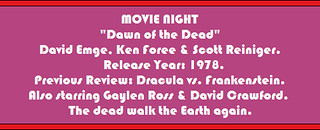
Dawn of the Dead (1978).


Review #1155: Dawn of the Dead.

Cast: 
David Emge (Stephen "Flyboy" Andrews), Ken Foree (Peter Washington), Scott Reiniger (Roger "Trooper" DeMarco), Gaylen Ross (Francine "Fran" Parker), David Crawford (Dr. James Foster), David Early (Mr. Sidney Berman), Richard France (Dr. Millard Rausch), Howard Smith (TV Commentator), Daniel Dietrich (Mr. Dan Givens), Joseph Pilato (Head Officer at Police Dock), Tom Savini (Blades/Mechanic Zombie shot through glass/Zombie hit by truck), and Taso Stavrakis (Sledge/Fountain Zombie/Sailor Zombie/Chestburst Zombie) Directed by George A. Romero (#738 - Night of the Living Dead)

Review: 
Night of the Living Dead (1968) was a great horror film upon its release, shocking audiences with its gore effects in crisp black-and-white photography that resonates in the despair and terror it showcases in its main enemy - us, as members of the dead brought back to life that eat flesh handily written by George A. Romero and John Russo. It wasn't the first zombie film, but it certainly holds an impact now for the zombie horror genre in the half century since its release. In the ten years that followed its release, Romero certainly kept busy with film-making, directing films such as The Crazies (1973) and Martin (1978), both of which are now considered cult classics. Romero got the idea to write the script from a friend's suggestion about surviving in a mall in the event of an emergency through hidden parts of the mall. This time around, the budget is slightly bigger (over $1 million as compared to the $114,000 of the original), and Romero also serves as editor again. One key help in raising funds was Dario Argento (famed Italian director of films such as Suspiria (1977)), who helped secure money to make the movie in exchange for international rights, and he (alongside a band called Goblin) would contribute the music. Subsequently, there exists different versions of the film besides Romero's final cut (which lasts 127 minutes), due to re-cuts and re-edits that Argento could make for international foreign language releases, such as a 119 minute version that takes out a few scenes with exposition and a faster pace with a bit more dialogue and gore, which was released in Italy on September 1, 1978 as Zombi: L’alba dei Morti Viventi, months before Romero released his cut in America in 1979.

In a span of roughly four months, Romero and his crew filmed most of the movie at the Monroeville Mall in the city of the same name in Pennsylvania, which they did for the time the mall was closed (11PM-7AM). The decision to have the film primarily be set in a mall proves to be a brilliant one, with several places for the characters to hide out and deal with the dead that perhaps don't seem too different from conventional shoppers, a subtle bit of satire that works pretty handy with the rest of the film, which has its bits of terror along with humor, which balances out pretty well. The main quartet of Emge-Foree-Reiniger-Ross prove to be a entertaining group to follow along with, with my particular favorite being Foree, probably the most confident of the group much like Ben from the original. Reiniger is also pretty amusing, especially when he goes down on an escalator slide. Emge and Ross are okay. Like before, the film shows the terror that would arise from an influx of the undead and what that would mean for society, from the arguments in a TV studio to conflicts in housing projects that are grim yet effective in setting up the premise without having too much exposition. There's also a bit of conflict and struggle in the fight to survive that we see from the group, particularly in the opening half, but as they warm to each other we grow to really follow these characters and enjoy their pursuits in the mall - which seems to be more than just a haven for stuff or safety. The scenes where they enjoy the mall are pretty amusing at times, and the sequence with the bikers is also handled pretty well, complete with an amusing use of pies.

Undeniably, the highlight of the film is the gore effects, done so by Tom Savini, with the undead being bluish-grey with bright red blood that contrasts with the previous film that looks pretty good in his own right. The gore may not be for everyone's taste, but I found it thoroughly enjoyable, having a gruesome nature and effective feel that goes along an enemy that still manages to invoke terror. I enjoy the beginning parts and the climax better than the middle, but the film doesn't drag or feel too long - although if you want more there also exists an extended version that lasts 139 minutes, which Romero had quickly assembled to show at the Cannes Film Festival. The next film in the Living Dead series came out seven years later with Day of the Dead; all three films have had remakes, with Zack Snyder serving as director for his version released in 2004, with a few cameos from members of the original cast. It lives up to the original film not by being something completely different or going by the same beats as before, but by doing something fresh and compelling that makes this not just a great sequel but also a great horror film in general.

Overall, I give it 9 out of 10 stars.

October 1, 2015

Night of the Living Dead (1968).


Review #738: Night of the Living Dead.

Cast
Duane Jones (Ben), Judith O'Dea (Barbra Blair), Karl Hardman (Harry Cooper), Marilyn Eastman (Helen Cooper), Keith Wayne (Tom), Judith Ridley (Judy), Kyra Schon (Karen Cooper), Charles Craig (Newscaster / Undead), Bill Hinzman (Cemetery Living Dead), George Kosana (Sheriff McClelland), Russell Streiner (Johnny Blair), and Bill Cardille (Billy Cardilly) Directed by George A. Romero.

Review
I remember watching this for the first time when I was about 13 or 14 on YouTube, before the night started to fall. I remember it being pretty good, though I don't think I remembered too much of the movie itself, but I did at least remember the opening scene. Years later, I decided to watch it again. One good thing I can say right off the bat is that it is easily available. The film was known as Night of the Flesh Eaters before it was changed before release due to there being a similar movie tilted like this (named The Flesh Eaters), which led to the copyright accidentally being taken off the credits. Lastly, this movie was made on a budget of $114,000. But enough about facts, let's talk about the movie, on the 47th anniversary of its release. It's interesting to note that though the term "zombie" wasn't used in the film, it is sometimes regarded as the movie that popularized the genre. The opening scene still manages to be one of my favorite scenes in the movie because of its relative simplicity. All it is at first is a conversation about laying a wreath near a graveyard between two siblings. "They're coming to get you, Barbara..." is a line that turns out to prophetic and also manages to be one of the more memorable lines from the movie. Maybe because it is the timing, slightly after Hinzman's character shows up, the first in a long line of living dead.

For an independent movie, this sure does have a good range of effects, especially in close-up. Even seeing a group of them is impressive to watch. The characters are varied in their reaction to this sudden nightmare from springing to action to quasi-catatonic to slightly paranoid, but it makes sense, given that courage and instinct are completely different things. That being said, it is tiresome (occasionally, anyway) to watch O'Dea just sit on the couch half the time and Hardman's character being so stubborn. But the movie is quick and efficient at being a horror movie that doesn't try to explain everything, or try to evoke optimism (Even though halfway the movie someone suggests that radioactive contamination from a space probe might have been the cause, it's never explicitly stated as the reason). Instead, it tries to show a look into what exactly people would do in the case of a disaster of this scope. Some (in the movie) form militias. Others keep on reporting, while rescue centers open to care. Others try to make something out of a tragedy, and why they may not survive, they can at least say in they tried to do something better. It's not a perfect world (or movie) by any means, but it's certainly an entertaining one.

Overall, I give it 9 out of 10 stars.