Showing posts with label Edgar Buchanan. Show all posts

May 14, 2020

McLintock!

Review #1414: McLintock!

Cast: 
John Wayne (George Washington McLintock), Maureen O'Hara (Katherine McLintock), Patrick Wayne (Devlin Warren), Stefanie Powers (Becky McLintock), Jack Kruschen (Jake Birnbaum), Chill Wills (Drago), Yvonne De Carlo (Louise Warren), Jerry Van Dyke (Matt Douglas Jr), Edgar Buchanan (Bunny Dull), Perry Lopez (Davey Elk), Strother Martin (Agard), and Gordon Jones (Matt Douglas) Directed by Andrew V. McLaglen.

Review: 
“The only one who could stand up to my father, and stand toe-to-toe with my father, and match him in everything.”

It never hurts to make a film that fit into numerous genres. In this case, why not have both a Western and a comedy? With famed stars in Wayne and O'Hara, who could go wrong? At the helm for the film was Andrew V. McLaglen, a British-born American director that grew up with his father Victor (a prolific character actor in numerous John Ford films, where he won an Academy Award for The Informer in 1935) around films, and he eventually found work for himself such as production assistance and assistant directing, with one notable film credit being The Quiet Man (1952, where he did the latter category). In 1956, he started his career in directing, doing Gun the Man Down while also starting work in television with programs such as Gunsmoke and Have Gun - Will Travel, and he directed over 90 episodes of each show over the course of nine and six years respectively. McLaglen would direct a variety of subjects over the course of 35 years in film and television (ranging from Western to war films) with a variety of stars like Wayne (who he would work with five times), James Stewart (four times), and Roger Moore (three times). Familiarity is the name of the game when it comes to this film, since James Edward Grant (who wrote several films with Wayne in them, such as The Alamo) served as writer for a film that was inspired by William Shakespeare's The Taming of the Shrew; Wayne acts alongside his third son while having his eldest son serve as producer and this was the fourth of five Wayne-O'Hara films, which were noted for their clear chemistry between their stars. One shouldn't forget about O'Hara in all of this, a figure of the Hollywood Golden Age that came from Ireland and theater acting at a young age to stardom in a variety of genres such as Westerns, melodramas, and adventure films. Speaking of actors nicknamed the "Queen of Technicolor", De Carlo (star of film and future star on television) was given a role in the film because of Wayne's sympathy in light of her husband being permanently crippled while doing stunt-work on How the West Was Won (1963, which had Wayne as star).

While the film is certainly a bit different from the usual Wayne fare, he also made this film as a way to express his belief (and disapproval) on certain topics, where his character yearns to tame both his wife and the West at the same time. There are quite a few moments of amusement within a story that moves at its own careful pace of 127 minutes, one with a casual story rather than tension that takes a familiar story to make a controlled film that sticks out from the usual Wayne experience without becoming a parody of itself. This is a film with a climax involving a paddling with a coal scuttle shovel, after all. The mud brawl proves to be a big highlight, one with plenty of fist-fighting and amusement, complete with the usage of bentonite (a type of clay that looks like syrup) for mud. Wayne seems to be having a fine time here, a clear-cut blunt performance that has a sense of honesty and humor without becoming too obvious about it. One can see the chemistry between him and O'Hara even when he's drunkenly falling down the stairs with her, really. O'Hara makes for a fiery presence with her own sense of humor that makes for plenty of smiles with those expressive eyes. The younger Wayne and Powers prove a fair pairing with others and themselves, while Kruschen, Wills and De Carlo provide capable careful chuckles that resonate with the trappings of the plot. There isn't the usual villain to make a showdown, but at least there are adversarial presences to drive things (however obvious things get). In the long run, this is a fair little mixture of Western and comedy, buoyed by Wayne, O'Hara and company to make a useful time worth having, particularly since it is readily available in the public domain (bless those failures to copyright) for anyone to stoke their curiosity in familiar territory for all in the 1960s.

Overall, I give it 8 out of 10 stars.

April 9, 2020

Shane.


Review #1382: Shane.

Cast: 
Alan Ladd (Shane), Jean Arthur (Marian Starrett), Van Heflin (Joe Starrett), Brandon deWilde (Joey Starrett), Jack Palance (Jack Wilson), Ben Johnson (Chris Calloway), Edgar Buchanan (Fred Lewis), Emile Meyer (Rufus Ryker), Elisha Cook Jr (Frank "Stonewall" Torrey), Douglas Spencer (Axel 'Swede' Shipstead), John Dierkes (Morgan Ryker), Ellen Corby (Mrs. Liz Torrey), and Paul McVey (Sam Grafton) Produced and Directed by George Stevens (#911 - Woman of the Year)

Review: 
“I’ve always been of the opinion that a director should never touch a film without his having a basic knowledge of its contents.”

There have been a countless amount of Westerns to choose from when it comes to picking a film to watch and plenty that came from the 1950s. It should only prove natural that a classic as timeless as this one is came from George Stevens. Born in a family of actors and film crewmen, Stevens honed his craft first as a cameraman with the Laurel and Hardy film series before soon cutting his teeth as a director for shorts and eventually his first feature with the comedy The Cohens and Kellys in Trouble (1933). In the prevailing next few years, he would go on to do comedies and romantic dramas before he left to serve in World War II, which had a diverse selection of stars ranging from Katherine Hepburn and Spencer Tracy (where he directed the first film to feature the two together in Woman of the Year) to Fred Astaire and Ginger Rogers with Swing Time (1936) to Cary Grant with Gunga Din (1939). He served with the U.S. Army Signal Corps as a head of the film unit, which filmed numerous events of the war such as the D-Day landings and shots of concentrations camps such as Dachau. When he returned to direct feature films in 1948, his films darkened in optimism, but he reached success with his ambitious efforts. He won two Academy Awards for Best Director for A Place in the Sun (1951) and Giant (1956), a feat matched by just twenty other directors before he closed his career with The Only Game in Town (1970). Stevens commanded respect from his fellow directors and stars, a man capable of keeping control of the film to himself and not at the whims of producers or big names, believing that films should be respected as more than just a tool to be used to sell products when they were aired on television.

It should only prove fitting that the film has a tremendous tense presence to headline a classic like this. Ladd (a man who tried his hand at extras and bit parts before getting his big break at the age of 29) is precisely the man for the moments required of him in this film, a weary presence that we see ourselves drawn to even before conflict has built itself to a boil. He doesn't have the biggest of backstories or the tallest of heights, but there is plenty to see within his eyes when interacting with the others, such as with deWilde or with Arthur, a graceful presence in her last performance before film retirement. Heflin keeps up with resilience fitting of a community man, while deWilde (who had his Broadway debut at the age of 7) makes a compelling coming of age presence that is crystalized with the final iconic scene with Ladd. The rest of the cast contribute in their own ways, such as a conniving Meyer. Palance utilizes his moments on screen with menacing precision through the way he says his lines, with the highlight being the sequence outside the saloon that builds tension right up until the gunshots are fired (done by shooting into a garbage can), complete with wires to jerk back the actor after being shot, a startlingly effective choice. The film was adapted from the Jack Schaefer's 1949 novel of the same name by Pultizer Prize novelist A.B. Guthrie Jr and columnist Jack Sher. It's interesting that the film turned out so well with the strange difficulties it faced at times with its stars. For example, Ladd, who disliked guns, took 116 takes when it came time to film the shooting demonstration sequence. Palance did not have much experience with guns or horses, and he had trouble in mounting (and demounting) his horse; the one take of him successfully mounting his horse would be used numerous times (along with being reversed for dismounts) during the film. This is a film that went from original plans of 58 shooting days to 75 (done in 1951) with extensive editing done by Stevens that led to delays. And yet here we are, talking about a classic for its decade because of how well-crafted it is, meticulous in its look in sets alongside award-winning cinematography from Loyal Griggs that go with a game cast and startling direction that certainly proved inspiring for future films (such as Pale Rider) while ultimately being a thought-provoking Western of a time that never ages and never dies.

Overall, I give it 9 out of 10 stars.

June 11, 2014

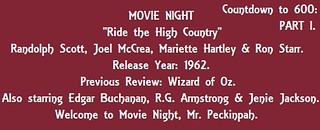
Movie Night: Ride the High Country.


Review #590: Ride the High Country.

Cast
Randolph Scott (Gil Westrum), Joel McCrea (Steve Judd), Mariette Hartley (Elsa Knudsen), Ron Starr (Heck Longtree), Edgar Buchanan (Judge Tolliver), R.G. Armstrong (Joshua Knudsen), Jenie Jackson (Kate), James Drury (Billy Hammond), L. Q. Jones (Sylvus Hammond), and John Anderson (Elder Hammond) Directed by Sam Peckinpah.

Review
Well, well, I'm finally doing a review of a Peckinpah film. I didn't know it would take this long to get to him, but hey, here we are. This was his second film (his first being The Deadly Companions), and he would direct only 14 films in the 22 years, from 1961 up until 1983, up until his death in 1984. Peckinpah is known for his eccentricities and range of violence of shown in his films, such as The Wild Bunch. But what about this film? This movie is more about the story of loyalty then about the action, and it works just fine. Scott and McCrea are brilliantly paired well against each other, and the way their friendship progresses throughout the movie is a useful part of what makes the movie work. It's not the rugged terrain, or the fairly decent action, it's the relationship between these two characters, and the others as well, about how the legends may fade, but their stories won't. The supporting cast is excellent, especially Hartley, who is certainly interesting to watch. This is on the whole a fairly decent movie that certainly shows the strengths of the good ol' Western. 10 to go to #600.

Overall, I give it 8 out of 10 stars.