December 24, 2021
Christmas Eve.
January 6, 2021
Terror by Night.
Cast:
Basil Rathbone (Sherlock Holmes), Nigel Bruce (Dr. Watson), Alan Mowbray (Major Duncan-Bleek), Dennis Hoey (Inspector Lestrade), Renee Godfrey (Vivian Vedder), Frederick Worlock (Professor Kilbane), Mary Forbes (Lady Margaret Carstairs), Skelton Knaggs (Sands), Billy Bevan (Ticket Collector), and Geoffrey Steele (The Honourable Roland Carstairs) Produced and Directed by Roy William Neill (#846 - Frankenstein Meets the Wolf Man, #873 - Sherlock Holmes and the Secret Weapon, #925 - Sherlock Holmes in Washington, #936 - Sherlock Holmes Faces Death, #1021 - The Spider Woman, #1040 - The Scarlet Claw, #1056 - The Pearl of Death, #1161 - The House of Fear, #1216 - The Woman in Green, and #1262 - Pursuit to Algiers)
Review:
This was the thirteenth film to star Basil Rathbone and Nigel Bruce as Sherlock Holmes and Dr. Watson, respectively, and this is the penultimate feature in the 14-film series loosely based on the works of Sir Arthur Conan Doyle. Honestly, one probably would need a primer on just what happened before in this series to really compare the quality of the films from 20th Century Fox and Universal Pictures; the first film is likely the most interesting, while the war-themed films were certainly offbeat, ranging from sabotage ring voices to the return of Moriarty (twice) to microfilm matchbooks to Rondo Hatton to Algiers. Decrying the shift to modernizing the tales is an easy out, but it was the mindset of the producers at Universal to try and keep up with the tastes of young filmgoers (much to Rathbone and Bruce's reluctance, as pointed out by Bruce in his unpublished autobiography). Besides, it wasn't the first Holmes adaptation to turn to modern-day technology, as Sir Doyle had decried the use of telephones for his Victorian icon for the Stoll Pictures series of shorts/features (Doyle lived long enough not only to introduce The Lost World but also admire Eille Norwood as his favorite portrayal of Holmes on screen). At any rate, Rathbone and Bruce (who were good friends besides acting) were also starring in The New Adventures of Sherlock Holmes, with Rathbone and Bruce starring in over 200 episodes before Rathbone left in 1946 (Bruce would leave the following year) that served as adaptations of the Doyle works into 30 minutes. The Neill films were generally made fast (roughly taking over three weeks to make, generally shot out-of-sequence), but they were efficient enough to keep the ball rolling for further interest while usually only running an hour.
So here we are, back with a series that now has a train murder mystery on its hands with a group of character actors and a hour to spend in the public domain. The film was written by a new writer this time with Frank Gruber, who generally specialized in writing in detective stories and Westerns through magazines and features (he would also write the next film). If you've kept up with the series by this point, there is no good reason to stop now, and what we have is a fairly serviceable film, fair in its setup of mystery in false leads and twists without devolving into anything out of step in nonsense. One gets to see a bit of danger for the lead, a bit of comic amusement (for better or worse), and other familiar aspects and folks (such as Hoey and Worlock, regulars at this point) that prove just diverting enough to keep the tone up to the usual Neill levels. In other words, it will keep your attention for those who seek an effort from the 1940s (read: 75 years ago), with relatively standard acting and pace with its one set (and jewel) keeping focus well. At this point in time, Rathbone was clearly itching to spirit away from playing Holmes (amid the fear of typecasting), but it never seemed to interfere with his work. As is the case for the standard bearer of calm analytical disposition, he delivers a fine performance, one that makes an encounter with a would-be killer while outside seem like a walk in the park. Bruce does what is given to him in retorts for clues and/or offbeat bumbling, whether that means in interacting with passengers that range from friend to foil or in dealing with thieves (teapot or otherwise) - there may be better portrayals of Watson out there, but Bruce will stick with you regardless. Mowbray follows along with Bruce with useful presence, a fair presence to counteract the other supposed figures of suspicion without being reduced to the stature of a coat rack. Hoey makes his last appearance as Lestrade go well enough, even sharing an interesting moment of discussion with Rathbone and Bruce that keeps the film on the conventional toes. Godfrey, sporting an "accent", does okay but is overshadowed by the burrowing bluster of Worlock (who gets the better of Bruce in one amusing sequence). Others fill the detail to what is needed, whether that involves stuffiness in Forbes or conniving with Knaggs, each longtime presences in cinema. As a whole, the film makes enough sense of itself with execution in intrigue and its setting to make for a relatively useful affair in a series winding down but still packing interest in a neat one hour package. If you've done one, what's another one (or thirteen) going to hurt?
Overall, I give it 7 out of 10 stars.
November 14, 2018
The House of Fear (1945).

Review #1161: The House of Fear.
Cast:
Basil Rathbone (Sherlock Holmes), Nigel Bruce (Doctor Watson), Aubrey Mather (Bruce Alastair), Dennis Hoey (Inspector Lestrade), Paul Cavanagh (Dr. Simon Merivale), Holmes Herbert (Alan Cosgrave), Harry Cording (Captain John Simpson), Sally Shepherd (Mrs. Monteith), and Gavin Muir (Mr. Chalmers) Directed by Roy William Neill (#846 - Frankenstein Meets the Wolf Man, #873 - Sherlock Holmes and the Secret Weapon, #925 - Sherlock Holmes in Washington, #936 - Sherlock Holmes Faces Death, #1021 - The Spider Woman, #1040 - The Scarlet Claw, and #1056 - The Pearl of Death)
Review:
The House of Fear is the tenth film of the Rathbone-Bruce series of Sherlock Holmes movies, released seven months after the previous installment in March 1945. It would prove to be the first of three Holmes features released in 1945 - the second (The Woman in Green) was released in July and the third (Pursuit to Algiers) was released in October. The credits state that the film was based off the 1891 story "The Adventure of the Five Orange Pips" by Sir Arthur Conan Doyle, although it seems the only thing the film took from it was the orange pips, which are present in letters sent to a group of men (all seven of which who have life insurance policies) living in a castle prior to their deaths, one by one. The mystery itself is a bit shaky, but at least there is some atmosphere present and a fairy game ensemble cast to push the film towards respectability, even with a collection of cliches (house on a cliff, spooky servants, secret passageways, odd villagers, etc). One wonders how to describe Rathbone playing a role that he played consistently for six years (in film and on radio) that defined him without feeling like a broken record; he does a fine job with the material he is given without feeling tired, and that's the best thing that can happen for this film. Bruce is at task to deliver the qualities expected from being the second banana to Rathbone, giving off some comic relief (most notably a bit with an owl), but at least he does play some part in the final deduction for the better. Mather plays the nervous one okay, and the other members of people in the castle are all okay, although there really isn't much of a villianous presence besides Shepherd creeping about while giving the men their letters. Hoey also does a bit of stumbling about as Lestrade in his fifth go at the role, of which he did six times, appearing in Terror by Night the following year. On the whole, it's not hard to see that the filmmakers were pretty comfortable with how they were making these mystery films as efficiently and quickly as possible (taking only a few weeks to make on cheap b-movie budgets) - with this one running at just 69 minutes. It isn't too ridiculous nor too boring to spend some time with. If you are a fan of the series of films with Rathbone and Bruce, this one will prove just fine for viewers and it works fine for anybody looking to pass some time with a film that has some good old-fashioned mystery cliches - right down to its title. The film isn't the best or worst of the series, being a middle-of-the-road kind of movie that is alright on its merits.
Next Review: Overlord (2018).
Overall, I give it 7 out of 10 stars.
March 7, 2018
The Pearl of Death.

Review #1056: The Pearl of Death.
Cast:
Basil Rathbone (Sherlock Holmes), Nigel Bruce (Doctor Watson), Evelyn Ankers (Naomi Drake), Dennis Hoey (Inspector Lestrade), Miles Mander (Giles Conover), Ian Wolfe (Amos Hodder), Charles Francis (Digby), Holmes Herbert (James Goodram), Richard Nugent (Bates), Mary Gordon (Mrs. Hudson), and Rondo Hatton (The Creeper) Directed by Roy William Neill (#846 - Frankenstein Meets the Wolf Man, #873 - Sherlock Holmes and the Secret Weapon, #925 - Sherlock Holmes in Washington, #936 - Sherlock Holmes Faces Death, #1021 - The Spider Woman, and #1040 - The Scarlet Claw)
Review:
The Pearl of Death (released less than three months after The Scarlet Claw) is the ninth film in the Sherlock Holmes series with Rathbone and Bruce, with this film involving the search of a valuable pearl that is linked to a series of murders. Given that previous plots have involved supernatural terrors, pyjama murders, house murders and wartime spy plots, I can't say that this plot is any stranger or weirder than the other films. As such, this film meets the standards for fans of the series, with no real detraction or distractions. Once again, Rathbone and Bruce do their jobs with the right kind of class and mannerisms that you would expect, although it is weird that the film has Holmes inadvertently starting the main plot by exposing the security system that protects the pearl. The supporting cast is acceptable, with Ankers and Mander playing capable adversaries without any bombast. Hoey does a fine job as expected, with a bit of entertaining banter between him and Rathbone. In any case, the rest of the movie is fairly suspenseful, moving along with all the right patterns and pace (69 minutes) that will satisfy people in the mindset for it that doesn't come off as an listless retread of any tricks utilized in the other films in the slightest.
The story took inspiration from Sir Arthur Conan Doyle's short story "The Adventure of the Six Napoleons", with the additions of an accomplice to the villain and The Creeper, played by Hatton. He became an icon of sorts due to his unusual facial features that were caused by acromegaly, which distorted his head shape along with his face that happened to him gradually after he had been a soldier in World War I and a journalist. He had appeared in small roles in four other movies prior to this one. The reception of Hatton (who delivers a decent if not briefly sinister job in his time on screen) and his portrayal of the Creeper led to Universal Pictures casting him into two other films with his as "The Creeper" (albeit unrelated to this film): House of Horror and The Brute Man, both released in 1946, the same year of Hatton's death. In any case, this is a capable film that works just as well as most of the other Holmes films.
Overall, I give it 7 out of 10 stars.
December 7, 2017
The Spider Woman.

Review #1021: The Spider Woman.
Cast:
Basil Rathbone (Sherlock Holmes), Nigel Bruce (Dr. John Watson), Gale Sondergaard (Adrea Spedding), Vernon Downing (Norman Locke), Dennis Hoey (Inspector Lestrade), Alec Craig (Radlik), Arthur Hohl (Adam Gilflower), Mary Gordon (Mrs. Hudson), and Teddy Infuhr (Larry) Directed by Roy William Neill (#846 - Frankenstein Meets the Wolf Man, #873 - Sherlock Holmes and the Secret Weapon, #925 - Sherlock Holmes in Washington, and #936 - Sherlock Holmes Faces Death)
Review:
This was the seventh film in the Sherlock Holmes series with Basil Rathbone and Nigel Bruce as Holmes and Watson, respectively, and it happens to be the first one since The Hound of the Baskervilles (#583) to not include Holmes' name on the title, and that would occur for the rest of the film series. This time around, Holmes is investigating a series of suicides that are termed as "pjyama suicides" (as spelled in the film), with the villain being dubbed a "female Moriarty"; this isn't so surprising, seeing how Moriarty was already featured as a villain twice in a three year span. Admittedly, the biggest surprise in the film happens in the first ten minutes: Holmes fakes his death in order to investigate the murders...of course this doesn't really fool the villain all too much by the time they meet (with Holmes in disguise), which makes this seem a bit ridiculous.
Fans of the stories will note the film's incorporation of elements from The Sign of the Four (1890), along with the short stories "The Final Problem", "The Adventure of the Empty House", "The Adventure of the Devil's Foot" and "The Adventure of the Speckled Band", so that is certainly interesting. This is an okay movie, but I find it to be not as good as the previous film in the series, mostly because the film feels likes its going through the motions, although it has a standard level of satisfaction. It has a mildly compelling performance from Sondergaard, although her character isn't exactly too menacing. Rathbone and Bruce are both fairly consistent as one would expect; the sequence with Bruce where he tries to out what he believes in Holmes in a disguise (portrayed by Hohl) is a bit ridiculous, especially because it seems obvious that it wasn't him, and it feels less surprising when compared to when he exchanged words with a person that turned out to be Holmes in disguise. The climax of the film, which takes place in a carnival atmosphere with a shooting gallery is pretty unusual, but I do find it to work with the odd nature of the movie, which is at the very least somewhat entertaining. At 62 minutes, it is worth at least some of your time, depending on whether you are in the mood for another story with Sherlock Holmes.
Overall, I give it 7 out of 10 stars.
May 20, 2017
Sherlock Holmes Faces Death.

Review #936: Sherlock Holmes Faces Death.
Cast:
Basil Rathbone (Sherlock Holmes), Nigel Bruce (Dr. John Watson), Dennis Hoey (Inspector Lestrade), Arthur Margetson (Dr. Bob Sexton), Hillary Brooke (Sally Musgrave), Halliwell Hobbes (Alfred Brunton), Minna Phillips (Mrs. Howells), Milburn Stone (Captain Vickary), Gavin Muir (Phillip Musgrave), and Gerald Hamer (Major Langford) Directed by Roy William Neill (#846 - Frankenstein Meets the Wolf Man, #873 - Sherlock Holmes and the Secret Weapon, and #925 - Sherlock Holmes in Washington)
Review:
I hope that I am not boring you folks with the reviews of these certain films; I do indeed have some interest in these detective films, which clearly have some sort of appeal for me. This is the sixth of the Rathbone series (#583 - The Hound of the Baskervilles, #721 - The Adventures of Sherlock Holmes, #798 - Sherlock Holmes and the Voice of Terror, #873 - Sherlock Holmes and the Secret Weapon, and #925), but this one is a mystery revolving around murder in a house (instead of something involving the war, though there are military characters present). After three films of wartime infused spy plots, this certainly comes off as refreshing (honestly, the title is a bit strange - doesn't he always face people dying?). One of my favorite scenes is when Holmes realizes one of the clues in a "ritual" involves a checkerboard floor on one of the rooms, and naturally Holmes decides to use the people in the house in order to act the ritual out. The film runs smoothly enough at 68 minutes, mixing capable characters alongside Rathbone and Bruce (with his character having a bit more competence than before) as expected. One of the more quirky scenes with Rathbone is him talking to a squawking raven. It isn't the best Holmes film with Rathbone (for me, nothing tops the first film), but it certainly is an improvement over the previous three movies, in part because of the way it operates itself. The villain (Margetson), while not strong or particular clever, is somewhat satisfying in that he is not merely one dimensional. Brooke is a somewhat fair supporting actress (the most quirky scene involving her is one where she is reciting a ritual and a bolt of lightning strikes through a window and hits a suit of armor near her). It ends with a dialogue between the two main actors about a "new spirit abroad the land" that isn't about greed (inspired by an act of selflessness by Brooke's character), which is interesting if not somewhat broad. The mystery is entertaining enough, and this is a fairly good way to spend an afternoon with a serviceable type of movie like this.
Overall, I give it 7 out of 10 stars.
November 19, 2016
Sherlock Holmes and the Secret Weapon.

Review #873: Sherlock Holmes and the Secret Weapon.
Cast:
Basil Rathbone (Sherlock Holmes), Nigel Bruce (Doctor Watson), Lionel Atwill (Professor Moriarty), Kaaren Verne (Charlotte Eberli), William Post Jr. (Dr Franz Tobel), Dennis Hoey (Inspector Lestrade), Holmes Herbert (Sir Reginald Bailey), Mary Gordon (Mrs. Hudson), and Henry Victor (Dr. Joseph Hoffner) Directed by Roy William Neill (#846 - Frankenstein Meets the Wolf Man)
Review:
This is the fourth of the Holmes series with the Rathbone-Bruce duo (with the previous three reviewed here previously: #583 - The Hound of the Baskervilles, and #721 - The Adventures of Sherlock Holmes, #798 - Sherlock Holmes and the Voice of Terror), premiering in Los Angeles in late December 1942. This film uses elements of the Doyle story The Adventure of the Dancing Men (actually just the code, but still), while taking place during the War, though this one is more of a spy flick. On the whole, it's a standard kind of flick that entertains in part due to Rathbone and Bruce, but also a relatively good climax. Obviously it's not a film to watch for faithfulness to Holmes stories (literally watch any other Sherlock adaptation), but the charm of the two actors along with a relatively sane plot make for good entertainment. I especially like how Holmes goads Moriarty on to drain his blood slowly, which is one of a few good moments in a climax that moves at its own pace. Obviously the tones of the war are prevalent once again (with a bombing test in the middle of the film), but there is some room for some sort of mystery. Atwill plays Moriarty fairly decently, stated with a good deal of coldness for an actor very prevalent in this era. Moriarty had already been portrayed in the series before (by George Zucco in the second film), but I suppose it's part of the tradition to reuse (or "revive") villains. The rest of the cast is okay, with some comic relief by Hoey and Bruce (the former would star in five more Holmes films), though the real focus is how the movie goes through the motions with some grace and some logic, with no real twist this time around. On the whole, it's an average film that would be nice for anybody looking to kill some time at 68 minutes, or just someone looking for some fine standard fare, with a bit of adventure for the time.
Overall, I give it 7 out of 10 stars.
October 12, 2016
Frankenstein Meets the Wolf Man.

Review #846: Frankenstein Meets the Wolf Man.
Cast
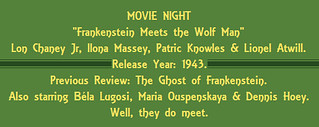
Lon Chaney, Jr. (Larry Talbot/The Wolf Man), Ilona Massey (Baroness Elsa Frankenstein), Patric Knowles (Dr. Frank Mannering), Lionel Atwill (Mayor), Béla Lugosi (Frankenstein's Monster), Maria Ouspenskaya (Maleva), and Dennis Hoey (Inspector Owen) Directed by Roy William Neill.
Review
This was the first in the Universal franchise to utilize two monsters for a crossover film, although one could see this as a sequel to The Wolf Man (#260). Chaney is excellent once again as the Wolf Man, expressing the tragic nature of this character with ease, along with wonderful effects and transformation once again. Lugosi's performance is well known for having been butchered by the studio, to the point where you do not get to hear him speak, not get much context into his walking nature. It's not a movie where the monsters just fight each other (that happens briefly near the end), but it is a fairly engaging yarn to watch. The music number (yes, you read that) is somewhat amusing, in that you wouldn't really expect it to actually occur. Massey does a fine job as well. Knowles is okay, but nothing too special. Atwill returns once again, getting to play a mayor, which is a bit amusing in that this time he doesn't end up dying. The continuity is a bit strange (the Monster is found in ice. What exact time period is this set in? And why does the Wolf Man need to die like this instead of just getting shot by silver and buried deeper?), but there is at least a plausible set up to most of the events of the film. The climax is satisfying in that we get to see these two monsters meet and fight (briefly), which seals the fun aspect of a concept that could have been played out terribly but thankfully isn't.
Overall, I give it 7 out of 10 stars.