Showing posts with label Lance Henriksen. Show all posts

July 19, 2026

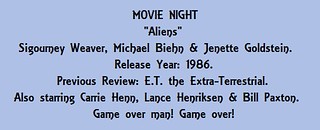
Redux: Aliens.

Redux Review #574: Aliens.

Cast: 
Sigourney Weaver (Ellen Ripley), Michael Biehn (Dwayne Hicks), Paul Reiser (Carter J. Burke), Lance Henriksen (Bishop), Carrie Henn (Rebecca "Newt" Jorden), Bill Paxton (Private Hudson), William Hope (Lieutenant Gorman), Jenette Goldstein (Private Vasquez), Al Matthews (Sergeant Apone), Mark Rolston (Private Drake), Ricco Ross (Private Frost), Colette Hiller (Corporal Ferro), Daniel Kash (Private Spunkmeyer), Cynthia Dale Scott (Corporal Dietrich), Tip Tipping (Private Crowe), Trevor Steedman (Private Wierzbowski), and Paul Maxwell (Van Leuwen) Directed by James Cameron (#001 - Terminator 2: Judgement Day, #063 - The Terminator, #388 - Avatar)

Review: 
You might remember that Alien (1979) was originally devised by Dan O'Bannon into subsequent collaboration with Ronald Shusett (pitched as "Jaws in space") that had further influence from David Giler and Walter Hill (it was they who came up with the android character of Ash) and, well, all the folks leading right down to Ridley Scott (and, well, maybe a little bit of positive executive influence, because they groused at Scott's original ending idea). Between the inspiration of films such as The Thing from Another World [1951] in O'Bannon and Shusett's screenplay, the creature design by H. R. Giger* to Scott's drive to make "The Texas Chain Saw Massacre of science fiction" resulted in a movie where terror inflicted the average Joes in space and, well, was pretty damn cool. After years of 20th Century Fox refusing to go along with actually making a sequel (which namely involved trying to screw over the producers in declaring the movie a financial loss), it eventually started development around 1983, and a search for writers led to curiosity over James Cameron's The Terminator scriptCameron (who once described the original as "almost the perfect movie") was hired to do a treatment that had advice from David Giler and Walter Hill that basically honed down to "Ripley and soldiers", which he submitted after three days of writing in the fall of 1983, although it didn't generate true interest (the studio thought it was just filled with horror) until after the release of The Terminator (in turn, Cameron, who didn't expect the movie to be a hit, had worked on an Alien script in his free time*²). Cameron, Giler, and Hill were each credited for the story.  The movie was released at 137 minutes due to an array of cuts that actually could've been a bit more substantial if Fox had gotten their way to make it barely over two hours. Nowadays, you can see the Director's Cut, which is 157 minutes long (with differences being noted here alongside cut scenes that aren't in either version). On July 18, 1986, the movie was released in theaters to tremendous success (plus, Scott seemed to have liked it). The movie was such a hit that 20th Century Fox was really interested in doing a third movie with no hesitation, although delays (namely in not being able to actually settle on a finished script*) resulted in it being released in 1992 that was thought to be considerably inferior to the previous two films and hated by its own director.

If the first film was akin to a fright house, the second film really does merit the comparison (made by Cameron) of aiming to be a roller-coaster ride, and yes, I did this re-review mainly to assert how damn great it is, mainly because the first time I reviewed it, I barely gave any type of insight the first time around in 2014, which basically saw wonderful interactions, a mood shift from "bravado to outright fear" and really good effects. But honestly, the obvious shining point of what basically became the be-all and end-all of the series is with Weaver. Cameron and company wanted Weaver from the jump, with no studio reluctance getting in the way (yes, the studio that was sued by producers into financing the development of the film thought saving money on a cheaper star was a good idea). The first film saw her slowly but surely take charge in the presence of all-encompassing terror that we all could see in ourselves. After confronting the terror of people breaking down in front of them (figuratively or literally) and being trapped in nothingness only to find a world colder than when she left it, Weaver proves up to the challenge of making this character a true wonder in take-charge charm with vulnerability that we still hold up as an icon that Weaver described as an "everyperson". She is trapped in the hell of what she experienced and the idea that of being right in the present of the worst possible thing: being on another crew considered expendable. With the director's cut reminding you of just what she lost the first time around (because again, you only see that photo in that version), it makes the journey back from isolation with Henn all the more rewarding. And then of course there is the wonderful interactions with such a confident supporting cast that view themselves as on the road to conquest with such gallantry only to find themselves in a mirroring of the Vietnam War. Sure, Biehn is tremendously entertaining (cast after James Remar backed out), but it really is the credit of Paxton and Goldstein* to really sell the journey through hell and back (to a point, anyway) with kickass enthusiasm. Rounding out as the odd-man is with Reiser, who actually does prove exquisite in showing that comedians really can play a scummy toad and make it look so easy. Doubly so for Henn and her brave performance filled with soulful qualities (incidentally, she became a teacher) and Henriksen as an android that really is just one of the guys (which he once said basically meant playing him as an innocent). Yes, the movie looks great with what is seen and what isn't seen from the miniatures/wires, and yes, the James Horner music is worthwhile to hear*, but it really does all come down to how much we end up loving to see these characters go through the ride with us (this can be as something as small as seeing Hope's pencil-neck character try to tell the squad to not use a particular weapon - that's an easy one to say "been there, done that") in chaos. If Alien strikes at the terror of being trapped in a place with little escape, Aliens strikes at the terror of actually having something to lose besides the soul. 
 
It's interesting to compare this film to say, the "crowd-pleaser" aim from the most modern film of the series with Alien: Romulus (2024), which aimed to go for "wonder and terror" feel in being set between the two great movies that mostly reminded me of how hard it is to really make a worthwhile ride that isn't merely derivative (to say nothing of one particular reference from Aliens that comes out in Romulus). Jokingly or not, I said that Aliens was better than Alien by a "Xenomorph egg". I have to believe in my heart of hearts that this statement holds water today, but I do admit that I have made it a habit to watch Alien each night of May 25. It's interesting that both movies basically end in the same manner: expelling the final creature into space before Ripley enters stasis for a return to Earth. At any rate, Alien, Aliens, you can't go wrong with the entertainment presented in the terrors of beasts that comes from dark corridors, beasts of acid, and the showing of what it really means to be alive. It was timeless before being a 40-year-old movie, that much is for sure. It is self-contained show of excellence from Cameron and company that stands on its own. 

Overall, I give it 10 out of 10 stars.


*I should give full credit to the list of people who won the Academy Award for Best Visual Effects for Alien: H. R. Giger, Carlo Rambaldi, Brian Johnson, Nick Allder, and Dennis Ayling. There are further inspirations listed that would clog up the opening paragraph: Planet of the Vampires (1965) - specifically the giant skeleton, It! The Terror from Beyond Space (1958), Clifford D. Simak's short story "Junkyard", Star Wars (1977) specifically in Scott's aim to be its "antithesis", the aesthetic of illustrator Moebius and possibly even H. P. Lovecraft (Giger found the initial storyline to be in the vein of the famed writer and listed him as one of his greatest sources of inspiration.). By the way, did you know that Scott...wanted Ridley to die at the end of Alien? No, really.

*² It should be noted that Cameron had done a spec script in 1980 (as seen with the link here: The Risk Always Lives: Words to Live by On the Set of James Cameron’s ‘Aliens’ • Cinephilia & Beyond) that dealt with trying to keep a young creature alive that dealt with a mother queen type creature and a climax with a power-loader. Incidentally, Cameron wrote a draft for Rambo: First Blood Part II around the same time as the Alien II script.

*See, I should see Alien 3 again, mainly to bring up that Fox and company went through a litany of ideas such as: a two-part story where Biehn would be the protagonist for the third film before an epic battle for a fourth movie (no chance of getting Ridley Scott, he was busy), a William Gibson script that he once jokingly described as "Space commies hijack alien eggs—big problem in Mallworld" (this was later adapted into an audio drama), a "wooden planet" with all-male monks...before settling on a cobbled together script that wasn't even finished when filming started. Don't get me started on what happens in the introductory scene of Alien 3. What the fuck? Game over, man! Game over! Yes, even in a notes section, I managed to get that reference in.
  
*Is it really good acting if you don't recognize that Goldstein isn't actually Mexican? (enjoy an interview detailing experiences making the film - Interview with Jenette Goldstein, 1987 | Strange Shapes). Incidentally, she actually owns a bra chain store company.

*Sure, the James Horner soundtrack has a few parts that sound like, say, his stuff from Star Trek II. But who cares? Incidentally, an un-used part of the soundtrack was later used in the climax of Die Hard.

November 3, 2025

Pumpkinhead.

Review #2464: Pumpkinhead.

Cast: 
Lance Henriksen (Ed Harley), John D'Aquino (Joel), Jeff East (Chris), Kerry Remsen (Maggie), Kimberly Ross (Kim), Joel Hoffman (Steve "Scratch"), Cynthia Bain (Tracey), Florence Schauffler (Haggis), Matthew Hurley (Billy Harley), Buck Flower (Mr. Wallace), Brian Bremer (Bunt Wallace), Mayim Bialik (Christine Wallace), Lee DeBroux (Tom Harley), Peggy Walton-Walker (Ellie Harley), Madeleine Taylor Holmes (Old Hill Woman), and Tom Woodruff Jr. (Pumpkinhead) Directed by Stan Winston.

Review: 
“It was a small picture, something I thought I could handle as a director; and I felt there was a lot that I could bring to the story. So I told the producers, ‘Yeah, I’ll do the creature — but only if I can direct the movie.’”

Apparently, Pumpkinhead started out as a poem, written by Ed Justin. It was merely a poem about avoiding Pumpkinhead unless one was tired of living or was one of his dead enemies, complete with stating that nothing, not even a guard dog prowling in the yard, would protect from it. Four different people were given writing credits: Mark Patrick Carducci and Gary Gerani wrote the screenplay, while Carducci, Richard C. Weinman and Stan Winston were given credit for the story. Winston expressed interest in directing the movie when asked by the De Laurentiis Entertainment Group about doing the special effects. Winston originally started in Hollywood as an aspiring actor before deciding to aim for makeup work, rising from an apprentice at Walt Disney Studios to having his own company by the 1970s. He won a handful of Emmy Awards in the decade before becoming a perennial Academy Award-nominated name, which started with Heartbeeps (1982) and peaked with Aliens (1986). Winston directed just two films: Pumpkinhead and A Gnome Named Gnorm (1990) but continued to work in effects for films that saw him win four Academy Awards before he died in 2008 at the age of 62. The movie inspired three follow-up films: two for television and one direct-to-video that saw Henriksen reprise his role twice. A remake has been teased for a few years now but nothing has happened as of yet (honestly, it wouldn't be a bad idea to try and give new life to the material - what, you want remakes of great horror movies again?). 

Admittedly, it is a bit above average. It has one worthwhile performance in Henriksen to go along with a solid looking monster to hold up a movie that is sometimes satisfying in what comes from one having to actually hear about what revenge really means when dealing with a creature that comes from an old pumpkin patch in a graveyard. Inspired or not, it reminds one of Forbidden Planet (1956), which had "monsters from the id" as a key focus, although it is placed in a movie that has a body count of a few teens that is more about having them be victims of impulse and anger rather than just straight up being people to dispose of like other slashers. It's a movie that has one interested most of the time in its rural atmosphere and occasional nice shots to see for a movie that has an interesting looking monster. It only gets shown in the dark, but it manages to come off so well with what you actually see of it and its movements, managing to come off a creature of vengeance and fear right from the jump, particularly since it doesn't have one of those silly weaknesses that could corral other being of anger but instead inward. Henriksen manages to achieve most of the goals probably set out in a performance meant to built on pain, mostly because he is likable enough to make you understand why someone might inquire about the sacrifices one might take when their pride and joy is put in danger. He makes for a quality doomed figure, one who we want to understand in the vulnerability that comes in looking upon what anger takes a person, which carries a movie where the teens are mostly just fine. The guilt is palpable even with the inevitability that comes with, well, a slasher, although it is curiously one with multiple final people. I like the ending in its swift nature of showing just where vigilante justice can take a person and what it may lead to again for those down the road, whether it involves one or a group to target. As a whole, Pumpkinhead has its peaks and valleys when it comes to entertainment value that you either like for what it is in spectacle or wash away in the sea of slashers. You might find some enjoyment here.

Overall, I give it 7 out of 10 stars.

Next up: Tales from the Hood.

March 22, 2024

Near Dark.

Review #2188: Near Dark.

Cast: 
Adrian Pasdar (Caleb Colton), Jenny Wright (Mae), Lance Henriksen (Jesse Hooker), Bill Paxton (Severen), Jenette Goldstein (Diamondback), Joshua John Miller (Homer), Marcie Leeds (Sarah Colton), and Tim Thomerson (Loy Colton) Directed by Kathryn Bigelow (#1258 - K-19: The Widowmaker, #1548 - The Hurt Locker, #1820 - The Loveless)

Review: 
I'm sure you can see the familiar tropes here: one wants to make a certain kind of genre movie but when they can't get the funding or interest for it, they find themselves framing it a different way. Eric Red (writer of one previous film with 1986's The Hitcher) and Kathryn Bigelow wanted to do a Western, but they found a lack of interest in making that sort of genre film, which eventually led them to the idea of think outside the box to make a horror-Western graft that attracted attention. The script was done on spec, which helped in having Bigelow to be the one to direct it rather than anyone else. It was made on a budget of $5 million but had considerably less attention paid to it when compared to that other movie about vampires in a small town for 1987 in The Lost Boys (incidentally, that film also featured a son of Jason Miller in Jason Patric). It was distributed by the DeLaurentiis Entertainment Group (as headlined by Dino De Laurentiis that had a place in North Carolina), which went under two years after the release of this film. While Bigelow went six years between The Loveless and this film, her next film would come out in less time with Blue Steel (1990), which she wrote with Red.

This is the kind of film that strips the vampire to the most basic of elements, ones that you don't see fangs or them being affected by religious objects (guns seem more like pellets to them) because the sun and the consequences of love and attraction is more than enough. One won't find anything Gothic here, unless one finds music by Tangerine Dream in that array (no). The vampires are basically gunslingers that happen to love the night while harassing would-be prey. It is a lean 95-minute runtime, packed with entertainment value when it comes to the clashes of a would-be father figure and reality. Honestly, it seems like a toss-up to say whether this one is the better vampire film of its year, but one can at least enjoy either film with their sense of handling the clash of communities, with our lead not exactly being the clear hero type (really one wouldn't be too off to be reminded of The Searchers, albeit in a smaller timeframe). One is watching a wolf pack of grimy people that would be grimy regardless of the vampirism. And it all starts because of one act of being bit by a woman. Pasdar thus has the interesting double-act of being a focus that wants as little to do with vampirism as one could possibly do because, well, it isn't his way as a country boy in a den of experienced bloodsuckers. Pasdar and Wright make for a shaky pairing because of course they would be shaky when it comes to coercions and trying to live down certain choices that grow bigger throughout the film. That scene of Pasdar trying to run down to the van with a cover, flames and all, is quite breathtaking to see when it comes to making choices and sticking with them. Apparently, Henriksen, in costume, would go around picking up hitchhikers to prepare for the role, which is meant to be a vampire old enough to fight for the Confederacy. He chews up this role for all of the charismatic menace possible, a "father of the night" that would fit the most within horror or the Western genres. Of course, the other big presence is Paxton, who is having a ball as a vampire could possibly have when it comes to practically playing with his food, such as the scene where he gets into a momentary fight with a tough guy that has him "choking" before he takes the time to steal some sunglasses and muse about hating eating folks who are unshaved. He just knows the buttons to push when it comes to conniving century-old presences that don't need much backstory to convey chaos. Rounding out the cast is Goldstein and Miller, with the latter indeed being a child actor playing a vampire that is quite creepy. I appreciate the film for maintaining steady pacing in the tension in trying to affirm just where they belong and making the choice of where to stand when the sun is about to rise. Bigelow's second effort as a filmmaker is a solid one, packed with a few thrills for the horror and western parameters that deserved better for its time - no better time to see some frontier terror in the dark.

Overall, I give it 8 out of 10 stars.

January 11, 2024

Stone Cold (1991).

Review #2168: Stone Cold.

Cast: 
Brian Bosworth (Detective Joe Huff / John Stone), Lance Henriksen ("Chains" Cooper), William Forsythe ("Ice" Hensley), Arabella Holzbog (Nancy), Sam McMurray (FBI Agent Lance Dockery), Richard Gant (FBI Special Agent In Charge Frank Cunningham), David Tress (District Attorney Brent "The Whip" Whipperton), and Illana Diamant (Officer Sharon) Directed by Craig R. Baxley.

Review: 
Okay, some "new directors" are for the curiosity. I had first heard "Brian Bosworth starring in a movie" and thought, hey, maybe I should consider it for Turkey Week (November 2022). It did not come to pass, but I struggled to find a way to talk about this, because such a goofy title and, uh, a former football star being paired with Lance Henriksen seemed ripe someday. This is currently the last feature film directed by Craig R. Baxley, as he has since directed a long list of television movies and a few miniseries (including multiple based on Stephen King works). Imagine going from Action Jackson (1988) and I Come in Peace (1990) to steady work on television...yes, I can't fathom that. Actually, Baxley had come from the world of stuntmen, eventually rising to positions as second unit director and stunt coordinator before breaking in as a director for stuff such as The A-Team. Bruce Malmuth (probably best known for Hard to Kill [1990]) was the original director intended for the film, and he had done a bit of filming before "personal issues that he couldn't control which poured out on set" led to him being replaced by Baxley. Four weeks had been spent filming with the main character having a family before that firing led to a portrayal instead of a loner (as quoted by Bosworth later, Baxley reportedly had said he was "hired to blow shit up and kill a lot of people"), because Malmuth's footage evidently was not useable. I would like to point out that Michael Douglas served as producer (uncredited). The film was written with Bosworth in mind by Walter Doniger, who actually graduated from Harvard is business before having his first profession being as a scriptwriter with Universal Films that eventually led to directing on occasion. His various scripts or direction included various things such as Duffy of San Quentin (1954) or the TV soap opera Peyton Place. The script was his last as a writer before his death in 2011 at the age of 94. The film was a bomb with audiences, but it has a small following, at least one that can be appreciated by say, a drafthouse screening.

This is the most noted film that featured Bosworth, who has appeared from time to time in direct-to-video fare (such as the Revelation Road trilogy) or guest roles. He was mulling on what he was going to do with himself now that his football career had unexpectedly ended at the age of 24. He apparently never considered himself an actor. His son even pointed out the, uh, interesting decisions made to make an action hero out of someone who doesn't really save that many people, and at one point, gets a motorcycle launched into a helicopter. Believe it or not, it was better than I expected. It was designed as a slam-bang action boiler that wanted to promote the physicality of a "name person" more than name actor that would basically put it probably a notch behind in the expectation levels one would have for a Steven Seagal film. Gratuitous and preposterous but never banging a false note, it is the sweet spot of average times for those who desire a film to see on a silly day besides just putting on The Wild Angels (1966). Henriksen was not keen on the original script for the character, because apparently all of his dialogue was cribbed from the Bible. He then went with doing all of his dialogue instead and also brought in outlaw bikers to serve as extras. I admire the dedication for an over-the-top role that is on point for what the film is selling: ridiculous but never boring (and Movie Night likes Henriksen anyway). Bosworth gets to do a few silly stunts like the opening (robbery at a convenience store? not if hiding man has something to say) and play the biker stuff to the routines you expect anyway. Forsythe seems game already to do any wild thing you ask in the name of acting, so having him being grim and gnarly is on point before that amusing endpoint chase. It is a highly combustible film with all the trappings of what should've been a small hit but instead got buried away. A handful of films like this is far more interesting than just going for direct-to-video fare, I imagine. Could it have been a movie about outlaw biker culture? Sure, but the result of striving for action straight on the line is an enjoyable piece of over-the-top filmmaking that delivers exactly on the expectations laid upon it anyway. Maybe Baxley wasn't destined to be a regular feature filmmaker for very long, but he sure looked like he had fun doing it, which sounds about right. Never a great film but always trying to be entertaining, it's a worthwhile pleasure to encounter.

Overall, I give it 7 out of 10 stars.
Next: Ken Loach's Poor Cow.

July 16, 2023

No Escape (1994).

Review #2043: No Escape.

Cast: 
Ray Liotta (John Robbins), Lance Henriksen (The Father), Stuart Wilson (Walter Marek), Kevin Dillon (Casey), Kevin J. O'Connor (Stephano), Don Henderson (Killian), Ian McNeice (Tom King), Jack Shepherd (Dysart), Michael Lerner (Warden), Ernie Hudson (Hawkins), Russell Kiefel (Iceman), and Brian M. Logan (Scab) Directed by Martin Campbell (#173 - GoldenEye, #220 - Green Lantern, and #285 - Casino Royale)

Review: 
Honestly, the only reason I picked this movie is because of the confounding elements that come from its director and stars. How does a movie that features Ray Liotta as star and Martin Campbell as director one year before GoldenEye (1995) slip by under the radar? The most noted film that Campbell made as a director came considerably late in his career, you know. Born in New Zealand, he moved to London to become a director for softcore sex comedies and action TV in the 1970s, as represented by The Sex Thief (1973) and The Professionals, respectively. His most notable television project, however, came with the six-part serial he directed for BBC Television in 1985 in Edge of Darkness (incidentally, he would direct the feature film remake in 2010). Campbell's first film away from his initial start was Criminal Law (1988), which was as successful as his next in Defenseless (1991), which is to say not very much. At any rate, No Escape may have been a ineffective hit with audiences, but GoldenEye, the first James Bond film in the 1990s, was a major hit that he followed with The Mask of Zorro (1998). The film is based on the novel The Penal Colony by Richard Herley, with the screenplay written by Michael Gaylin and Joel Gross.

Technically, the movie does look like the cost to make it was $20 million, because it is a decent-looking "sci-fi action film", but the plot has the rumblings of something unearthed from decades ago in the B-movie realm. Think about it: a man is dropped into a totally inescapable situation and finds either savages or a slipshod attempt at community that has his own reasons to escape. Set in the then-future year of 2022 involving a lead character that suffers PTSD from his experience in Benghazi, the result is something you can see coming right from the very get-go. I really wished I liked the film better, but the only thing that may stick out for you beyond the name actors is the odd distinction that it has no women in the cast (what zero interactions with women does to a person, heh). It just seems too ordinary as a dystopian film (even with a for-profit prison depiction), so stop if you've heard this before: a loner rogue ends up leading people off to safety, an elder that is secretly dying ends up sacrificing oneself, a greedy authority (and/or traitor) figure gets what they deserve, and so on and so on. Liotta is at the very least a solid presence to give the movie some sort of attempt at a redemption story, one where he simply cannot escape being with people despite his traumas and desire to run. Henriksen certainly has a knack for playing authority figures for a handful of his roles, but it is merely too little for him to really lean into for anything meaningful (perhaps it is dwarfed by having Hard Target (1993) on my mind). Wilson seems to be having a nice time playing the heavy, even with the makeup done to portray "the law of the jungle", but yea, we both know that the conflict between him and Liotta isn't exactly the stuff that compelling duels are made of. Dillon is in the most obvious of sacrificial lamb roles and it has very little to trot in meaningful interest, which slips by more than Hudson, who comes and goes with little to no distinctions. Hell, the "rat" character and the "eccentrics" aren't exactly ones to write home about, the movie just seems a bit too plaid to do anything that would stick out that could threaten the serious time the film aims for that ends up for not much when you realize it is a B-movie with nowhere to go but the middle because you don't really know these folks that much or feel like you want to know about them for 111 minutes. As a whole, it is a movie that comes and goes without anything really meaningful to say about people beyond the mildest of conflicts of "decent" and "very bad" that can only go one way when you already know where the cards are stacked to escape. It is a decent-looking movie with decent-seeming people that just can't find that extra ingredient to carry it over the finish line, but maybe you might find something to notice for yourself.

Overall, I give it 6 out of 10 stars.

December 19, 2022

Redux: The Terminator.

Redux #063: The Terminator.

Cast: 
Arnold Schwarzenegger (the Terminator), Michael Biehn (Kyle Reese), Linda Hamilton (Sarah Connor), Paul Winfield (Ed Traxler), Lance Henriksen (Vukovich), Bess Motta (Ginger), Rick Rossovich (Matt), Earl Boen (Dr. Silberman), Shawn Schepps (Nancy), and Dick Miller (Clerk) Directed by James Cameron.

Review: 
From my review on July 30, 2011:
This film is in a word a classic. It has good acting for the most part, a good film noir, (which will be referred to as TechNoir) and a great plot. Good effects especially at the end. Good action and also good direction with a young Cameron at the wheel.
"The Terminator themes had been important to me since high school. Those apocalyptic visions, ideas about our love/hate relationship with technology, our tendency as a species to move in a direction that might ultimately destroy us, and a central faith in the resourcefulness of humanity." - James Cameron

In 1981, James Cameron was trying to become a feature film director when he was hired to do Piranha II: The Spawning, rising from special effects director to the main job due to creative differences with the producer (Cameron had become interested in films due to reading about special effects while in school, if you remember). The movie was not a pleasant experience for him (namely because he got fired days into the film), but it was during a moment spent in Rome after being fired that proved important for Cameron. One night, wracked with a fever, he had a fever dream of a metallic man with knives that dragged itself from an explosion. Taking inspiration from John Carpenter (once described by Cameron as his idol) and how he made Halloween for less than $100,000 as a stylish horror film, it helped serve as a launching pad for what became the initial script of The Terminator. Cameron did have help in the script, for the most part. William Wisher, Jr helped turn Cameron's draft into a script, such as writing scenes involving the police or early scenes with Sarah Connor (he got an "additional dialogue" credit); Gale Anne Hurd, who suggested edits to the scripts, was given screenwriting credit to go along with serving as producer, as both Hurd and Cameron had worked under Roger Corman at New World Pictures (Orion Pictures, who distributed the film, had two ex-Corman associates on staff). Cameron even did concept art for trying to sell the idea to prospective filmmakers (such as Hemdale Film Corporation), to the point where Lance Henriksen was the likeness for the drawing along with being brought in to spook the staff in boots and leather, which worked out well in a deal with Hemdale and Cameron. Admittedly, any mention of The Terminator (1984) might bring a reminder that Harlan Ellison is listed with an acknowledgement in the credits. He loved the movie, but he thought it seemed familiar to his script for "Soldier", written for the TV program The Outer Limits in the 1960s. The filmmakers decided to settle and give him a credit in later prints of the film, much to the chagrin of Cameron.

Roger Corman has one hell of a filmmaking tree when it comes to people he employed who ended up becoming directors, and James Cameron essentially had his first major film success come with a production that he treated like a Corman film, complete with filming at night with guerilla-style shots done on a small(ish) budget; the fact that the film runs at 107 minutes is a testament to making a lean but effective piece of entertainment without any sort of element that seems unnecessary. I know I have said the movie is a classic, but the movie has only gotten better with age and further viewings, in my view. Every so often you have to remember that this is basically a slasher movie when you consider the body count. Aside from failing to take his main target, the Terminator takes down over two dozen folks, probably doing so with more efficiency than slasher villains of the time ever did. Hell, Biehn and Schwarzenegger have only one moment together where they are even in the same frame, consider that. Stan Winston and his studio had the task of doing a "flesh-covered endoskeleton", i.e., not just a man in a robot suit. They clearly made a great result, one that menaces the screen and achieves the art of seeming quite real to the audience without distraction. A creature that can't be reasoned with that manages to come after you even when it is shed of its humanoid skin, that is one hell of a concoction for a film that veers into horror, science-fiction, and yes, even noir territory.

Schwarzenegger had one key film credit to his name with Conan the Barbarian (1982), and it should be noted that he actually speaks less lines in this film than the prior movie. The funny thing is that he was actually thought by Orion for the film not as the title character but for the Reese character. This was contrary to Cameron's expectations of using low-key actors to do a cheap film, since he figured that he would have Henriksen play the Terminator, since it was meant to be a character that could blend in a crowd (go figure, Orion had O. J. Simpson in mind for the title role). A meeting between the two made it apparent to Cameron and Schwarzenegger that he would probably be better suited for the Terminator role, which clearly was the right decision. He sells the role in ways that one could only dream they could do in a role with little to say beyond having to act like a machine. Aside from a few television appearances, Hamilton had one prominent film credit before this film: Children of the Corn (1984), which was released a few months before this film. Hamilton is given the task of playing both relative innocence and hidden strength in a variation of the "Final Girl" trope in horror, which she handles expertly. Her terror at the situation she is thrust into becomes one we feel is thrust onto us. Biehn was actually cast because of his role in The Fan (1981), a movie that Cameron saw where Biehn plays a nice-looking guy who ends up being a killer stalker. For a good part of the film (at least for those who haven't seen it once), Biehn is effective in that mindset before he enters the picture as the would-be protector, which he handles quite well without having to strain to make the dialogue (consisting mostly of reacting to the Terminator or to Hamilton) work as well as it does. Henriksen may not have a big role, but the fact that he was effective in helping the film gain some interest with the whole "dressing up like the Terminator" stunt makes him an unforgettable part of how The Terminator became what it was. Winfield is the other part of the supporting cast that is basically cosigned to police beat elements, which works out pretty well for what is needed. It really is a lean movie, one that wraps itself quite tightly in efficient storytelling that shows just enough of the future landscape in perspective to make the drama occurring back in the present seem even more thrilling, particularly when it comes to the last sequence within a factory setting, where a machine stripped to its core is still on the chase and even still a menace with diminished legs. The synthesizer soundtrack by Brad Fiedel only adds to the level of terror in ways I hadn't really appreciated until listening to it once again, one that doesn't come off as dated (not to say that synthesizer music is dated, just that the use of it can have consequences in lesser hands). 

As a whole, the real crime is that the film was not even more successful. Sure, it did strike well with audiences, but Orion did not have as much faith for such a great movie as one would expect, doing little promotion (owing to wanting to elevate some of its other features of the time, such as Amadeus, the eventual Academy Award winner for Best Picture that year). At any rate, Schwarzenegger was clearly interested in making a sequel more so than Cameron, but a sequel wasn't commissioned until the film right were purchased back from Hemdale and Hurd. At any rate, with a story idea cribbed from the first film and a bigger budget, Terminator 2: Judgement Day was released in 1991. Four sequels would follow in the next three decades, with varying reception made worse by the fact that T2 is generally thought to be one of the greatest sequels ever made. At any rate, The Terminator is the film that made James Cameron a name to be reckoned with as a filmmaker and Arnold Schwarzenegger a true star, and it is a grand achievement for all involved as a science fiction action masterpiece.

Overall, I give it 10 out of 10 stars.

June 24, 2022

Hard Target.

 
Review #1855: Hard Target.

Cast: 
Jean-Claude Van Damme (Chance Boudreaux), Lance Henriksen (Emil Fouchon), Arnold Vosloo (Pik Van Cleef), Yancy Butler (Natasha Binder), Kasi Lemmons (Detective May Mitchell), Chuck Pfarrer (Douglas Binder), Willie C. Carpenter (Elijah Roper), Wilford Brimley (Uncle Clarence Douvee), Sven-Ole Thorsen (Stephan), Jules Sylvester (Peterson), Robert Apisa (Lopacki), Tom Lupo (Jerome), David Efron (Billy Bob), Joe Warfield (Ismael Zenan), Eliott Keener (Randal Poe), Douglas Forsythe Rye (Frick), Mike Leinert (Frack), and Marco St. John (Dr. Morton) Directed by John Woo (#030 - Face/Off, #336 - Broken Arrow (1996), and #1100 - Mission: Impossible 2)

Review: 
"Mr. Jim Jacks, the writer, Chuck Pfarrer, and Jean-Claude Van Damme, they flew over to Hong Kong to meet me, and push me to do the job. They all loved my movies, liked my style, and they wanted an American action film with a new look. And I found the people from the studio were very sincere, very warm, and made me feel very relaxed about doing the film. So I took the job."

There will be time yet to cover the long career of John Woo in all the meaningful details. He was born in Guangzhou, China before purges in the country saw his family move to Hong Kong when he was five; at the age of 23, he started work in the film industry with his first short before directing features in 1974. A director for over four decades, he has directed features for both Asian and American cinema, with The Killer (1987) receiving considerable attention abroad. After the release of Hard Boiled (1992), Woo decided to move to the States despite not having a dream to work there before coming there. Chuck Pfarrer, a former Navy SEAL, had developed a script at Universal Pictures that was soon developed with Van Damme in mind. The script took a couple of renditions (such as being inspired by The Naked Prey (1965) and Aliens (1986)) before it found its final form, which was inspired by The Most Dangerous Game (as helped by producer Jim Jacks). Jacks, Pfarrer, and Van Damme all flew over to Hong Kong to meet Woo and try to get him to do it. Jacks helped to bring Woo onto the project, although the studio would have to be convinced to hire Woo because of their doubts - one about his handling of drama and the other about his command of English. Van Damme was the star brought on to star in the movie, although Pfarrer actually had Armand Assante in mind when writing the movie (for his part, Woo actually wanted Kurt Russell, but he was too booked). Woo had gone through a couple of scripts offered to him (one was a script involving switching faces...) before he accepted this one; Sam Raimi was hired by Universal as a potential successor to look over Woo in case things would go south for him, which is why he is credited as an executive producer, although obviously Raimi had confidence in Woo. Van Damme had the star power of script approval and even final cut privileges, which means that there are different versions of the film - Woo had to cut the film just to make sure it wasn't rated NC-17 (the last cut submitted to the MPAA that failed was called the international version, running at 99 minutes), while Van Damme insisted on a version with more of him, complete with close-ups too. This means that the theatrical cut is 97 minutes as opposed to a screening cut done by Woo, which had lasted 116 minutes; an unrated director's cut was released in 2021. A direct-to-video sequel was released in 2016 with none of the cast, and I'm sure none of you give a crap about that. Hard Target was the first Hollywood studio film made by an Asian director.

Even if he had trouble converting his directing talents to a Hollywood "sensibility", one can still see the talent involved in his distinct techniques, whether that involves slow-motion shots and birds that fly around before action starts. I'll be honest, the movie may be a "starring vehicle", but it actually is the second actor that takes control of general interest. No seriously, Henriksen is the more interesting presence in the movie, and this is in a movie where our lead is playing a Cajun drifter who just happens to be a former Marine with a greasy mullet, and one of the supporting actors is Wilfred Brimley playing a Cajun relative who doesn't even show up until a hour has passed. In a sense, it probably is a bit strange to see a movie about taking rich eccentrics and company hunting down homeless veterans (which happen to be in New Orleans after several hunts in other places). If Van Damme (a martial artist after his father enrolled him in classes at the age of 10 before also taking up ballet) is known for his rigid stature of doing one particular hero type for his movies, Woo at the very least managed to make him seem a bit more heightened in a way that will at least make one believe him to be in between say, Arnold Schwarzenegger and Steven Seagal (in other words, below the former but considerably higher than the latter). He moves well to the beat of the action without becoming just a man wrapped in the background of lurid fun, which makes it better than previous stuff like Bloodsport (1988), obviously.

There is a twisted elegance to Henriksen that dominates the interest in ways that probably made Van Damme jealous. Imagine someone as professional and dedicated to their work as Henriksen, who excelled in character roles such as Aliens, stealing the show away from a guy who kicks hard because of his pitch-black attitude. He lives on the edge, complete with a dandy weapon that makes him very entertaining to see against the lead, which is probably best represented by a scene where an explosion leads to his jacket being on fire and he just rips that thing off like it was a wad of gum on the shoe (which was an ad-lib by Henriksen). Vosloo is the other key adversary, and he does just as well here in conniving charm needed for the other sociopath in the movie. Hell, you could almost have made a movie with just them as the leads, in an offbeat sort of way, because one does have some fun with what they do together. Butler (making her feature starring debut) is the middle person between interesting presences that is adequate without becoming just a shell for nothingness (Lemmons gets to be the empty one, since authority figures in this kind of movie is like throwing beer on a fire). Brimley is clearly enjoying putting on an accent bordering on "hooting and hollering" that is silly enough to endear oneself to a movie that uses him to solid effect for the climax with Van Damme.

You will get the whole gumbo of things to note and possibly enjoy, whether that involves our lead biting a snake after asking someone to trust them before setting it up as a death trap, jumping over burning barrels before kicking a fuel canister to shoot at it, guys getting shot through keyholes, arrows being fired at home-made moonshine to help light people on fire, and a climax that happens in a Mardi Gras warehouse (it "helps" that the cops happen to be on strike) because the villain doesn't want to just take him down from the air. It really does flow like lurid ballet, packed with a tiny bit of philosophy (or something when the bad guy targets veterans that no one will notice for his weird hunts) mixed with the primal action. By the time the movie ends, you will either find yourself wanting to see the differences between this movie and other Van Damme movies or you will want to see further John Woo movies (he would do five further films in Hollywood before shifting his focus to make films in China by the end of the 2000s). Silly, bombastic, engaging, it really does make for a curious winner that will hit a certain kind of sweet spot in audience and never let go in Woo's attempt to make a modern Western that succeeds.

Overall, I give it 8 out of 10 stars.

June 9, 2021

Alien vs. Predator.

Review #1688: Alien vs. Predator.

Cast: 
Sanaa Lathan (Alexa "Lex" Woods), Raoul Bova (Professor Sebastian De Rosa), Lance Henriksen (Charles Bishop Weyland), Ewen Bremner (Dr. Graeme Miller), Colin Salmon (Maxwell Stafford), Tommy Flanagan (Mark Verheiden), Carsten Norgaard (Rusten Quinn), Joseph Rye (Joe Connors), Agathe de La Boulaye (Adele Rousseau), Sam Troughton (Thomas Parks), Petr Jákl (Stone), Liz May Brice (The Supervisor), Karima Adebibe (Sacrificial Maiden), with Tom Woodruff Jr (The Alien / "Grid") and Ian Whyte (The Predator / "Scar") Directed by Paul W. S. Anderson (#1670 - Mortal Kombat)

Review: 
Well, we have now moved into the next phase for two separate film franchises, and it's interesting to consider how it affected the quality of each over the prevailing next few years. Alien (1979), if you recall, was a series of four films that had four distinct visions of people being terrorized in space (each starring Sigourney Weaver), whether involving a gradual build in terror like the first film, or a segue into action-horror with the sequel, or whatever the idea was supposed to be for the third and fourth movies. Predator (1987) is a different story (written by Jim and John Thomas). The first one was pure sci-fi action, one carried by Arnold Schwarzenegger and other folks generating bravado for a well-done experience. I honestly can't really remember the second film, which either might mean it is due for a re-consideration, or it just means that it was forgettable enough to have killed further attempts more sequels about the predator and its hunt. Both franchises would also see follow-ups come in the years that followed this (Alien went to the past while Predator had two films released eight years apart that had soldiers banding together to take down modified predators). To be technical, the inspiration for doing a crossover came first within comic books, because a series was done that crossed the two franchises that was released in 1989 by Dark Horse Comics; further stories would be released by the company over the next two decades that also involved video games (of course there was also a tease in the aforementioned Predator 2). Got all that? Good, because you get a crossover between the two franchises with people that are seemingly designed to just get gobbled up for fodder while involving temples hidden in Antarctica. Anderson was responsible for the screenplay while co-writing the story with Ronald Shusett and Dan O'Bannon (writers of the story for Alien). 

Maybe the only ringing endorsement of the film that means anything is from James Cameron, who described it as the third best film of the Alien movies. Of course he initially thought the idea was akin to Frankenstein Meets the Wolf Man (which irked him enough to where he had stopped trying to do a script for a potential fifth film), so take that for what it is worth. Besides, Alien: Resurrection (1997) might actually be more interesting, comprised of goofy narrative decisions to go with hyper-extended acting/acting choices. There are two reasons to probably see the movie: seeing the fight sequences to override a thin plot, and Henriksen show up for nearly an hour. Of course I am talking about the unrated version when it comes to said violence, because why would you watch the original (PG-13 rated) version? The original lasted 101 minutes, while this version has an increased runtime of eight minutes, which adds little moments of story (like an opening in 1904 Antarctica) alongside shots of CGI blood added in to certain shots. In that sense, the action sequences are fairly decent, since one is mostly looking at performers at work and not too much CGI wrangling that makes for useful grimy moments. Lathan does okay here, in that everyone around her is a wax figure waiting to be melted down, which is very okay for the obvious final leftover. Bremner and his instantly-doomed presence (uh huh, take photos before you get started with the mission) is probably the only other presence to note, because face it, you are sort of chuckling when it comes to dinner time for the creatures in the dreary pyramid. Henriksen is cut and dry in what is needed in a spot designed for a familiar presence, one that you know exactly where it is going to go but enjoy because it is a reliable actor involved.

The comparison to the aforementioned Frankenstein crossover is interesting, but perhaps a more apt comparison would be Freddy vs. Jason (2003), which also took a number of years to finally do a monster mash that involved character you couldn't remember if they wore name tags before being vanquished (of course that movie also fudged with basic qualities such as geography, so there's that). Man is this a bleary movie to watch. Making a movie that lives to the title really isn't a high bar to clear, but you have to be kidding with this, right? The aforementioned Predator movie may be a macho extravaganza, but one always has the feeling of excitement when it comes to the actual action that just never hits with this feature; conversely, there are no moments that reach the level of Aliens (1986) when it comes to ripping tension in action with the creatures, probably because there isn't a single moment of shock when it comes to building camaraderie between its characters before the terror hits (i.e. there isn't a Hicks parallel one is curious to see again). I guess it really depends on what one is desiring for a movie about predators that gave humans pyramids to build while doing a hunt every century to take down Xenomorphs with human hosts - and they have the perfect solution if they end up as losers. At least the idea to have a focus on a predator for longer than a few minutes is interesting, but the cynic in me thinks a film that just features predators and Xenomorphs without much dialogue might be a better experience (in that I would endorse it driving other folks nuts). Overall, it is a movie that rides hard on how much one really wants to see monsters fight with the bare minimum involved that obviously found a favoring with the audience it wanted to warrant a sequel with Aliens vs. Predator: Requiem three years later. So yeah, it is incredibly average, but it might be good to doze off too before the creatures wake you up. Oh well...

Overall, I give it 6 out of 10 stars.

June 19, 2020

Dog Day Afternoon.

Review #1450: Dog Day Afternoon.
Cast: 
Al Pacino (Sonny Wortzik), John Cazale (Salvatore "Sal" Naturale), Charles Durning (Sergeant Eugene Moretti), James Broderick (Agent Sheldon), Lance Henriksen (Agent Murphy), Chris Sarandon (Leon Shermer), Penelope Allen (Sylvia), Sully Boyar (Mulvaney), Susan Peretz (Angela Wortzik), and Carol Kane (Jenny) Directed by Sidney Lumet (#035 - 12 Angry Men, #036 - Network, #404 - The Anderson Tapes, #1065 - Deathtrap, and #1446 - Murder on the Orient Express)

Review: 
"I don't think of myself as anything but an actor struggling to find the next role and when I do get the role to try and see if I can find any way into it."

"While the goal of all movies is to entertain, the kind of film is which I believe goes one step further. It compels the spectator to examine one facet or another of his own conscience. It stimulates thought and sets the mental juices flowing."

How can one talk about esteemed method actors and not think about Al Pacino? Although Pacino had ambitions of baseball as a teenager, he soon shifted focus to acting, for which he would have to take modest-paying jobs to help finance study, with one job being a mailroom employee for the magazine Commentary. He acted in small plays in New York, but he wasn't accepted into the Actors Studio when applying as a teen (he would attend the HB Studio for four years until being accepted into the Actors Studio). He cited Lee Strasberg and the Studio as a key effect on his future career in putting all of his focus into acting, and the two would even appear in films together in later years (most notably with The Godfather Part II). He soon shifted to stage work (which he has continued to make on-and-off star appearances), performing for the first time in 1967, with his debut in Broadway coming two years later. That same year, he also made his first appearance in film with Me, Natalie. The 1970s proved to be a tremendous decade for Pacino, starting with notice in The Panic in Needle Park (1971), and it helped him get attention for his next role: The Godfather (1972), for which he was picked over prominent other choices. One of the eight films in the decade Pacino did was Serpico (1973), which he did with Lumet to tremendous success (including an Academy Award nomination, which he received four other times in the decade). Lumet was known for his distinct prolific work over a lengthy career in films (over 40 in a half century starting with 12 Angry Men) and television (primarily doing work in television in the fifties), noted for their social realism and naturalism while mostly set in New York (where he grew up after being born in Philadelphia) that served him well as someone labeled an "actor's director".

The film is very loosely based on real-life events that occurred on August 22, 1972, where failed bank robbers John Wojtowicz and Salvatore Naturale held nine bank employees hostage for 14 hours in attempts to take money for an sex change operation for the former's lover, which resulted in one death and 20 years for Wojtowicz. The exploits of the robbery were covered in an article ("The Boys in the Bank" by P. F. Kluge) for Life magazine, and while writer Frank Pierson wanted to interview Wojtowicz personally in prison, an agreement couldn't be reached about how much to pay for the story. Wojtowicz would later state that only 30% of the film was accurate, although he did find that Pacino and Sarandon were captured accurately (the actual amount robbed was over 37 thousand in cash and over 175 thousand in traveler's checks, and this doesn't even count the allegations from anonymous sources that it was actually organized by a Mafia family). For an biographical film (of sorts), it is interesting to note the improvisations done through the dialogue at times (which keep with the structure of Pierson's screenplay), since Lumet encouraged the actors to show spontaneity when it came to rehearsals (a hallmark of his when it came to establishing trust with his actors) that would help in making lines come out naturally (the famed Attica! line was improvised, for example).

One always seems to feel on the edge when it comes to a film like this, where you can feel every little moment of tension and furor that is headlined by a tremendous performance from Pacino. He molds himself into a frantic pace in a tour-de-force achievement of wired hysteria that we cannot take our eyes of, where our view of him through the film and the people that see him through their television or right in front of their eyes seem to muddle each other into something worth pondering about. The 1970s were certainly a divergent time for America, particularly in light of what people saw on their television screens or in the streets, and seeing someone holding a bank hostage isn't too different. Even now the film proves relevant because of the nature of fame (or infamy) in the eyes of a curious audience looking for some sort of person to relate to or stand with (regardless of how one feels about glorifying/boosting certain actions) in social media. The others prove just as well in following along on a natural tense pace, such as Cazale (who did over a decade of work in the theater before making his first of five film appearances in The Godfather) and his well-placed subtlety as the lead man to a situation that gets worse and worse by the minute. Durning proves resilient with growing tension through some bluster that takes a good chunk of the first half more so than the second for effect. Broderick and Henriksen fill the screen nicely, while Sarandon delivers well in evoking curiosity and humanity for the second half of the film, particularly through the phone call sequence with Pacino. When the film opens itself up in tension and details, we care to see where it all may lea to without too much judgement or impatience. On the whole, while it may prove a bit too much to hold for all of its 125 minute run-time, this is a film worth checking out to see the raw spirit of the times play out in fascinating detail from Pacino, who makes for a frantic yet always interesting presence worth viewing to the bitter end.

Overall, I give it 9 out of 10 stars.

December 31, 2016

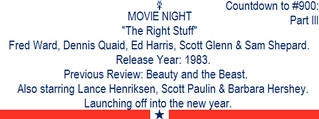
The Right Stuff.


Review #892: The Right Stuff.

Cast: 
Fred Ward (Gus Grissom), Dennis Quaid (Gordon Cooper), Ed Harris (John Glenn), Scott Glenn (Alan Shepard), Sam Shepard (Chuck Yeager), Lance Henriksen (Wally Schirra), Scott Paulin (Deke Slayton), Barbara Hershey (Glennis Yeager), Veronica Cartwright (Betty Grissom), Jane Dornacker (Nurse Murch), Harry Shearer and Jeff Goldblum (NASA recruiters), Kim Stanley (Pancho Barnes), Pamela Reed (Trudy Cooper), Charles Frank (Scott Carpenter), Donald Moffat (Lyndon B. Johnson), Levon Helm (Jack Ridley and Narrator), and Mary Jo Deschanel (Annie Glenn) Directed by Philip Kaufman.

Review: 
Watching epic movies (especially historical ones) can be interesting, provided that that the pacing and the subject matter make for good entertainment, with this being adapted from the non-fiction book of the same name by Tom Wolfe, which covered both the story of the Project Mercury astronauts (also known as the Mercury Seven) along with the pilots dealing with high-speed aircraft such as Chuck Yeager, ranging from his breaking of the sound barrier in 1947 to the launch of Mercury-Atlas 9 in 1963. Even with a 192 minute (over three hour) run time, obviously some liberties had to be taken in order to tell a story like this, and the end result is certainly satisfying enough, with spectacle and cast to boot. Even after Project Mercury is introduced by the first hour, it doesn't merely become about the crew, as it also continues to give time to Yeager, while also not being just a technical story. The two stories run parallel with each other very smoothly, while showing some wonderful effects and costumes. By the time Yeager's story ends, there is a sense of triumph that carries on to the end of the other narrative that make for exquisite viewing and an ambitious movie.

Ward does a fine job, along with Quaid, who make for entertaining scenes together. Harris (playing the recently departed John Glenn) stands out amongst the crew, likely due to his charm but also the determination he manages to show in someone as interesting as John Glenn was. Glenn (playing Alan Shepard) is pretty entertaining, having some quips along with some sort of charm. Shepard (playing Chuck Yeager) plays the role with a straight laced but ultimately interesting way.  The rest of the cast is also pretty good, with Moffat being quite entertaining as LBJ. As said earlier, the film takes liberties with certain events (such as the Mercury-Redstone 4's hatch cover blowing, with some implication toward Grissom being the cause and Jack Ridley being shown talking to Yeager after the former had died in 1957), but it does not detract too much from the story's flow. It never feels too long, nor out of its element in regards to showing these astronauts and their lives. One of the best scenes is them discussing with the scientists over installing a window, in part because you see how they see themselves more than just test subjects. On the whole, this is a movie that inspires curiosity along with excitement over an age long gone but not forgotten, with enough depth and skill to make for a tremendously entertaining experience.

On that note, I wish all of you readers at home a Happy New Year as we approach 2017, and in effect Season 7 of Movie Night. Season 6 had 116 reviews (with only one review in January to begin the season), as compared to the 90 in the previous season (2014). With any luck, Movie Night will keep trying to push the limit of the standard I hold myself when writing these reviews, along with trying to cover a diverse amount of movies, the good and the bad.

Thank you for reading, and I will see you in the new year. 10, 9, 8...

Overall, I give it 9 out of 10 stars.

June 7, 2014

Movie Night: Alien 3.


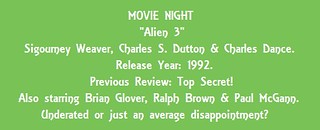
Review #586: Alien 3.

Cast
Sigourney Weaver (Ellen Ripley), Charles S. Dutton (Dillon), Charles Dance (Jonathan Clemens), Brian Glover (Harold Andrews), Ralph Brown (Aaron), Paul McGann (Golic), Danny Webb (Morse), Lance Henriksen (Bishop II), and Tom Woodruff, Jr. (The Alien) Directed by David Fincher.

Review
"No one hated it more than me; to this day, no one hates it more than me."
That quote came from the director himself, David Fincher, director of Alien 3, which is probably the unluckiest installment of the franchise. Where did all the trouble begin? Aliens was a massive success, and naturally the studio wanted a sequel, two in fact, but with Hicks the main focus instead of Ripley. The idea then fizzled out as an array of writers tried to deliver a satisfactory (to the studio) script, to the point where after all the scripts were rejected, the producers had to write the screenplay themselves, meshing parts of some of the other writers scripts (most notably the prison planet idea), and having to complete the script while filming started. Also there was interference by studio executives that meddled with the film, which made Fincher angry to the point where he has actually disowned the film.

So yeah, after all that trouble, how is the film itself? It's a sad mess of a movie, that's for sure. The first problem of the movie? How did the egg get onto the escape ship when there was no sign of any aliens on board? It's a plot hole that is quite literally made in the first minutes. Oh, and the characters you cared about in the last film? All dead. Yes, they are shamelessly killed off, without any sense of care, but on the plus side it sets the tone for an extremely depressing movie. The movie tries to set its own tone, trying to be its own. And it just doesn't help the movie much. The big problem is that all of the characters are disposable, Dutton is the only interesting new character, maybe because he lasts the longest, or because Paul McGann (insert your 8th Doctor reference here) isn't in it enough. It's not that we want the characters to die, we're just waiting for them to, which they do. It's not that I don't like the film because it's not like Aliens, I don't like it because it's just a slog of a movie to get through. Now granted it is hard to make a sequel to a franchise that has had two great movies already, but Alien 3 just doesn't cut it. It tries and fails at being something new. The deaths in the movie are not awful, but they certainly are predictable, and the four legged alien looks more silly then threatening, it's the movements that kill it. The shots with the motion camera as the alien chases the crew is ridiculous in its concept, only making you wonder how this franchise fell so far. Weaver isn't bad in this film, but not even she can save this train wreck. The movie at least knows when to end, and boy does it end spectacularly. There is an Assembly Cut for this movie that has more footage, but more doesn't necessarily mean better. Just stick to the first two, and watch this one if you want to be depressed.

Overall, I give it 6 out of 10 stars.

April 29, 2014

Movie Night: Aliens.


Review #574: Aliens.

Cast
Sigourney Weaver (Ellen Ripley), Michael Biehn (Corporal Dwayne Hicks), Jenette Goldstein (Private Jenette Vasquez), Carrie Henn (Rebecca "Newt" Jorden), Lance Henriksen (Bishop), Bill Paxton (Private William Hudson), Paul Reiser (Carter Burke), William Hope (Lieutenant William Gorman), Al Matthews (Sergeant Al Apone), and Mark Rolston (Private Mark Drake) Directed by James Cameron (#001 - Terminator 2: Judgement Day, #063 - The Terminator, #388 - Avatar)

Review
Back when I first reviewed the first film (#530 - Alien), I realized that if I ever managed to review the sequel, I had to answer the question that connects the first two films: Which one is better? Alien is a tense horror thriller that masterfully hides the alien for as long as it could to keep tension high. Aliens decides to use an alternate strategy. Aliens is an action-packed horror movie that still pulls a punch...and then some. We all know that trying to hide the aliens (A welcome change is to have multiple aliens) again is silly, so outright showing them all throughout is what Cameron does, more terror but also more awesomeness. Weaver is the big star and also the best character in the whole movie, right next to Bishop and Vasquez (You try to argue against an android who saves a character from dying while ripped in half; Vasquez is just fun to watch interact with the overconfident crew), the whole cast is great to watch interact with each other, the mood of the movie shifts from bravado to outright fear as the movie goes on, and everything works perfectly, especially the effects, which are still great. But here's the question: Is it better than the first movie?It all depends on what exactly you want, horror or action horror, but Aliens is the winner by a xenomorph egg. But we all can at least agree that the last two aren't up to par. Hopefully I'll get to the third movie sooner rather then forty reviews later.

Overall, I give it 10 out of 10 stars.