Showing posts with label Lucien Littlefield. Show all posts

November 2, 2022

The Cat and the Canary (1927)

Review #1914: The Cat and the Canary.

Cast: 
Laura La Plante (Annabelle West), Creighton Hale (Paul Jones), Forrest Stanley (Charles Wilder), Tully Marshall (Roger Crosby), Gertrude Astor (Cecily), Flora Finch (Susan), Arthur Edmund Carewe (Harry), Martha Mattox (Mammy Pleasant, housekeeper), George Siegmann (the Guard), and Lucien Littlefield (Dr. Ira Lazar) Directed by Paul Leni (#863 - Waxworks and #999 - The Man Who Laughs)

Review: 
When it comes to the haunted house movie, you can't go wrong with The Cat and the Canary, even if it wasn't the first to really come out. There were quite a few films with a killer going around a house, such as Cecil B. Demille & Oscar Apfel's The Ghost Breaker (1914), its 1922 remake by Alfred E. Green, D. W. Griffith's One Exciting Night (1922), along with Roland West's The Monster (1925) and The Bat (1926), for example. It would continue in further years, with West remaking his film in 1930 as The Bat Whispers, and James Whale directed The Old Dark House (1932). But some films last longer in the public consciousness than others, as is the case with a film like this. The movie was adapted from the 1922 play of the same name that had been written by John Willard to noted success on Broadway. The screenplay was written by Alfred A. Cohn and Walter Anthony, while the story was done by Alfred A. Cohn and Robert F. Hill. This was the first of five adaptations: Universal did both an English and Spanish version in 1930 (The Cat Creeps and La Voluntad del muerto, respectively), which are both lost. A 1939 film was done with more comedy involving Bob Hope and Paulette Goddard, while the next (and last) adaptation was done in 1979 for British audiences. It was the first of four American films directed by German director Paul Leni, the German Expressionist director that went from avant-garde painting to set designer to work in film by the 1910s. He moved to America at the invitation of Carl Laemmle at Universal Studios, as part of a wave of people from Europe coming to America for films (like Fritz Lang, for example). The Last Warning (1928), his final film, was presented as a companion film to The Cat and the Canary, as it also stars La Plante (it was released in both part-sound and silent, but the latter survives), albeit more as a mystery than comedy-horror. Leni would not live long to direct many films in America, dying of a sepsis from a tooth infection in 1929 at the age of 44.

So yes, we have a story about a creepy house filled with folks hearing about a will from a man 20 years dead. The only thing standing in the way of riches for one is to just not be declared insane but sliding panels and a fiend called "The Cat" threaten the whole affair. So yes, the suspense is balanced with comic relief, because this was the time for that kind of movie where horror can't be given to you full throttle, and the final twist is about what you might expect. However, it is the presentation that matters most, and that is where Leni shines. He utilized all of the tricks one would hope for in terms of establishing quality atmosphere, whether that involves shadows, superimpositions, gliding camera shots, or its lively title cards. The scene with a person walking in the hallway with a candle in hard while curtains blow is certainly a highlight when it comes to striking effect, alongside the opening sequence when it comes to saying "a man is trapped like a canary". So yes, the movie is a causal ride of spooky terror that fits far better than a movie without as much subtlety, because, well, things in 1927 can still play well in 2022. La Plante was a key presence for a number of Universal Pictures in the pre-sound era, and she does pretty well for not having too much to really do besides having things happen to them rather than with them. So yes, it's not too hard to be on her side when it comes the towering threat of spooked either by weirdo eccentrics or visitors. The other castmates are mostly there for relief without pandering to bad jokes, which works in favor for Hale in goofy charm that compliments La Plante pretty well or with the familiar face in Marshall. The others bumble in all the right ways without leaving an obvious clue to what could happen next. Yes, you have a good idea where things could go in its 82-minute runtime by about the halfway point, but it still is weird and engaging enough regardless of that fact. As a whole, it is a solidly dignified bit of horror worth a look for its era, being unsettling while having a solid atmosphere that makes everything work out just right.

Overall, I give it 8 out of 10 stars.

Well, we have had a quality month of horror. But you know the turn to November means it ain't over yet. As with the case with 2019, 2020, and 2021...it is time for Halloween: The Week After 4.0. That is correct, a number of horror reviews from November 1 to November 7, basically comprised of movies that deserved to be covered in October but are now present in November for all to enjoy. This time, I will be generous and tell you what is coming next because I like you very much.

Next film up is Exorcist II: The Heretic. Shit.

July 10, 2021

Why Change Your Wife?

Review #1697: Why Change Your Wife?

Cast: 
Gloria Swanson (Beth Gordon), Thomas Meighan (Robert Gordon), Bebe Daniels (Sally Clark), Theodore Kosloff (Radinioff), Sylvia Ashton (Aunt Kate), Clarence Geldart (The Doctor), Mayme Kelso (Harriette), Lucien Littlefield (Butler), and Edna Mae Cooper (Maid) Directed by Cecil B. DeMille (#1245 - The Squaw Man (1914) and #1371 - Unconquered)

Review: 
“I love to take some vitally interesting theme and work it out according to life. That is what I am doing with Why Change Your Wife? These themes I am toiling on do a damn lot of good.”

Cecil B. DeMille made seventy feature films over the course of a four decade career, but one would probably be surprised to know that 52 of them were silent films. Sure, the sound features would play a key part in defining him as a crowd-pleasing director with scale and showmanship, but one can't get there without doing a few other kind of films in between for the Massachusetts native. This was the fourth film featuring Swanson directed by DeMille, which started with Don't Change Your Husband (1919) and ended with The Affairs of Anatol (1921). It happens to be part of a string of films that DeMille made involving marriage, although reading a description of the former film (prosaic husband, romantic wife) might make this seem a bit clearer. Of course, this film had a story done by William C. deMille (Cecil's older brother, who unlike his brother did not alter his name) while Sada Cowan and Olga Printzlau wrote the scenario. You may or may not be surprised that this is generally labeled as both a comedy and a drama. Consider the premise: a couple gets tired of each other and divorce each other before eventually falling in love again even with one of them being re-married. Of course, there are a few things that make this a bit interesting, starting with the character played by Swanson, described as someone whose "virtues are her only vices". By the sixth minute, a intertitle is shown that has her character gripe about her husband spending money on wine when one could be thinking about the starving millions in Europe. Her attempts at being a real goody goody extend to music choices, having a dog/not having a dog in the house, clothing, even sleeping next to each other in little separate halved beds. Amusingly, she is inspired to dress better not because of her divorced husband or because of a friend advising her to (we don't see anybody who looks like a friend to either of these folks, so one could just assume these people either don't have friends or they don't get involved in said stuff), but instead because she hears gossipers mocking her looking like her aunt. A myriad of weird events lead to a conclusion that I'm sure you already know, since this actually seems more like a DeMille instructional manual, but I suppose each lead learns a lesson about being a better spouse...well, I guess Swanson learns more than Meighan, but whatever.

So here we are with Swanson, Meighan, and Daniels. Really when you think about it, they seem to have an energy that could be seen as prescient to the screwball comedy that would come across a few years later, or even movies like Mr. & Mrs. Smith (1941, although that divorce movie involved a love triangle with two guys). Swanson gets to play a bit of a double act in terms of balancing "goodliness" with daring charm, which just means that one gets a few chuckles, such as when she is sitting at the pool turning suitors away or when she does the old dangerous substance-in-the-eye wash trick. Meighan pulls enough in the mild bewildered act of dopey straight man to make it work without too many hitches, making sure that one does not grow annoyed at the potential annoyed amusement at someone striking out twice in marriage. This was the third feature role for Daniels, who had moved on from doing short subjects to doing contract work for DeMille. She plays the contrast to Swanson fairly well, peppy in her own way with flaws just as the other two that are interesting when paired with Meighan for (somewhat obvious) moments; each share a scene where one is trying to shave but is foiled by interruptions (because hey, that one bathroom is big enough for the two of us), and it is a bit amusing on the second run). Basically, you get to see how romance can go when piety and superficiality loom over it; either one is a "think of the children!" type or a loose woman...with this film, the latter seems more interesting, but I'm probably more familiar with pious hypocrites than either stereotype here - this is 1920, so consider that along with it.

DeMille made plenty of movies considered to be crowd-pleasers, and this fits that description to a T, although one's mileage may vary depending on how much curiosity they have on the subject of folks learning a lesson about marriage. Honestly, it is the intertitles that might generate more chuckles, if only because of how strange their details get with describing things (one ends with "optically a pippin", really). that either range from being one sentence too long or other various words. I especially admire this one card in minute eight, talking about the "husband's eternal problem" that uses the "-" three times while going on about what he's going to do and the "bad luck of a married man" he has in picking the shop; consider minute 39 with the idea of a mysterious force that gets people together who think of one another that they say "fools call it coincidence"...yeah, I think the writer is messing with the viewer. I especially like the times during the dialogue where certain words are underlined, but the nail on the coffin is near the end when the main two are on a train, where one intertitle talks about if this was fiction, there would be a train wreck or a terrible car accident (!), but in real life ("if it isn't a woman", right), something like a banana peel will change a guy's destiny. Either one is thinking the writers have decided to act out some gripes with themselves or others (some sort of weird therapy or perhaps a predecessor to further personal movies years later), or they are in the mindset of details, details, details (of course, maybe slipping on a banana peel didn't seem quite familiar in 1920). In the end, it is a 90 minute tale that will either entertain your curiosity for what DeMille and company accomplished in its blend of amusement and romance, or one simply will let it pass them by. For me, it is an okay movie, a strangely entertaining movie for some of the right reasons that makes for a very curious affair, one that passes a bit better in the second half while the intertitles manage to befuddle the audience. At any rate, this is in the public domain, so one can see for themselves if they want to encounter this film and its director for a century-old time.

Well, this is technically part of a new project. In coverage of Movie Night from 1921 to 1949, there exists eighteen years in which there are not at least ten reviews for said year (i.e. with this review, 1920 now has ten reviews one can look at). As such, I will commit a small part of my time to picking films from that era to increase the year output over the next few months; for example, 1929 has just five films that were reviewed by me. This "Count to Ten Project" will run as long as I see fit (incidentally, the 1910s will have their own certain project at some point this year).

On the board for the Count to Ten Project:
1921: 5, 1922-23: 8 each, 1924: 9, 1926: 7, 1929: 5
1930: 6, 1931: 9, 1934: 4, 1935: 5, 1936-37: 6, 1938: 5
1940-41: 8 each, 1944: 7, 1948-49: 8 each

Overall, I give it 7 out of 10 stars.

January 8, 2020

The Sheik (1921).


Review #1318: The Sheik.

Cast: 
Rudolph Valentino (Sheik Ahmed Ben Hassan), Agnes Ayres (Lady Diana Mayo), Ruth Miller (Zilah), George Waggner (Yousaef), Frank Butler (Sir Aubrey Mayo), Charles Brinley (Mustapha Ali), Lucien Littlefield (Gaston), Adolphe Menjou (Raoul de Saint Hubert), and Walter Long (Omair) Directed by George Melford.

Review: 
It is interesting to see where a career can go when it comes to a person's legacy. What does one think when they see the name of Rudolph Valentino? They see a matinee idol, a person who became a romantic symbol for Hollywood whose star rose like a comet and vanished just as quickly, with a leading career that lasted less than a decade. He had gotten his start in films as an extra after emigrating to the United States from Italy in 1913, with his debut allegedly being in a lost film named My Official Wife (1914). His major break was the film The Four Horsemen of the Apocalypse (1921), which occurred after June Mathis had discovered him during one of his extra appearances. In any case, the film proved to be a major success, making him into a star overnight. He appeared in four further films in that same year, but this is the one that would help seal his reputation and image as a "Latin lover" for the rest of his brief career. This was an adaptation of the 1919 romance novel of the same name by Edith Maude Hull and was adapted for the screen by Monte M. Katterjohn. It should be noted that James Kirkwood, Sr was the original choice for the title role before he declined due to salary concerns. Valentino had jumped studios to do this film (done at Paramount), feeling less than satisfied with Metro Pictures (who you may recognize from their 1924 merger with Goldwyn Pictures and Louis B. Mayer Pictures to make Metro-Goldwyn-Mayer).

In any case, one wonders how this desert romance holds up when looked at through the lens of a near century since its release. The immediate thought that went through my head before viewing it was "Stockholm syndrome" (involving someone developing a psychological alliance with captors during captivity). If one views it as a period piece, perhaps one can find a bit of surreal enjoyment, particularly for a film that even uses one of its final title-cards to say that its title character is actually European (English/Spanish, actually, but whose counting?). Look, the film is a bit weird. However, it cannot be denied that there is still a bit of fiery staying power for this film, having a hypnotically passionate Valentino that rises above being billed second to Ayres (whose career also started with small roles in 1914) to make something that keeps the eyeballs focused on something that teeters on corniness while trying to fit into escapism. Ayres does fine, although one might think the romantic angle was more of a tease than anything (the novel was far more controversial with its duo involving rape and plenty of stereotypes, so imagine the studio trying to be careful with the censor boards). The others are okay, in the same way that they certainly look like they want to be there making gestures and seem useful to something that seems mildly ready to inspire passion for 80 minutes. The film is fairly diverting enough to overcome its rickety foundations, where one can look at its main stars without it seeming completely off-putting or ridiculous. There were two more films involving the Sheik, with The Son of the Sheik (1926) starring both Valentino (in a double role that proved to be his last before his death that same year) and Ayres. A comedic role reversal named She's a Sheik with Bebe Daniels was released the following year. This is one of those unlikely films that finds a place in movie history. One wonders how it would've endured if was made in any other time other than the early 1920s, such as if it was made seven years earlier or later, but there is something mystical about it attracts attention even after nearly a century. Valentino may have lived as an idol for only five years, but his mark still comes through today as someone to look at on the screen.

Overall, I give it 7 out of 10 stars.

August 22, 2016

Scared Stiff.


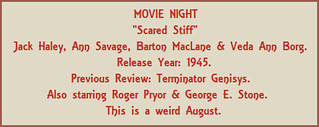
Review #835: Scared Stiff.

Cast
Jack Haley (Larry Elliot), Ann Savage (Sally Warren), Barton MacLane (George Markham), Veda Ann Borg (Flo Rosson), Roger Pryor (Richardson), George E. Stone (Mink), Robert Emmett Keane (Prof. Wisner), Lucien Littlefield (Charles Waldeck / Preston Waldeck), Paul Hurst (Sheriff), Arthur Aylesworth (Emerson Cooke), Eily Malyon (Mrs. Cooke), and Buddy Swan (Oliver Waldeck) Directed by Frank McDonald.

Review
Scared Stiff (also known as Treasure of Fear) is the kind of movie that falls into someone's lap if one is either bored enough or just stumbles into public domain territory, with this being a comedy/murder mystery. Haley (who appeared in just six more films after this) plays a bumbling chess reporter (of course he does) who is assumed to be a murderer due to a dead guy on the same bus being found with a chess piece near him (seriously), alongside the other weirdo passengers, including his girlfriend, a boy genius (who throws a smoke bomb into a room at one point), and his mentor professor. Hijinks (and I put that extremely loosely) ensue in a mystery lumpier than mashed potatoes. There is a subplot about retrieving chess pieces from an antique chess set from the 13th century, which seems better than the main character, actually. Do you like a bumbling character played for some sort of laugh? Well, you'll have to find a better movie. Haley isn't very interesting to watch, becoming tedious to watch after a while. There really isn't much energy to the cast, which just go through the motions of a sluggish script. There really is no chemistry between Haley and Savage. The killer is in the movie briefly, to the point where he has no defining characteristics. The length of the movie is 65 minutes, which is some ways is it's own relief. On the whole, there are countless other movies from this time period that are more interesting to watch than this, ultimately. It doesn't inspire many laughs, nor elicit any interest in the mystery, simply put. You know the people that remake movies and the ensuing reactions over it? Try remaking this and see what happens, which is a better idea than watching the movie.

Overall, I give it 4 out of 10 stars.