Showing posts with label Henry Fonda. Show all posts

July 12, 2024

How the West Was Won.

Review #2228: How the West Was Won.

Cast (i.e. who features most prominently in each segment)
"The Rivers" segment: James Stewart (Linus Rawlings), Carroll Baker (Eve Prescott), Debbie Reynolds (Lilith Prescott), Karl Malden (Zebulon Prescott), Agnes Moorehead (Rebecca Prescott), Walter Brennan (Col. Jeb Hawkins), and Brigid Bazlen (Dora Hawkins) Directed by Henry Hathaway (#1314 - True Grit and #1687 - O. Henry's Full House)
"The Plains" segment: Debbie Reynolds (Lilith Prescott), Gregory Peck (Cleve Van Valen), Robert Preston (Roger Morgan), Thelma Ritter (Agatha Clegg), and David Brian (Lilith's attorney) Directed by Henry Hathaway.
"The Civil War" segment: George Peppard (Zeb Rawlings), Andy Devine (Corporal Peterson), Harry Morgan (Gen. Ulysses S. Grant), John Wayne (Gen. William Tecumseh Sherman), Russ Tamblyn (Confederate deserter), Carroll Baker (Eve Prescott Rawlings), and Raymond Massey (President Abraham Lincoln) Directed by John Ford (#398 - The Last Hurrah, #1324 - 3 Bad Men, #1349 - Stagecoach, #1372 - Fort Apache, #1392 - The Searchers, #1409 - The Man Who Shot Liberty Valance, #1778 - 3 Godfathers, #1827 - Tobacco Road)
"The Railroad" segment: Henry Fonda (Jethro Stuart), George Peppard (Zeb Rawlings), and Richard Widmark (Mike King) Directed by George Marshall (#650 - The Ghost Breakers)
"The Outlaws" segment: George Peppard (Zeb Rawlings), Lee J. Cobb (Marshal Lou Ramsey), Eli Wallach (Charlie Gant), Carolyn Jones (Julie), Debbie Reynolds (Lilith Prescott van Valen), and Mickey Shaughnessy (Deputy Stover) Directed by Henry Hathaway

With Spencer Tracy (Narrator).

Review: 
Yes, there was a union between Metro-Goldwyn-Mayer and Cinerama. MGM had plenty of success with making epics that attracted folks to not just go with television such as, say, Ben-Hur (1959), so it makes sense to say that there was two films distributed by MGM involving another big-related process in film. The Wonderful World of the Brothers Grimm was released in the three-strip Cinerama process in August of 1962 before November saw the release of How the West Was Won, which apparently took inspiration from a series of articles by Life magazine (take one guess what the title of those articles was) that was first published in 1959. As one might remember, Cinerama (as invented by Fred Waller) was a process involving widescreen with a considerably distinct presence: three projectors projecting images onto a curved screen (the panoramic image on a screen curved 146 degrees around the front of an audience. This Is Cinerama (1954) was the showcase that rocked folks as a grand travelogue; as one might notice, trying to shoot actors with this setup was tough when it comes to sightlines and requiring plenty of detail dressing of clothing for sets. Hathaway was quoted famously as calling it "Goddamn Cinerama" (along with calling it "nothing but a big window display") when noting the fact that the closest as one could get with the process was a waist shot; because of the wide view, one apparently couldn't watch the actors without somehow being in the shot. Bottom line, one would see various films done in varying levels of camera lenses such as Ultra Panavision 70 to Super Panavision 70, as Cinerama became single camera for later films such as It's a Mad, Mad, Mad, Mad World (1963). At any rate, here we have a big Western covering various moments of the Old West for MGM, with directors chosen specifically because they were "old pros" (as opposed to "no young geniuses", as quoted by producer Bernard Smith); Ford and Marshall had directed films since the late 1910s while Hathaway started in 1932 before each director eventually ended their careers by the turn of the 1960s into 1970. Going by the word of Hathaway, production was semi-rough, owing to both the Cinerama filming process and (in his words), "an idiot for a producer" to the point where production almost ended before the filming of the fifth and final segment; he also claimed to write the second segment of the film, as he was originally brought in to help with scripting problems, although the final print listed James R. Webb as the only screenwriter. The movie was a roaring success and has a pretty good reputation for itself among epics, particularly since one can watch it on home video (since the 21st century) with pretty good restoration (as one must do when it comes to making screens look whole).

There are plenty of peaks and valleys with this film, most of which come from the fact that the quality of enjoyment comes and goes depending on which segment one is on in the 164-minute epic. The opening segment has a near sixty-year-old Stewart playing a guy meant to be 28, while Reynolds and Peppard are the only actors in the most segments (three) to go with borrowing footage from The Alamo [1960] and needing four cinematographers. You get plenty to see in this endurance round of anthology action: river pirates, rapids, wagon attacks, a John Wayne cameo, stampedes, and a railroad attack all in one. It is pretty much Hathaway's film to hold court involving drive and desire in the frontier, as the Civil War and railroad segments (as done by Ford and Marshall) don't exactly rise too far above stagy scenario-making (apparently, Hathaway did re-shots for the railroad segment). The first two segments are probably the strongest in terms of general construction, even if one is always seeing the strain of trying to make a worthwhile epic that has to rely on plenty of pictorial views and a bit of bombastic acting (as one might see coming when having to deal with weird cameras) to go with the motions. The third segment is mostly set around the aftermath of the Battle of Shiloh that has brief moments in the start and finish involving the Rawlings family farm. Most of it though...is a couple of folks listening to a conversation of two U.S. generals (William Tecumseh Sherman and Ulysses S. Grant). Apparently, Spencer Tracy was once tapped to play Grant, but this eventually washed away to just have him provide the narration from time to time. As tempting as it is to wonder how cool it would've been to see Tracy and Wayne on the same screen...it probably wouldn't have made it any less stagey, because really it isn't as involving as it could've been. Regardless of the detail taken for costuming (again, one had to be careful and not skimp in front of those Cinerama cameras), it just comes up feeling hollow for actual interest because you know you've seen (and heard) Wayne and Morgan in better Westerns. The fourth segment and fifth are pretty mild on each count, but at least the latter segment has the railroad spectacle to let the film coast on a good note despite the fact that I can barely remember Peppard as a lead presence here. It is a hard thing to do for a film that has him (by his idea) do a Stewart impersonation in the middle of things because hey, do you remember that Stewart played the character's dad for one segment? The highlights are the sequences involving action because of the staging that allows for things to just move on their own, as opposed to acting that is mostly just fine (it is hard to really pick a favorite), but you have a cadre of character actors to go with name guys doing a fraction of the work that straddles just above being accused of phoning it in and settling right into "stagey but comfortable". As a whole, it is a grand old epic that is good enough in the categories that matter in spectacle to make a serviceable recommendation for those interested in what the film tries to show within a distinct camera setup and approach.

Overall, I give it 8 out of 10 stars.

May 23, 2024

The Ox-Bow Incident.

Review #2214: The Ox-Bow Incident.

Cast: 
Henry Fonda (Gil Carter), Dana Andrews (Donald Martin), Harry Morgan (Art Croft), Frank Conroy (Major Tetley), Harry Davenport (Mr. Arthur Davies), Anthony Quinn (Juan Martínez / Francisco Morez, The Mexican), Francis Ford (Alva Hardwicke, The Old Man), William Eythe (Gerald Tetley), Mary Beth Hughes (Rose Mapen / Rose Swanson), and Jane Darwell ("Ma" Jenny Grier) Directed by William A. Wellman (#349 - Wings, #494 - The Public Enemy, #866 - Nothing Sacred, #973 - A Star is Born, #1387 - Track of the Cat)

Review: 
Once upon a time, you could come across a whole variety of Westerns in the same year. The Ox-Bow Incident was a special kind of case that seems apt to come from a craftsman director in William A. Wellman, because he had wanted to do an adaptation of Walter Van Tilburg Clark's novel of the same name, which had been published in 1940 (you might recognize Clark from the fact that Wellman would direct a second Clark adaptation years later with Track of the Cat). The novel was a distinct success with readers in ways different from one could read in usual dime store stuff or films that had covered the dangers of a mob in say, Fritz Lang's Fury (1936), for example. At any rate, Wellman's persistence in wanting to make a film based on the book paid off eventually, doing so with 20th Century Fox (on the condition of doing two films in return) that was shot mostly in studio backlots and sound stages. The film was written and produced by Lamar Trotti, who had added the latter category to his line of work beginning with Thunder Birds (1942), which incidentally had been directed by Wellman. The fact that the film went by the Production Code is interesting, because, well, it depicts a lynching in 1885. It should be noted that Fonda himself had seen a riot that soon turned into a lynching when growing up in Nebraska in 1919, and it probably isn't too surprising that he called this one of the few movies he liked doing at 20th Century Fox and in general. Released in the midst of wartime, the movie was not a hit with audiences on release (with Zanuck noting that even a Laurel and Hardy movie outperformed it), but its legacy has certainly grown in the eight decades since its release. 

What we have is a lean and mean drama of the most efficient kind. It is quite thorough in showing the perils of mob rule and what would happen in a society where the "very conscience of humanity" in law is ignored in a sweeping generalization. The uncompromising truth can hurt when it stares you right in the face because of how timeless that realization is: if you get enough people together to be complicit in an action (whether that involves actions of vigilantism or war), you can do plenty of damage and maybe be able to get away with it, at least if one doesn't mind possibly losing a bit of one's soul in the process. The system of values that we want to hold dear only work if we are willing to accept that for every action we think is "right" to do, we have to accept that there are just as many that we have to confront that are "wrong" that can't be ignored. Among the genre of the Western, it belongs to what we could call a "revisionist" Western (of course that label is more for stuff that happened after the end of the Production Code, but still) that looks upon the Old West and sees just as many cultivators of impulse as there are at the moment. There are no real heroes to be found here, but it doesn't mean the performances are lacking anyway, as evidenced by seeing Fonda play observer in the web of paranoia and impulse that is handled with simple grace that Fonda knows how to do so naturally. Seeing a town lose their soul in the shambling display of mostly unified display of "might makes right" is fit for Fonda and Morgan to waltz into. Andrews leads the group (Quinn and Ford) suffering from the eyes of impulsive fools with a worthy display of anguish worthy of a martyr for one that really was just trying to be a man in a frontier that varies in its view of them. Conroy and Eythe handle the dynamic that arises in defining "what a man looks like" and finding that action really does speak louder than words in the worst possible ways that makes for such a harrowing lesson in the nature of shame and not allowing older authority to take all heed over oneself (regardless of if it is say, a former Confederate). The film builds that gut-churning tension of what may and may not happen when it comes to a town looking for what it thinks is justice to hold to worthwhile realization in sheer audacity. Nothing is easy to find in answers or in letters, but the shame of living with what one sees is probably apt for a lesson to stew on, unless one has a reason to get out of town and start anew. As a whole, it is a pretty good Western that is a cut above a good chunk of the Westerns in its era fitting for a craftsman like Wellman in handling a tale that can still be played for eras of the present about mob rule, for better or worse.

Overall, I give it 9 out of 10 stars.

May 23, 2023

The Farmer Takes a Wife.

Review #2012: The Farmer Takes a Wife.

Cast: 
Janet Gaynor (Molly Larkins), Henry Fonda (Dan Harrow), Charles Bickford (Jotham Klore), Slim Summerville (Fortune Friendly), Andy Devine (Elmer Otway), Roger Imhof (Samson 'Sam' Weaver), Jane Withers (Della), Margaret Hamilton (Lucy Gurget), Sig Ruman (Blacksmith), and John Qualen (Sol Tinker) Directed by Victor Fleming (#159 - The Wizard of Oz and #569 - Gone with the Wind)

Review: 
For all of the films I have seen, I wonder if I have perhaps not given a proper spotlight to certain names in the classic era of Hollywood, or at the very least the 1930s. Victor Fleming wasn't just the director of 1939's The Wizard of Oz and Gone with the Wind, you know. Fleming had got his start as a cameraman in the 1910s, but it is probably most interesting that he also once served an assignment to teach at Columbia University, specifically teaching Military Cinematography, due to the U.S. Army needing it for the efforts in World War I. Some of the members in that program that Fleming helped teach involved future names such as Josef von Sternberg, Ernest B. Schoedsack, and Lewis Milestone. Fleming made his feature directing debut with When the Clouds Roll By (1919). Overall, he made a variety of adventure and comedy films, with his association with MGM in the 1930s being particularly memorable, such as with Captains Courageous (1937); Fleming died at the age of 59 in 1949, having directed over three dozen films. The film is based on the 1934 play of the same name, which had been done by Marc Connelly and Frank B. Elser, which in of itself was based on the 1929 novel Rome Haul that had been written by Walter D. Edmonds; Henry Fonda and June Walker served as the leads for the production, which ran for a time on Broadway. Connelly and Elser wrote the screenplay alongside Edwin J. Burke. In case one didn't know, the Erie Canal was a really big deal when it came to navigating waterways, which started upon its completion in 1825. Of course, in real life, the railroad only overcome the competition with the canal in the early 20th century. The film was remade as a musical comedy in 1953 by 20th Century Fox with Betty Grable and Dale Robertson as the leads.

Admittedly, it is more of a curiosity than a real treat, but it is serviceable at 91 minutes for those who like mildly charming romances, one that is filled with plenty of recognizable faces for those who are familiar with vintage films (whether for character actors or in general). It doesn't pull anything particularly memorable when it comes to showing the future that is yet to come with farming, but it moseys about with general decency to make things matter enough. Gaynor was in the midst of transition, one who was still a name presence in the mid-1930s but was seeing the times change when it came to audience preferences (two months before the release of the film, Fox Film Corporation, which she had been with since the mid-1920s, became 20th Century Fox due to a merger), which can loosely be defined as "wholesome". Fonda had been active in the stage since 1925 that had started in his native Nebraska, which eventually took him to Broadway. He was picked for the role after Fox tried to pursue Gary Cooper and Joel McCrea and failed. It is evident, even in his debut film, where he would become a future star, in part because of his sincerity, which manages to come through in a way that somehow outmatches Gaynor and her attempts at playful vulnerability. Their coupling is a gradual one, with his balanced sense of sentimentality for the soil going with her stubborn spirit for the canal that is basically a reckoning for each to make up their minds of who they are. Inevitable as it may seem, at least the resolution is one you could buy between the two. Bickford was mauled by a lion and nearly killed while filming another movie that came out in 1935, which led to him being more of a character presence the rest of his career. Evidently, Spencer Tracy (a regular presence at Fox since 1930 that was noted more by the critics than the audiences for his films) was originally cast in the role Bickford inherited, since Tracy was taken out, reinstated, and then released from the role when he got out of his contract for Fox (he would sign with MGM in the spring of 1935 and the rest is history). At any rate, Bickford makes a solid heavy, belligerent and willing to play along with what is needed. The others make for solid relief in parts, whether that involves the dependable Devine or Hamilton (who had appeared in the play with Fonda). They make the canal life at the very least one not of bland caricature, since the film is at least lightly funny without panhandling your attention. As a whole, the film moves through the motions of friendly 19th century romance with the pacing of soil being planted gently onto the ground, one handled with general efficiency from director and crew to make a tolerable experience, with the talent of Fonda and the future that would come from him being apparent at that moment in time.

Overall, I give it 7 out of 10 stars.

May 29, 2020

Once Upon a Time in the West.

Review #1429: Once Upon a Time in the West.

Cast: 
Henry Fonda (Frank), Charles Bronson ("Harmonica"), Claudia Cardinale (Jill McBain), Jason Robards (Manuel "Cheyenne" Gutiérrez), Gabriele Ferzetti (Mr. Morton), Paolo Stoppa (Sam, the Coachman), Marco Zuanelli (Wobbles), Keenan Wynn (the Sheriff of Flagstone), Frank Wolff (Brett McBain), Lionel Stander (The Barman), Woody Strode (Stony, first gunman), Jack Elam (Snaky, second gunman), and Al Mulock (Knuckles, third gunman) Directed by Sergio Leone (#015 - The Good, the Bad and the Ugly, #017 - A Fistful of Dollars, and #019 - For a Few Dollars More)

Review: 
"I had never thought of making a western even as I was making it. I think that my films are westerns only in their exterior aspects. Within them are some of my truths, which happily, I see, belong to lots of parts of the world. Not just America. My discussion is one that has gone all the way from Fistful of Dollars through Once Upon a Time in America. But if you look closely at all these films, you find in them the same meanings, the same humor, the same point of view, and, also, the same pains."

Who better to make an epic Western of the last days of the gunfighter than a man well-known for making capable Westerns with their own kind of style and complexity in Sergio Leone? He was the son of a family of film (father Roberto Roberti was a silent actor and director while mother Bice Valerian was an actress), and he worked in filmmaking from an early age as an assistant to directors such as Vittorio de Sica (Bicycle Thieves) to William Wyler (Ben Hur) that were working in Italy, with his second unit work on the latter going un-credited. He also turned his hand at writing, collaborating with others for his first screenplay credit with Slave Women of Corinth (1958, one of numerous sword-and-sandal works). While working on The Last Days of Pompeii (1959), he was asked to help with direction after the director fell ill. Leone would go un-credited for this, but he would subsequently get his chance to direct with The Colossus of Rhodes (1961). It was a fair success, but his next film proved far more memorable with A Fistful of Dollars (1964), the first of a trilogy of Western films with Clint Eastwood as "The Man with No Name" known as the Dollars trilogy. The films were known for their distinctive visual and thematic style in contrast to the Westerns of the time abroad in the United States (with these three being designated as Spaghetti Westerns). Akira Kurosawa felt that it was a fine film, but that it was his film, since it had taken inspiration from his 1961 film Yojimbo. Regardless of this, Leone would be noted for his extreme close-up shots with long shots that made for a worthwhile career that was comprised of seven directed efforts from 1961 to 1984 before his death of a heart attack in 1989.

The film was an Italian-American production, with Leone being coaxed into making a Western by Paramount because they allowed him a fair budget and the one star he always wanted to direct: Henry Fonda, who was convinced to do the film by friend Eli Wallach (stating that he would have the time of his life). Shooting was mixed between Italy, Spain, and America (notably with Rome and Monument Valley), with considerable preparation made by Leone and his writers in constructing a story with ties to American Westerns of the past, such as The Iron Horse (1924) and The Searchers (1956). Leone co-wrote the screenplay with Sergio Donati, while the story was done by him, Dario Argento, and Bernardo Bertlucci (the latter two would become noted directors in their own right). The touches to other films work themselves out nicely where a lesser film would've seemed too slavish to the past with no ambition forward. The film runs at 166 minutes, although it was changed for American release by cutting twenty minutes (conversely, it was a flop here while a hit abroad). What a marvelous film this is. This is a grand Western to potentially end all Westerns for its era, one with its own vision about the Old West and a pondering nature and scope to back it up with class. Longtime collaborator and famed Italian composer and orchestrator Ennio Morricone is especially important to making this a beauty to listen to, with such distinct and devastating power that reaches for the soul like an opera. The interesting thing is that the music was actually done before shooting started, and Leone would play the music in the background for the actors on set. It takes time to set itself up with its core four of focus, but once it starts rolling down the hill with tension, it never seems to stop in making gritty poetry with somberness to make a revenge story with contemplation over the past and future of the Old West sweep through with the blaze of a railroad engine.

Fonda, generally known for appealing roles over the prevailing four decades, is exactly on point in conviction for such a ruthless lead role, with no ham or any other tricks needed; Leone liked Fonda's blue eyes to reflect his cold character (as opposed to Fonda utilizing contact lenses and a mustache), which would prove quite a shock upon his first appearance on screen with those striking eyes. It should make sense to see Bronson here in a Leone film, since he had rejected the chance to appear in the first film of the Dollars trilogy. Now, with Clint Eastwood rejecting this role for fear of typecasting, it fell to Bronson, who makes the best of it with a hardened stance that invites one in to curiosity that simmers without needing to say (or play the harmonica) much, which proves particularly true for the showdown in the end, a masterful climax to show Fonda and Bronson face each other with skill (after the latter helps the former escape betrayal from within, an interesting scene in of itself). Cardinale, a Italian Tunisian of numerous Italian, French and American productions, shows inner strength and passion that drives the film well, whether when dealing with moving the West forward or a brusque Fonda. Robards (a man of film, television and stage that could do historical roles as well as common ones) rounds the cast out with rough charm and a few zinging moments that make for a colorful rogue to the end. Ferzetti makes for a restrained but welcome presence that encircles the ranging conflicts of greed and lust. In the end, it all proves worth a viewing as a lasting achievement for the Western that utilizes a dynamic cast and music to go with somber tone and pacing for one grand adventure worth the time to view in all of its gritty glory.

Overall, I give it 10 out of 10 stars.

March 28, 2020

Fort Apache.


Review #1372: Fort Apache.

Cast: 
John Wayne (Capt. Kirby York), Henry Fonda (Lt. Col. Owen Thursday), Ward Bond (Sgt. Major Michael O'Rourke), Shirley Temple (Miss Philadelphia Thursday), John Agar (Lt. Michael Shannon "Mickey" O'Rourke), Dick Foran (Sgt. Quincannon), Pedro Armendariz (Sgt. Beaufort), Miguel Inclan (Cochise), Victor McLaglen (Sgt. Festus Mulcahy), Guy Kibbee (Capt. Wilkens), Anna Lee (Emily Collingwood), George O'Brien (Capt. Sam Collingwood), Jack Pennick (Sgt. Daniel Schattuck), Irene Rich (Mary O'Rourke), and Grant Withers (Silas Meacham) Directed by John Ford (#398 - The Last Hurrah and #1324 - 3 Bad Men, and #1349 - Stagecoach)

Review: 
"Anybody can direct a picture once they know the fundamentals. Directing is not a mystery, it's not an art. The main thing about directing is: photograph the people's eyes."

Legends can be an interesting thing to think about when relating to film, depending on who has the vision to make it come alive more so than if one just went to a museum or read a book. As such, it should prove no surprise that this was based on a prior work, in this case a 1947 short story "Massacre", written by James Warner Bellah in The Saturday Evening Post, which was adapted to film by Frank Nugent. It had utilized two historical battles involving Native Americans in their fight against the US Army in the 19th century with the Fetterman Fight and The Battle of Little Big Horn, particularly the leader of the latter battle, George Armstrong Custer, whose certainly has had a debatable reputation that has certainly had varied opinions over his leadership decisions in the battle that led to his death, with the efforts of his widow campaigning on his behalf helping to mold Custer into a legend for a great deal of the 20th century. This is a film that has its own view on Native American alongside a parallel of Custer in its film, which certainly does seem a bit different from the old-fashioned fare from Westerns of its time (compare this film to Unconquered, for example). It is the first film of what is referred to as director-producer Ford's "cavalry trilogy", with each of the films (the others being She Wore a Yellow Ribbon and Rio Grande) featuring Wayne as the main star along with adapting short stories from Bellah in each of the films. It should prove no surprise to see Wayne and Fonda in a Western, since they both stood out in their decades-long careers for their work in them, with the former making roughly one-to-three films a year for this decade; Fonda had slowed his versatile career due to serving in World War II, and he decided to return to the stage, not appearing again in a feature role for the next seven years. This happened to be the fifth-to-last role for Temple along with the first for Agar (an Army Air Corps man who served in World War II), with the two having married three years earlier. One particular person who found themselves a break was Ben Johnson, the champion rodeo cowboy-turned stuntman that found himself with an acting contract because of his help with stopping a runaway wagon from a potential deadly accident.

One will find themselves impressed with the way that Ford handles this capable tale of the nature of leadership and heroism with solid foundation to make fine entertainment. This is a film that Fonda and Wayne share with equal strength of solid acting that match like bighorned sheep on the grass. On one side is the tactically stubborn but capable humane performance from Fonda and on the other is the practical reliability of Wayne in the face of anyone. Bond makes for a fine presence, engaging with rugged rough charm that made him a character actor worth having throughout the years. Temple and Agar are okay, with fair chemistry. Foran and the others make for capable camaraderie through the moments they have on screen in making this regiment as interesting as it needs to be when setting up its conflict - whether within or with its possible enemy. The battles certainly are well-executed, even when one knows the inevitability provided by its inspiration, particularly with its lasting point about legends and glory in perspective of the one who writes it, whether that seems right or not. One is left in awe of the towering Monument Valley when seeing it in the film, particularly with the use of infrared film stock, which was utilized in outdoor sequences to enhance the scenery. There were a few quibbles with the script with stuff one might not expect. Concerns involved a manure pile scene, a shot of dead troopers, keeping contact with the Humane Society when dealing with animals, and an order to not show a toilet on screen (I kid you not). In any case, this is a relatively interesting film, one with a solid cast and ambitions beyond the usual Western of conflict that make it a worthwhile Ford film for its era.

Overall, I give it 9 out of 10 stars.

April 1, 2019

Meteor.


Review #1204: Meteor.

Cast: 
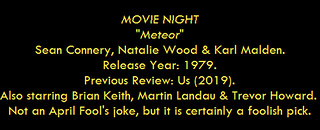
Sean Connery (Dr. Paul Bradley), Natalie Wood (Tatiana Donskaya), Karl Malden (Harry Sherwood), Brian Keith (Dr. Alexei Dubov), Martin Landau (General Adlon), Trevor Howard (Sir Michael Hughes), Richard Dysart (Secretary of Defense), Henry Fonda (The President), and Joseph Campanella (General Easton) Directed by Ronald Neame (#673 - Scrooge)

Review: 
What is a meteor? One definition (at least according to a cursory Google search) is that it is a " small body of matter from outer space that enters the earth's atmosphere, becoming incandescent as a result of friction and appearing as a streak of light." Perhaps the definition doesn't give the movie's big threat proper credit, since this is a disaster film released to ride on the popularity of films of its ilk released in the 1970s such as the Airport films (1970, 1974, 1977, 1979), The Poseidon Adventure (1972) and countless others  - with this one being distributed by American International Pictures and funding from Hong Kong studio Shaw Brothers. This was one of numerous AIP films in the 1970s that differed from the usual fare they had delivered in previous decades, with less focus on horror and more focus on other genres (whether it involved kung fu, blaxploitation, or something else), with an increase in budgets. This film, unlike others released by the studio, proved to be a failure, making less than $10 million on release with a budget over $15 million. This led to the demise of AIP, which soon merged with Filmways, Inc and stopped distributing films by 1980. In any case, the hands that attempted to guide the film might have seemed promising. Stanley Mann and Edmund H. North were the writers for the film, with the latter being responsible for writing films such as The Day the Earth Stood Still (1951) and Patton (1970). Much like the disaster films mentioned already, this one also boasts a collection of big-name actors of its time to supplant the roles.

With all of that in mind, it sure is strange that this film turns out to be a dud. How does one make a film racked with only the bare minimum of suspense and mild special effects? How does one make a film where the energy of the cast and the people they are playing fight blandness? By the time the actual meteor shows up for its climax, the level of excitement jumps up a percentage point, since it means it's almost over, even if the tension levels by this time are nearly non-existent. This probably would've fared better as a comedy, actually. Imagine a bunch of people flailing around talking about a giant rock hitting the Earth in your driest voice, and you have this movie basically summed up. As nice as it is to see Connery be pulled into this ridiculous mess, he isn't too particularly interesting - whether that it is due to the script or due to being on autopilot waiting to get done with this mess (and the check to clear) is up to you. Him and Wood don't have much chemistry with each other, but it really is more because it just feels like filler before scenes of exposition/meteor stuff take the stage again. Keith is fine, and he does provide a bit of humor to a film that is practically begging for some action. Malden proves okay with his gruff if not stock kind of role. Landau goes over-the-top for a role without any real sort of depth to it besides being adversarial to the others. The other members of the cast make brief appearances that come and go as they please. The effects are okay, but they don't really elevate this material to any real sense of enjoyable spectacle, with one sequence utilizing footage from Avalanche (1978) alongside tons of artificial snow for background shooting. The sequence involving the subway and the mud surely must've proven interesting to think of as effective in concept - but it just seems more of a waste of money and time (along with a pain for any actor having to act in mud). This mish-mash in quality for the effects can be attributed in part because numerous visual effects teams came and went during production due to being fired for the quality of effects delivered on a small budget (no doubt due to the budget focus on the actors) - the shots involving building collapsing near the end was actually just re-used footage from building demolitions. Ultimately, it is the lack of any interesting characters or situations that prove fatal to the film. It becomes evident quickly that there isn't much in the way of tension, since the idea of the meteor actually hitting the Earth never really seems all that likely. The film actually ends with a notation about a report named "Project Icarus", a student project done in 1967 at the Massachusetts Institute of Technology that involved students in a systems engineering class to make a plan to use rockets to deflect or destroy an asteroid in the event of a possible collision with Earth, which led to a book release the following year. One would likely be better off reading the report than watching the film, actually. It disappoints on a basic level as entertainment with its actors and it disappoints on a level of spectacle that makes this a chore for all but people with nothing better to do.

Overall, I give it 4 out of 10 stars.

December 11, 2017

Jezebel (1938).


Review #1022: Jezebel.

Cast: 
Bette Davis (Julie Marsden), Henry Fonda (Preston Dillard), George Brent (Buck Cantrell), Donald Crisp (Dr. Livingstone), Fay Bainter (Aunt Belle Massey), Margaret Lindsay (Amy Bradford Dillard), Richard Cromwell (Ted Dillard), Henry O'Neill (General Theopholus Bogardus), Spring Byington (Mrs. Kendrick), John Litel (Jean La Cour), Gordon Oliver (Dick Allen), and Janet Shaw (Molly Allen) Directed by William Wyler (#509 - Roman Holiday)

Review: 
Admittedly, it is hard to talk about the film without comparing it to Gone with the Wind (#569), which was released one year after this movie, which was based off the 1933 play of the same name by Owen Davis. It has been stated that Davis got the role as a sort of a consolation prize for not being awarded the role of Scarlett O'Hara, which went to Vivien Leigh. However, it should also be mentioned that the original actress intended for the role for Jezebel was Tallulah Bankhead, but she fell ill during rehearsals.

In any case, Davis won an Academy Award for Best Actress (her second and final career win) and Banter would win one for Best Supporting Actress for this movie. For the time, Davis' character must have come off as shocking (manipulating people for love and wearing red to a party), but she just comes off as spiteful and not all too compelling, even with her story arc. It should be noted that Davis does pull of a fine performance, though. I will say that her character is mildly compelling to see progress through the movie, but the ending is a bit odd with her motivations, which seems a bit tacked on. The other performances are pretty consistent, and they (along with the production values) help in making for a film that is at the very least dazzling, with Fonda being a fine standout along with Brent and Bainter. The sequence with Davis and Fonda at the ball is a particular highlight in striking tone. The black-and-white photography is fine, but this is a film that probably should've been filmed in color in order to to make the red dress that she notably wears stand out (this is coming from someone who has nothing against black-and-white, of course). The run-time of 103 minutes is fine for the romantic drama that it wants to be, with a few interesting scenes that make it worth it just enough. It doesn't hold too much of a candle to the other more famous film that followed a year later, but if you look past that and try to see the movie for its own worth, you will find it something that is probably worth a look.

Overall, I give it 8 out of 10 stars.

May 15, 2014

Movie Night: The Best Man.


Review #580: The Best Man.

Cast
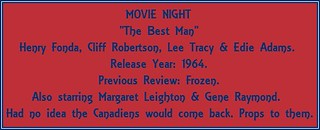
Henry Fonda (William Russell), Cliff Robertson (Joe Cantwell), Lee Tracy (Art Hockstader), Edie Adams (Mabel Cantwell), Margaret Leighton (Alice Russell), Ann Sothern (Sue Ellen Gamadge), Shelley Berman (Sheldon Bascomb), Gene Raymond (Don Cantwell), Kevin McCarthy (Dick Jensen), John Henry Faulk (Governor T.T. Claypoole), and Richard Arlen (Senator Oscar Anderson) Directed by Franklin J. Schaffner (#347 - Planet of the Apes)

Review
It's sort of hard to talk about this movie because when it all boils down to it, this is an okay movie. Fonda and Robertson are exceptional, especially when they share a scene, but Lee Tracy is even better, he steals the show and makes it his own in his final performance as he just dominates the movie with a commanding presence. The movie itself is alright, full of supporting characters that either are tolerable or just forgettable, though at least Kevin McCarthy is decent. This is more of a curiosity of a time different from now, but relevant in some ways that surprise even me.

Overall, I give it 7 out of 10 stars.

April 21, 2011

Movie Night: 12 Angry Men.

Review #035: 12 Angry Men.

Cast
1. Martin Balsam
2. John Fielder
3. Lee J. Cobb
4. E. G. Marshall
5. Jack Klugman
6. Edward Binns
7. Jack Warden
8. Henry Fonda
9. Joseph Sweeny
10. Ed Begley
11. George Voskovec
12. Robert Webber
Directed by Sidney Lumet.

Review
Review to be updated at a later point in time - hopefully by the end of 2018 or 2019. 

This movie is the first covered of the 1950s on this show, and it is just pure greatness. It shows a lot of talent all in one set (And for a movie that took less then three weeks and $325,000 to make). Henry Fonda is the big star, and he is the best person in this movie. I like how it seems you are the Juror, you are feeling like you are one of them. The theories are deconstructed over time as the tension builds until the conclusion. It shows a lot of heart, and it can and will, make your heart beat.

Overall, I give it 10 out of 10 stars.