Showing posts with label Sig Ruman. Show all posts

January 17, 2026

A Night at the Opera.

Review #2497: A Night at the Opera.

Cast: 
Groucho Marx (Otis B. Driftwood), Chico Marx (Fiorello), Harpo Marx (Tomasso), Kitty Carlisle (Rosa Castaldi), Allan Jones (Ricardo Baroni), Margaret Dumont (Mrs. Claypool), Sig Ruman (Herman Gottlieb), Walter Woolf King (Rodolfo Lassparri), and Robert Emmet O'Connor (Sergeant Henderson) Directed by Sam Wood.

Review: 
In fairness, Sam Wood does sound like a name I've covered before. But so it goes. Wood actually was a real estate broker in his young years in California before the growing industry of film for the 1900s eventually became something worth investing time into, starting as a movie assistant and eventually assistant director, most notably with Paramount Pictures for a number of years. He became a director by the turn of the 1910s with Wallace Reid. His efficient nature in getting films done landed him several opportunities to direct for a variety of places over the next two decades, although his longest tenure ended up being with MGM, where he worked in both silent and sound productions starting in 1927. In the middle of his tenure there, Wood ended up as the one directing a key assignment with the Marx Brothers because Irving Thalberg needed a dependable guy to direct the group (now consisting of Groucho, Harpo, and Chico), who had recently departed Paramount Pictures after five features because of contractual disputes that boiled over with Duck Soup (1933). The resulting success led to Wood directing the next Marx movie with A Day at the Races (released in 1937 months after Thalberg's death). For the Marx Brothers, they worked with MGM further on with At the Circus (1939), Go West (1940), and The Big Store (1941). Wood moved on to a wavering list of noted work, most notably with Goodbye, Mr. Chips (1939) before he became a freelance director for the remainder of his career and life, which led to films such as Our Town (1940), Kitty Foyle (1940), and Kings Row (1942). During production of Ambush (1950), Wood died from a heart attack at the age of 66 in 1949. Incidentally, both of Wood's Marx movies served as loose inspiration for the 1992 movie Brain Donors.

With this film, certain parts of the routines were basically workshopped with live stage performances that the brothers did on the road that was performed around the country prior to filming, with Wood traveling with the group from city to city to watch the audience reaction to the gags. The writing credits went to James Kevin McGuinness for the story, George S. Kaufman & Morrie Ryskind for the screenplay while gagman Al Boasberg contributed uncredited dialogue. If Thalberg's idea that the brothers would be best served by having a solid framework to hold up a grab-bag of jokes, well, he probably had a point. Basically, you get a good chunk of Marx mayhem with a handful of gags that come and go with solid efficiency depending on just how much you love seeing a group of oddballs casually loop in and out of affairs that either come off as trivial or just about the right sort of absurd. Obviously, the stateroom sequence is a key highlight of the film in that high-desired quality of rhythm and setup, although I would say the scene with the group trying to evade trouble involving furniture-moving is a nice favorite. Admittedly, the aspects involving Carlisle and Jones is the weakest part of the film, particularly since Dumont is such a solid straight presence anyway. But Groucho is Groucho in terms of just slinging lines full of zip with efficient nature that manages to evoke the charm within conman routines. And of course, there is the usual bumbling from Chico and the not-exactly silent Harpo. As a whole, it isn't hard to see why the Marx Brothers thought A Night at the Opera was one of their favorite films, as it manages to zing on a consistent level with its humor and execution to where one is immediately chuckling with its trio of stars with warm familiarity regardless of how many Marx movies you've seen. 

Overall, I give it 8 out of 10 stars.

June 4, 2023

The Wedding Night.

Review #2016: The Wedding Night.

Cast: 
Gary Cooper (Tony Barrett), Anna Sten (Manya Novak), Ralph Bellamy (Fredrik Sobieski), Helen Vinson (Dora Barrett), Sig Ruman (Mr. Jan Novak), Esther Dale (Mrs. Kaise Novak), Leonid Snegoff (Sobieski), Eleanor Wesselhoeft (Mrs. Sobieski), Milla Davenport (Grandmother), Agnes Anderson (Helena), Hilda Vaughn (Hezzie Jones), and Walter Brennan (Bill Jenkins) Directed by King Vidor (#987 - Show People, #1015 - Bardelys the Magnificent, and #1369 - Duel in the Sun)

Review: 
It is entirely possible that certain directors will fade away in relevance with the passage of time no matter what one does or says. This is especially apparent when you consider the moods of certain folks when it comes to watching "black and white" movies or perhaps hearing directors (dork or not) talk about not knowing who directed certain famous movies. The best way to respond is to educate oneself in making suitable choices and not let silly reasoning win the day. Movie Night is here to spotlight directors until death, so one might as well try to give a spotlight to as many filmmakers as possible. So let us go with King Vidor and a semi-compelling story in a semi-compelling movie, which was actually released in the latter part of a career that lasted over four decades. He was a Galveston native that honed an interest in cameras from a young age, going from photographing them for portraits to serving as an amateur newsreel cameraman. The very first person to give him a chance to do films for places beyond his home was a judge-turned-humanitarian-turned-filmmaker Willis Brown, where he made a handful of short films all about juvenile delinquents and their rehabilitation (the irony is that Brown was actually a guy who falsely claimed to be a lawyer and was called out on it). Anyway, The Turn in the Road (1919) was his first feature film (which he wrote and directed), and he basically never stopped from there, making at least one film for various studios that ranged from Brentwood Film Corporation all the way to United Artists. Vidor was the kind of man who put forth his own "Creed and Pledge" about what he would do as a filmmaker...in 1920, one that believed in the motion picture in carrying a message to humanity that ended with him making an "endeavor to draw upon the inexhaustible source of good for my stories, my guidance and my inspiration." Time has probably been kind to the question about if he achieved his goal or not.

Oh right, there is a film to talk about. The Wedding Night was written by two folks: Edwin H. Knopf wrote the original story that was then turned into a screenplay by Edith Fitzgerald (Knopf based his story on the exploits of F. Scott Fitzgerald and his wife Zelda, since he was a close friend of Knopf). The story that goes with the film is the last real attempt to make Anna Sten a mainstream name. She was born in Kiev in the Russian Empire (the place where she was born is now what you would call Ukraine) and she had studied theater before becoming an actress for Soviet and German films in the mid 1920s. Samuel Goldwyn discovered her when trying to find an actress of his own that could be promoted in the same way as Greta Garbo (Swedish-born, but I think you get the idea) and decided to sign her to a contract along with extensive training. The result was three films: Nana (1934), We Live Again (1934), and this. They actually promoted her as "The Passionate Peasant", which is, um, interesting when coming in the era of the Depression, and it probably doesn't help that Goldwyn's attempt to make her a star became a punchline in Cole Porter's famed "Anything Goes" song. None of the films were particularly successful, and the result was that Goldwyn released her from the contract. Over the next 27 years, she would make eleven appearances in films (some with the involvement of her husband Eugene Frenke, who was a producer and director for a couple of years) but she was never as prominent as she was with these films. 

The film is actually decent, but I am sure you can figure out how it wasn't exactly destined for stardom. It is actually a fairly well-shot film (done by Gregg Toland), one with fair sensitivity towards the inevitability of a doomed strike of love that, well, you know can only go one of two ways. For the most part, Cooper shines over the rest of the cast in a semi-balanced exploration of what it means to be a writer trying to dig out of the muck and also the differences that arise from a Polish family and someone like Cooper's character. It isn't just a man finding a story in what he is watching around him, it is a man that finds himself in that very story that may or may not be too involved with his own mythmaking. So yes, Cooper outshines them when it comes to plain-spoken honesty for a name right in the middle of becoming more than just a name on certain films (Mr. Deeds Goes to Town, his first Academy Award nominated film, came out the following year), and while I can't say he makes a great "drunken writer", I will say that he trembles his way towards romance with enough conviction to carry things to where they need to go. Ruman and Vinson basically act as the plugs against the idea of the two together, whether that involves traditional coarseness in the former or cloying sensibility in the latter, which is fine. Bellamy makes a quality adversary in affections, in that it is clear where he fits and doesn't fit within an would-be arranged marriage with certain goals. Stem seemingly acts better when placed in quiet moments where one can just watch her react to what is around her rather than, say, heavy dialogue. That isn't saying anything about her accent or anything to do with chemistry, it just means that some actors do better than others when it comes to the line between actor and character played by an actor. It is mildly convincing to see her with Cooper, but one is either invested in the sheer inevitability of who these people are and what must be, or they find it very mild stuff, or perhaps just a trifle, which I guess means that those 83 minutes will either tug on your curiosity or just pass through, and I firmly sit in the middle. It is a nice little film, but that is all it ends up being, just one that you can say warm things about for a time and await further curiosities that either will pique your interest in something else similar or perhaps better. You can't go wrong within certain choices in directors or actors in the 1930s if you know where to go.

Overall, I give it 7 out of 10 stars.

May 23, 2023

The Farmer Takes a Wife.

Review #2012: The Farmer Takes a Wife.

Cast: 
Janet Gaynor (Molly Larkins), Henry Fonda (Dan Harrow), Charles Bickford (Jotham Klore), Slim Summerville (Fortune Friendly), Andy Devine (Elmer Otway), Roger Imhof (Samson 'Sam' Weaver), Jane Withers (Della), Margaret Hamilton (Lucy Gurget), Sig Ruman (Blacksmith), and John Qualen (Sol Tinker) Directed by Victor Fleming (#159 - The Wizard of Oz and #569 - Gone with the Wind)

Review: 
For all of the films I have seen, I wonder if I have perhaps not given a proper spotlight to certain names in the classic era of Hollywood, or at the very least the 1930s. Victor Fleming wasn't just the director of 1939's The Wizard of Oz and Gone with the Wind, you know. Fleming had got his start as a cameraman in the 1910s, but it is probably most interesting that he also once served an assignment to teach at Columbia University, specifically teaching Military Cinematography, due to the U.S. Army needing it for the efforts in World War I. Some of the members in that program that Fleming helped teach involved future names such as Josef von Sternberg, Ernest B. Schoedsack, and Lewis Milestone. Fleming made his feature directing debut with When the Clouds Roll By (1919). Overall, he made a variety of adventure and comedy films, with his association with MGM in the 1930s being particularly memorable, such as with Captains Courageous (1937); Fleming died at the age of 59 in 1949, having directed over three dozen films. The film is based on the 1934 play of the same name, which had been done by Marc Connelly and Frank B. Elser, which in of itself was based on the 1929 novel Rome Haul that had been written by Walter D. Edmonds; Henry Fonda and June Walker served as the leads for the production, which ran for a time on Broadway. Connelly and Elser wrote the screenplay alongside Edwin J. Burke. In case one didn't know, the Erie Canal was a really big deal when it came to navigating waterways, which started upon its completion in 1825. Of course, in real life, the railroad only overcome the competition with the canal in the early 20th century. The film was remade as a musical comedy in 1953 by 20th Century Fox with Betty Grable and Dale Robertson as the leads.

Admittedly, it is more of a curiosity than a real treat, but it is serviceable at 91 minutes for those who like mildly charming romances, one that is filled with plenty of recognizable faces for those who are familiar with vintage films (whether for character actors or in general). It doesn't pull anything particularly memorable when it comes to showing the future that is yet to come with farming, but it moseys about with general decency to make things matter enough. Gaynor was in the midst of transition, one who was still a name presence in the mid-1930s but was seeing the times change when it came to audience preferences (two months before the release of the film, Fox Film Corporation, which she had been with since the mid-1920s, became 20th Century Fox due to a merger), which can loosely be defined as "wholesome". Fonda had been active in the stage since 1925 that had started in his native Nebraska, which eventually took him to Broadway. He was picked for the role after Fox tried to pursue Gary Cooper and Joel McCrea and failed. It is evident, even in his debut film, where he would become a future star, in part because of his sincerity, which manages to come through in a way that somehow outmatches Gaynor and her attempts at playful vulnerability. Their coupling is a gradual one, with his balanced sense of sentimentality for the soil going with her stubborn spirit for the canal that is basically a reckoning for each to make up their minds of who they are. Inevitable as it may seem, at least the resolution is one you could buy between the two. Bickford was mauled by a lion and nearly killed while filming another movie that came out in 1935, which led to him being more of a character presence the rest of his career. Evidently, Spencer Tracy (a regular presence at Fox since 1930 that was noted more by the critics than the audiences for his films) was originally cast in the role Bickford inherited, since Tracy was taken out, reinstated, and then released from the role when he got out of his contract for Fox (he would sign with MGM in the spring of 1935 and the rest is history). At any rate, Bickford makes a solid heavy, belligerent and willing to play along with what is needed. The others make for solid relief in parts, whether that involves the dependable Devine or Hamilton (who had appeared in the play with Fonda). They make the canal life at the very least one not of bland caricature, since the film is at least lightly funny without panhandling your attention. As a whole, the film moves through the motions of friendly 19th century romance with the pacing of soil being planted gently onto the ground, one handled with general efficiency from director and crew to make a tolerable experience, with the talent of Fonda and the future that would come from him being apparent at that moment in time.

Overall, I give it 7 out of 10 stars.

April 10, 2020

Stalag 17.

Review #1384: Stalag 17.

Cast: 
William Holden (J.J. Sefton), Don Taylor (Lieutenant James Dunbar), Otto Preminger (Colonel von Scherbach), Robert Strauss (Stanislas "Animal" Kuzawa), Harvey Lembeck (Harry Shapiro), Peter Graves (Price), Sig Ruman (Sergeant Johann Sebastian Schulz), Neville Brand (Duke), Richard Erdman ("Hoffy" Hoffman), Michael Moore (Manfredi), Peter Baldwin (Johnson), Robinson Stone (Joey), Robert Shawley ("Blondie" Peterson), William Pierson (Marko the Mailman), and Gil Stratton (Clarence Harvey "Cookie" Cook / Narrator) Produced and Directed by Billy Wilder (#106 - Some Like It Hot, #194 - Ace in the Hole, #422 - The Fortune Cookie, #641 - The Apartment, and #809 - Sunset Boulevard)

Review: 
"Trust your own instinct. Your mistakes might as well be your own, instead of someone else's."

Nobody could quite as versatile as Billy Wilder for film. Born in Austria-Hungary, he found himself wanting to become a journalist from viewing a newsreel (as opposed to prelaw in college or the family business in cakes). He worked for magazines and newspapers in both Austria and Germany, but he eventually found himself wanting to be a screenwriter, with his first credit being for The Daredevil Reporter (1929). During his time in Germany, one notable film he wrote for was People on Sunday (1930), which had notable collaborators such as Edgar G. Ulmer. However, he left the country in 1933 for Paris after the rise of the Nazis. He had his directorial debut with his collaboration with Alexander Esway in Mauvaise Graine (1934) before deciding to leave for America. Over the next few years, he would find himself collaborating on film scripts that gradually found attention, most notably with Charles Brackett. For over a decade, the two would write scripts together (with a few occasions having an additional writer), with the first major hits coming in 1939 with Midnight and Ninotchka. Anxious at the idea of directing and not being confined with just writing, Wilder was given a chance with The Major and the Minor (1942). It was here that he met another important figure in honing the craft in editor Doane Harrison, who had edited Wilder and Brackett's Hold Back the Dawn the previous year. With Harrison on set, Wilder credited him for helping him in technical knowledge in terms of cutting so that there wouldn't be excess footage to deal with. The two would work together for the next two decades. Over the course of the next four decades, Wilder would direct and write plenty of noted successes in genres from noir to comedy drama, such as Double Indemnity (1944), The Lost Weekend (1945), and Sabrina (1954). In his career, he would win six Academy Awards on 21 nominations, with three of them being for screenplay, two for direction, and one for Best Picture.

The film is an adaptation of the Broadway play of the same name by Donald Bevan and Edmund Trzcinski, who had based it on their experiences in a prison camp named Stalag 17B in Austria. When it comes to a war film about prisoners, there certainly wasn't anything like this film before it came out, one that balances dark humor with suspense alongside a claustrophobic atmosphere that makes for a compelling two hour viewing. One key star that was part of some of Wilder's successes for the decade was William Holden, who appeared in three of his features (with one more years later in Fedora). It was the result of these films that elevated him to prime star status, with this being his one Academy Award winning performance of three nominations, although he felt that he didn't deserve to win (instead favoring Burt Lancaster in From Here to Eternity). In fact, he actually disagreed with the characterization of the role (which had Charlton Heston and Kirk Douglas thought of before Holden), since he felt it was selfish and he wanted Wilder to make him nicer, which was rejected. In any case, one finds plenty to draw themselves into Holden and his world, a heel-hero with smarmy complex charm beyond the usual expectations for a film with suspense like this one, which plays to the film's favor in drawing out its traitor twist (kept under wraps by filming in sequential order) through subtlety in both Holden and the camera movement. The rest of the cast keep up with him in establishing the close-knit and hard-driven members contrast with the menace and bluster on the other end. In that sense, the ones who shine best are Strauss, Graves, Brand, Ruman, and Preminger, each delivering a distinct layer that makes the film operate as well as it does without feeling monotonous. There is a key balance of drama and humor that earns the film key moments that can go from a sequence involving a telescope on friendly Russian women to the discovery of the traitor to the whole group. In the long run, this is an entertaining film in a long line of Billy Wilder achievements that merits a watch as a key piece for the decade in balancing drama and humor without too much trouble.

Overall, I give it 9 out of 10 stars.

March 10, 2020

To Be or Not to Be (1942).


Review #1358: To Be or Not to Be.

Cast: 
Carole Lombard (Maria Tura), Jack Benny (Joseph Tura), Robert Stack (Lt. Stanislav Sobinski), Felix Bressart (Greenberg), Lionel Atwill (Rawich), Stanley Ridges (Professor Alexander Siletsky), Sig Ruman (Col. Ehrhardt), Tom Dugan (Bronski), and Charles Halton (Dobosh) Directed and Produced by Ernst Lubitsch (#1026 - The Shop Around the Corner)

Review: 
Satire can be a curious thing. If you do it right, one will appreciate the humor and irony for years on end, regardless of how much time has passed (such as Gulliver's Travels). One would expect a war satire to come from brilliant directors (such as Charlie Chaplin with The Great Dictator the previous year), so it only makes sense for Ernst Lubitsch to make one as well. The German-born director had started as an actor in 1913. Although he appeared in roughly 30 films over the next seven years, he gradually shifted his attention to directing, making his debut with Shoe Palace Pinkus (1916). He made numerous movies in his native Germany with actors such as Pola Negri before leaving to Hollywood for good in 1922. He made films in numerous genres, ranging from comedy to bio-dramas to musicals, and he received an Honorary Academy Award in 1946, one year before his death from a heart attack. The story was done by Melchior Lengyel (who had co-written Ninotchka) while the screenplay was done by Edwin Justus Mayer (with un-credited work done by Lubitsch). Naturally, one would expect a star or two to headline the film, and one can't go wrong with Lombard and Benny. Lombard had started her career in 1921 (with a main debut in Marriage in Transit in 1925),  having small roles in films for Fox Film and Mack Sennett's short films before reaching her first high point with Twentieth Century (1934). It was the first of numerous screwball comedies that she became known for over the next few years. Tragically, this was to be her last film. She was killed in a plane crash after a war bond rally on January 16, 1942 (roughly a month before the film's release). Benny came into this film because Lubitsch wrote the film directly for him. He had originally done vaudeville for his violin playing before eventually deciding to do comedy with his act. In 1929, he had signed a contract with Metro Goldwyn Mayer and had his debut with The Hollywood Revue of 1929. While he made numerous appearances in film over the next few years, he became more well-known for his radio program, which ran from 1932 to 1955. 

The film is a wonderful one, dark and witty with its pursuit of making ridicule of a serious situation like the Nazis, in a time where World War II was in its third year and America had just entered the fight. There was a mixed reception among audiences and critics of the time, where even Benny's father initially was disgusted with the sight of his son in a Nazi uniform before being convinced otherwise (where he promptly saw it again and again). It is a keen movie with plenty of sharp observations and facial situations that rewards the viewer time and time again. The movie has a tremendous sense of timing, balancing comedy and drama with such deftness, which is helped with a prime screwball pairing through Lombard and Benny, who are both inspiring to watch either together or with others. The film doesn't repeat itself with tiring gags, knowing when to do something without needing to be prodded into it, where one could make a comedy-less version of the same basic story without finding trouble. Stack (who was reportedly terrified going into this role) does just fine with keeping up with Lombard and Benny with careful demeanor. The other actors pull off an inspired front in retaining interest, with Ruman doing the most well with bombast. It certainly is a timeless one to last among other comedies, and it even inspired a remake in 1983. The film moves with a dashing pace of 99 minutes, never seeming to wear itself out at any time with making a capable dark comedy that also serves as a romance and thriller with plenty to make light of with daring ambition and an especially capable director and stars at hand to make things shine in the dark. One can't go wrong with a Lubitsch picture, and this is no exception.

Next Review: The Invisible Man (2020).

Overall, I give it 10 out of 10 stars.

November 10, 2016

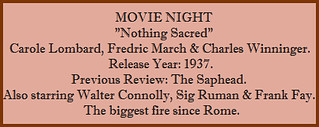
Nothing Sacred.


Review #866: Nothing Sacred.

Cast:
Carole Lombard (Hazel Flagg), Fredric March (Wally Cook), Charles Winninger (Dr. Enoch Downer), Walter Connolly (Oliver Stone), Sig Ruman (Dr. Emil Eggelhoffer), Frank Fay (Master of Ceremonies), Troy Brown (Ernest Walker), Maxie Rosenbloom (Max Levinsky), and Margaret Hamilton (Warsaw, Vermont Drugstore Lady) Directed by William A. Wellman (#349 - Wings and #494 - The Public Enemy)

Review:
In a time like this, Nothing Sacred manages to find its place in being relevant to the point where it is timeless, in part due to a neat simple story and some fun screwball comedy within its satire elements. This film is readily easy to find, due to it being in the public domain after its copyright registration wasn't renewed in 1965, so you can find it on the Internet (or other alternative manners) without problem. It should be noted that this was the first screwball comedy in color, along with Lombard's only film in Technicolor, and it certainly stands out. This was also a film that used effects such as rear screen projection (most notably during the scene where the characters arrive in New York via plane). Lombard and March certainly have a decent chemistry together, especially when they argue, which culminates with a "boxing" scene at the end. Lombard has a welcoming presence, being one easy to root for, certainly fitting the part with enough grace and charm to fit such a fun role, which she often called one of her favorites. Connelly certainly stands out as the exasperated newspaper head; one of my favorite parts is when he tells March's character some news with a cracked voice, obviously trying to hide exasperation, which is amusing. As one would expect there is enough fine little lines, with a fine balance of timing. The rest of the cast is also pretty good, even if the film is really all about Lombard and March, who seem to have a really good time. The satire excels in that it doesn't choke the fun of the film nor does it seem artificial. It's not a film that will make you deeply about journalism and the "big story", but it is a movie that would inspire at least one conversation, and I suppose that is all that counts.

Overall, I give it 9 out of 10 stars.