
Review #999: The Man Who Laughs.
Cast:
Mary Philbin (Dea), Conrad Veidt (Gwynplaine / Lord Clancharlie), Brandon Hurst (Barkilphedro), Olga Baclanova (Duchess Josiana), Cesare Gravina (Ursus), Stuart Holmes (Lord Dirry-Moir), Samuel de Grasse (King James II Stuart), George Siegmann (Dr. Hardquanonne), and Josephine Crowell (Queen Anne Stuart) Directed by Paul Leni (#863 - Waxworks)
Review:
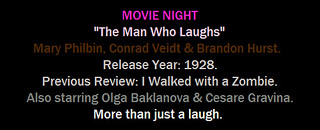
I figured that it would be fitting to do a silent film for the 999th review, with this being the 62nd of its type covered on Movie Night. You may notice that the square right next to the title card is in a few colors like pink, grey and black. These colors were utilized for the 99th review (Mutiny on the Bounty), albeit with a bit more stylizing this time around. Enjoy this review.
This was adapted from Victor Hugo's 1869 novel of the same name. The novel had one previous adaptation in 1921 named The Grinning Face, made in Austria. Universal had previously adapted Hugo's The Hunchback of Notre Dame (#850) back in 1923, and the intent was to have Chaney star in the title role after the success of that film, although issues to the rights of the novel meant that Chaney would be released from doing this film in favor of The Phantom of the Opera (#774). After that film's release, producer Carl Laemmle decided to try and make this as his next attempt at Gothic success, with Veidt picked to play the title role. Leni, who had recently moved to Hollywood after having been invited by Laemmele, was selected as director. Both choices prove to be fairly crucial in why this film works as well as it does; Leni uses his lighting and sets to fine effect, as one might expect from a German Expressionist such as him. Veidt wears a makeup device that made his mouth swollen while being supplied disturbing teeth, which contributes to the look of his character. While it is a great effect, it takes a good actor to help convey numerous emotions with only his eyes, and Veidt stands up to the challenge quite well. The appearance of Veidt proved to be the visual inspiration for the comic book villain the Joker, appearing in comics over a decade later. Philbin, playing a role not too different from her role from Phantom of the Opera (in which she played opposite Chaney), does a decent job, given that she is playing a blind person.
This film is sometimes counted as one of the films of the Universal Monsters series, and while it isn't much of a horror film, there is a fair amount of gloom within its tone to make a case for it, although it also has elements of romance and swashbuckling action. Yes, it has a climax with excitement, but the scenes that precede it also can be sad, such as when Veidt's character is shown in a freak show, or when he is being propositioned by Baklanova's character. The scene at the House of Lords proves to a moving and effective scene in part because of Vedit and his mannerisms towards the others. Though this is a silent movie, it was (on re-release) shown with sound effects, a synchronized score, and even a theme song (named "When Love Comes Stealing"). The sounds we get to hear are of laughter during the freak show, which is certainly a startling (and satisfying) effect, and the theme is fairly passable as well. As a whole, this is an efficient movie that satisfies on numerous levels while being fairly paced well at 110 minutes. It might not be the horror film that you might expect from seeing Veidt's appearance on screen, but it is a satisfying romance drama (with a bit of horror) with enough competence and style to make a top-notch effort.
Well. Here we are at end of review nine hundred ninty-nine.
You are likely wondering what is next for the one thousandth review, so I'll tell you...
...tomorrow night, when the review is actually up. I'm not trying to hype the review, but I figure it makes sense to let you all wonder a bit and enjoy.
Overall, I give it 9 out of 10 stars.