Review #2585: Videodrome.
Cast:
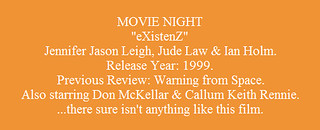
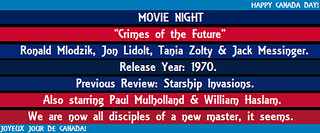
James Woods (Max Renn), Debbie Harry (Nicki Brand), Sonja Smits (Bianca O'Blivion), Peter Dvorsky (Harlan), Leslie Carlson (Barry Convex), Jack Creley (Dr. Brian O'Blivion), Lynne Gorman (Masha), Julie Khaner (Bridey James), David Bolt (Raphael), and Reiner Schwarz (Moses) Written and Directed by David Cronenberg (#816 - Crimes of the Future, #1127 - eXistenZ, #1220 - A History of Violence, #1239 - Stereo, #1624 - Shivers, #1712 - The Fly [1986], #2132 - Crimes of the Future [2022], #2276 - Rabid [1977])
Review:
"I've always been interested in dark things and other people's fascinations with dark things. Plus, the idea of people locking themselves in a room and turning a key on a television set so that they can watch something extremely dark, and by doing that, allowing themselves to explore their fascinations."
We do love our technology, don't we? Now more than ever, the lines between reality and what we actually see for "entertainment" (television, phone, what have you) is blurred. The human body is the battlefield for what is "too far" and it probably goes without saying to consider how far the word "goon" has gone beyond its original meaning. People will believe what they see and hear from their screens, and you could figure that out in the time when people still used tapes (hell, in different future days, there were people who believed what they heard on the phone from alleged cops). One man's reality is another's delusion, and it goes doubly for how far things have moved from TV being reality and therefore reality being less than TV, as they say. Apparently, when David Cronenberg grew up in his native Toronto as a kid, he could tune into American TV signals from Buffalo in the States when the Canadian stations went off the air and the idea of maybe seeing something he shouldn't see lingered in his mind. The ideas gestated in his head (as one does when knowing about Marshall McLuhan, who taught at the University of Toronto when not being the one considered the "father of media studies") before getting a good chance to do the film with his particular growing reputation. With partial financing from Universal Pictures (it should be noted that this was the last film of his made in the Canadian "tax shelter" era) and filming in Toronto, Videodrome actually did get released to hundreds of theaters in February 1983 and promptly died in theaters, with Cronenberg once musing it wasn't an "exploitation sell [or]...an art sell." At any rate, it soon developed a cult following (various videos exist involving the making of the film, as seen here).
You get a shelter that has homeless people gather to watch television, people who communicate through a TV screen, a certain point where the lines between reality and fantasy blur, and, oh yeah, gooey body horror moments within the actual horror of what really does lurk beyond "special names" and manipulation of people's obsessions. It's not what you see that's important in terms of the "videodrome", it's the fact that reality can in fact be shattered by those who live on the screen that really matters in control. It all leads to Woods and his commanding presence in a cynic with no sense of philosophy beyond "there's an outlet somewhere" (wiser minds wondered if it was really the medium that was the message). There is a killer instinct within Woods to just make a role look so intense by the way you see him maneuver with his expressions more than anything that reaches to the heart of all with the perverse rot in one's soul (which, well, is the type that can be alluring to a certain type of stimulated person). His certain type of "soul" does go hand-in-hand with how Harry (the vocalist of Blondie who dabbled in acting such as Union City [1980], this and Hairspray) treats the world of over-stimulation and curiosity. Her awareness of craving pleasures and pain (for whatever you might read when seeing someone stuff a cigarette on their chest) is the type of alluring "question mark" (well, if you go with that from an interview with her); with so much time spent in a box, you almost could call it a virtual performance (compared to the v-tubers of the now, I suppose being told about the flesh is an improvement). In the battlefield of what airwaves are to be seen in the mind to take the bed with you, one sees the dueling sides with Smits & Creley and Carlson & Dvorsky to sobering effect, well, at least when you consider that both want to shape would-be users for a certain type of evolution. Sure, the plot of the movie is loose, particularly when it comes to really figuring just what is hallucination (full-scale, if you will) and what is the horrors of actually seeing a new type of hell (slits in the abdomen and appendages to the arm that might as well be a new type of sex organ). You just have to enjoy the ride of raveling and unravelling in stimulation to see that, yes, the video screen really can be a tool or weapon and you are living in that world right now. With an efficient pace of 89 minutes that rides the wave of grime and bleak nature of what it really means to see beyond the flesh, it's a pretty good way to unsettle oneself in the eyes of stimulation.
Overall, I give it 9 out of 10 stars.
It begins. We're going to try and get as many horror movies as we can, which will run the gamut from franchise stuff such as Saw V all the way down to anthology picks to the oldies to beyond while having time for spectacular fun in November. Stay spooked.