Showing posts with label John Cromwell. Show all posts

May 25, 2023

The Prisoner of Zenda (1937).

Review #2013: The Prisoner of Zenda.

Cast: 
Ronald Colman (Major Rassendyll / King Rudolf V), Madeleine Carroll (Princess Flavia), Douglas Fairbanks Jr (Rupert of Hentzau), C. Aubrey Smith (Colonel Zapt), Raymond Massey (Duke Michael), Mary Astor (Antoinette de Mauban), and David Niven (Captain Fritz von Tarlenheim) Directed by John Cromwell (#1008 - The Racket, #1341 - Of Human Bondage, and #1348 - Algiers

Review:  
In 1894, a novel was published in the United Kingdom that was written by Anthony Hope, which was titled The Prisoner of Zenda. As one might expect, it has been adapted several times in the realm of stage, film, and radio, with the first adaptation being a play (as adapted by Edward Rose) that opened exactly one year after the novel was published. The silent era saw a handful of films (1913, 1915, 1922), with the most noted one being done by Rex Ingram. Evidently, there were plans to make a musical by MGM with Jeanette MacDonald and Nelson Eddy as star. However, it eventually fell into the hands of David O. Selznick and his studio, and he took notice of the abdication of King Edward VIII in 1936 when it came to marketing. There were several writers credited with the writing: John L. Balderston wrote the screenplay while Wells Root wrote the adaptation, Donald Ogden Stewart provided additional dialogue, and un-credited work was done by Ben Hecht and Sidney Howard. John Cromwell, already in his forties when he went from stage performances as actor and Broadway directing to films in the late 1920s, was chosen by Selznick to direct (Cromwell had directed with various studios from Paramount to RKO to United Artists). However, W. S. Van Dyke was brought in to help with reshoots in fencing while George Cukor was recruited to shoot the renunciation scene because he apparently was felt to be good with directing women. Did you know that Hope wrote a follow-up novel to Zenda? Rupert of Hentzau was written the year after Zenda's publication but not seen until 1897 (there have been a few adaptations, but not nearly as many as Zenda, probably because that book ends with the death of the lead, albeit with fitting irony). Evidently, there were plans announced in 1947 to make a film adaptation by Selznick after the success of this film with Joseph Cotten set to star, but it did not come to pass (coincidentally, Selznick's father Lewis was the producer of the 1923 version of Rupert of Hentzau). A shot-for-shot remake of Prisoner of Zenda was done in 1952, with the next (and last) high-profile remake being a 1979 film with Peter Sellars as star. 

When it comes to classics, this one is a pretty easy one to spot. It has all of the pieces you would expect from a swashbuckler: a nifty setup, a few costuming choices, a villain almost as dashing as the hero, and various other methods of adventure. Colman gets to employ the use of tables and chairs to go along with swordplay when it comes to playing with fire in the adventure sense, which reflects well when playing a double role that has him also play a weakened would-be king. It is no surprise that Selznick waited until he secured Colman to get the ball rolling on the film, because he is the dashing presence required in such a film that would seem lacking with perhaps anybody else but him when it comes to glamour without having a sense of being aloof to the fray. Of course, this is also a romance, so the time spent with Carroll is crafted quite well, mostly because her newfound sense of affection for the face standing in front of her is compelling to view in elegance, which makes what occurs in the resolution all the more poignant. Fairbanks Jr, the son of that famed swashbuckler with whom he shared his name, was told by his father to take the part of Rupert when he was offered it over the double role because (in his words), it was "probably one of the best villains ever written". Fairbanks clearly had good advice for his son, because it is a compelling role. He gets to snidely whiplash his way through the action with clear enthusiasm for the material when it comes to being the real threat behind the throne (as opposed to Massey, who actually is pretty decent himself), and the fact that he glides through the final action sequence to parts unknown certainly makes it a memorable adversary to see all the way through. Smith (the lead actor in the London production of the play decades earlier) and Niven (cast right before his turn as a star) provide support to Colman in very mild relief. As a whole, you can see the professionalism displayed by Cromwell and company to make entertaining adventure roll off the pages that generally utilizes its 101-minute runtime for suitable pacing that makes most of the right moves to set a place among the classics to watch in eight-decade cinema of a fantasy that all can enjoy within kingdoms and the duality and duplicity of people.

Overall, I give it 9 out of 10 stars.

February 26, 2020

Algiers.


Review #1348: Algiers.

Cast: 
Charles Boyer (Pepe le Moko), Sigrid Gurie (Ines), Hedy Lamarr (Gaby), Joseph Calleia (Inspector Slimane), Alan Hale (Grandpere), Gene Lockhart (Regis), Walter Kingsford (Chief Inspector Louvain), Paul Harvey (Commissioner Janvier), Stanley Fields (Carlos), and Johnny Downs (Pierrot) Directed by John Cromwell (#1008 - The Racket and #1341 - Of Human Bondage)

Review: 
It should only figure that some films come from doing it over again for a different audience. As much as one can bemoan the shrinking originality of doing the same source material numerous times (then and now), interest does tend to rise a bit when it comes to how a remake fares in a different country. In this sense, Algiers is a remake of Pépé le Moko (1937), a French film based on the novel of the same name by Henri La Barthe, featuring Jean Gabin as star and Julien Duvivier as director (there also was a musical remake with Casbah in 1948). Of note is the American debut of Sigrid Gurie (who was born in New York but had grown up primarily in Norway) and Hedy Lamarr, who had made appearances in five films (all but one being from either her native Austria or Germany) from 1930 to 1933, with an encounter of Louis B. Mayer scouting for European talent helping to lead her to a Hollywood career, with Walter Wanger serving as producer for this feature. Another emigrant serving as star for this film was Boyer, who had started his career in his native France in 1920 before making a move to do Hollywood films alongside his French films in 1930. He soon gained a reputation as a leading man for romantic dramas, with his work being recognized through four Best Actor nominations (including one for this film) before his last film in 1976. The remake would keep certain aspects of the original, most notably with a majority of the music alongside background sequences (at least ones that weren't shot in Algiers and later integrated later into the film by cinematographer James Wong Howe), although censor demands led to the ending being different (murder rather than suicide), along with other aspects. Boyer was not a big fan of his work on the film, since Cromwell wanted him to emulate Gabin (even running scenes from the original), which he disliked doing as an actor, although Cromwell later gave compliment to Boyer on how his performance had been different from each other in terms of nuance. He certainly does a fine job with this film, where one gets a sense of allure and curiosity from whenever he is on screen, a certain kind of confidence that resonates whenever on screen with someone like Lamarr or his on-screen cohorts. The romance that occurs within this triangle comes out with a bit of passion, although Cromwell felt that Lamarr's problem was that she could not act (stating that he could take some of the credit for making her acting passable, while sharing it with Boyer). She provides some exotic charm, a raw but expressive presence that does tend to benefit when on-screen with Boyer more than anyone (which I suppose isn't too surprising). Gurie pulls off an anguished side of this triangle neatly enough, not getting lost in the shuffle too much. Calleia makes for a decent adversary, while Hale provides a bit of wise levity alongside an effective sniveling Lockhart among the rest. The film moves at a fair pace with 99 minutes, although one does not really seem to sense too much suspense inside it. One gets a fair amount of fleeting pleasure, which should be enough for most. At least one can see why it served as one of the inspirations to be patterned for Casablanca (1942). It goes on the strengths of curiosity over its atmosphere and romance with agreeable results, and its free status in the public domain makes this a curiosity worth seeking out without any doubt.

Next Time: It won't be Love Affair, since an addition has been made to go right before that film to make for a 1939 trifecta to close out February's 30s tribute. That film will be Stagecoach.

Overall, I give it 7 out of 10 stars.

February 15, 2020

Of Human Bondage.


Review #1341: Of Human Bondage.

Cast: 
Leslie Howard (Philip Carey), Bette Davis (Mildred Rogers), Frances Dee (Sally Athelny), Kay Johnson (Norah), Reginald Denny (Harry Griffiths), Alan Hale (Emil Miller), Reginald Sheffield (Cyril Dunsford), Reginald Owen (Thorpe Athelny), and Tempe Pigott (Agnes Hollet, Philip's landlady) Directed by John Cromwell (#1008 - The Racket)

Review: 
What is there to say about Bette Davis that hasn't already been said before? Davis is one of the most famous actresses of film to ever grace the screen, but one only needs to point to her six decade career of various sardonic roles that ranged from various dramas that garnered multiple Academy Award wins (two) and nominations (only three other people have more nominations than her ten). One nomination that is not technically recorded is for her role in this film (for which she received write-in votes for in one of only two ceremonies to allow said votes), which is generally considered her breakthrough role. She had started her career on the stage in 1929 before moving to Hollywood the following year to screen test for Universal Studios. She made her film debut with a supporting role in Bad Sister (1931), but her time with the studio was characterized by a dearth of roles before her release from her contract the following year. On the verge of leaving Hollywood, it was the decision of George Arliss to have her cast as the fiancee to his character in The Man Who Played God (1932) with Warner Bros. that gave her the foot in the door she needed, as she soon signed a contract with the studio after they liked the rushes. She would subsequently stay with the studio until 1949, although there were not always easy times. She notably attempted to breach her contract in 1936 when presented an offer to make two films in Britain, owing to be faced to perform in parts she felt were mediocre (incidentally, it was her appearance in a film named The Cabin in the Cotton (1932) that led director Cromwell to want her for this film). In any case, Davis had wanted the un-glamorous role despite the reluctance of studio head Jack L. Warner to let her star in what was to be a production by RKO Radio Pictures. A chance to trade actresses for a part led to RKO being allowed to borrow Davis for this film while Warner Bros borrowed one of their contract players for a film of their own. Davis proved to be dedicated to making this role the first of many noted performances of her career, from hiring a housekeeper with a Cockney English accent to prepare for the role to even designing her own makeup for her final scenes when downtrodden with tuberculosis.

For a film released just as a strengthened Motion Picture Production Code was coming into effect in July of that year, this is sure a daring film to inspire such shock and passion. This was an adaptation of the 1915 novel of the same name by W. Somerset Maugham, which has a mix of autobiographical and fictional elements, as admitted by the author (with both him and the main character having a physical calamity, being an orphan at an early age, and studying medicine). It was the first of three adaptations, with ones to follow in 1946 and 1964. Obviously the work is going to be changed a bit for a film adaptation, especially a 600-page book going down to an 83 minute film. A curious synopsis glance notes that the film only mentions the main character's uncle at the end when he dies, as opposed to showing his experiences growing up with his uncle. The film has a stagey if somewhat dated feel to it at times (this proves true with some of Cromwell's decisions like the perspective shots), but it is the dominant performance of Davis that keeps the film rolling with curiosity. She has a fearlessness and tenacity to making this role worth viewing to see her run the gamut in cruelty, most notably when she chews the main character out near the end. We all have had at least one experience or knew at least one person in our lives with that kind of emotional recklessness, the kind of person we think we need in our lives no matter how they might treat us. It doesn't mean that Howard's character is completely in the right either, but it is a film that uses most of its time (save for its obligatory moralistic line for the ending) to show two people who really just don't belong together who keep lining up that way. Sure, the main character still finds someone to be with after his obsession is lifted, but the film still hits on those basic points without too much trouble. Howard (a man of theatre and film who was an idol in his own right for the decade) comes off as stiffly sensitive, quiet yet fairly easy to follow along with despite some of the offbeat decisions his character can make. With lesser actors, this could've been easily turned into a vamp piece and nothing else. But these two make for a worthy duet to view, which go with a decent supporting cast to make for a decent piece to study. Interestingly enough, this is a film readily available for viewing, since the copyright for this film was not renewed in the 28th year of publication, meaning that this is in the public domain for easy viewing. I recommend this one without any doubt, a fairly entertaining film on the strength of Bette Davis in the role that made her a star worth viewing with interest.

Overall, I give it 8 out of 10 stars.

November 14, 2017

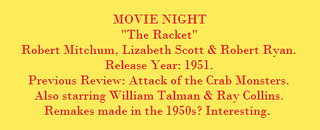
The Racket (1951).


Review #1008: The Racket.

Cast: 
Robert Mitchum (Captain Thomas McQuigg), Lizabeth Scott (Irene Hayes), Robert Ryan (Nick Scanlon), William Talman (Officer Bob Johnson), Ray Collins (District Attorney Mortimer X. Welch), Joyce MacKenzie (Mary McQuigg), Robert Hutton (Dave Ames), Virginia Huston (Lucy Johnson), and William Conrad (Detective Sergeant Turk) Directed by John Cromwell.

Review: 
When I reviewed the original 1928 version of The Racket (#901), I described it as an efficient film that ran at a fine pace that pushed the right buttons and served its purpose as a crime drama that had originally served as a stage play the previous year. In any case, it is interesting reviewing the remake that was made just two decades later, with the man who had starred as McQuigg in the original Broadway production serving as director. In any case, this is a movie that isn't much of an improvement on the original, though it is also a movie that is at best moderately satisfying to the standard of film noir crime drama that you might expect. The best thing about the movie is the scenes involving Mitchum and Ryan, such as their first scene together, when the latter ends up having to deal with his brother's involvement with a singer and an ensuing conversation about his care for him - along with dialogue about how the other will try to pull one over the other. There isn't much going for the film that you could already see in other gangster films (or even the original version), and the characters themselves aren't really all too interesting. Sure, Mitchum and Ryan pull off fine performances, and the rest of the cast are fairly decent, but they can't really elevate these characters to anything too special or compelling, although Conrad is certainly interesting to watch even when in the background. It seems to hint at something more with the corruption element, but it never really comes off as anything too revealing nor does it seem like it wants to say something more relevant than what you might expect. Oddly, though Cromwell is the only credited director, four other directors directed supplemental scenes in the film due to re-shoots ordered by Howard Hughes (owner of the studio that released the film, RKO Radio Pictures): Nicholas Ray (director of Rebel Without a Cause (#181) and Bigger Than Life (#928), Tay Garnett (director of films such as the 1946 version of The Postman Always Rings Twice), Sherman Todd (who also served as editor of the film) and Mel Ferrer (actor/director). Notable scenes that Ray directed include the beginning scene with the the Crime Commission, a police locker sequence, and other bits and pieces.

At 88 minutes, it's not exactly a slog of a film to go through, and it is a movie that is on a basic level entertaining, but it's really hard to recommend this film over other films (The Big Combo (#934), He Walked by Night (#947), or the 1928 original). On a grading scale, this would fall along a C level, but I can't blame someone for finding it useful to watch at least once. It's a mess, but it is a fine mess that shines in all sorts of directions for everyone, for better or for worse, being a pretty good example of a toss-up.

Overall, I give it 6 out of 10 stars.