
Showing posts with label Burt Lancaster. Show all posts

April 29, 2025

The Professionals (1966).

Review #2371: The Professionals.

Cast: 
Burt Lancaster (Bill Dolworth), Lee Marvin (Henry "Rico" Fardan), Claudia Cardinale (Maria Grant), Robert Ryan (Hans Ehrengard), Woody Strode (Jake Sharp), Jack Palance (Jesus Raza), Ralph Bellamy (Joe Grant), Joe De Santis (Ortega), Rafael Bertrand (Fierro), Maria Gomez (Chiquita), and Jorge Martínez de Hoyos (Padillia) Written for the Screen and Directed by Richard Brooks (#871 - Cat on a Hot Tin Roof, #1033 - Dollars, #1426 - In Cold Blood)

Review: 
Admittedly, it does help to highlight a director that likes to have it their way as writer and/or producer too, particularly one as fiery and as less covered as I would like to admit. Richard Brooks was actually a reporter before he became interested in the film industry, and it served him well to serve in the Marine Corps film unit in World War II because his debut novel (you might know it as Crossfire [1947]) got him attention in actually being sought for writing in film, most notably with uncredited work with The Killers (1946) and collaboration on Key Largo (1948). He became writer/director with Crisis (1950) at MGM and honed his talent there, culminating with Cat on a Hot Tin Roof (1958), one of his numerous adaptations of previous material. He struck forward with other studios and won with Elmer Gantry (1960), which won him an Academy Award for his script. Two films later (Sweet Bird of Youth (1962), Lord Jim [1965]), here we are with another adaptation of previous material, in this case being the 1964 novel A Mule for the Marquesa, by Frank O'Rourke (O'Rourke was a regular writer of Western books, with The Bravados (1958) being among the first of his adapted into movies). The movie was shot in both California and Nevada (most notably with Death Valley). The result was a hit that garnered Brooks two Academy Award nominations. If any director had multiple peaks and valleys, Brooks likely reached his last peak with his next movie that arose in 1967 with In Cold Blood, as he directed six further movies in the next two decades.

Oh hell, you need to balance out the Westerns when travelling along the trail for curious entertainment, one that has two distinct halves that will hold one's attention with how much energy can be put on screen in such lean execution. Cliche as it sounds, this is clearly the work of a professional when it comes to establishing an entertaining ensemble (one that sure won't remind folks of say, The Magnificent Seven) and a locale that isn't lost among the peaks and valleys of dirt. It is a gritty and fun movie for its 117-minute run-time, suffice to say. It is a pal's kind of movie, not one where one ego just overshadows the other, but if we are being fair, Marvin fits the movie like a glove. There is something about Marvin* that inspires a smile with how one just rolls with him to lead a movie with such an understated charm that might as well have come right down from his days playing hardboiled guys that doesn't have to say much to just make one roll with things. Of course, Lancaster isn't too far behind in wise-ass charm, he just happens to be shrouded in curiosity in following along with being part of the kicking-ass nature and causing mayhem. Ryan and Strode round out the core four with their own entertaining qualities (even with both past their fifties, one can see an ass-kicker there, basically) while Cardinale and Palance fill the sides with commitment that show the actual sides to a frontier closing in on people where people will die for their commitment to a cause because of the passion they yearn to show. Bellamy is the right kind of craven outsider needed to start and end the movie. Being trapped in peaks and valleys roll well with the mayhem created in just letting things fly with relatively colorful people to hold it. By the time one gets to the ending, you might see a movie that strains to really hold it all together, but it does work out to see the culmination of making a choice on conviction rather than by simple order. In that sense, this is a neat movie, maybe not a great Western but a worthwhile ensemble movie with worthwhile people all around to make it worth your while.

Overall, I give it 8 out of 10 stars.
*You might want to know that would be Academy Award winning Lee Marvin, as the previous year saw the release of Cat Ballou (1965), which saw him win for Best Actor. Incidentally, Marvin and Ryan teamed up the next year for The Dirty Dozen in another movie about colorful characters and guns, guns, guns.

July 14, 2023

The Killers (1946).

Review #2041: The Killers (1946).

Cast: 
Burt Lancaster (Pete Lund/Ole "Swede" Anderson), Ava Gardner (Kitty Collins), Edmond O'Brien (Jim Reardon), Albert Dekker ("Big Jim" Colfax), Sam Levene (Lt. Sam Lubinsky), Vince Barnett (Charleston), Virginia Christine (Lilly Harmon Lubinsky), Jack Lambert ("Dum-Dum" Clarke), Charles D. Brown (Packy Robinson), Donald MacBride (R.S. Kenyon), Charles McGraw (Al), William Conrad (Max), Phil Brown (Nick Adams), and Jeff Corey ("Blinky" Franklin) Directed by Robert Siodmak (#468 - Son of Dracula, #797 - People on Sunday, and #1826 - The Suspect)

Review: 
In 1927, Ernest Hemingway's short story "The Killers" was published in literary form. Set in his home state of Illinois, it details two hitmen entering a restaurant with an owner and a cook alongside a patron named Nick Adams, which Hemingway wrote from his own experiences. The two hitmen suddenly take Adams and the cook into the kitchen to tie them up while telling the owner that they were hired to kill a prizefighter expected to enter the place soon. Of course, when the guy doesn't show up, the hitmen leave while Nick is sent to a boarding house to warn the man about the job, but Nick is told to do nothing because it is futile for there to be attempts to save him from his fate. Hemingway later stated, "That story probably had more left out of it than anything I ever wrote. I left out all Chicago, which is hard to do in 2951 words." The entirety of that story is told in the first twenty minutes of the 1946 film adaptation (the killing depicted isn't in the actual story, of course). This was the fourth adaptation of a Hemingway story, following in the wake of A Farewell to Arms (1932), For Whom the Bell Tolls (1943), and To Have and Have Not (1944). The screenplay is credited to Anthony Veiller, although it was said in later years that Richard Brooks and John Huston contributed to the script in uncredited form. At the helm as director was Robert Siodmak, who had directed films in his native Germany and France before being driven to America by the rise of Nazism each time. He had done his fair share of genres, although most know his film noirs or B-movies that made him a "actor's director". This would work wonders for Burt Lancaster, who was making his film debut. He actually had an early interest in theatre productions and the circus from a young age, but injuries had him give up the circus. After serving in the U.S. Army in World War II, he took up acting and made an impression on Broadway in a flash. Mark Hellinger, who produced The Killers, happened to need another unknown to make up the cast after getting Ava Gardner from doing pretty much nothing at MGM (Wayne Morris and Sonny Tufts were the initial choices in mind for the role played by Lancaster). He got a tip about Lancaster (near the age of 33 when this film was released), who had signed a contract with Hal Wallis but hadn't made anything for release until Hellinger tested him and decided to sign him on. The film was an audience hit and received four Academy Award nominations that year (directing, editing, score, and screenplay), for which it received none. In 1964, a second adaptation of the story was done in film (after being thought of as too much for television) with Don Siegel as director that had Lee Marvin, Ronald Reagan, and Angie Dickinson as stars.

The premise sure is an interesting one to setup a noir, particularly one built for 103 minutes where one of the key characters is dead right then and there. But it is the journey in the way that things are shot or lit that matters when the scenarios matter most with femme fatales, double crosses, and the good ol' setup for a bag of dough. It isn't often you get a cast filled with so many dependable actors (future or at the moment), whether as stars or not. O'Brien is the one observing all of the pieces moving across the board that has the air of inevitability that he does well with, maneuvering through the tension with good timing. Lancaster is a lean block of excellence, one who generates screen presence in a near instant that delivers well among the flashback sequences told (aside from the one of his death, which he handles pretty well to begin with) in a malleable force of nature. He will only end up in one path, but it is the choices that are made there that make it interesting to see the level of challenge it takes for anyone to try and escape their big desire. It's clear to see how his face became one to reckon such desires in further films. Gardner makes a solid femme fatale, one who has the allure required to drive tension into the heart of anyone, a devastating display of dashing duplicity. The rest of the cast follow along in worthy interest for the subject at hand, whether that involves the heavy or the key part of the crisscross of who is fixing who. The robbery sequence itself is executed quite skillfully, done with resounding timing without wasting a moment. By the time the film has maneuvered its way through all of the twists and turns that come with "the best laid plans of mice and men often go awry”, the final result is a lean and mean noir that shows the potential of its stars in a solid effort from Siodmak and company. The fatalistic nature of the whole affair makes for a solid entertaining ride that merited the highest praise from Hemingway, who once called it "the only good picture ever made of a story of mine." That pretty much says it all right then and there.

Overall, I give it 8 out of 10 stars.

December 16, 2020

Airport (1970).

Review #1612: Airport.

Cast: 
Burt Lancaster (Mel Bakersfeld), Dean Martin (Vernon Demerest), Jean Seberg (Tanya Livingston), Jacqueline Bisset (Gwen Meighen), George Kennedy (Joe Patroni), Helen Hayes (Ada Quonsett), Van Heflin (D. O. Guerrero), Maureen Stapleton (Inez Guerrero), Barry Nelson (Anson Harris), Dana Wynter (Cindy Bakersfeld), Lloyd Nolan (Harry Standish), Barbara Hale (Sarah Demerest), Gary Collins (Cy Jordan), John Findlater (Peter Coakley), Jessie Royce Landis (Mrs. Mossman), Larry Gates (Ackerman), and Peter Turgeon (Marcus Rathbone) Written and Directed by George Seaton (#303 - Miracle on 34th Street)

Review: 
I'm sure you are familiar with the disaster film. After all, how many times can you draw from the well of disaster films in a decade quite familiar with big spectacle and stars? Airport isn't the first disaster film ever (obviously), but it surely played a key part in the boom of big-time spectacles involving thrills that would be refined into refined hokum to chuckle with The Poseidon Adventure (1972) and The Towering Inferno (1974), which turned out way better in actual suspense (namely by not putting its characters in peril so late in the film). But wait, we are talking about a movie that somebody somehow really liked, since this made its budget back ten times (on a $10 million budget) and received a plethora of Academy Award nominations (going from Best Picture to Best Supporting Actress...twice! This was the year of Patton and Love Story, remember). But hey, this might seem interesting in its connections with Airplane! (1980). That film was a remake of a film called Zero Hour! (1957), which was adapted from a TV production that both featured Arthur Hailey as writer. A decade later, Hailey would write a book called Airport (1968), one of his numerous novels involving the depiction of a certain profession (such as hotels or the automobile industry), for which this film is adapted from. So, in a decade that saw disasters like earthquakes, meteors, infested animals, what can happen with an airport? If you can believe it, not too much, because this manages to be an interminable experience, proving that big stars cannot hold a 137 minute movie beyond B-movie clichés with all the predictable trimmings for exactly one thrill and nothing else. It is as if Grand Hotel (1932) was being regurgitated, one might say.

This was the 20th of 21 films done by George Seaton, the contract writer-turned-director who many will recognize from Miracle on 34th Street (1947, which he won an Academy Award for), although this film was the biggest one of his career; he never actually shot in Minneapolis–Saint Paul International Airport due to catching pneumonia, and Henry Hathaway stepped in to direct for five weeks there (he did not want payment for his work), complete with starting with fake snow upon having clear conditions. It is interesting to note this as the second-to-last film produced by Ross Hunter, mostly because of the fact that it reminded me of the fact that he left Universal Studios after this to produce Lost Horizon (1973), and we all know how that worked out. The only reason this is any better than that other film is the fact they don't think to ever start singing. Burt Lancaster even called the film a "piece of junk", and he starred in this film! At least he enjoyed the money that came from starring it to do something better (which is preferable to starring in junk and then getting swindled). Seberg didn't like it much either, but I'm sure the big winners proved to be Kennedy and Hayes, since the former was the only one who ended up starring in the next three Airport films and the latter won an Academy Award for her performance (no, I am not kidding, beating out her own cast-mate Stapleton!). This was also the last film role for Heflin and Landis. The only thing that will likely come out of it fine is the airplane industry, seeing how it is promoted so much in such a corny movie, one that will talk about anything else before thinking about thrills, whether that means trouble with noise pollution, office affairs, and quirky customers - oh, but the thing with a flailing airplane, that's just there for the last 25 minutes. To go through the list of actors is like looking through a view-finder and seeing the various slides to see which one "sticks out" the best, before realizing it is a hunk of junk. Lancaster is a fine actor, but he can't help a silly time get better, stuck between rescue mission and workaholic-ism that would've been in vogue with the 1940s or 1950s more than played here. Martin gets the pleasure of being Martin with a considerable age difference in his romance subplot (while reminding me of how many movies I've yet to get to with him as a lead). Seberg seems more stuck in that coat than anything, miles away from films like Breathless (1960) with confounding astonishment. Bisset is here and there with a supposed role of the mistress that seems quite empty for a film in need of a hole in the head. Kennedy is quite enjoyable, in the sense that a cigar-chomper trying to get a plane moving is probably more exciting than anything else that happens in the film. Hayes plays the stowaway with a few wisecracks that is only noteworthy because it is the famed actress of theatre, film, and TV playing it and nothing else - her being used as a ploy near the climax is amusing though. Heflin, a actor of theatre, radio, and film with star and character roles before his death in 1971, does just fine with the quiet adversarial role that is given very little to really do besides bide his time. Stapleton mounts herself to the ground with panic that could be thought of as camp pantomime, while others are there to point out and say words about, like Nelson (never quite a star, but he was the first James Bond...on television), or Wynter (tall, elegant, and wasted in this film for arguments), or Nolan (various roles in light entertainment or B-fare).

So yes, I have been quite mean with just calling it a turkey, and it is the fact that I did not expect much from it that only seals just how bland my disappointment is at the end of the day. The only plot that really matters involve Kennedy or the plane in the air possibly going down, not so much with the billions of other plots about these folks. But at least when the plane does receive some trouble, it ticks up in interest, which therefore means I did get some silly amusement in seeing actors fumble in cheesy danger, complete with the magic of split-screen photography. Actually, that is my other bone of amusement, because certain scenes feature a shot of someone in a circle cut into a scene on the plane saying their dialogue, as opposed to simply cutting to them just saying it...or just having them heard instead of seen. This is also used with a scene of someone using code words for security (with a diamond cut to see all five guards - nifty?). If things are happening in this film, watch out, because it will probably just stop not long after for something else. With a movie that introduces only one troubled person and nothing else, take a guess at how many people will face danger and lose by the end. Congratulations, you won - oh did you guess zero? If you did, you get credit because that would have made an even worse film. Naturally, there were sequels, and they only managed to get sillier with their progression alongside their choice of stars, which ranged from James Stewart to Gloria Swanson that were all released later in the 1970s (1974, 1977, 1979). Truly, the only thing I learned from this is maintaining an aversion to airplanes for yet another year, with the hope that no one tries to make corny movies like this about the bus industry or worse yet about walking. At that point, one might as well just cover your eyes and look for the hurl bag.

Overall, I give it 6 out of 10 stars.

April 21, 2020

Gunfight at the O.K. Corral.

Review #1395: Gunfight at the O.K. Corral.
Cast:
Burt Lancaster (Marshal Wyatt Earp), Kirk Douglas (Doc Holliday), Rhonda Fleming (Laura Denbow), Jo Van Fleet (Kate Fisher), John Ireland (Johnny Ringo), Lyle Bettger (Ike Clanton), Frank Faylen (Sheriff Cotton Wilson), Earl Holliman (Deputy Sheriff Charlie Bassett), Ted de Corsia (Shanghai Pierce), Dennis Hopper (Billy Clanton), Whit Bissell (John Clum), George Mathews (John Shanssey), John Hudson (Virgil Earp), DeForest Kelley (Morgan Earp), Martin Milner (James 'Jimmy' Earp), Lee Van Cleef (Ed Bailey), and Jack Elam (Tom McLowery) Directed by John Sturges (#427 - The Magnificent Seven)

Review: 
"Take one for spontaneity."

Everyone needs an entertaining picture. John Sturges could do an entertaining picture when given the chance to do so. He had started in the film business with RKO through a connection to his brother in their Art department, gradually rising from bluebrints to editor in a period of seven years. He subsequently served in World War II under the US Army Air Corps (where he did direction on training films and documentaries with William Wyler such as Thunderbolt) before returning to Hollywood with Columbia Pictures, who gave him his shot at directing with The Man Who Dared (1946), the first of a bunch of b-movies for them, with The Walking Hills (1949) being his first Western. A move to MGM in 1949 led to films with a bit more prominence, where he continued to make dramas, noirs, and Westerns. His most significant film through the studio before he turned independent was Bad Day at Black Rock (1955). Ultimately, Sturges (who favored just one take to get a scene done) would direct over 40 films in a 30-year career before his death in 1992 at 82 years old.

Making a film about the Old West can be an interesting time when there is some historical precedent to it, which has been the case for numerous Westerns about the legend of Tombstone, although most of those films probably didn't have a ballad to them. Of course one isn't going to particularly learn all there is to know about a famed gunfight in a movie like this (particularly an event that in reality lasted less than a minute and had just three people killed), where even an acclaimed Western on the subject like My Darling Clementine (1946) had tinges of inaccuracy (which also featured Ireland), with the formerly considered factual novel Wyatt Earp: Frontier Marshal having risen the late Earp into a famed Old West icon. While this film is not as particularly good on the subject as say Tombstone (1993), this is a solid Western for its era, building itself with quiet ambition and a capable duo in Lancaster and Douglas for a useful climax. Lancaster, the circus performer-turned-war veteran-turned actor (along with occasional producer) resonates with calm authority, which goes well when acting alongside Douglas, as they worked together on several films together. Douglas (another fellow war veteran turned actor, albeit with a rough childhood) commands attention each time he is on screen, a forceful presence even when coughing as the film goes on that showcases plenty of discipline that he was known for. They click the most together, with scenes of the Earp family together being second and everything else being okay at best. Fleming (who had "Queen of Technicolor" as a nickname by others) does okay, but a film with a fictional character to make a romance (Earp married three times, each common-law) doesn't prove to have much structure anyway since she doesn't have as much screen-time anyway, while Van Fleet delivers a few weary wicked moments. Ireland and the other adversaries do fine with stoking tension, which includes a young Dennis Hopper in just his fourth film role. On the whole, while the film can sometimes seem a bit too pedestrian at 122 minutes, there is a fine quality to follow along with its two leads and the conflict which work to serve an action-stuffed climax just the same. It isn't a great Western by any means, but it will serve its purpose of entertainment just the same with its own particular grip of a legend of the Old West for its time.

Overall, I give it 7 out of 10 stars.

January 18, 2017

Sweet Smell of Success.


Review #897: Sweet Smell of Success.

Cast: 
Burt Lancaster (J. J. Hunsecker), Tony Curtis (Sidney Falco), Susan Harrison (Susan Hunsecker), Martin Milner (Steve Dallas), Sam Levene (Frank D'Angelo), Barbara Nichols (Rita), Jeff Donnell (Sally), Joe Frisco (Herbie Temple), and Emile Meyer (Lt. Harry Kello) Directed by Alexander Mackendrick (#567 - The Ladykillers)

Review:
This is the kind of movie (often put under the category of film noir) that lures you and never seems to let go of your interest, even with character such as these and dialogue spoken in ways that are still as sharp as they were nearly 60 years after its release. Lancaster and Curtis are the perfect pair of leads that will make you recoil at their actions and how they convey them with the right sinister touch, where it's hard to tell who is more villainous and who is more pathetic. The way that the movie is shot is also another positive, where the lighting (particularly on Lancaster) really give the movie a certain feel that mike make one a bit squeamish, and for good reason. Harrison doesn't get much to do, but she certainly does a fine job at portraying a pawn in a movie all about schemes. Milner is also pretty decent at playing such a headstrong character that contrasts well enough with the rest of the characters. The supporting cast is also pretty good in making the atmosphere even more seedy. There is certainly a good degree of wit and pacing where you can be uncomfortable with the implications (read: actions) brought by the movie and still find the movie an achievement in film-making, with a good run time at 96 minutes as well. Mackendrick certainly manages to make a movie (based off a novelette by Ernest Lehman with the film written by Clifford Odets) worth watching, thick in its own layers of darkness within its cleverness. It's not a movie for anyone, but it is a movie worth watching, in part because of how well crafted it is, from the production values to the cast.

Countdown to #900: 10, 9, 8, 7, 6, 5, 4, 3...

Overall, I give it 9 out of 10 stars.

July 4, 2014

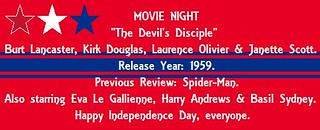
Movie Night: The Devil's Disciple.


Review #612: The Devil's Disciple.

Cast
Burt Lancaster (Anthony Anderson), Kirk Douglas (Richard Dudgeon), Laurence Olivier (General John Burgoyne), Janette Scott (Judith Anderson), Eva Le Gallienne (Mrs. Dudgeon), Harry Andrews (Major Swindon), and Basil Sydney (Lawyer Hawkins) Directed by Guy Hamilton (#280 - Diamonds Are Forever, #289 - The Man with the Golden Gun, #291 - Goldfinger and #293 - Live and Let Die)

Review
It figures to review a movie (based on a play) based around the Revolutionary War on the day of America' declaration of Independence 238 years ago, and The Devil's Disciple fits that bill just nicely. Is the movie good though? Yeah, pretty much. The most interesting actor is Kirk Douglas, playing a clever little character that fits so unevenly with the rest of the character, and yet he's the most interesting one of the bunch. Lancaster is at least commanding, and Olivier is as well, the cast is pretty good all in all. The action is brief, but it is fun to watch, and while the movie may run short, it does its job pretty well. The movie may take its time to get where it wants, but it eventually makes its mark, and it works well overall, especially today. Happy Independence Day to all, and stay safe.

Overall, I give it 8 out of 10 stars.

November 27, 2013

Movie Night: Field of Dreams.


Review #488: Field of Dreams.

Cast
Kevin Costner (Ray Kinsella), Amy Madigan (Annie Kinsella), James Earl Jones (Terence Mann), Ray Liotta (Shoeless Joe Jackson), Burt Lancaster (Archibald "Moonlight" Graham), Timothy Busfield (Mark), Frank Whaley (Archie Graham), and Gaby Hoffmann (Karin Kinsella) Directed by Phil Alden Robinson.

Review
Being a baseball nut (as I am) will probably make this film even more of a treat for them, but even if you're not a baseball nut, this is still a pretty enjoyable film. This is my first time watching a film that stars Kevin Costner (Though my dad seemed to love watching his films on DVD when I was growing up), and he does an alright job, perfectly awkward in a film like this, and he pairs off really well with James Earl Jones, the two just mesh well with each other. But of course, the two actors who quite nearly steal the show are Ray Liotta and Burt Lancaster, and it's because their presences in the scenes each have just leave a lasting impression on me, and it really is a warming film that forgoes sentimentality it transcends into its own one of a kind of films. Costner joined this film because he felt this would be "this generation's It's a Wonderful Life", and I don't blame him because while it may not be one of the greats, it can certainly be watched any time, any day, and work just the same.

Overall, I give it 9 out of 10 stars.