
Showing posts with label D. W. Griffith. Show all posts

October 2, 2022

The Avenging Conscience.

Review #1895: The Avenging Conscience.

Cast:
Henry B. Walthall (The Nephew), Blanche Sweet (His Sweetheart), Spottiswoode Aitken (The Uncle), George Siegmann (The Italian), Ralph Lewis (The Detective), and Mae Marsh (The Maid) Written, Produced, and Directed by D. W. Griffith (#415 - America, #695 - Broken Blossoms, and #1317 - Way Down East)

Review: 
You have to remember that film is an old medium, one that had to evolve beyond shorts and productions made in humble little studios. This is how it works out for horror, which has been there in some shape and form from the beginning, although we are here to talk about features because of their depth, regardless of the notability that came with early ones such as The House of the Devil (1896) or Frankenstein (1910). One of the people at the forefront of doing films that became more than what they were was D. W. Griffith, who went from failed attempts at script-writing to acting in 1908 only to become a director of shorts in that same year for Biograph Company, and it was he who became one of the first directors of films produced in the States alongside one of the first feature-length movies in Judith of Bethulia (1914). His disputes with the company over wanting to make features along with budgets and cast listing made him leave the company in 1914, taking his troupe of actors with him. Six months after the release of this film (the ninth he did in this year, keep that in mind) came The Birth of a Nation (1915) ...and you get the idea about Griffith being a name not long forgotten among cinema. The movie is based on two works by Edgar Allan Poe: the 1843 short story "The Tell-Tale Heart" and the 1849 poem "Annabel Lee". If one is curious about the film, it is widely available in the public domain for all to check out, and an alternate title is presented in the opening as The Avenging Conscience: or 'Thou Shalt Not Kill'.

You may remember that the Heart story was about a man killing someone and then being tormented by the thumping he hears from somewhere that sees his sanity unravel over where the body is. As for the poem, it was a lament for a departed woman that left someone, and certain lines from the poem are shown as intertitles in the film. So yes, this is how Griffith tries to make a bit of material rise out of loose story elements for 78 minutes of staging, complete with a lead character that is depicted as having a liking for Poe (right down to showing a picture of him). It results in a film that seems a bit corny now but surely must have been quite the interesting one for diverting time in 1914. Walthall makes a quality focus, conveying the spooked desires and regrets required in the role to make tension without overextending himself. He fidgets and makes you think about fidgeting without giggling. Sweet plays the role of affections and all that jazz, while Aitken makes a quality target foil for someone meant to exist as both a grump, alive or dead. The effect to show the ghost of the dead soul isn't anything spectacular, but it gets the basic job done in trying to set some sort of unease in a film that also shows a spider catching a fly and visions of Death and demons (and, perhaps not surprisingly, religious overtones). As hammy it is in actually setting up the story you are here to see, there is something curious in getting to the road of desire and tortured regret that Griffith makes work in enough ways to offset the actual ending. If you think "it was all a dream" seems a bit cliche now, imagine how it must have sounded 108 years ago, one that is both cheap for narrative purposes and the Poe story as a whole (but hey, if you are doing a story "inspired by Poe" where a Poe devotee happens to get in a situation similar to a story, who is the real winner here). As a whole, it might not exactly rank highly as a great horror feature, but as a curiosity for where the steps to get to seeing further chills for the audience in the pre-1930 era, it makes a good start.

Overall, I give it 7 out of 10 stars.

January 6, 2020

Way Down East.


Review #1317: Way Down East.

Cast: 
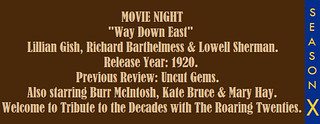
Lillian Gish (Anna Moore), Richard Barthelmess (David Bartlett), Lowell Sherman (Lennox Sanderson), Burr McIntosh (Squire Bartlett), Kate Bruce (Mother Bartlett), Mary Hay (Kate, Squire's niece), Creighton Hale (The professor), Emily Fitzroy (Maria Poole, landlady), Porter Strong (Seth Holcomb), Edgar Nelson (Hi Holler), and Mrs. Morgan Belmont (Diana Tremont) Directed by D. W. Griffith (#415 - America and #695 - Broken Blossoms)

Review: 
Welcome to Movie Night: Tribute to the Decades. While Movie Night always tries to review films from every sort of decade, inevitably the show is a bit slow to cover certain decades in more depth (the 1930s for example have just 45 reviews, with the last review being from December 2017). Given that Movie Night is celebrating ten years in 2020, why not do theme kind of year? As such, each month will have at least four reviews that cover a certain decade, with this month being for the 1920s (the third least-covered decade with 65). The idea is to pick films that are either repersentative of the decade or something worthwhile in some sort of way. Certain months will be preceded by announcements over what is to be covered, but I do hope that you folks enjoy.

The 1920s were a blossoming time for film, particularly when it came to making features. Hollywood was now the center of where films would be made, fit for a decade wracked with extravagance and glamour. There had been feature films released in the previous decade that stood out as successes for features, such as Traffic in Souls (1913, one of the earliest kinds of narrative films), Cabiria (1914, an Italian epic silent release), The Birth of a Nation (1915, a controversial landmark from Griffith that proved a huge commercial success), Intolerance (1916, Griffith's further epic with four parallel storylines, and Cleopatra (1917, lost but known for its lavish sets). It cannot be denied, however, that the 1920s would be the decade that feature films came into further prominence (while the two-reeler kind of films lingered before shrinking further in later decades). While the decade found itself with struggle of evolving from silent to sound, most of the prominent films of this decade would come from silents like the one seen here. It is an adaptation of the 1898 play of the same name by Charlotte Blair Parker. The play proved an eventual hit, with Phoebe Davies (wife of the person who revived the show after initial release, which she starred in) going on to play the lead role for over 4,000 performances. It had been adapted twice before for film, and a further adaptation followed in 1935 that featured Henry Fonda. Anyone familiar with Griffith films will appreciate seeing Gish and Barthelmess together again, particularly for a film that runs at 145 minutes (not surprising given Griffith's collection of work that I mentioned and what would come later, such as the 150-minute Orphans of the Storm, also featuring Gish). It definitely has the feeling of a play at times, although Griffith is certainly talented enough to make this romantic drama engaging enough that it makes the experience worth viewing through the lens of a century since its release.

Gish carries the film as well as she does because of the expressions she can pull when the moment is needed. The concept of an innocent lured into seedy trappings is a familiar one to draw upon, and Gish lives up to someone that we can relate to, one that we can care about whenever dealing with a "marriage" proposal or when with her newborn without a name. Barthelmess proves just as capable, a soulful kind of presence that led to him having a following among women for the decade. Sherman pulls the right kind of smarminess through the eyes that makes for a worthy counterpart for the feature. The rest of the cast do their part just fine, whether if they are a family patriarch or bumbling comedy relief. The film is noted for its climatic sequence with ice floes down a river towards a waterfall as a snowstorm raged on. The ice sequence was filmed in White River Junction, Vermont, with a short waterfall being used. Ice needed to be sawed or dynamited before filming, with the crew making a small fire near the camera to keep the oil from freezing. The leads had to perform their own stunts, with Gish having her hair and hand trail in the water at one point (which led to impairment in her right hand for the rest of her life); Griffith had frostbite on one side of his face at one point. It certainly is a spectacular sequence, worthy of being remembered as a hallmark for a film that works out fine in entertainment for the time in holding up with its convictions through a director in his prime in Griffith. It might seem like old-fashioned melodrama, but Griffith managed to elevate it to something that still feels like timeless entertainment that endures to this very day, worthy for the curious at heart for cinema.

Overall, I give it 8 out of 10 stars.

February 14, 2015

Movie Night: Broken Blossoms.


Review #695: Broken Blossoms.

Cast
Lillian Gish (Lucy Burrows), Richard Barthelmess (Cheng Huan), Donald Crisp (Battling Burrows), Arthur Howard (Burrows' Manager), and Edward Peil Sr. (Evil Eye) Directed by D. W. Griffith (#415 - America)

Review
I admit to not having covered the 1910's much on this show, as this is only the 4th film from that decade (the others being Mickey, Back to God's Country, and The Poor Little Rich Girl) featured on this show, let us just push that fact aside for now for a movie unlike the other films. This is a movie that manages to evoke sadness over the small rays of hope while never betraying its purpose of tragedy. Gish is instantly likable for the audience, from the sad expressions in her eyes to her forcing a small smile, she makes the movie have an unsettling mood. Barthelmess and Gish are wonderful in the scenes they share with each other. Maybe it's the way they look at each other, or how innocent it all seems, which is a blessing by contrast to the rest of the film's tone. Speaking of that, Crisp is brutally effective at making the movie nearly uncomfortable to watch, with his expressions of anger, which all boils down to the surface with the closet scene near the end. Gish's fearful expressions and Crisp's anger combined with filming in a small set make for a climax that delivers. Yes, it's a sad movie. But this a sad movie that manages to be well made along with having some really effective acting. Because after all, if we just watch happy movies all our lives, we'll never know what to do when we encounter a sad moment in our lives.

Overall, I give it 10 out 10 stars.

July 4, 2013

Movie Night: America.

Review #415: America.

Cast
Neil Hamilton (Nathan Holden), Erville Alderson (Justice Montague), Carol Dempster (Nancy Montague), Charles Emmett Mack (Charles Montague), Lee Beggs (Samuel Adams), John Dunton (John Hancock), Lionel Barrymore (Capt. Walter Butler), Arthur Donaldson (King George III), Charles Bennett (William Pitt), Frank Walsh (Thomas Jefferson), Frank McGlynn Sr. (Patrick Henry), and Arthur Dewey (George Washington) Directed by D. W. Griffith.

Review
The first film to be reviewed with D. W. Griffith, America was at the last parts of his directing career, and this film wasn't much of a success in 1924. Is the film any good anyway? Sort of. The facial movements aren't bad, but Hamilton and Alderson don't exactly do the best job. The battle scenes are alright, and the film tries in the history department, looking decent. The film has a length that I imagine some audiences in 1924 might not have liked, over 2 hours at about 140 minutes, and sometimes it feels slow, but if you want a film that has some patriotism, this might be for you, even if it is a bit dated.

Overall, I give it 7 out of 10 stars.
original: