Showing posts with label Alfred L. Werker. Show all posts

July 26, 2023

Repeat Performance.

Review #2056: Repeat Performance.

Cast: 
Louis Hayward (Barney Page), Joan Leslie (Sheila Page), Richard Basehart (William Williams), Virginia Field (Paula Costello), Tom Conway (John Friday), Natalie Schafer (Eloise Shaw), Benay Venuta (Bess Michaels), and Ilka Grüning (Mattle) Directed by Alfred L. Werker #676 - Shock, #721 - The Adventures of Sherlock Holmes and #947 - He Walked by Night)

Review: 
Admittedly, some film directors stay anonymous when it comes to directing, even if there is some sort of promise with select film assignments. But Alfred L. Werker had a consistent career to give himself credit for, because it spanned four decades from his work as an assistant director in the silent era all the way to becoming a director by the time the 1920s ended. He even got to direct within the more noted studios such as 20th Century Fox for a time, and he was the one who directed the second of the Rathbone-Bruce series of Sherlock Holmes films in 1938. Strangely enough, his career saw him on both sides of the coin when it came to directors replacing directors without credit: he was brought into doing a re-shoot and re-editing on Erich von Stroheim's troubled Hello, Sister! (1933) and he was given credit for He Walked by Night (1949) although Anthony Mann contributed a certain amount of input as director. For this film, oddly enough, Werker was brought in by Eagle-Lion Films to do it over Jules Dassin (don't worry about Dassin, he got to direct useful efforts in that time with Brute Force (1947) and The Naked City (1948), so there's that). The film is based on the 1942 novel of the same name by William O'Farrell, with a screenplay by Walter Bullock that reversed the character traits of the lead characters (the man was the troubled shooter while the woman was an alcoholic, but the poet character was, well, a crossdresser); this change was done apparently because when they casted Leslie, they thought she would be more suited for a not-alcoholic role. It was one of the first releases from the studio of Eagle-Lion, who released a considerable number of films that year (no need for coincidences, but one of those features...was T-Men, by Mann), one that would not be a mere cheapie to be paired on package films. 

Okay, here's a film noir that could throw you for a loop: a movie that takes place over the course of 1946 where the lead character is reliving that year all over again after killing their husband on New Years Eve. It may very well be one of the first films to feature a time loop, although obviously it is certainly something to try and make an act out of one person trying to avoid destiny with twelve months to plan that happens to involve her as a stage actor. Apparently, there exists a restoration (as done in the mid-2000s, because it nearly languished in complete obscurity) of the film out there in the markets, which is possibly more intriguing than trying to search for it on the Internet, where at least one version has a "Nick at Nite" bumper at times or happens to have burned-in subtitles (TCM, if you were curious, only showed it first in 2019). The 92-minute runtime is perhaps a bit too long to truly hold up its premise, but it is a curious achievement. Hell, I suppose there are more stories and films about time loops than I thought there would be, aside from that one time you could see it on The Twilight Zone. It begs for some sort of suspense here, but instead it mostly goes about with the air of inevitability more than anything, which is only mildly involving. But one can at least see why Leslie, in the first of two films she did with Eagle-Lion (Northwest Stampede was done the following year), is a worthy presence to set the table in trying to avert a fait accompli. Try as she might in a knowing sense of vulnerability, her realization in the gut-churning countdown to December 31. Hayward is perhaps a bit overextended in trying to play this raving man of drunken bitterness, which results in a bit of hammy acting when it comes to the final setup of a guy doomed to be shot. So confident was Eagle-Lion with the audience reviews about Basehart was that they gave him better billing, which is pretty impressive for a guy going from stage work to his film debut. There is an alluring quality to him as the only one who goes with this idea of destiny, albeit as an eccentric (so yes, instead of cross-dressing, he just gets roped into the asylum because of a girl). The rest of the players do just fine in routines as the film eventually makes its way around what can and perhaps cannot be changed when it comes to thinking about looking at the past a certain way twice. As a whole, it is more curious than anything, but it makes at least some use of its premise with a few decent performances to make a useful recommendation. 

Overall, I give it 7 out of 10 stars.

June 14, 2017

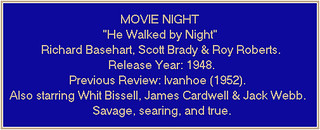
He Walked by Night.


Review #947: He Walked by Night.

Cast:
Richard Basehart (Roy Martin/Roy Morgan), Scott Brady (Sgt. Marty Brennan), Roy Roberts (Captain Breen), Whit Bissell (Paul Reeves), James Cardwell (Sgt. Chuck Jones), and Jack Webb (Lee) Directed by Alfred L. Werker (#676 - Shock and #721 - The Adventures of Sherlock Holmes) and Anthony Mann.

Review:
This is an interesting type of film noir in the fact that it is shot in a semi-documentary tone that is also loosely based off the crime spree of Erwin "Machine Gun" Walker, who like the character in the film was a former police employee and World War II veteran that committed thefts and burglaries with police in Los Angeles roughly three years before the film was made. In any case, this is a police procedural that does not waste much time in establishing its story along with its choices in how to film it, from the narration that occurs throughout the movie to the cinematography by John Alton (who I previously mentioned in The Big Combo - #934) to the group of police characters (and small supporting cast) that are given focus. Werker (along with an uncredited Anthony Mann) gives fine direction to the movie, delivering tension and violence without overshadowing the story.

Basehart gives the gritty kind of performance for a movie bounding itself in reality and having no sort of frills, and it works quite well in serving its purpose. Brady and Roberts are fairly decent police leads, working the movie in a serviceable way. Bissell does a fine job in making this character feel gullible but not outright annoyingly weaselly. One thing to note is that Jack Webb was inspired by a conversation with Detective Sergeant Mary Wynn (who served as police technical advisor for the movie) to create Dragnet, which is the most notable and most influential police procedural drama that had separate runs on radio and television.  Reed Hadley provides the narration in an uncredited role, and he does a capable job, doing a fair job in making the movie seem accessible. There is a consistent type of pace in this 79-minute movie, where nothing seems over-extended past a logical conclusion nor too short; one highlight is the scene where they attempt to identify the suspect via building a composite, with numerous changes before it is finally finished. The ending scene in the sewers is a riveting finale that has the right balance of sounds, shadows and lights, with Basehart's expressions and movements being quite helpful in seeing the climax to its bitter end (which is not exactly like the events in real life, but no matter). This is a fine little gem that does it by the book and succeeds.

To any readers, I am experimenting with using hyperlinks for anytime a previous review is mentioned. With any luck, this will work out without any problems. Hope you enjoy it.

Overall, I give it 8 out of 10 stars.

June 30, 2015

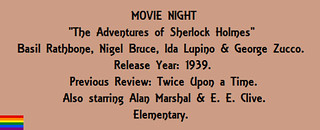
The Adventures of Sherlock Holmes.


Review #721: The Adventures of Sherlock Holmes.

Cast
Basil Rathbone (Sherlock Holmes), Nigel Bruce (Dr. Watson), Ida Lupino (Ann Brandon), George Zucco (Professor Moriarty), Alan Marshal (Jerrold Hunter), and E. E. Clive (Inspector Bristol) Directed by Alfred L. Werker (#676 - Shock)

Review
It's been a while (#583 - The Hound of the Baskervilles) since I reviewed a Sherlock Holmes film, and it's only fitting that it's the second film of the Rathbone series, which had 14 films in total in seven years. In fact, this was the second Holmes film with Rathbone released in 1939, because in those days, films were made really quickly, with the gap between the two films being only 5 months (and 1 day). It is in this film that the phrase "Elementary, my dear Watson" came into popularity, and while it wasn't a phrase used in the Doyle stories (though it was used in stage adaptations before this film), it has entered into Holmes' lore mainly because of the quality of this movie, which is exceptional. The interactions that Rathbone has with Bruce are well paced and make for a good duo, though his scenes with Zucco are also well done, especially their last scene, which has some good action. It may be a little typical at times, but it at least is a good way to spend 81 minutes while watching Rathbone steal the show (as usual) and see a little mystery play out nicely.

Overall, I give it 8 out of 10 stars.

December 20, 2014

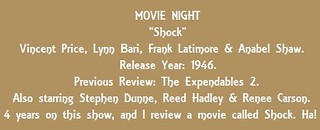
Movie Night: Shock.


Review #676: Shock.

Cast
Vincent Price (Dr. Richard Cross), Lynn Bari (Elaine Jordan), Frank Latimore (Lt. Paul Stewart), Anabel Shaw (Janet Stewart), Stephen Dunne (Dr. Stevens), Reed Hadley (O'Neill), Renee Carson (Mrs. Hatfield), and Charles Trowbridge (Dr. Franklin Harvey) Directed by Alfred L. Werker.

Review
I guess I'm shocked this show managed to get to its fourth year anniversary, so logically this movie makes sense for today's focus. It's a delight to review a film with Vincent Price in it, especially when it's a film noir. And hey, it's a 70 minute one, which I guess is a selling point if you want something quick and cheap (made on a budget of $350,000), but that would also work for fast food, so make up your mind on that one. The movie itself is fine, even if it is devoid of mystery. Really the movie is more about waiting for the characters to catch up to Price's schemes. Speaking of Price, he does a fine job; he doesn't just play an evil doctor, which is a good thing, he does a pretty good job portraying the complexities of his predicament. The other actors are fine, they don't overact their roles, though this is more a movie for Price to shine, even over the patient afflicted with shock (Anabel Shaw). It at least looks good to watch, and it has its moments, especially near the end, which manages to be pretty effective in suspense. For this film, anyway. Well I'm glad Movie Night still has new reviews after four years, and I do hope for more fun and entertaining films in the next year or so. Thank you.

Overall, I give it 8 out of 10 stars.