Showing posts with label Kris Kristofferson. Show all posts

September 15, 2024

Convoy (1978).

Review #2252: Convoy (1978).

Cast: 
Kris Kristofferson (Martin "Rubber Duck" Penwald), Ali MacGraw (Melissa), Ernest Borgnine (Sheriff Lyle "Cottonmouth" Wallace), Burt Young ("Love Machine" / "Pig Pen"), Madge Sinclair (Widow Woman), Franklyn Ajaye (Spider Mike), Brian Davies (Chuck Arnoldi), Seymour Cassel (Governor Jerry Haskins), Cassie Yates (Violet), Walter Kelley (Federal Agent Hamilton), Billy Hughes (Pack Rat), and Jorge Russek (Texas Sheriff Tiny Alvarez) Directed by Sam Peckinpah (#590 - Ride the High Country, #591 - The Wild Bunch, #944 - Pat Garrett and Billy the Kid, #1439 - Straw Dogs, #1685 - The Deadly Companions, #1936 - The Getaway)

Review: 
Sure, one might think of Smokey and the Bandit (1977) first when they wonder about Convoy. But actually, there is a tiny bit of things to think about beforehand. Bill Fries Jr was interested in music but more so in commercial art, which eventually lead to Bozell & Jacobs for art direction. In the 1970s, a character called "C. W. McCall" was created to aid in advertising for...bread, which because of the nature of transporting it through trucks, well, why not making a truck-themed ad and character. The ads (played by Jim Finlayson) were a hit, and Fries used it as a way to come up with a song, which he wrote with Chip Davis (with Donald Sears as producer). Played over the winter of 1975 and early 1976 to interested airwaves, the song (an ode to renegade truckers) was a hit to people in an era where CB radio and trucking were a thing to talk about (McCall wasn't exactly a one-hit wonder, he merely just found other things to do besides singing songs for long, which actually included being mayor of Ouray, Colorado for six years; he died in 2022 at the age of 93). I think you can understand how it might've made sense for United Artists to go out for a film based on the truck stuff. The film was written by B. W. L. Norton, who had wrote/directed Cisco Pike [1972], the somewhat noted cult classic that had starred Kristofferson in his first go at being an actor. Sam Peckinpah had directed these three films before this one: Bring Me the Head of Alfredo Garcia (1974), The Killer Elite (1975), and Cross of Iron (1977). Suffice to say, he needed a hit, and he went with it while fiddling where he could in the script that found a bit of time to cast someone like Ajaye in an apparent attempt to add some social commentary. Apparently, he used James Coburn not so much just for second unit work but also to direct certain sequences due to his furthering addiction to drugs and alcohol. Evidently, the original cut of the film was over three hours long, but editing resulted in a 114-minute film, complete with a new rendition of McCall's "Convoy". The production of the film resulted in a commercial hit, but he did not direct for a while (doing second unit work on Jinxed! [1981] before his final film with The Osterman Weekend [1983]).

Admittedly, you could probably say the film sure smells like it has a substance in its body with how it actually makes one appreciate the fine art of enjoying a dumb-as-hell movie. You thought Smokey was hokum? You haven't seen anything yet. It is the staging of chaos like you have probably seen before, but it is kinetic enjoyment (complete with stunts you can't quite tell are staged or just part of the "go with it" show) that I can't help but admire even in average enjoyment. Besides, the casual average qualities of his prior 70s work such as Straw Dogs and The Getaway make one appreciate the pedal-to-the-medal ridiculousness that looks like if a Western was deep-fried (what else could one say about a line in which Kristofferson refers to him and Borgnine as being part of the "there ain't many of us left" department). Kristofferson drifts in and out as the inadvertent hero for the people that you probably have seen before, but there is a lean confidence in his charm that you can practically have a beer with. MacGraw may have been fine for Peckinpah's Getaway, but she doesn't really have anything of note to do in this film (cut because of the edits or not, you decide)., particularly when one focuses more on the goofy dynamic between Kristofferson and Borgnine anyway,. There is something delightfully enjoyable about Borgnine in how he cuts through the film in terms of smarmy authority that is the kind of played-out entertainment worth sticking around for as the film gets further absurd with the introduction of a Governor character that really believes a convoy of truckers (comprised of a chunk of folks who probably don't even know why they are going along with it all) can be the key to reaching "the people", which is pretty amusing. Rounding out the interest is Ajaye and Young, who make quality character presences in the salt-of-the-earth nature that comes from people wrapped up in essentially the grind of their lives (the off-screen assault of the former in particular sticks out). The ending is probably easy to see coming when it comes to "man of the people!", but it does ring amusement in the actual reveal and lasting laugh, so that works out. The film is clearly not any better than the fried ridiculousness that arose in low-budget / B-movie enjoyment in its wake, but Peckinpah and company managed to grind out a curious movie filled with chaotic engagement anyways. It wouldn't be the first one to recommend in the work of Peckinpah, but it sure would garner curiosity for those who love to see vintage 1970s entertainment with the staging of real-scale effects and stunts to go with a catchy song.

Overall, I give it 7 out of 10 stars.

August 2, 2024

Heaven's Gate.

Review #2237: Heaven's Gate.

Cast: 
Kris Kristofferson (Averill), Christopher Walken (Champion), John Hurt (Irvine), Sam Waterston (Canton), Brad Dourif (Mr. Eggleston), Isabelle Huppert (Ella), Joseph Cotten (The Reverend Doctor), Jeff Bridges (John L. Bridges), Geoffrey Lewis (Trapper), Paul Koslo (Mayor Lezak), Richard Masur (Cully), and Terry O'Quinn (Captain Minardi) Written and Directed by Michael Cimino (#1458 - The Deer Hunter

Review: 
"I wanted you to feel what it was like to walk down a street in that period: to follow those noisy wagons, to cross all that activity, what you felt, what you heard. People made so much dust; my God, was it dusty! That makes the streets dirty... when hundreds of wagons go around, they raise dust. And very often, we took the time to record the background sound. In the store, for example, we recorded numerous conversations, with the intention of inserting them into the soundtrack later. This isn’t general background noise; you hear people, in a corner, argue over the price of a knife, discuss the merits of a particular rifle... each of those people are engaged in a very specific activity and you hear them."

Believe it or not, I was awaiting the chance to watch this film in the best scenario and presentation possible. No, I was not waiting for this day to come just to deluge you with some spiel about the production of the film being the legacy of the film for years and years. August seemed to be the best time to see if this film truly deserved to be acknowledged as something beyond just being thought of by critics and audiences as a failure. The attention to detail actually shouldn't be surprising considering that Cimino (the Yale graduate in fine arts of painting) was quite familiar with the arts before his filmmaking era had begun. In fact, his cinematographer for this film (Vilmos Zsigmond) equated Cimino's selection and placement of extras (which could be as many as fifty) in particular places for shots to painting to go with doing as many takes as it seemed necessary to get the right one to use for a scene. Let us run down the various versions of the film really quickly: Cimino's first screening was for studio executives in June of 1980 (initially before all of the hubbub happened, United Artists wanted a Christmas 1979 release), which ran for 325 minutes that he felt would only be a little bit longer than the final cut. The November 1980 screenings (which lasted a week and had critics going "the Devil has just come around to collect") saw a 219-minute version cut by Cimino. Five months later, a 149-minute cut came and died in theaters. Cimino would only direct four films (the last being The Sunchaser [1996]) prior to his death in 2016. Both of these versions were released in some form of the days of home media. In 2005, a "restored cut" came out for screenings that was assembled by MGM archivist John Kirk with no involvement from Cimino, who had stated that even the original premiere version wasn't really a "director's cut". Finally, in 2012, a version restored and supervised by Cimino himself that lasts 216 minutes and removes the sepia tint that had been present in every edition (which is one that you can see here); it was screened to apparent applause and ovations that Cimino got to hear for himself (while saying once that he "never needed vindication") before an eventual home media release, with the Criterion release being the one I saw for myself.

From 1889 to 1893, a reported range conflict, now generally referred to as the "Johnson County War" occurred in Wyoming involving county settlers and cattle companies (the Wyoming Stock Growers Association) trying to prosecute who they felt were rustlers that led to a variety of lynchings and deaths, such as Ella Watson and her husband Jim Averell or a murderous gunfight involving Nate Champion. The film utilizes real-life names such as Watson, Averell, Champion and Cannon but is generally fast and loose with actual events (such as the death of one person who actually lived until the 20th century). Cimino had envisioned making a film loosely based on the War since the early 1970s (after being inspired by the history of barbed wire in relation to the Old West), but it was only just before The Deer Hunter (1979) garnered Academy Awards that had United Artists onto the idea of giving him money and carte blanche to do what he wanted in filming (located mostly in Montana and Idaho). The result was a film that had a studio executive write a book detailing the movie in all the grisly details (Final Cut, published in 1999). What I see from this film (set in 1890) is one that tries to thread the needle of being the epic of mythmaking, one that wonders just what really lies beneath the fabric of what we call America (complete with a line musing about it "always was" a danger to be poor in the country). It is a movie all about tragedy in its mosaic that demands plenty from its viewer that is easy to see its qualities and drawbacks that are quite distinct from those who saw it in its "prime". Beneath all of the lush photography (and an edited tint, remember) is a film for those with the patience to gaze at the building tragedy that arises from knowing blood will be spilled on this soil as manifested by the destiny of those to live with people who look and act like themselves. The obsession for perceived perfection by Cimino bleeds out quite evidently in the weirdest of ways. In other words, to get to the climatic sequence of wagons and wood, one must see for themselves a sequence of roller-skating (which is where the title comes from) or plenty of stilted moments of this would-be love triangle. Kristofferson and Walken seem to battle for who dominates the screen best in terms of presence in the trouble of staying with the loyalty they wish to express to both Huppert along with the uncertain frontier (Walken has that certain type of glare and Kristofferson has that facade of trying to seem like a common man). Poor Huppert seems lost in trying to hack it beyond hazy charm when Walken can just waltz into his introduction without losing a step. Hurt gets to play an observer removed from actually being involved with the general plot (because of his hollow character) that is sort of effective in a sea of one-note stuff. Poor Bridges chimes in just as little as one thinks by the time of the halfway point, while Waterston seemingly is one really good scene away from being the true presence of soulless manifest the film seems to think he is. The film gives one a hazy outline to basically use their imagination in trying to make one see themselves in these folks that are not merely outsiders, which is only somewhat successful. Its battle sequence at the end makes for a poignant hollow victory for all involved, one where the blood will stay on the soil long after all involved have shuffled off the coil that is considered "settled" to go with that last scene of an older and, well, settled lead presence in the privilege that comes with compliance. I can't call it a great movie because really it is just a bit too bloated to really rise to greatness (although being close to sprawling flawed films like Dances with Wolves is not a bad thing), but I think it is pretty obviously a movie worth checking out to see for oneself (while paying attention, naturally) to assess where it ranks in the pantheon of tragic Westerns and mythmaking as a whole.

Overall, I give it 8 out of 10 stars.

Hello folks. As you can see, we have another August upon us, which means a theme month once again.
The theme for 2024 is "Acknowledged in August", which will cover films that were either lambasted or forgotten by critics or audiences at the time of release in an attempt to see if, well, they deserve to be acknowledged for possibly worth having a cult following. What better way to start than with a film trashed to hell and back in Heaven's Gate? From Michael Cimino to Robert Altman, we will cover some films that may or may not be "something to acknowledge". There will be a few new releases covered alongside the Acknowledged stuff this month, as evidenced by the next review: Trap.

April 15, 2021

Blade: Trinity.

Review #1667: Blade: Trinity.

Cast:
Wesley Snipes (Eric Brooks / Blade), Jessica Biel (Abigail Whistler), Ryan Reynolds (Hannibal King), Dominic Purcell (Dracula / Drake), Kris Kristofferson (Abraham Whistler), Parker Posey (Danica Talos), Callum Keith Rennie (Asher Talos), Paul "Triple H" Levesque (Jarko Grimwood), Natasha Lyonne (Sommerfield), Haili Page (Zoe), Mark Berry (Chief Martin Vreede), John Michael Higgins (Dr. Edgar Vance), Patton Oswalt (Hedges), and James Remar (FBI Agent Ray Cumberland) Written and Directed by David S. Goyer.

Review:
“That was the most personally and professionally difficult and painful thing I've ever been through,. Having said that, I have incredibly fond memories of working with Ryan and Jessica and a lot of people on the movie. Ryan and I remain really good friends today. It was a challenged shoot, as has been reported. What can I say?”

You don't need any fancy sentences to tell you that this is the worst of the Blade trilogy. However, I will make one easy crack at it: Blade: Trinity is probably the dumbest third action installment of a film series since RoboCop 3 (1993), and it is appropriate given the link between main performances that might as well be played by robots. Each film effectively turned their title hero character into a joke while killing their franchise - it should only make sense that there are talks for a remake of Blade, considering that RoboCop got a remake as well (albeit a very mediocre one). Of course, there are a few differences that make this argument amusing: RoboCop 3 is actually quite amusing to watch, one that is a cheap thrill of hammy lines and effects from folks that did what they had to do with a PG-13 script. Blade: Trinity is a movie to laugh at, mindboggling in its attempts at finishing a trilogy that can't even be definitive in its actual conclusions while being plagued by an indifferent actor and a director/writer that also were producers. Oh, but one could be fair to David S. Goyer, because he actually had been a director one previous time before this film - Zig Zag was released two years prior. However, Snipes did not find favor with Goyer being selected to direct the third movie (after a previous director was selected), and production only rolled down the hill from there in terms of interference and breakdowns - if you listen to the grapevine of reports, Snipes at one point would only respond to the name of his character and communicate by post-it notes, although he has refuted these reports (made by cast members alongside a report from someone who spent time on set that claimed of extensive use of stand-ins for Snipes for anything that wasn't a close-up shot), since he was a producer on this film (among the other two). How about we just sum up the troubles like this: it is a movie so miserable that its main star sued the production for its choice in director, writer, and cast (a settlement was apparently reached, although it certainly left no one with a good taste of memory).

Of course, you have to remember what the Blade series was about in the first place: an adaptation of the comic book character of the same name (as created by Marv Wolfman and Gene Colan) that first got his start in the comic series The Tomb of Dracula - Snipes really seemed in his element with a coolly collected hunter of vampires that had plenty of action to go with some dazzling over-the-top action with plots that hold up just enough to work out well as the first triumphant example of turning Marvel characters into movies. Blade: Trinity is none of that. Vampires have now progressed to running themselves in a big skyscraper with an interest in art that makes them want to bring Dracula into the fold (or more specifically, Dracula leading the vampires around). They have also decided to bring Pomeranians into the fold, which is probably worse than having those dogs as pets. Is this a movie that is supposed to be taken seriously? Perhaps the best argument against that is a scene involving Blade meeting the villain (Dracula, who for some reason is also referred to as Drake) after a long foot chase that ends with a confrontation with a baby being thrown; one gets to see the perspective of Dracula towards humans and vampires...and then he throws a baby at Blade that ends up with him going "coochie coo" after the catch. Actually, you could start as early as the first action sequence with Blade, since (are you ready for this?) he is fooled into taking down humans that were disguised as vampires. Blade has become so efficient at killing vampires that he can't even tell the difference between human and vampire anymore. Questions start to arise quickly? How about Whistler getting shortchanged and dying (again) 20 minutes into the movie? How about a character that engages in action with earbuds that blares music into her ear - who just happens to be the secret daughter of Whistler (a character who saw his two kids and wife get taken down by vampires)? How about a scene where Dracula goes into a goth store that is selling merchandise of Dracula from lunch boxes to cereal (before drinking a worker's blood)? The answer to everything is simple: There is none.

One could almost forget that actors are present in this film, really. Snipes probably didn't say that many lines in the first two films to begin with but consider one thing: him and Kristofferson are the only ones to star in each movie, let along star in two of them. Each movie is a different group to experience that just happens to have him paired with Kristofferson in diminishing ways, and the only way Snipes reacts to it is to persist on with trying to seem cool. This time around, it is a good thing I found out about the "stand-in" rumors after I saw the movie, because one could really be distracted by what counts as acting by Snipes and what isn't acting and never come out with a straight answer. Simply put, there is a balance of times where the lines will land as amusing that are either meant to be that way or are not intended to be but come off as unintentionally hilarious, as if the sunglasses are only there to hide displeasure at what is going on in the script. Before we get to the other main focuses, I have to note Kristofferson, because it seems almost any movie with him being featured should get a modest description of him - man, do I wish he wasn't short-changed in this feature. Perhaps it was always the intent to have his time with Snipes come to a natural conclusion...of course, he also was "shot" in the first film, and that last exchange was actually more meaningful than anything that came afterwards. Simply put, Kristofferson deserved better than to be cut down to a few sentences. Oh but Purcell deserves mention too when it comes to deserving better, because he has to play a role that has been done to death for over a century in Dracula, who this time around gets to walk in the sun and shape-shift on occasion before turning into a beast. That aforementioned scene in the goth shop is the easiest scene to highlight in embarrassment, not so much because it is meant to show Dracula's disdain for the modern world (uh huh), but because of the fact that you could trim it down to five seconds and probably miss nothing of importance. By the time he is fighting Blade with a blade, one isn't so much wondering how the fight will end but rather how silly it can get with beast-man Dracula in this duel of honor. Biel and Reynolds each were best known for roles on television series (7th Heaven and Two Guys and a Girl, respectively), although film roles were sprinkled between that. One can see where the idea for a spin-off could happen here, not so much because they are good, but because they might actually have more stage presence than the main star itself with their attempts at action hero dress-up. Reynolds is better in that the ad-libs are the easiest thing to remember in terms of lines (whether to groan at or not), even if they can't help be anything other than generic. Posey, who most might know for work within independent cinema, is certainly an interesting pick for a secondary villainous role - she seems fine with the role, treating it as something fun to do as one could see in a big dumb action movie without falling into the trap of scene-chewing (at least not too much, considering the film). Triple H, however, seems aptly appropriate for a movie this ridiculous, towering over all the folks with a goon presence that only a (WWE) wrestler could do with flourish. Everyone else is pretty much disposable, which seems appropriate given the propensity of the series to keep introducing people to Blade for help/hinderance only to see them not be seen again.

Folks who remember the first film well enough will note that the third film has decided to use the "blood farm" idea that had been deleted from the first film's intended climax, in which the vampires had a solution to that whole problem of turning everyone into a vampire - just store some humans in a fridge and feast on the leftovers. Honestly, it still seems pretty silly to think about, but what is amusing is the fact that each side ends up having the exact same plan: wanting to wipe out the other side like the plague. It is bad enough to have resorted to Dracula as your final villain, but sure, let's just throw a plague out there in the open...and the movie can't even be definitive about anything, since the movie ends with Blade still going around trying to take down more vampires in a never-ending war. The action shots don't seem that much more interesting, as if to add insult to injury. Somehow, there are three different endings to this mess: the original ending involves Dracula being nice in honor of his death by making it look like Blade is dead for the authorities while Blade goes on to fight his never-ending war against vampires; the unrated ending ends with Blade attacking the authorities that makes one wonder if the thirst has returned, while a different ending involves a new enemy for everyone but Blade: werewolves (yes, you heard that right). There were ideas of doing a spin-off film with the Nightstalkers, because if you couldn't do anything else with Blade (aside from a subsequent television series that lasted one season), why not spin further away from things? In the end, 113 minutes cannot end fast enough for a movie that is an absolute headstone for a series that ran its course with failures in action and characterization that make for a laughable affair for all involved, going from Snipes all the way down to its director. But hey, at least a new Blade feature might come into your future to make things seem better.

Overall, I give it 5 out of 10 stars.

June 23, 2020

A Star is Born (1976).

Review #1454: A Star is Born.

Cast: 
Barbra Streisand (Esther Hoffman Howard), Kris Kristofferson (John Norman Howard), Gary Busey (Bobbie Ritchie), Paul Mazursky (Brian Wexler), Joanne Linville (Freddie Lowenstein), Oliver Clark (Gary Danziger), Venetta Fields (One), Clydie King (Two), Sally Kirkland (Photographer), and Marta Heflin (Quentin) Directed by Frank Pierson.

Review: 
"Filming with Barbra Streisand is an experience which may have cured me of the movies."

"For us, the picture cost $6 million and a year of our lives. For the audience it's $3.50 and an evening out. If it's a bum evening, it doesn't make me any better or worse as a person. But if you think the film is you, if it is your effort to transform your lover into a producer worthy of a superstar, if you think it is a home movie about your love and your hope and your deepest feelings, if it's your life that you laid out for the folks and they don't smile back, that's death."
I think I had a pretty good idea of what I was getting myself into when it came time to do this film. It isn't exactly the first time I've seen this kind of story done of a film before. We've moved from romantic drama to musical to musical romantic drama when it comes to A Star is Born, and the easiest thing that can be said is that it certainly is the worst of the bunch in making a consistent romance and tragedy. It seems completely perplexed at times what to do when the camera isn't incessantly focusing on Streisand (who also served as executive producer for the film) as the whole thing threatens to collapse as an ego experience. It is only the curiosity of seeing the limits of where Streisand can go in this "pop and roll" style combined with the enjoyment of seeing Kristofferson stagger with charisma and self-destruction that make things not self-destruct into oblivion for a baffling 142 minutes. This is ridiculous junk, but I'll be darned if I didn't get some sort of cackling enjoyment from seeing how far one can really go in making such a murky 70s film that seems like the ideal sellout and embarrassment for all involved. My particularly favorite memory with the film is not so much a particular scene but actually an article that director Pierson wrote for New West magazine a month before the film's release with "My Battles With Barbra and Jon", which detailed some of the conflicts that Pierson had with producer (and star) Streisand and producer Jon Peters (a hairdresser-turned-producer and Streisand's boyfriend at the tine). There are some interesting little moments involving clashes of ego, but one of my favorite baffling moments is Pierson's meeting with the two in which at one point Peters actually asked if the lead male star had to commit suicide at the end as opposed to having it be an accident instead, since it sounded like such a turnoff. By the time Pierson was approached by Warner Brothers to do the film, numerous writer and directors had been brought in and brought out of doing the film, which had originally been written by Joan Didion and John Dunne as a rock musical with a couple like James Taylor and Carly Simon in parallel careers. Oh but the troubles did not stop with just Streisand (as amusing as it might seem to lay all of the squabbles and jokes on one star/producer). Kristofferson chafed when it came to filming, since he felt that they were making a "Barbra Streisand lollipop extravaganza" rather than some sort of statement about rock music (at least he has the excuse of drinking to act for a drunk lead). Sure, one could debate the ethics of doing an article so close to a film's release, but I heartily enjoy details like this, and even without the article the film is amusing to pick and poke at for its ambitions that crash like a motorcycle on stage.

It is entirely possible that there is a movie here worth really looking into the jagged turns that fame can do to a rock star that the other two films had done for actors. Of course the main problem with that theory is that perhaps Streisand just can't entirely pull off a nervous unknown given a push into stardom. It all seems too manufactured to really stick, too absorbed in showing off without letting you really breathe an actual romance, since the two leads seem entirely focused on literally anything but the other person in front of them. To say the film is all sizzle and no steak is an understatement: the steak got so caught up in re-writes that it turned into a small nut to disintegrate on the grill. On the other hand, I did rather enjoy Kristofferson (a native of Brownsville, Texas that took upon acting to go with his singing-songwriting) and his distant demeanor in his weary entertaining performance. He may be playing a jerk, but man does it invite more conviction and more of a look than what comes out on screen. Busey, an eccentric playing an eccentric peddler of producer (and other certain things) is amusing to see in the few scenes that he is in. Mazursky, who started work as an actor (debuting in Fear and Desire in 1953) before taking on writing and eventually directing (with films such as Bob & Carol & Ted & Alice in 1969), does a careful job here in balancing out the line between producer and man trying to keep someone off the deepest end. The others are here and there, just people to fill in the background before yet another wild or silly antic between our strange stars. To put it mildly, this film stinks, but it sure is a funny one to think about. It is a testament to how overproduced and micromanaged a film can be in hands that believe they are truly making something that can match up to what was old (and classic) while serving the masses with no problem then and now, a hubris unmatched in mediocrity. I know one can see better films with Streisand or Kristofferson, but none could probably be as ridiculous to view play out like this one.


Overall, I give it 6 out of 10 stars.

February 20, 2019

Payback (1999).

Review #1191: Payback.

Cast:
Mel Gibson (Porter), Gregg Henry (Val Resnick), Maria Bello (Rosie), Lucy Liu (Pearl), Deborah Kara Unger (Lynn Porter), David Paymer (Arthur Stegman), Bill Duke (Detective Hicks), Jack Conley (Detective Leary), John Glover (Phil), William Devane (Carter), James Coburn (Justin Fairfax), Kris Kristofferson (Bronson), and Trevor St. John (Johnny Bronson) Directed by Brian Helgeland (#372 - 42)

Review: 
The strangest thing about films can be the ways that it can sometimes transition into numerous forms before a final shift into the form that goes to audiences. This film is a particular example of where a director's vision can verge differently from ultimately made it to the screen. Brian Helgeland was making his directorial debut after meeting up with Gibson on the set of Conspiracy Theory (1997), a film that he had written for. During the post-production stage for that film, Helgeland happened to have the script with him when Gibson inquired about the pages he had with him, for which he read the first act of. A few weeks later, Gibson agreed to finance the film with his production company Icon Productions provided they could shoot within 12 weeks. The film is as adaptation of the 1962 novel The Hunter by Richard Stark (pen-name for David E. Westlake), the first of 24 novels from 1964 to 2008 with the character Parker as the main lead. It had already been adapted a movie in 1967 as Point Blank, featuring Lee Marvin, and other novels had been given film adaptations.

Before I talk about the circumstances that led to Helgeland's dismissal from the film, let's talk about how the movie is first. For a neo-noir, it certainly is a decently entertaining one. It maybe a bit routine in terms of its story and action, but it is a road worth walking onto in part because of its dark charm, which in some ways feels like a guilty pleasure. Gibson is certainly up to task in delivering a character worth following with a subtle grin in a film with oddball people basked in noir types. Henry is fairly adept at showing menace for his time shared with Gibson. Bello does fine with her material, sharing her time with Gibson quite well. Liu (playing a dominatrix) is quite quirky. Paymer plays his role with a good deal of sleazy ooze that is pretty amusing. It is amusing to see Coburn briefly, but interesting to see Kristofferson all of a sudden in the film appear; he isn't really too menacing as the big bad but he is at least neat to watch. The movie moves with a dynamic pace to try and garner up excitement along with a chuckle, and it works out fine for the most part, playing to the noir type handily. It is sometimes a bit wobbly with its plot motivations (and its action violence on occasion), but the final product works out mostly because it manages to distract itself enough to where while you can see where "producer's notes" may have stepped in, you can at least find something to watch without too much disapproval. It has a bit of fun with its aspects of revenge without being too demanding.

Helgeland's version of the film was felt to be too dark for a mainstream audience in terms of story, tone, and look. he was fired from the project, which occurred two days after winning an Academy Award for Best Adapted Screenplay for his work for L.A. Confidential (1997). Thirty percent of the film was re-shot (with new material written by Terry Hayes), with John Myhre (production designer) doing un-credited directorial work. Helgeland would have his version of the film (referred to as Straight Up: The Director's Cut) released on DVD in 2007. His version differs from the theatrical version in several ways, such as a shorter length (90 minutes as opposed to the 101 in the theatrical), a female Bronson un-seen by the audience that is voiced by Sally Kellerman, the removal of the narration by Gibson, and the restoring of the look of the film from a bleached tone to one more normal. Honestly, the look is okay as is (even if sometimes it may seem better in black-and-white by simply taking the color out of the screen manually), but at least there exists two versions to compare. I don't have too much interest in watching the other cut, but if you are curious about what makes a movie go in different directions, I'm sure it is right up your alley. The film as is just fine, not being any kind of big statement as a neo-noir action flick, but it will serve just alright for the tastes of people wanting some entertainment.

Overall, I give it 7 out of 10 stars.

original image:


February 11, 2019

Blade II.


Review #1188: Blade II.

Cast: 
Wesley Snipes (Eric Brooks/Blade), Kris Kristofferson (Abraham Whistler), Ron Perlman (Dieter Reinhardt), Leonor Varela (Nyssa Damaskinos), Norman Reedus (Scud), Thomas Kretschmann (Eli Damaskinos), Karel Roden (Karel Kounen), Luke Goss (Jared Nomak), Matt Schulze (Chupa), Danny John-Jules (Asad), Donnie Yen (Snowman), Marit Velle Kile (Verlaine), Darren "Daz" Crawford (Lighthammer), Tony Curran (Priest), and Santiago Segura (Rush) Directed by Guillermo del Toro (#425 - Pacific Rim and #1061 - The Shape of Water)

Review: 
The cheapest way I think I could describe the film would be that if you liked the first film, you'll be fine with the sequel. It isn't wrong, however. It's a movie that has plenty of loud action, ridiculous moments, and a continuing winning combo of Snipes and Kristofferson. Its plot and some of its characters may be a bit shaky, but in the long run there is just enough here to make something worth a watch for entertainment. It isn't a particularly great comic book film, but it tries to have a balance of action and horror that makes it stick out a bit, not being too much of a copy from its predecessor, which was also written by David S. Goyer. I can't really say it is a better film, in part because of the story, which is okay in getting to its spectacle parts but sometimes ridiculous when giving deep thought to some of its motivations. The initial idea of the film (which sounds like Blade crossed with the Dirty Dozen but with vampires that call themselves the Bloodpack) is a curious one, although it is amusing in execution, since if this so-called pack were trained to supposedly terminate Blade at some point in time, I imagine they would've probably been beaten senseless in less than a hour. Obviously the movie doesn't reply on the ability of this pack to be able to beat Blade, but their lack of characterization besides Perlman and Varela, with the others feeling like fodder. Even though they do fine jobs, they are characters who can sometimes feel one-note, with the former being a bully with watchable qualities and the latter being okay but not invoking as much interest when it comes time to the plot or when with Snipes. Reedus is okay and charming, and Kretschmann is occasionally creepy, but these are cursory moments. Even Goss can't really deliver too much as a villain, perhaps because he doesn't really have much to say (which doesn't help when compared to Stephen Dorff and his villain from the original), and the Reapers (as interesting as they look) seem a bit muddled when compared to Blade; the action is fine and dandy, but after a while the film can't quite find a way to wring itself to anything other than just going through the motions between going from one dialogue piece to another before an action sequence comes in. At least it doesn't feel like an endless cutscene (although the CGI can be a bit dodgy sometimes). The climax is alright for spectacle, although it doesn't really have too many surprises. The film suffers a bit when comparing it to the first film, which felt more flexible with balancing its action and mythology without too much trouble. As okay as the film is with its execution, it still invites curiosity for anyone looking for some vampire action horror that can deliver in the end.

Overall, I give it 7 out of 10 stars.

Special Note for 2019 only: In an error best described as "counting sheep wrong", the review count for Movie Night had been miscounted since review #1168, which was Firewall (2006). Somehow, it was never properly cataloged into my records (which I keep for things such as ratings of each film, release year, etc), while the reviews that followed were. The numbering was done correctly for #1169 (About Schmidt), but the next review of Futureworld was mislabeled as #1169 instead of the correct #1170. This means that the reviews that followed up to now were the wrong number. The review numbers have been corrected and things are fixed, but I wanted to make sure that there is no confusion. Enjoy.

October 10, 2018

The Jacket.


Review #1142: The Jacket.

Cast: 
Adrien Brody (Jack Starks), Keira Knightley (Jackie Price), Kris Kristofferson (Dr. Thomas Becker), Jennifer Jason Leigh (Dr. Beth Lorenson), Kelly Lynch (Jean Price), Brad Renfro (The Stranger), Daniel Craig (Rudy Mackenzie), Steven Mackintosh (Dr. Hopkins), Brendan Coyle (Damon), and Mackenzie Phillips (Nurse Hardling) Directed by John Maybury.

Review: 
The Jacket certainly has an interesting premise to it, with a story from Marc Rocco and Tom Bleecker that was turned into a screenplay written by Massy Tadjedlin. Maybury stated that the film was "loosely based a true story that became a Jack London story." The story he is referring to is the 1915 novel The Star Rover (known as The Jacket for its release in the United Kingdom), which is a novel about a man put into a canvas jacket while in prison that tightly laced his body. The description of the device were based on interviews with Ed Morrell, a convict who was subject to the device during some of his time at San Quentin State Prison in the late 19th century/early 20th century. In any case, this is a movie that certainly likes to think of itself as one step ahead of the audience, although I would like to argue that the film actually staggers along with the audience while dangling some keys in front of them. Perhaps you manage to get more out of this psychological thriller/horror film than I do, because I found this to be a pretty average experience that doesn't stand out as much as it probably should.

Brody heads the cast, and he is occasionally effective, such as with the scenes at the mental institution and the jacket sequences, certainly looking the part. However, I don't find him to be as interesting to follow along with in the other sequences in "2007", being a bit too underplayed. Knightley does alright for what is needed, but this is a movie that perhaps needs a duo a bit more interesting to follow along with, especially since their chemistry is quickly established, and yet it doesn't feel particularly convincing. Think about this - Brody's character meets her character as a kid in 1992, then "meets" her again in 2007 - and they unite to solve a mystery surrounding the former character - and then they fall in love with each other, somehow. Kristofferson doesn't have as much to do as one would expect besides a few scenes that don't make him out to be too particularly menacing. A film like this really needs someone to rally around and rally against (while presenting some sort of interesting ideas to think about), and this one doesn't have much for either. Leigh is fine, having her own subplot that comes and goes with about as much effect (read: minimal) as you would expect. The other cast comes and goes, but Craig stands out with some charm that comes through in his few scenes  The plot involving the jacket and the mystery about Brody's character are occasionally intriguing, but it seems to stick out more for its style shots than anything while trying to play some tricks with the narrative. Instead of being compelling or chilling, I felt more a tinge of passiveness that could've been worsened to boredom, especially since there seems to be a skeleton of a film that can really make a winner. By the time that the film sinks itself into a climax, my mood wasn't so much one of disappointment as it was just one of slight apathy. If I don't care too much about what happens with these people, is the film really worth it? On some levels the film works out fine, and there are a few times that it is creepy, but other times I just couldn't find myself buying into it fully. Despite being 103 minutes long, there just isn't enough effective moments that last enough to really make this something I can recommend definitively.

Overall, I give it 6 out of 10 stars.

February 17, 2018

Blade.


Review #1049: Blade.

Cast: 
Wesley Snipes (Eric Brooks / Blade), N'Bushe Wright (Dr. Karen Jenson), Stephen Dorff (Deacon Frost), Kris Kristofferson (Abraham Whistler), Donal Logue (Quinn), Udo Kier (Gitano Dragonetti), Sanaa Lathan (Vanessa Brooks), and Arly Jover (Mercury) Directed by Stephen Norrington.

Review: 
Blade was the sixth film that was based off a product from Marvel Comics (although it was only the second to be released widely in America, besides Howard the Duck in 1986), adapted off the comic book series created by Marv Wolfman and Gene Colan. The film began its development earlier in the decade, with LL Cool J expressing interest in playing the lead role before Snipes signed onto the role in 1996 (it is interesting to note that Snipes had plans to make a film about Black Panther, although that movie languished in development for over two decades until this year). In any case, this is an interesting take on the vampire film that generally hits more than it misses while notably being Marvel's first box office success.

There is just a certain level of excitement and style that makes the film ride consistently enough that comes in large part due to Snipes and his performance. He just manages to make the material feel believable and useful that might've sound silly with a lesser actor. Wright does a fine job, although I find that she doesn't particularly stand out too much. Dorff proves to be a quirky but fairly entertaining villain, having an unhinged manner to him that gels well on screen at times. Kristofferson manages to stand out pretty well with his rugged charm that clicks despite not having too much time on screen. The rest of the cast do their parts fairly well, not going too overboard nor too serious either. The action sequences are gripping and intense, managing to make for a quick tone that is fairly effective while not being disorientating. The plot isn't anything to be desired, but the film keeps itself entertaining enough to erase some of the nagging problems that would've become more noticeable for a film without as much enthusiasm or fun. The effects (with numerous sequences involving blood) look a bit wonky, but they don't distract too awfully as they probably could've been. The original cut (which lasted 140 minutes) had Dorff turn into a big mass of blood instead of the sword fight that does happen in the final cut, and upon seeing both versions of the fight, I can definitely say that they made the right decision in not using the big mass. At 120 minutes, the movie has a serviceable length that works without too much drag to it. On the whole, Blade is a strange mix of energy and slick filmmaking that works in the right places to make a solid piece of entertainment.

Overall, I give it 8 out of 10 stars.

July 14, 2017

Planet of the Apes (2001).


Review #969: Planet of the Apes.

Cast: 
Mark Wahlberg (Captain Leo Davidson), Tim Roth (General Thade), Helena Bonham Carter (Ari), Michael Clarke Duncan (Attar), Paul Giamatti (Limbo), Estella Warren (Daena), Cary-Hiroyuki Tagawa (General Krull), David Warner (Senator Sandar), Kris Kristofferson (Karubi), and Erick Avari (Tival) Directed by Tim Burton (#040 - Batman, #107 - Beetlejuice, #132 - Alice in Wonderland, #196 - Charlie and the Chocolate Factory, #262 - Corpse Bride, and #316 - Batman Returns)

Review: 
On the cusp of a new film from the Planet of the Apes franchise (of which I've covered three of them: #347 - Planet of the Apes (1968), #615 - Rise of the Planet of the Apes#662 - Beneath the Planet of the Apes) , I figured that it made sense to cover the 2001 film of the same name that was a remake and an attempt to start the franchise up again; I remember my dad watching this on DVD one quite a bit when I was growing up, and the only part I remember vividly was the ending, so perhaps that colors my thoughts on the movie (although it is the probably the only part of the film anyone remembers). Not only does it try to be based of the 1968 film, it also is based off the novel La Planète des Singes (known in English as Planet of the Apes) by Pierre Boulle. So how does this "reimaging" do?

How is it a movie with a good deal of production value like this manage to feel so shallow? What is it about this movie that springs an energy of mild but not quite there sense of entertainment? How is this not as good as the original? Unlike the ending, these are questions that the movie can provide answers for. The easiest way to say why the movie isn't particularly exciting is the fact that the story and some of the acting seem hollowed out and not as appealing as in the original 1968 film. Wahlberg doesn't do a terrible performance, but he also never really springs much enthusiasm as a lead hero; even a scene where he laments the loss of a crew looking for him doesn't have much emotion to it. It's not that he is inherently unlikable, it's just that he also isn't inherently one to really root for. Not to compare it with the original too much, but Heston's character was someone the audience could go for and want to see succeed, and he actually viewed the environment he landed in with a better sense of shock, as opposed to Wahlberg's space jockey attitude. Technically he has two love interests in the film, though neither have particularly good chemistry with him and it predictably goes nowhere. Roth steals the show with his militaristic, scenery chewing performance that gives the film a bit of life, even if his fate is somewhat of a letdown. Bonham Carter is fairly decent, but she doesn't really give too much depth or life to the character that one probably would've wanted from the role. Clarke Duncan and Hiroyuki Tagawa are fairly decent standouts as well; Warren doesn't really have too much expression nor impact, and Giamatti does fine in a smarmy role that probably had more screen-time than it probably should've had. Charlton Heston has an uncredited cameo appearance, having a somewhat pivotal role that is interesting in the one scene he appears in. The prosthetic makeup by Rick Baker is commendable and quite an upgrade from the original, with this likely being the only shining achievement in the movie. The plot is a bit muddled, and with no real character to go for and care about, there isn't much to want to watch happen. It's watchable as an action flick, but not so much as a science fiction movie. Burton does direct the movie fine enough, with the movie looking pretty decent, but the way that the movie operates with its characters sinks its hopes.

And of course there's the ending. To some, the ending could be viewed as a reasonable way to end the movie and leave the possibility of doing a sequel (as Burton has stated), or it could be viewed as one that doesn't make much sense. It's interesting, considering the ending falls in line with the novel that it is based off of. For me, it was weird watching the movie in full and then getting to the ending and finding myself giggling at it. Who knows how Thade beat Leo to Earth? Who can care to speculate about what the ending is supposed to mean? After all, this is a movie that never really kicks into full gear, with the ending that is like the movie: mild, without much substance. It's not awful, but it also doesn't feel entirely necessary either.

Overall, I give it 6 out of 10 stars.

June 8, 2017

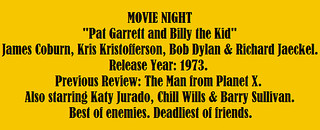
Pat Garrett and Billy the Kid.


Review #944: Pat Garrett and Billy the Kid.

Cast:
James Coburn (Sheriff Pat Garrett), Kris Kristofferson (Billy the Kid), Bob Dylan (Alias), Richard Jaeckel (Sheriff Kip McKinney), Katy Jurado (Mrs. Baker), Chill Wills (Lemuel), Barry Sullivan (Chisum), Jason Robards (Governor Lew Wallace), R.G. Armstrong (Deputy Sheriff Bob Ollinger), Luke Askew (Eno), John Beck (John W. Poe), Richard Bright (Holly), Matt Clark (Deputy Sheriff J. W. Bell), Rita Coolidge (Maria), Jack Dodson (Lewellen Howland), Jack Elam (Alamosa Bill Kermit), Emilio Fernández (Paco), Aurora Clavel (Ida Garrett), Paul Fix (Pete Maxwell), L.Q. Jones (Black Harris), and Slim Pickens (Sheriff Colin Baker) Directed by Sam Peckinpah (#590 - Ride the High Country and #591 - The Wild Bunch)

Review:
It is easy to say that this is a movie that does not skew for morality within its main characters, who seem to have interesting chemistry with each other. Not only is it a Western, it also serves as a sort of tragedy, where former friends are now pitted against each other. This is a bittersweet movie, filled with grit and action that make for a movie that can be rewarding if one has the patience for it. Everywhere you look in this film has a raw connection in someway to violence, where even lawmen are not so different from the outlaw that they hunt down; this is a bitter film, but it is also a film that accomplishes in expressing the nature of what the Old West looked and felt. Watching this movie feels like a eulogy for the times and myths that have gone by, and while the movie may drag itself under its own weight at points, it definitely hits more than it misses.

Coburn and Kristofferson are a fine tandem when on screen together, with the former having a reliable cool nature and the latter having a good amount of charm to him; right from the first scene they just seem to have an easy connection, where it doesn't look like we need a dump of exposition in order to set the stage. Dylan (who also contributed to the music) plays a strange cipher of a character (being more of an observer than a participant in the bloodshed going on), but he definitely is noteworthy to watch, even when he is reading food cans on the shelf. The music in the movie is pretty effective with the tone of the movie, with "Knockin' On Heaven's Door" being a key highlight. The rest of the cast (some who make only brief appearances) are pretty effective, managing to serve the film well when needed. The opening of the film (in the special edition and Peckinpah's cut, but more on this later) where Garrett's death and the shooting of chickens by Billy and his gang intersplice with each other is quite interesting, having a strange violent beauty to it. This was filmed in the Mexican state of Durango (in part due to conflicts with MGM), and the sets contribute into making this a visual achievement; it's not so much that the Old West is glorified, but it definitely becomes a character in a movie that isn't above myths and showing the clash of the times, where freedom and safety (within profit) interact violently. There is a spirit to this movie that is unyielding in its passion, and it definitely works even after over forty years.

This was a movie that went through production turmoil, which resulted in Peckinpah's version not being seen for years due to conflicts with MGM (and more importantly James Aubrey, President of the company at the time) over budgeting and scheduling. After the film finished 21 days behind schedule and more than a million dollars over budget, Aubrey had the film cut from a preview version of 124 minutes to 106 minutes with numerous scenes cut (including the beginning scene) and six editors being credited (this edition was disowned by cast and crew). In 1988 (four years after Peckinpah's death), a preview version of the film was released by Turner Home Entertainment, which lasts 122 minutes. In 2005, Warner Bros released a special edition version, which incorporates elements of the two movies along with additional scenes, which lasts 115 minutes. In any case, the movie has gained a new status among respective audiences, in large part due to the versions that have come out in the past few years.

On the whole, what more is there to say? Watch the film in the right state of mind, and you may very well have a good time with a film that has only become a mistreated classic in the years following its original release. Is it for everyone? No, but it definitely has its own kind of appeal that outweigh nearly everything else.

Overall, I give it 9 out of 10 stars.