Showing posts with label Corbin Bernsen. Show all posts

November 4, 2025

Tales from the Hood.

Review #2465: Tales from the Hood.

Cast:
Welcome to My Mortuary (framing segments): Clarence Williams III (Mr. Simms), Joe Torry ("Stack"), Samuel Monroe Jr. ("Bulldog"), and De'Aundre Bonds ("Ball")

"Rogue Cop Revelation" segment: Tom Wright (Martin Ezekiel Moorehouse), Anthony Griffith (Officer Clarence Smith), Wings Hauser (Officer Strom Richmond), Michael Massee (Officer Newton Hauser), and Duane Whitaker (Officer Billy Crumfield)
"Boys Do Get Bruised" segment: Brandon Hammond (Walter Johnson), Rusty Cundieff (Richard Garvey), Paula Jai Parker (Sissy Johnson), and David Alan Grier (Carl)
"KKK Comeuppance" segment: Corbin Bernsen (Duke Metger), Roger Guenveur Smith (Rhodie Willis), Art Evans (Eli), Tim Hutchinson (Councilman Rogers), Christina Cundieff (Miss Cobbs), John A. Cundieff (Funeral Priest), and Erika Hansen (Anchorwoman)
"Hard-Core Convert" segment: Lamont Bentley (Jerome "Crazy K" Johns), Rosalind Cash (Dr. Cushing), Ricky Harris ("Lil' Deke"), and Rick Dean (Racist Inmate)

Directed by Rusty Cundieff.

Review: 

The movie's anniversary did slip past by me, but there's always time to redeem oneself. Rusty Cundieff was born and raised in Pittsburgh with an interest in the entertainment business from a young age, with horror being a genre he liked from his days watching Chiller Theatre on late Saturday nights going hand in hand with him participating in plays as a youth that had him liking comedy, and he started doing stand-up in his junior year of high school. He attended Loyola University for his freshman year at college before transferring to USC with an interest in their film and television department, although its lack of great features meant that he took filmmaking courses on the side; he graduated with degrees in philosophy of religion, journalism, and drama. He did a bit of acting and found the experience in working on School Daze (1988) to make him want to direct and write. In 1993, Cundieff wrote and directed his first film with the rap mockumentary Fear of a Black Hat. The basis for his second film came from a one-act play he performed called The Black Horror Show: Blackanthropy. Cundieff and Darin Scott co-wrote the film, which was made with Lee's 40 Acres and a Mule Filmworks. The movie had a mild impact with audiences but for whatever reason, it had a prolonged release on home media in the 21st century, where a DVD release occurred in 1998 that subsequently went out of print before a Blu-Ray release finally came out in 2017. Cundieff has directed for a variety of television shows (most notably Chappelle's Show) and a few films over the prevailing decades and was behind two sequels to Tales from the Hood in 2018 and 2020.

Within a 98-minute runtime features an eight-minute opening to set the stage of what is to come that might remind you of Tales from the Crypt (1972) or The House of the Dead (1978) in coffins and mislaid belief colliding together with a stranger (in this case a group trying to score some drugs); each of the four stories have its own length, with "KKK Comeuppance" running the shortest at roughly 18 minutes while the longest story is the last one at "Hard-Core Convert", which goes 27 minutes. It is clear pretty early that Cundieff wanted to make a movie that actually touched upon issues one could find in their community without being done for cheap scares or jokes that basically meant that the scariest things that could happen to someone if the human things that happen every day. Williams makes for a solid person to set up each of the stories in his daffy energy that is quite infectious and altogether entertaining. You get four pretty solid segments, all things considered. "Rogue Cop Revelation" deals with the fallout that arises when a Civil Rights activist is brutally murdered by a group of cops. It proves to be an interesting one for the eventual comeuppance for its key adversaries that are probably just as likely to exist in the real world as one thinks. Wright is a solid enough crusader from the grave (the best one is when he turns someone into a mural), and the overall endgame that comes from reckoning with action vs inaction is at least a curious one to end on. "Boys Do Get Bruised" deals with a young boy dealing with a monster in his closet that leads the teacher to learn what it really means to draw upon experiences at home. It probably fits the best in being a short segment when you consider that it is actually a segment about the perils of domestic violence, and Grier makes the most of a brief but terrifying enough role. Apparently, the movie was going to get an X rating until a chunk of the domestic violence scene near the end was trimmed. At any rate, it has a neat little ending. "KKK Comeuppance" (as "absolutely informed" by 1975's TV movie Trilogy of Terror) deals with an aspiring politician (and white supremacist) that deals with a few historical dolls. Coincidence or not, when actual racist-turned-politician David Duke ran for Governor of Louisiana in 1992, someone did an anti-Duke voodoo doll on display in New Orleans and a photo was taken of it. Bernsen makes for a delightfully hammy performance in extolling just the type of person that could have confidence in themselves to say what they say and not expect it to boomerang back to them. Sure, you know what is going to happen pretty early on, but it is still fun. Apparently, the last sequence, as done by the Chiodo Brothers in stop-motion animation, was only done because test audiences were not satisfied at the original ending. Clearly, they made the right decision. "Hard-Core Convert" deals with a murderer being given a chance to cure himself by seeing the consequences of his actions literally thrown at him. Amid the gang violence of the time that was depicted in movies such as Boyz n the Hood (1992) is a look upon a violent person seeing both a racist that wants to bond with him because of their apparent shared hatred of black people and then a montage of actual public lynchings and beatings. It probably is the standout segment of the four for how Bentley handles the scenario thrust upon him in all of its bravado and vulnerability as a murderer. In total, what we have is four pretty interesting segments that all want to look upon actual things that happen in people's lives (black or not), whether that involves domestic violence or a lust for violence and make it compelling to see it intersect with the supernatural for macabre effectiveness. In that regard, it is a nice little film that may be right up your alley.

Overall, I give it 8 out of 10 stars.

Next up: the match made for the Devil itself: Exorcist: The Beginning vs. Dominion: Prequel to the Exorcist

May 3, 2025

Kiss Kiss Bang Bang

Review #2375: Kiss Kiss Bang Bang.

Cast: 
Robert Downey Jr (Harold "Harry" Lockhart), Val Kilmer ("Gay" Perry van Shrike), Michelle Monaghan (Harmony Faith Lane), Corbin Bernsen (Harlan Dexter), Dash Mihok (Mr. Frying Pan), Larry Miller (Dabney Shaw), Rockmond Dunbar (Mr. Fire), and Shannyn Sossamon (Mia Frye (Pink Hair Girl) Directed by Shane Black (#396 - Iron Man 3)

Review: 
"I have always assumed that in a very over compensatory way that I will come back tomorrow and the treasures will be gone. Then you have those days when you have not written for a while, you are a bit rusty and you think the vault is empty. Eventually you have to take a leap of faith. But I have never been too big on faith. Deep down I hope I have this overall positivism within. I have faith in life’s ability to provide terrific crescendos but there is also this nagging certain that what awaits me are these horrible pitfalls."

It sure has been a while since we talked about Shane Black. The UCLA Drama School graduate rose to prominence with a spec script he manage to sell to Warner Bros... which ended up being Lethal Weapon (1986). Well, okay, that isn't the whole story. For one, the Pittsburgh native actually had an interested in hardboiled fiction from his printer father before he went to UCLA for film, and while he liked to write from a young age, it was his friend Fred Dekker who inspired him to go for a living in the film industry by showing him a script he was doing. He worked as a typist and in data entry before his "The Shadow Company" script had gotten an agent and executives to basically guide him to do something for them, and, well, Lethal Weapon (among other observations)*. His first draft for the sequel (which was darker in tone that basically is referenced here) was not accepted, and he had lingering doubts in his confidence, but he followed this with scripts that got turned into movies with The Last Boy Scout (1991), a re-write of Last Action Hero (1993), and The Long Kiss Goodnight (1994). The relatively quiet reception to that script led to Black being disillusioned for a number of years. When he decided to try and write a script different from his usual stuff with a romantic comedy, he asked James L. Brooks for advice (Brooks apparently told Black that he "always pictured [Black] doing something like Chinatown which was character driven with a lot of twists") but found that the only way to solve his problems with the script was to make it a movie about a murder with detectives. The script, which was inspired by the 1940s novel Bodies Are Where You Find Them by Brett Halliday, ended up at Warner Bros. with Joel Silver (already familiar with Black in previous ventures) as producer; with a budget of $15 million, the movie wasn't a big hit at the time, but Robert Downey Jr called the movie "my calling card to Iron Man". Black would next direct (and write) with Iron Man 3 in 2013.

Admittedly, it is a shaggy type of neo-noir that balances its 103-minute runtime with varying levels of humor and enjoyment that comes from such a curious ensemble and style on screen. Far from just being a namedropping tribute (note the titles for its "chapters"), it goes and coasts in shrouding mystery and sharp amusement that may not be a great movie at first glance but sure is at least a good enough time to possibly encounter again anyways. Downey Jr** in particular seems to be having a fun time as a crook that is wrapped up in the growing hijinks that arise in overbearing people and situations and handles it with worthy timing (it helps to narrate the movie at times to general chuckling). We roll along with things just as Downey does in being quick on one's feet to make for a delightfully clumsy guy to follow along with. Apparently, it was Kilmer who suggested that his character should be gay (with Black being fine with a character that is going to kick the door down, gay or not). Obviously, Kilmer knew what he was doing in terms of matching Downey in pace and timing that has passion for what he does in terms of results that breezes through the film in a way that buddy films could only dream to have. Monaghan accompanies the proceedings with peppy charm that has enough of a curious rapport with Downey Jr to balance the movie out beyond the procedures that come in mystery without needing to go to all of the obvious romcom things. Bernsen lurks in the ground probably not nearly as much one might want to see, but he lingers enough to sell the trick that comes in looking past appearances and smiles while Mihok and Dunbar make for useful henchmen to pop in and out as well. In general, the movie does coast along with charm that eventually levels its machinations for a suitable enough climax with fair closure that at least lets the audience have the satisfaction in being on the ride without throwing out on their end, if you know what I mean. As a whole, Black's debut as a director works out the best in having enough charm from its main cast in hardboiled chuckles to make this a worthwhile recommendation for those looking for a little bit of everything.

Overall, I give it 8 out of 10 stars.

*Okay, there was also The Monster Squad and acting but blah blah blah, get on with it, right?
**Noted at the time for slowly making his way out of addictions rather than say, previous noirs like The Singing Detective (2003) or his Academy Award nominated role in Chaplin.

August 8, 2024

Radioland Murders.

Review #2241: Radioland Murders.

Cast: 
Brian Benben (Roger Henderson), Mary Stuart Masterson (Penny Henderson), Scott Michael Campbell (Billy Budge), Michael Lerner (Lieutenant Cross), Ned Beatty (General Walt Whalen), Brion James (Bernie King), Stephen Tobolowsky (Max Applewhite), Michael McKean (Rick Rochester), Corbin Bernsen (Dexter Morris), Bobcat Goldthwait (Wild Writer), Anita Morris (Claudette Katzenback), Jeffrey Tambor (Walt Whalen Jr), Larry Miller (Herman Katzenback), Christopher Lloyd (Zoltan), Harvey Korman (Jules Cogley), and Dylan Baker (Detective Jasper) Directed by Mel Smith.

Review: 
Believe it or not, I have had this film very, very, very loosely on the radar for years. Here's a good question for you folks: would you believe that this film had George Lucas as a writer? Among the fifteen films where he has been credited as a writer (story or otherwise), it probably goes without saying this is the most obscure of the group. Lucas thought of the story for the film around the time he had developed American Graffiti, which if one remembers was released in 1973 (Lucas equated the friendship had in the film between the kids and the disc jockey to a phenomenon that Radioland would explore further when it comes to radio infused with fantasy). The co-writers of that film in Gloria Katz and Willard Huyck were asked by Lucas to work on the script for the film, which in the mind of Lucas was meant to be aimed as a homage to films such as Who Done It (the Abbott and Costello film from 1942); strangely enough, if one looks up this film on Wikipedia, it lists two other films involving murders at a radio station. The success of films such as Star Wars (1977) among other things kept Lucas busy, but eventually he came back to the idea of a film based on his interests in old-time radio, once stating that "You can trace radio back to the old storytellers around the fire. It's been lost over the years." By the time of the 1990s, one could utilize computer technology for their films, and this apparently is one that really used it to distinct usage, such as the sights in the exterior of the main building the film takes place to go along with select interior walls to go with a certain shot for the climax. Jeff Reno and Ron Osborn (best known for their work on the TV show Moonlighting) were hired to deliver re-writes to the script, evidently under the request of Universal Pictures. The director was Mel Smith, who had done plenty of work within sketch comedy in his native England prior to directing his first film with The Tall Guy (1989), which Lucas liked. The result was a production that had plenty of rushed work near its ending stages, with Lucas apparently doing some unit work alongside Smith. One description of the film was "cinematic pickup sticks." The film, once budgeted for $10 million that eventually rose to $15 million as a Lucasfilm production for Universal, came and went into theaters to incredibly small audience turnout. Smith directed three further films before his death in 2013 at the age of 60, most notably with Bean (1997).

Why don't we be a little nice for a moment when it comes to a movie now three decades old: there are gags in it that are worth a chuckle (heh, radio will never die...), and it is actually a bit interesting to figure what is an special effect in a movie that one wouldn't expect to need many effects, which make for a curious eye (or what have you) on the chase at times. It looks like a radio production for worthwhile decor. One gets a slight chuckle at seeing George Burns basically play himself for one last film bit (incidentally, Burns, playing a 100-year-old comedian for a bit, would die in 1996 at the age of 100). Now, where were we? You don't usually see it happen, but this is one of those sad, sad, sad times where you can see just where a film is about to die that makes one really understand the meaning of "death by a thousand cuts". I feared it would happen late in the 108-minute runtime but nope, this is a movie that either ropes you in with its barrage of slapstick and zany nature or makes you internally scream for it to shut up and breathe. It tries to be quick in pace with its 1939 setting that tries to make one interested in the workings of its radio trappings and the growing murder mystery...and it really strains credibility once you wonder why it couldn't just have been one or the other instead of this miserable mishmash. See, one really wants to like these people and the strange quirks that come with a soundman being played by the most lucid actor possible in Lloyd or the goofy military-stylings of Beatty...and then one gets to the leads and finds the charm levels are essentially right down the tube. It doesn't seem particularly fair to denigrate Masterson (then known for roles such as Immediate Family [1989]) and Benben (the then star of the HBO sitcom Dream On), because surely, they were at least game to do the gags with quick timing and the routine I'm sure you would expect of a once burning romance. But with Benben and his preening mugging in a role that is meant to be funny in its comedy of circumstance (get it? he happens to be around when murders keep happening? eh?!), you can't craft a winner when essentially stuck in a pit with a plastic spoon when Masterson is essentially left adrift to try and match. The sitcom-level dynamic just comes off as noise bereft of life. Even seeing Lerner there makes one sad because if you're going to see someone play a familiar role, you sure as hell want it to be in something more rewarding (Goldthwait somehow makes his performance in Scrooged seem subtle). Campbell isn't even on the level of a goofy Baker while poor Tobolowsky is merely ordinary until the film remembers it has a mystery to solve. By the time the film lumbers to the end of who did what and why to go with how and where it will go, you are gladder that it has ceased transmission. In trying to capture what one thinks the screwball was all about in the realm of rapid-fire construction, being outclassed by previous throwback attempts like Oscar (1991) is a sad state of mind to be in. With middling interest in characters that don't win one's attention for an overcooked script, one can only find pity within a film that never really had a chance.

Overall, I give it 6 out of 10 stars.
Next up: Hell, come on down Dutch.

May 9, 2021

Major League: Back to the Minors.

Review #1676: Major League: Back to the Minors.

Cast: 
Scott Bakula (Gus Cantrell), Corbin Bernsen (Roger Dorn), Dennis Haysbert (Pedro Cerrano), Takaaki Ishibashi (Taka Tanaka), Jensen Daggett (Maggie Reynolds), Eric Bruskotter (Rube Baker), Walton Goggins (Billy "Downtown" Anderson), Ted McGinley (Leonard Huff), Kenny Johnson (Lance "The Dance" Pere), Judson Mills (Hog Ellis), Lobo Sebastian (Carlos Liston), Thom Barry (Frank "Pops" Morgan), Peter Mackenzie (Carlton "Doc" Windgate), Tim and Tom DeFilippo (Juan Lopez), and Bob Uecker (Harry Doyle) Directed and Written by John Warren.

Review: 
You can tell there is probably a bit of laziness with the filmmaking with one little shot about 25 minutes before the end, where you can see the scoreboard that signifies the runs and hits in the wrong place (runs are listed in the inning portion for one team while the runs column says the game is 0-0); this also happens in the baseball game in the climax, where it lists a score of 4-2 but has two runs listed in the seventh and one in the eighth for the home team (which happens right before one sees the third run scored). Watching high school baseball a long time ago makes one appreciate the fine art of having a scoreboard operate correctly. Anyway, here is the third and final installment of the Major League films. Imagine thinking that the best things to follow up a foul-mouthed classic is two movies that all people of age would groan away at. If you didn't know already, David S. Ward (who had lived in a Cleveland suburb growing up) wanted to make a movie where he could see his beloved Cleveland Indians win (and with that in mind, he felt it would only happen in a comedy). The result was Major League (1989, #426) - a riveting classic, one that I revere as the perennial baseball movie that had a collection of name actors to go with soon-to-be familiar presences in an enjoyably predictable and raunchy time. It is actually one of the few movies I try to watch every year, preferably as baseball season is starting. The sequel (1994, #444), released five years later by Ward, was not quite as successful, likely owing to middling returns of humor that for some reason was done for a PG-audience. The co-producer of that film in James Robinson returns to produce this film, but this time around the attempts at humor try to reach a PG-13 level (Ward, who had no involvement in this movie, disowned it while trying to shuttle hopes for a true third movie, which has not gone anywhere). It is perhaps a bit baffling to see that the team of focus besides the minor leagues is the Minnesota Twins.. Welp, perhaps the state of Minnesota was more accommodating to the production or something, but I can technically say that I do think of pity when I think of sports in the state (on that matter, go Vikings), so I guess that works out, and Little Big League (1994) featured them while a child became their new owner, so technically this is a step up. This makes this the only Major League movie to actually use the right filming location for its intended team, since Milwaukee County Stadium and Oriole Park at Camden Yards doubled for Cleveland for the first and second film, respectively; one is curious about that air-supported roof of the Metrodome and its unique right-field wall that I kid you not was called "The Baggie" (besides, I cannot fault its Astroturf setup because the Astrodome would be one of the first places I could visit if I had to visit Houston). Besides, the movie can't even get the minor league aspect correctly, since the "Buzz" were actually the minor league team of the Twins...who played in Salt Lake City, not South Carolina (I suppose filming in the high elevation would have been quite a difference in contrast). I will admit that despite being a baseball nut, I really don't have many minor league team names on hand to note, except for one - my region had an independent baseball team named the Whitewings for over a decade, and my parents took me to a game when I was a young boy that resulted in a baseball I still have in my house.

I wonder if the film would have been an even bigger failure if it didn't have "Major League" slapped on (such as calling the movie Minor League). This was the work of writer/director John Warren, who apparently would not direct or write any more movies after this (the only other directing credit was for The Curse of Inferno, released in 1997). Keep in mind, nothing makes much sense in this movie. Beyond the collection of misfits that range from a ballerina-turned third baseman to a catcher that has to be told he stinks in order to be any good...a major league team plays a series of exhibition games with its minor league affiliate. Honestly, how does that work? Do the players in this mythical series get paid extra, or is it all just on the whim of their nut owner (who if you've seen these movies has somehow managed to purchase a baseball team on two separate occasions)? Is this really going to help inspire the major league team if they are playing against guys who could presumably replace them? Just how long is the major league manager for the Twins going to last at the position if he can't even beat the minor league team, especially when he apparently can just call the electricity man at the Metrodome and turn off the power in the span of a pitch being thrown? Then again, in this movie players will just come out if you call out to the sky and say you need a player right before you take a ball to the head. Five folks from the first two films return here through means that I can't really explain very well, because you have one guy who is managing a putt-putt course and a major-turned-minor league announcer. Maybe this was actually supposed to be thought of for television, because the levels of humor certainly feel that way, and it only seems to serve as the further de-evolution of a series that should have stopped when it was ahead. This isn't to say that the first movie is perfect (because it really isn't), but there is something about how it handled the clichés when it comes to the sports movie and made it a warm story that was never too crude or syrupy with characters and lines that actually could stick with you. Yes, seeing the Indians win is the end note, but it is the journey to get around with in the various little stories that encompass it that make it mean something; strangely enough, this statement might also apply in some way to another movie that received sequels with Slap Shot (1977). In short: there is no real heart to the movie. It has essentially turned into a product, one that groans and heaves towards trying to mine moments that are used for obvious gags or to remind you of something from before.

It is weird to see Bakula in this film, honestly. This isn't because of some sort of animosity towards him, because his star role in Quantum Leap (1989-1993) is a favorite of mine, but it is because half the time he really looks lost here (that, and one wonders if an imaginary friend will start to show up - incidentally, the second episode of that aforementioned show featured him playing a baseball player on the skids). Besides, the attempts to move along with the player-turned-manager plot in ways different from what one saw in the second movie might have felt more interesting with Tom Berenger. Bakula here just seems too reserved to really stick as a lead trying to shepherd this ensemble into anything. Bernsen probably has even less to do this time around when it comes to generating humor that sticks beyond sitcom stuff. Haysbert is playing for the laugh track like everyone else, and it proves just as disappointing as was the case last time, complete with him even putting a hood over his head as practice. Ishibashi is used here and there for silly gags that involve him stating dialogue that will either be translated to English, Japanese, or snarky guesses at what he is saying - the result is a performance blander than his appearance in the second one. Daggett has barely anything to do as a whole, with snippets providing no spark between her and Bakula through fault of the script and not her. Bruskotter probably play acts baseball better than he does with acting for laughs, which is technically an accomplishment. Goggins (in one of his first film roles before hitting it big with television in the 2000s) moves through the drawl of attempting confidence that sometimes can seem like a refreshing presence for a movie in need of one, but the traps of the story means that there isn't much tension to really draw interest. You might think that Bakula is the only television favorite to experience this weird feeling, but then one recognizes McGinley from Married...with Children (he also appeared in other shows, but we both know where favorites reside) shows up from time to time as the adversarial manager. He reflects the sitcom-level of filmmaking that happens here, for better or worse. The movie can't be taken seriously for a variety of reasons, but one can at least think that McGinley is at least trying to have some sort of fun with it, regardless of how goofy he seems, particularly since he is always shown with lush hair and no hat (this obviously gets used for a gag near the end, where he shakes his hair to prove it is real). Johnson and the others collect into obvious gags and quiet failure that play for the laugh track and nothing better. 100 minutes can not pass by soon enough when it comes to a limp movie filled with the bare minimum in meaningful baseball and even less in meaningful heart that prove that some movie ideas should just stay as ideas.

Overall, I give it 4 out of 10 stars.

August 26, 2013

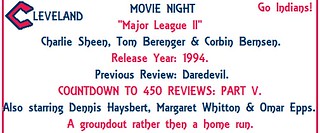
Movie Night: Major League II


Review #444: Major League II.

Cast
Charlie Sheen (Rick "Wild Thing" Vaughn), Tom Berenger (Jake Taylor), Corbin Bernsen (Roger Dorn), Dennis Haysbert (Pedro Cerrano), James Gammon (Lou Brown), Omar Epps (Willie Mays Hayes), Bob Uecker (Harry Doyle), David Keith (Jack Parkman), Takaaki Ishibashi (Isuro Tanaka), Margaret Whitton (Rachel Phelps), Eric Bruskotter (Rube Baker), Alison Doody (Rebecca Flannery), Michelle Burke (Nikki Reese), and Randy Quaid (Unnamed Fan) Directed by David S. Ward (#426 - Major League)

Review
Major League had its shares of laughs, and while it could've been better, it was a good comedy, arguably a classic. Five years, they made a sequel. This isn't as good. It feels like a rehash at times, and while it does have its moments, it's an okay comedy, as it eventually seems to win down in the same way the first film went, but at least this film doesn't get too sappy, which I guess helps...sort of. The film even retains the same "villain" from the first film, though I do wonder if she would've been allowed to own the team again, what with her deliberately trying to sabotage the team last season and all but oh well. The actors do fine, and Omar Epps does an okay job replacing Wesley Snipes from the last film, not too bad. It's an okay film, having some laughs, but not rising above the first film, inspiring more comparisons to the first film than praise for it. But hey, at least Cleveland got to win something, and that's always nice to see I suppose. I love the fact I've reached 444 reviews, and on my first day back at school. Countdown to 450 Reviews: 10, 9, 8, 7, 6...

Overall, I give it 6 out of 10 stars.

July 13, 2013

Movie Night: Major League.


Review #426: Major League.

Cast
Tom Berenger (Jake Taylor), Corbin Bernsen (Roger Dorn), Charlie Sheen (Ricky Vaughn), Margaret Whitton (Rachel Phelps), James Gammon (Lou Brown), Rene Russo (Lynn Wells), Bob Uecker (Harry Doyle), Wesley Snipes (Willie Mays Hayes), Charles Cyphers (Charlie Donovan), Chelcie Ross (Eddie Harris), Dennis Haysbert (Pedro Cerrano), and Andy Romano (Pepper Leach) Directed by David S. Ward.

Review
Major League may not bring too much of new things to the table that other sports films like The Natural or 42 have, but it has its own way of trying to reach the level of enjoyment that it mostly gets right. It has its moments of being funny, and while it is sometimes crude in approach, it is excusable because the characters are endearing after a while.  The actors are alright, Berenger and Bernsen do good, Sheen steals the show, but Bob Uecker of all people has memorable moments, even for an announcer, the one liners are memorable It feels dated at times, with the old, now demolished stadiums (Milwaukee County Stadium was used for filming, though it was used only because the stadium that is actually depicted (Cleveland Municipal Stadium) was too busy for filming), the uniforms and other such things, But this film has some charm, it feels close to home, there's always that team that just feels down on times, especially Cleveland teams, and while the idea of comeback is somewhat cliche, there's always something to try and make different about it, and while sports films do run into one another a lot, this breaks that mold, if only slightly.

Overall, I give it 8 out of 10 stars.