Showing posts with label Barbara Harris. Show all posts

July 8, 2022

Grosse Pointe Blank.

Review #1859: Grosse Pointe Blank.

Cast: 
John Cusack (Martin Q. Blank), Minnie Driver (Debi Newberry), Alan Arkin (Dr. Oatman), Dan Aykroyd (Grocer), Joan Cusack (Marcella), Jeremy Piven (Paul Spericki), Hank Azaria (CIA Agent Steven Lardner), Barbara Harris (Mary Blank), Mitchell Ryan (Mr. Bart Newberry), K. Todd Freeman (CIA Agent Kenneth McCullers), Michael Cudlitz (Bob Destepello), and Benny Urquidez (Felix La Poubelle) Directed by George Armitage.

Review: 
Yes, this was a movie script that was first written by a man who received an invitation to their 10th high school reunion. Michigan native Tom Jankiewicz worked as both an advertising copywriter, a substitute teacher and cashier when he was developing a script that would become this movie, which he started in 1991, which had a variety of characters that were based on people he had known (no, not the lead character). The script, when finally picked up for production, would feature re-writes that saw three people credited alongside Jankiewicz in the final version: John Cusack, Steve Pink, and D.V. DeVincentis. In the end, this was the only feature script that Jankiewicz would see made into a film, although he did serve as a script doctor on a handful of scripts while working primarily as an advertising copywriter and news-writer. In 2013, while participating in a question-and-answer session with college students about the movie, he collapsed and died; he was 49. Now, a film does need a solid director, which is where George Armitage comes into the picture, since Cusack sent him a copy of the script to see if he was interested. Born in Hartford with a move to California as a teenager, he started the road to filmmaking as a film fanatic who happened to study political science and economics at UCLA before being offered a mail room job at 20th Century Fox. He would do work for the studio on television while writing his first scripts in the mail room, most notably with Peyton Place. It was Roger Corman, who was there at the studio to make The St. Valentine's Day Massacre (1967), that helped inspire Armitage on his way to become a filmmaker, particularly his style of letting the actors improvise while getting his day in of shooting; he would write Gas-s-s-s (1970) for Corman (while also serving as an associate producer), and he was impressed enough to have Armitage direct his first film with Private Duty Nurses (1971). Armitage, when presented the script by the four writers, found himself having to guide them to cut down the script in pre-production in order to get it right for shooting (in a sense, he was doing un-credited script work, although he did not want to deal with the Writers Guild and their way of handling credits). It was shot three ways: the written version, a mildly understated version, and an over-the-top version, with the latter being generally utilized to go alongside actor improvisation. This was the fifth feature he directed in his career.

It's funny how you can make a movie about a morally flexible assassin trying to not satisfy their urge and end up having to do so anyway for a solid and clever movie, one that manages to get the finer points of what it really means to try and go home again. It is a coherent black comedy that rewards its viewer with solid characterization in the art of detachment and wry behavior that happens to also have a soundtrack by a member of the Clash. The strength comes from Cusack, wrapped in curiosity and well-placed timing in a character role that requires someone who can eke out something worthwhile in a mess of a character that isn't simply just a calm and collected mercenary. It all comes with the eyes of watching someone who has seen the other side of life and wants to come back, with a little bit of shooting on the side. Driver makes up the other part of the captivating chemistry that comes with the movie in passionate cynicism that has tried to re-invent themselves again and again only to find frustration and hesitancy, complete with sharing a kiss with Cusack from the get-go only to throw a mic on him to do on-the-air blasting in ten years of irritation. Of course, the other members of the cast lend a hand in curious charm, whether that involves Cusack and Cusack sharing brief scenes together or on the phone that matches stoic and chipper attitudes. Arkin makes a reluctant pairing with Cusack that results in a few good moments in the art of attempted conventional therapy. Aykroyd is enjoyably deranged here, making for a quality (union man) ham that makes a quality contrast to Cusack without overstepping him. The setup to get to the climax might be a bit convenient, but one could also find a variety of situations to be a series of convivences and coincidences, which it is really a dandy way of saying that some things are just fun enough to go with things. The 107 minute run-time makes for a pleasant breeze, one that carries its time back home with memories and long-gone people with select moments of action, most notably with a locker-room fight that is executed effectively. As a whole, Armitage and company cultivated a movie with plenty of lasting appeal that has not diminished in the 25 years that have followed the release of this film, one with capable wit and timing from its characters that make it a lingering classic worth checking out.

Overall, I give it 8 out of 10 stars.

July 28, 2020

Dirty Rotten Scoundrels.

Review #1489: Dirty Rotten Scoundrels.

Cast:
Steve Martin (Freddy Benson), Michael Caine (Lawrence Jamieson), Glenne Headly (Janet Colgate), Anton Rodgers (Inspector Andre), Barbara Harris (Fanny Eubanks), Ian McDiarmid (Arthur), Dana Ivey (Mrs. Reed), and Meagen Fay (Miss Trumble) Directed by Frank Oz (#521 - The Muppets Take Manhattan, #795 - Bowfinger, #1468 - The Dark Crystal, and #1482 - Little Shop of Horrors)

Review: 
"The greatest thing you can do is surprise yourself."
"I love comedy. I love to make people laugh. If I hadn't been an actor, or an architect, which I really wanted to be, I'd have been a stand-up comic."

To have a good duo film, you need a good pairing to begin with, particularly when it comes to a comedy since pairings really happen only once and just that nowadays. Steve Martin, for example, was a fairly established comedy star at the time, having gone from television writing (such as The Smothers Brothers Comedy Hour) to stand-up (defined by self-referential riffs alongside banjo playing) and television work to eventually starring in his own films with The Jerk (1979). As for Michael Caine, he had done over a decade of work in films and television before coming to prominence in the late 1960s that included films such as The Ipcress File (1965) and The Italian Job (1969) that has continued with starring and character roles for over five decades. It is a remake of the 1964 film Bedtime Story, which had starred Marlon Brando and David Niven that had been written by Stanley Shapiro and Paul Henning. This time the two wrote the screenplay with Dale Launer. There were a few changes made while keeping the basic core of two con artists that bump into each other in the French Riveria that goes from apprenticeship to contest, most notably with the resolution (which had originally ended with one of the cons turning good and romancing the one being played...so I suppose that makes sense). This would serve the basis for a musical of the same name in 2004 (featuring John Lithgow) and another remake of the material was done in The Hustle (2019).

However one views the material, this is a fairly well-paired film. It makes for a good natured time with its balanced pair of timing and zippy lines in a relaxed setting that allows for chemistry between its actors without smothering them in complications. With a run-time of 110 minutes, the film runs fairly well for itself in staging amusing situations and bits for Caine and Martin to run free with (of sorts) making general humor that is fairly cheerful in making a decent setup. Martin is quite enjoyable here, jumping at the chance of playing off Caine with enthusiastic contrast that leads to quite a handful of moments to look upon him and laugh, whether that involves him struggling for a name or trying to scare off someone for an act (including a corked fork). Caine proves just as handy for generating snappy charisma and quick chemistry with Martin that does manners on the fly that seems fairly effortless, whether to ladies or gentlemen. Headly makes for a fair foil between the two, not quite too assuming nor too much of a mark to forget in the background, particularly for the last scene together. In general, if you like the movie enough, the last scene helps seal the deal in a charmer (if not however, welp). The supporting cast is a mix of dupers and dupes that do just fine, such as a subtle Rodgers. What we have here is a clever game of tricks and humor that generally work out well in pace and buildup with two likable scoundrels that maneuver gags with reasonable timing that seems well-suited for its era as a fine time for all and a fair piece for both Martin and Caine to have fun with along with a good show for Oz as well.

Overall, I give it 8 out of 10 stars.

January 31, 2017

Nashville.


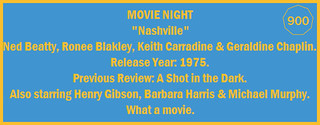
Review #900: Nashville.

Cast:
David Arkin (Norman), Barbara Baxley (Lady Pearl), Ned Beatty (Delbert Reese), Karen Black (Connie White), Ronee Blakley (Barbara Jean), Timothy Brown (Tommy Brown), Keith Carradine (Tom Frank), Geraldine Chaplin (Opal), Robert DoQui (Wade), Shelley Duvall (L. A. Joan), Allen Garfield (Barnett), Henry Gibson (Haven Hamilton), Scott Glenn (Pfc. Glenn Kelly), Jeff Goldblum (Tricycle Man), Barbara Harris (Albuquerque), David Hayward (Kenny Frasier), Michael Murphy (John Triplette), Allan F. Nicholls (Bill), Dave Peel (Bud Hamilton), Cristina Raines (Mary), Bert Remsen (Star), Lily Tomlin (Linnea Reese), Gwen Welles (Sueleen Gay), Keenan Wynn (Mr. Green), and Thomas Hal Phillips (Hal Phillip Walker) Directed by Robert Altman

Review:
Nashville is quite an experience, that much is for sure. It takes place over the course of five days, and yet it still manages to have one of the biggest assemblages of cast that work together to make for such an interesting movie of expression. There is no real main character, nor is there ever a moment where the film loses balance over what it wants to be: a film with people as diverse in nature and as interesting as the city it sets itself in. Even some of the settings (such as the Grand Ole Opry and the Parthenon in Nashville that is used for the climax) seem to reach out as their own character, with their own kind of blemishes just like these characters. For me, my favorites in the film were not so much because of likable they were, but because of how interesting they managed to be, with Beatty, Blakley, Chaplin, Gibson, and Tomlin being the big standouts who really have their own noticeable traits and flaws that one can see in themselves or others. The scene where Tomlin and Beatty are with their (deaf) children is especially telling in making these characters significant with a good degree of subtlety. The characters don't veer too much into cliches in part because they seem so real and seem so authentic to the vision of the film.

Even minor characters (like Welles or Black) are ones that we can still relate to, even if they aren't as high up on the success trail. Goldblum (in a voiceless but constant role) is also pretty memorable, in part because of the tricycle he rides throughout the film. DoQui and Welles certainly make a good pair together in the time they share together on screen. Phillips (and the dialogue that his voice is heard from for a good part of the film) is good in conveying the reach of his character without having to show him. There are so many scenes with their own range of emotion and feeling, where even a scene where Chaplin is talking poetic about buses in a junkyard is great. The film has a great deal of quality music (all done live, and by the actors themselves), all of the songs working intricately with the scene it goes with, such as with "I'm Easy"a key standout, sung by Keith Carradine, who carries the song with the right sense of tension and emotion (fun fact: this song won the Oscar for Best Original Song that year). The film doesn't try to resolve the plot threads in a concise manner, letting it up to the viewer to see where the path of these characters go from there, especially with a climax that is great in its surprise and its final beat with the last song ("It Don't Worry Me"). Nashville is a movie that does not try to bait and switch the realities of the time it was made in, and its impact can still be felt and related to over four decades after its release.

I hope you enjoyed this review, the 900th review done since this show began 2,234 days (over six years) ago. It is obvious (to me anyway) that Movie Night has progressed significantly in terms of quality and the kind of film that gets a shot at being covered. Though the show has gone on its own kind of pace, I hope that Movie Night continues to evolve in a positive way and that you all continue to enjoy this, even if in a small way. This is still a good hobby of mine, but it is also an excellent hobby to do every so often. Thank you all.

Overall, I give it 10 out of 10 stars.