
Showing posts with label Lois Wilson. Show all posts

February 19, 2020

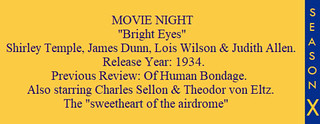
Bright Eyes.


Review #1342: Bright Eyes.

Cast: 
Shirley Temple (Shirley Blake), James Dunn (James "Loop" Merritt), Lois Wilson (Mary Blake), Judith Allen (Adele Martin), Charles Sellon (Uncle Ned Smith), Theodor von Eltz (J. Wellington Smythe), Dorothy Christy (Anita Smythe), Jane Withers (Joy Smythe), Brandon Hurst (Higgins), Jane Darwell (Elizabeth Higgins), Walter Johnson (Thomas), and George Irving (Judge Thompson) Directed by David Butler (#1334 - Just Imagine)

Review: 
When it comes to needing a charming and good-natured kid presence for a film or two, one can't really go wrong with Shirley Temple. Born in 1928, she had been enrolled at Meglin's Dance School with encouragement from her mother by the time she was three years old, and she was noticed by a producer from Educational Pictures, known for their one-reel comedies in the 1920s and 1930s. In 1934, she was given her first major breakthrough with Stand Up and Cheer!, a musical from Fox Film that served as a vehicle for various actors to sing. In that year alone, she made appearances in nine films (two of them without credit), with this being her last one released (done so on December 28), which happened to be the first one made specifically as a starring vehicle for her, which was written by director Butler and Edwin J. Burke. Her run was a quick but memorable one, starring in at least two films until 1940 while making appearances in thirteen further films before her last in 1949. Her main features were usually made on the cheap, with songs and dances to go alongside sentimental and melodramatic situations, which certainly must've proven to inspire plenty of hope when it comes to escapist fare for Great Depression audiences. In that sense, this proves to be an okay piece to look back upon with the age of nearly 85 years behind it. If one can get behind a kid singing "On the Good Ship Lollipop", one could probably get behind any sort of sugary stuff for 83 minutes. It isn't so much a predictable film as it is just one that will go exactly where it wants to go and nowhere else. Oddly enough, the best parts of the film are usually when Sellon or Withers (who would star in her own kid films) are on screen, delivering a good share of the laughs despite having cranky characterizations. This is especially true for the latter, who was defended by Butler from calls of being cut down by Temple's mother - the contrast between the two is importantly distinct and amusing, right down to one being slapped again and again. Temple carries the film enough, in that one really doesn't need much to go along with a nice kid for a film (barring a lack of personality of course), but she makes the experience worth it in her enthusiasm. Dunn goes along fine, carefully crafted to suit Temple when it comes to being a guardian of the clouds. The rest are here and there, lending help to try and make this fairly predictable tale of spunky kids cheering up old cranks and young people go without trouble. The film received one award for its main star in an Academy Juvenile Award, which was given out to twelve child performers until it was discontinued in 1960. Temple is (and remains) the youngest recipient to be honored by the Academy. The curiosity is fair, and it should prove fine for the young ones looking for some old-fashioned charms like Temple can provide.

Overall, I give it 7 out of 10 stars.

January 10, 2020

The Covered Wagon.


Review #1320: The Covered Wagon.

Cast: 
J. Warren Kerrigan (Will Banion), Lois Wilson (Molly Wingate), Alan Hale (Sam Woodhull), Ernest Torrence (William Jackson), Tully Marshall (Jim Bridger), Ethel Wales (Mrs. Wingate), Charles Ogle (Jesse Wingate), Guy Oliver (Kit Carson), and Johnny Fox (Jed Wingate) Directed by James Cruze (#1263 - The Roaring Road)

Review: 
What is it about the Western that inspires such curiosity? What inspired so many directors and studios to make their own tales (or adapt works) about cowboys, gunslingers, and other various subjects that dominated the film landscape for over half of the 20th century, doing so from the very get go with the first one shot in the United States (and second overall) in The Great Train Robbery (1903), which captivated audiences with its action in such quick time at 12 minutes. The evolution of film production in the two decades that followed meant that at some point one would strive to make a big budget Western epic to hang their cowboy hat on, at least until someone made one that looked better. The honor of being known as the first big-budget Western epic (made for roughly over $700,000 from Paramount Pictures) falls to this feature, which is adapted from the novel of the same name by Emerson Hough. Expense was not spared when it came to research to get costumes and locations scoped out, particularly when it came to finding a herd of wild bison (alongside other animals like oxen and horses) to roam the plains, complete with authentic wagons. If that sounds daunting enough, try being an actor having to spend months in the desert of Utah, dealing with various weather elements alongside being fairly distant from railroads, with one sequence involving wagons fording a torrent being a risky one to film in part because they had to actually swim for it alongside the accompanying horses and oxen. Simply put, one can trace Western epics and the level of craftsmanship one must take in executing ambition from costumes to characters to this film, which manages to hold itself fairly well without becoming too much a thing of the past.

It is an honest spectacle, welcome of curiosity for those who seek out fair pleasures. It has exactly the kind of things you would expect from a Western, with a clear hero, romantic lead and heavy to follow, and one can take a guess as to how these pioneers will do in their journey from Kansas to Oregon for 98 minutes - as long as one does not find themselves checking their watch from time to time or peeking at what comes next, you should do fine. It is the journey that counts when it comes to films, and how one enjoys the ride or trip with these actors and views that counts most, and this one does fine with that in mind - you could probably see this and at have some sort of interest in wondering about the plight of the pioneer, whether that means trouble with just getting to where they need to go or in-fights and so on. The highlight proves to be Torrence and Marshall, giving a bit of amusement as the comic relief, while Kerrigan and Wilson prove adequate if not too memorable people to look at through the lens of a routine romantic Western. Regardless, it proved an audience hit, making roughly seven million dollars, exceeding films now regarded as classics for that year such as The Hunchback of Notre Dame and Safety Last!, which now can all be found in the public domain for one to eye with curiosity. This film may not stand too highly with some of the Westerns that would come to pass over the next decade and beyond, but it still holds ground as a resilient charmer when it comes to entertainment, and that surely will prove enough for those who want to seek it most.

Overall, I give it 7 out of 10 stars.