Showing posts with label Myrna Loy. Show all posts

September 16, 2022

The Thin Man.

Review #1887: The Thin Man.

Cast: 
William Powell (Nick Charles), Myrna Loy (Nora Charles), Maureen O'Sullivan (Dorothy Wynant), Nat Pendleton (Lt. John Guild), Minna Gombell (Mimi Wynant Jorgenson), Porter Hall (Herbert MacCaulay), Henry Wadsworth (Tommy), William Henry (Gilbert Wynant), Harold Huber (Arthur Nunheim), Cesar Romero (Chris Jorgenson), Natalie Moorhead (Julia Wolf), Edward Brophy (Joe Morelli), Edward Ellis (Clyde Wynant), and Skippy (Asta) Directed by W. S. Van Dyke (#231 - San Francisco)

Review: 
Admittedly, a movie with a director known as "One Take Woody" sounds like a recipe for an interesting time. W. S. Van Dyke entered film in 1915 after a wide variety of time spent in business school and numerous part-time jobs and theater company tours. He went from assistant director with D. W. Griffith to director in the span of two years. When it came to sound, he was adept in his craft that made him a solid company man for Metro Goldwyn Mayer that served him well until his death in 1943. Of course, this is something worthwhile to mention because of the fact that he was one of the key parts behind what ended up becoming a film series. The Thin Man saw five further features: After the Thin Man (1936), Another Thin Man (1939), Shadow of the Thin Man (1941), The Thin Man Goes Home (1945), and Song of the Thin Man (1947). Van Dyke would direct three of the sequels while its main stars in Powell and Loy starred in each of the movies (one would notice that the "Thin Man" actually originally refers to a missing man played by Ellis, but people referred to Powell as "Thin Man" pretty early on). The movie, if you didn't know, is an adaptation of the 1934 novel of the same name by Dashiell Hammett. Hammett was a member of the Pinkerton National Detective Agency (both private law enforcers and aggressors against organized labor) before he was a writer, which led him to write numerous stories and novels with characters such as Sam Spade (as it turned out, this was the last novel written by Hammett, who dealt with tough health and other struggles before his death in 1961). Husband-and-wife duo Albert Hackett and Frances Goodrich wrote the feature, with instruction by Van Dyke to loosely adapt the novel while having concentration on providing witty banter for its lead actors, with Van Dyke often shooting the first take due to his belief that actors lose spontaneity with every passing take.

Go figure that a movie shot in less than three weeks ended up being a complete success for all involved.  The chemistry between Powell and Loy in banter is one that other filmmakers would be jealous enough to wish they could steal for themselves. Van Dyke knew he had magic with these folks, so he made a movie with resourceful pacing and spontaneity that makes for a capable mystery with chuckles to go around. Powell may have been considered a bit too old for the part (42) when compared to Loy (29), associated with exotic roles at the time. But they are so dazzling here, zinging off each other without serving as distraction for tired plotting. Powell knows exactly what to lend to the material in his timing and mannerisms, sophisticated in deduction without coming off as a Sherlock pastiche. He glides through 91 minutes as if the plot wasn't particularly important to having fun. It wasn't his first crack at playing a detective (he had played the character Philo Vance in four films from 1929 to 1933), but it was his first crack at having a film that wanted to show him with sophistication and charm. Powell and Loy would star in fourteen total movies together. Loy makes a quality partner in her own wiry charm that pushes things along with easygoing flair that matches wit (and alcohol) with Powell all the same in pure escapism. O'Sullivan and the others have to play a bit of catch-up in maintaining the plot to some sort of believable level (i.e. things that you've probably heard from a detective story but not completely cliche), in order to not be completely overshadowed by the duo, much less the dog and his paw movement. The dinner sequence where all are seated in order to gradually explain the whodunit is particularly effective in execution in closing the romp. This is the kind of movie where a guy can sock someone from behind before getting into a scuffle or have lines like "didn't come anywhere near my tabloids", you should have a real good time with this movie. Regardless how the follow-up films went, Dyke cultivated in record time a work of useful entertainment that saw one of the best pairings in film history (Powell and Loy) come together for one of the most interesting films of its era that practically walks on air with its sophistication that all would be proud to be part of.

Overall, I give it 10 out of 10 stars.

May 7, 2021

Airport 1975.

Review #1675: Airport 1975.

Cast: 
Charlton Heston (Captain Alan Murdock), Karen Black (Chief-Stewardess Nancy Pryor), George Kennedy (Joe Patroni), Efrem Zimbalist Jr. (Captain Stacy), Gloria Swanson (Herself), Susan Clark (Helen Patroni), Helen Reddy (Sister Ruth), Linda Blair (Janice Abbott), Dana Andrews (Scott Freeman), Myrna Loy (Mrs. Devaney), Sid Caesar (Barney), Roy Thinnes (First Officer Urias), Ed Nelson (Maj. Alexander), Nancy Olson (Mrs. Abbott), Larry Storch (Glenn Purcell), Martha Scott (Sister Beatrice), Norman Fell (Bill), Jerry Stiller (Sam), and Conrad Janis (Arnie) Directed by Jack Smight.

Review: 
There are quite a few times that you see a sequel to a movie and wonder why there was a second one to begin with. Unfortunately, you know, and I know, the reason that there exists a sequel like Airport 1975 (1974): money. People really couldn't get enough of big stars to go with airplanes in trouble, complete with a title that I suppose was made to sound like it came from the future. It appears that the budget was reduced in the four years since the last film in 1970 (from ten to three million), but this one also managed to make over $100 million, and one can only wonder how rentals would go for this fellow turkey. To be fair, one probably can't blame Jack Smight for his direction here. He did his work in both television and film (starting with the former since its golden age in the 1950s), and this was the eleventh of seventeen films that he would direct from 1964 to 1989, with Harper (1966) generally being the one that stands out among his work. I'm sure you might remember Airplane! (1980) when it comes to its take on the disaster genre...and those little gags that might seem familiar to those who have seen both films, what with a kid that is awaiting a transplant as soon as they make an airplane trip (complete with a doctor calling beforehand to make sure they aren't startled), and a singing nun that plays to the kid. Now, technically Reddy was qualified to sing, because she was actually a singer (with one newspaper outlet describing her as the "Queen of '70s Pop", after all)...so keep that in mind in trying to figure out which one is a parody. That 1980 film also had Ethel Merman in a cameo appearance, while this feature has Gloria Swanson playing herself (if you really want to stretch this around into an oblong circle, Linda Harrison accompanies her...while using a second name as "Augusta Summerland"...yes). I am not playing you for a bit, because Airport 1975 actually features Dana Andrews in a brief appearance, and Andrews had starred in Zero Hour! (1957), which Arthur Hailey had adapted from his teleplay a few years prior while eventually writing the novel Airport...and Airplane! would lift lines from said movie. At least one will get to see the pair of Heston and Kennedy again, because they had co-starred in another disaster film with Earthquake (1974), which was also done by Universal Studios.

So yes, there are a few strange folks present here, whether that means a trio of odd drunks overshadowed by Myrna Loy playing a more eccentric drunk...or Swanson, who had apparently wrote all of her lines. Strangely enough, this may actually be better than the original film, mostly because of one thing: it manages to be so cheesy that it nearly defies reason. It is so self-serious at the weirdest times that one wonders how exactly this was the only film credit for screenplay man Don Ingalls, who specialized in television from Have Gun - Will Travel to Fantasy Island. It sometimes feel like a script that mutated from the bins of television hokum and engulfed any famous person they could find, who I hope managed to enjoy the monetary benefits of this sham spectacle. Heston is technically the star, in that he gets to ham the screen up from moment to moment while doing the bare minimum in charisma and minimal plane involvement. One wonders if he was worn out from the aforementioned film about the earthquake. Kennedy blusters through some shouting in a performance that is probably degraded from what one saw in the first film, although it can be said that in the earlier movie he was more of a helpful highlight (since if you remember, the airplane trouble was somewhere sidelined behind lots of gobbledygook about affairs and the airplane industry). Ah, but the real presence is Black, making her shift into commercial work after a string of noted supporting roles. While it isn't a great performance by any means, I'm sure I wouldn't fare much better at fumbling with the controls and not collapsing into panic with trying to fly a plane over mountains (the attempts at chemistry with Heston is a different story), although older fans might recognize that this isn't the first movie where a flight attendant is shown taking a plane to safety (Julie (1956) starred Doris Day in a noir, of all things). Zimbalist plays the unfortunate pilot that gets to spend half his time on a couch with his eyes closed to makeup, so there is that. Swanson, making her final film appearance before her death in 1983, certainly had to have a fine time here, since I imagine a role spent mostly in a chair talking about oneself would make anyone proud. It isn't exactly a parody of herself, but one can still keep their eyes open to wonder how this "interesting" pairing of famed star to alleged disaster movie came to be. Others have the energy of a broomstick when it comes to really sticking out, most notably with a bored-looking Andrews, or a bedridden Blair, or an oddly complacent Caesar to go with Storch (who might as well have been chosen out of a hat), and it is Loy who really seems to stand out best when it comes to pairing eccentricity to the level of cheese needed. At least there is some sort of inherent danger present here, since the chances of even one important character biting the dust is at 1% rather than the level done from the first film, although it hasn't meant the movie has increased its levels of thrill from before. One wonders exactly how the other two Airport movies turn out in raising (or keeping) the standards of disaster movie excitement, really. Airport 1975 (1974) isn't really an accomplishment in anything, but technically being better than its predecessor in being less boring has to account for something. If one desires a movie packed with ridicule and name actors, one might not go wrong here.

Overall, I give it 6 out of 10 stars.

March 24, 2020

The Best Years of Our Lives.

Review #1368: The Best Years of Our Lives.

Cast:
Myrna Loy (Milly Stephenson), Fredric March (Platoon Sergeant Al Stephenson), Dana Andrews (Captain Fred Derry), Teresa Wright (Peggy Stephenson), Virginia Mayo (Marie Derry), Cathy O'Donnell (Wilma Cameron), Hoagy Carmichael (Uncle Butch Engle), Harold Russell (Petty Officer 2nd Class Homer Parrish), Gladys George (Hortense Derry), Roman Bohnen (Pat Derry), Ray Collins (Mr. Milton), Minna Gombell (Mrs. Parrish), and Walter Baldwin (Mr. Parrish) Directed by William Wyler (#509 - Roman Holiday, #1022 - Jezebel, and #1360 - Mrs. Miniver)

Review:
The most enduring films can be the ones that strike us in their poignancy. Emotional honesty can be the best policy, particularly when it comes to a film basked in real life, about soldiers coming home from war. One prominent person returning from the war was director William Wyler. The year that he had directed Mrs. Miniver (1942) to roaring success (although he subsequently called it an "incomplete" film that only scratched the surface about war), he had volunteered to serve in the US Army Air Forces; he shot footage that was turned into two war documentaries, and there were risks to filming footage over actual bombing missions, with Wyler losing a significant part of his hearing due to exposure to loud noise. It should prove no surprise that Wyler was the director to be for a film about veterans arriving home from war, with numerous touches done by the director to make an authentic piece of grand naturalness, such as having the actors buy their own clothing and having sets constructed at life-size level (as opposed to camera-friendly larger sets). To go alongside Wyler was a producer with the capable hands in Samuel Goldwyn. He had gone from bustling garments to salesman to being in a film company partnership in 1913 with Jesse L. Lasky and others to turn plays into feature-length films. They would later merge with Paramount (alongside Adolph Zukor's Famous Players Film Company), although Goldwyn would later resign in 1916 over disagreements, so he went on to partner with the Selwyn brothers to make the enterprise known as Goldwyn Pictures (with that leading to him changing his name to Goldwyn after being known as Goldfish that he had changed from Gelbfisz). It ran for eight years before being acquired by Marcus Loew to merge with Metro and Mayer to form Metro-Goldwyn-Mayer, although Goldwyn moved on to his own production company, and the company produced films for 36 years that would distributed through various studios such as United Artists and RKO. This was written by Robert E. Sherwood (four-time Pulitzer Prize winner and head of the Office of War Information from 1943 until the end of the war) as an adaptation of the novella Glory for Me (1945) by MacKinlay Kantor, which had been inspired by an article in Time Magazine.

One finds themselves wrapped right in with a film like this from the very first minutes, and it should prove no surprise that this film manages to accomplish this through capable storytelling, having a consistent and engaging focus for each of its veteran plots that weaves magnificently for 172 minutes, where one is absorbed in where the path may go next. March commands the film with great presence, a weary and dogged man that we can go along at any point, which matches Loy and her capable patience that makes for great established chemistry. Andrews pulls off a tremendous performance as well an evolving performance built on humility, with him and March both expressing trauma in their own respective ways (which is especially striking now as it was then). Wright proves fairly charming in a film wrapped in honest realism, where naivety and sentiment are behind for most if the film, while Mayo pulls off a conniving turn in her moments on screen, with the best highlight probably being the scene between the two when they are on a double date and talking to themselves privately. an Army instructor who had lost his hands due to a defective fuse when handling TNT) had been noticed by Wyler due to an Army film named Diary of a Sergeant, which was about rehabilitating veterans. He appeared in three total films, with Wyler having told him to finish his interrupted studies at Boston University. He pulls off his story with tremendous courage in a natural manner, where one is focused on him and his trouble like we would with others with more acting experience while not thinking about his hooks. Rounding out the cast is capable edge filling from singer-turned occasional actor Carmichael and an understanding O'Donnell performance. There is plenty that one can see when it comes to following natural pursuits in this film, one that eventually finds hope in the murkiness that could accompany such a hard readjusting that war can be. It isn't overly-sentimental or cynical to the point of irritation, finding an honest middle ground that lets these characters breathe for themselves. From the deep focus shots from Gregg Toland to highlights like the aircraft boneyard sequence, one will have an interesting time to spend with people that still seem relevant now.

One may not be surprised to know that this was a hit for its year with audiences and critics. It won seven Academy Awards, with Wyler, Sherwood, March, and Russell winning in respective categories of directing, screenplay, and acting while also winning for editing and original score. The night belonged to Goldwyn and Russell, with the former being awarded both an Irving G. Thalberg Memorial Award along with Best Picture (his one win in eight nominations as producer for Best Picture) for this film while the latter became the first and only actor to receive two Academy Awards for the same performance, having been awarded an Honorary Academy Award (since the Academy apparently believed his Oscar hopes were slim). In any case, it is easy to see why this endures as one of the best films of its era, where one will find themselves satisfied with going through the time to see something like this and not finding their patience tested at any real point.

Overall, I give it 10 out of 10 stars.

February 29, 2020

The Rains Came.


Review #1351: The Rains Came.

Cast: 
Myrna Loy (Lady Edwina Esketh), Tyrone Power (Major Rama Safti), George Brent (Tom Ransome), Brenda Joyce (Fern Simon), Nigel Bruce (Lord Albert Esketh), Maria Ouspenskaya (Maharani), Joseph Schildkraut (Mr. Bannerjee), Mary Nash (Miss MacDaid), Jane Darwell (Aunt Phoebe - Mrs. Smiley), Marjorie Rambeau (Mrs. Simon), and Henry Travers (Rev. Homer Smiley) Directed by Clarence Brown (#423 - A Woman of Affairs, #433 - Angels in the Outfield, and #484 - Plymouth Adventure)

Review: 
If you want a disaster film to go along with your romance, I guess this could fit the bill. This was a film that 20th Century Fox spent nearly half of its 100-day schedule in making rain to go along with a flood sequence (using a 50,000 gallon tank of water on a studio soundstage), with 33 million gallons of water used, with a fifth of the $2.5 million budget being spent on flood and earthquake scenes. It surely paid off for its effects crew, since E. H. Hansen and Fred Sersen ended up as the first awardees for Best Visual Effects through this film. Who better to helm the film than veteran director Clarence Brown (a versatile director of romance, dramas and period pieces) and established actors like Loy (a versatile actress known for vamp roles prior to The Thin Man in 1934), Power (a matinee idol in the latter 1930s along with the 1940s), and Brent (a leading man for romances primarily in the 1930s and 1940s) to go with it. The film was adapted to the screen by Philip Dunne and Julien Josephson from the 1937 novel of the same name by Louis Bromfield. A remake would be produced by the studio with The Rains of Ranchipur (1955), which changed the ending (so no one dies). This is a glossy but finely crafted film,  where one will be pleased at what they get on a visual level alongside the romantic quartet when it comes to generating intrigue. Loy certainly seems to be having fun with such a mischievous (at least at first mischievous) headline role, brash but immensely watchable every time she is on screen, whether that involves playful banter or helping the sick. Power comes off a bit reserved, but it works out in making calm passion. This plays itself out with Loy's death scene, where Brown had told her to try acting it out with her eyes open through holding her breath. It is a striking scene, one must say. Brent plays a decent rogue, one that fits in contrast to whoever leading lady he is playing towards, whether that means a clash with Loy or a fresh (in that this was her debut role) Joyce. Bruce (a character actor since 1922 whose most famous portrayal was of Dr. Watson starting in 1939) certainly does fine with a boorish turn, and Ouspenskaya certainly proves a charmer from time to time. The romances play out fine for its 105 minute run-time, where one can see how they'll draw themselves out but not find themselves predicting everything (for a film with a title like this, at least).  In a year with plenty of romance and spectacle on numerous fronts, The Rains Came is a decent little gem among others. It makes for a decent show with its fair passion and well-done effects to make a diverting time to go with, utilizing a workable cast and an accomplished director to get things done without too many troubles.

Overall, I give it 7 out of 10 stars.

Ah yes, the end of the month (and the tribute to the 1930s) has come. If you are wondering, I have not forgotten about doing films from the current year as well. Those will be sprinkled into March at their own time, apart from the primary goal of March, the third phase of Tribute to the Decades with the 1940s.

February 21, 2020

The Great Ziegfeld.


Review #1344: The Great Ziegfeld.

Cast: 
William Powell (Florenz Ziegfeld Jr.), Myrna Loy (Billie Burke), Luise Rainer (Anna Held), Frank Morgan (Billings), Fannie Brice (Herself), Virginia Bruce (Audrey Dane), Reginald Owen (Sampson), Ray Bolger (Himself), Ernest Cossart (Sidney), Mae Questel (Rosie), Joseph Cawthorne (Dr. Ziegfeld), Nat Pendleton (Sandow), Harriet Hoctor (Herself), Jean Chatburn (Mary Lou), and Paul Irving (Erlanger) Directed by Robert Z. Leonard.

Review: 
I did not foresee a thousand word review that took longer to write than it did to get through the film. And yet, here we are.

One needs a bit of history now and then. Or at the very least needs a big show to really drive up attention. This is a film based on the life of Florenz Ziegfeld Jr and his Ziegfeld Follies, which made numerous productions from 1907 to 1931 (with two further revivals after Ziegfeld's death). There were numerous entertainers that appeared in the show over the years, ranging from W. C. Fields to Will Rogers to Louise Brooks to Fanny Brice. Who else to deliver a film with elaborate costumes, dances and sets but Metro-Goldwyn-Mayer, with the most notable set being for the set for "A Pretty Girl Is Like a Melody", which spent roughly $220,000 on a 100 ton, 175 spiral stepped towering rotating volute. The music for the film was done by Walter Donaldson, Irving Berlin, and lyricist Harold Adamson, while Seymour Felix did the dance direction, and William Anthony McGuire wrote the film. I suppose it shouldn't have proved a surprise that this won the Academy Award for Best Picture. It happened to be one of the highest grossing films of the year, right next to another fellow MGM Best Picture nominee with San Francisco. Of course it also shouldn't be surprising that this is a tremendous long spectacle, running 176 minutes (185 for roadshows). One expects a veteran director to serve as a reliable hand for a big production, which is the case with Robert Z. Leonard. He had studied law at the University of Colorado before moving to Hollywood to start his film career acting in various short subjects in 1908. Five years later, he would take up directing the subjects to go alongside his career. It was not long before he got into directing feature-length films, starting with the mostly lost serial The Master Key (1914). In his five decade career, he directed two films nominated for Best Picture and Best Director (this and The Divorcee from 1930). He is known for his association with MGM, where he made most of his features for (starting with their predecessor Metro Pictures) from Peacock Alley (1922) to The King's Thief (1955).

One thing that is easy for me to say is that I don't know too much about the life of Florenz Ziegfeld Jr. After this film, I still don't think I really know much about the man that seems substantial. Even his death is wrongly depicted, as if him dying of pleurisy in Hollywood didn't seem impactful enough to depict for film. It all seems carefree, where the ups and downs seem more catered for its audience to escape with than something that presents anything other than bloated lavishness. In trying to cover all the bases of production value, it soon becomes a hollow experience that seems dated more than anything, although I suppose big-budget effects extravaganzas have some sort of link with this film in attempts at trying to hide hollow plots with some sort of flash. One seems to feel the passage of time of this film like it is taking 30 years rather than three hours. Powell does seem like the man for a role like this, having risen from heel roles in his early years since starting a career in Hollywood in 1922 to leading man roles, most notably with The Thin Man (1934). He starred in five further films in that series, each with Myrna Loy (they appeared in 14 total features together). He received three nominations for Best Actor (1934, 1936, 1947), and although he never won an Oscar, he cultivated a 33-year career with class and charm. I like seeing him here, even if he is playing a role that begs to have at least one flaw show itself on screen. He seems like a nice rogue, but he almost seems lost in a sea of pep and convenience. Loy has the disadvantage of time, since she doesn't show up until over two hours in. In that sense, she pulls off an okay performance playing a living actress (after Ziegfeld's death, she had sold off the film rights to try and pay off his debts and subsequently worked as technical consultant for this film), where one will say it has some stature but not too much else. Rainer (who aspired to be an actress at 16) was in her fifth role in film, having moved from the theatre to film after seeing A Farewell to Arms (1932), describing it as "beautiful". She moved from her native Germany to Hollywood three years later, signing with MGM, with her first American feature being Escapade, which also happened to have Powell and Leonard. She had a peak like no other actress, being the first actress to win back-to-back Academy Awards (Spencer Tracy would do the same for actors for 1937 and 1938), having won for this and The Good Earth (1937). She made fifteen film appearances in her career, owing to the pressure in living up to audience expectations along with dissatisfaction with MGM head Louis B. Meyer with getting roles she found to her liking (as opposed to the other way around). The one highlight scene for Ranier is the phone sequence, a heartbreaker that likely gave her the edge in winning an Academy Award for Best Actress. She does fine with delivering vulnerability, but the film's melodramatic approach does tend to make some of her scenes a bit over-the-top. The others prove hit and miss. Morgan and Brice deliver a bit of levity, but the rest seem to get a bit lost in the shuffle.

There would be further ventures with the Ziegfeld name by MGM, who released Ziegfeld Girl (1941, also directed by Leonard), and Ziegfeld Follies (1946, directed by Vincente Minnelli), which was composed of musical numbers and sketches. At the end of the day, this could prove a curiosity, for either the right or wrong reasons. One could hold up the musical pieces and its designs with some respect, alongside its boundless optimism in the face of marginalizing some of the facts. Or perhaps one could find it to be an overlong affair that can't quite satisfy in every department that creaks with age. I wish I liked this better than I did, because there is some entertainment value present in the film. Its a film that aspires to be the cream of the crop and instead seems to have a bit too much sugariness to really get there and stay on top. 

Overall, I give it 6 out of 10 stars.

January 19, 2014

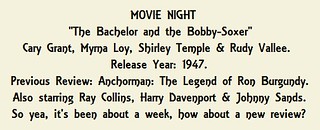
Movie Night: The Bachelor and the Bobby-Soxer.


Review #527: The Bachelor and the Bobby-Soxer.

Cast
Cary Grant (Richard Nugent), Myrna Loy (Margaret Turner), Shirley Temple (Susan Turner), Rudy Vallee (Tommy Chamberlain), Ray Collins (Dr. Matt Beemish), Harry Davenport (Thaddeus Turner), Johnny Sands (Jerry White), and Don Beddoe (Joey) Directed by Irving Reis.

Review
The title certainly got me interested in this film, trying to figure out what exactly a Bobby-Soxer was. Apparently it (according to Wikipedia) is a 1940s sociological coinage describing the often very zealous fans of Swing music, often young adults, or in this movie, Shirley Temple. If your like me, you probably didn't know Shirley Temple made films in her teenage years (that or like me you didn't watch any of her films prior to this and only know her due to commercials trying to sell her films to people watching at home), and she doesn't do a bad job, and while her character could be regarded as annoying at times, she is okay either way. Cary Grant is charming and is certainly very entertaining, and Myrna Loy works well with Grant as well. The rest of the cast do well, and there are good laughs with this film, it has a clever way with fun, and this is a film that while unusual with its pairing, is a good film.

Overall, I give it 8 out of 10 stars.