Showing posts with label Ed Harris. Show all posts

December 22, 2022

The Rock.

Review #1943: The Rock.

Cast: 
Sean Connery (SAS Captain John Patrick Mason), Nicolas Cage (FBI Special Agent Dr. Stanley Goodspeed), Ed Harris (Brigadier General Francis X. "Frank" Hummel), John Spencer (FBI Director Jim Womack), David Morse (Major Tom Baxter), William Forsythe (FBI Special Agent-in-Charge Ernest Paxton), Michael Biehn (Commander Charles Anderson), Vanessa Marcil (Carla Pestalozzi), John C. McGinley (Captain Hendrix), Gregory Sporleder (Captain Frye), Tony Todd (Captain Darrow), Bokeem Woodbine (Gunnery Sergeant Crisp), Jim Maniaci (Private Scarpetti), and Greg Collins (Private Gamble) Directed by Michael Bay (#057 - Transformers, #058 - Transformers: Revenge of the Fallen, and #129 - The Island)

Review: 
“They make up words like Bayos and Bayhem and all this crap.” 

It was never intentional to miss out on watching films directed by Michael Bay for so long, which reached a decade this year. I suppose it is hard to find time for every director, polarizing or not. The Rock was his second feature film as a director, which like Bad Boys (1995) was produced by Jerry Bruckheimer and Don Simpson (in their final production together) who had noticed his success in directing music videos. Bruckheimer would serve as a producer on Bay's first five films (Simpson died five months before the release of The Rock). The original script had been done by David Weisberg and Douglas Cook. Mark Rosner contributed work to the screenplay, but there were various writers who did work on the script that did not receive credit, such as Jonathan Hensleigh (who Bay felt deserved credit), Aaron Sorkin, and Quentin Tarantino; the result is a script that had little humorous moments, with Cage ad-libbing a good chunk of his dialogue. Admittedly, the premise might seem cobbled from other action films: it is a siege film, one set on Alcatraz Island where the choice is either a payout (for families of forgotten veterans) or gas-loaded rocket destruction. Of course, things aren't quite what they seem in a film that pairs a chemist, a talented escape artist, and a SEAL team together, and that is part of the fun.

The key to the film working as it does beyond the usual action expenditures is the engaging ensemble cast. Oh yes, Connery and Cage are enjoyable together, but the whole film has pretty good character presences within its three sides: the beleaguered pairing of our heroes, the indignation shown by Forsythe and Spencer at the whole proceeding, and the wavering villainy that goes from Harris to Todd. In other words: the people prove enjoyable to watch on screen just as much as the action sequences, which means that the stakes mean just as much as they would in a generic movie. Its funny that this was the first big action film for Cage, fresh off an Academy Award performance in Leaving Las Vegas (1995) alongside a wide variety of films that had included Moonstruck (1987) and... well, stuff like Fire Birds (1990). But The Rock was the first of a variety of mainstream entertainment (or whatever you might call it), and it is pretty clear to see his appeal. Here, he plays the angle of comic relief alongside action hero to worthy compromise, showing plenty of timing within his facial expressions and mannerisms that makes for an engaging presence, particularly when matched against Connery, the king of relaxed charm even in his late sixties. The amusing little theory that has been passed around over the years is that Connery is really playing an older James Bond, and while I can't really endorse it, it probably does work within explaining how Connery proves so effective in his measured charisma that comes through all of the action beats. Connery and Cage have a nice, weird chemistry together that serves as the ideal match of established names that doesn't see either overshadow the other. Harris is the ideal adversary in that he isn't merely there to shout banal dialogue, and the film actually spends a bit of time giving him depth beyond the usual siege film: a man fed up with higher-ups failing the paragon of virtue he has tried to live up to (so in a way, Harris and his performance might remind one of the Rambo films). He is a natural leader that makes the ideal villain: one with a point that they firmly believe in. Sporleder and Todd make worthy adversaries when it comes to representing both heavies and the ideals of what it takes to be a sellout. Spencer and Forsythe each make capable foils to our leads in indignation, whether that involves one being held on a rooftop or the latter trying to tolerate the whole proceedings as the semi-tough guy, who like any good tough guy generates a smile. There are a number of folks that are meant to fall by the wayside such as Biehn or Morse, which they handle like character pros. It is an over-the-top film, but it is a roaringly fun film that justifies its 136-minute run-time. His filmmaking style may be called "Bayhem", but it only serves as a useful compliment when one sees his craftsmanship (and theories about the government) on display. It balances its two halves neatly: you get a car chase in one half and careful pacing of action with the latter half. Bay lives for what James Cameron calls "the big train set", which basically means one huge production with all the trappings of non-compromise. So yes, thinking of Bay and Cameron as similar filmmakers may sound weird, but give it a bit of thought sometime. As a whole, The Rock is an enjoyable film, serving as the most respected film of Michael Bay because of the display of craftsmanship that is put firmly on display with no sense of compromise or false note within its engaging ensemble cast. It pulls most of the strings correctly in ways that any director would be proud of.

Overall, I give it 9 out of 10 stars.

May 28, 2022

Top Gun: Maverick.

Review #1844: Top Gun: Maverick.

Cast: 
Tom Cruise (Pete "Maverick" Mitchell), Miles Teller (Bradley "Rooster" Bradshaw), Jennifer Connelly (Penelope "Penny" Benjamin), Jon Hamm (Beau "Cyclone" Simpson), Glen Powell (Jake "Hangman" Seresin), Lewis Pullman (Robert "Bob" Floyd), Ed Harris (Chester "Hammer" Cain), Val Kilmer (Tom "Iceman" Kazansky), Monica Barbaro (Natasha "Phoenix" Trace), Charles Parnell (Solomon "Warlock" Bates), Jay Ellis (Reuben "Payback" Fitch), Danny Ramirez (Lieutenant Mickey "Fanboy" Garcia), Greg Tarzan Davis (Lieutenant Javy "Coyote" Machado), Manny Jacinto (Lieutenant Billy "Fritz" Avalone), Jack Schumacher (Lieutenant Neil "Omaha" Vikander), and Bashir Salahuddin (Bernie "Hondo" Coleman) Directed by Joseph Kosinski (#343 - Tron: Legacy)

Review: 
"With Top Gun: Maverick I hope it shows people why we make movies for theaters. The film was designed to be enjoyed on the biggest screen with a packed audience."

Admittedly, the original Top Gun (1986) was a film of its time in terms of spectacle and flavor. It was a movie made by committee with the efforts of director Tony Scott, star Tom Cruise and producers Jerry Bruckheimer & Don Simpson. It was a quality movie that lived and died on the heights of its aerial sequences with enough instinct and style. The idea of doing a sequel started in 2010 with Paramount Pictures offering each of the main core of Bruckheimer, Scott, and Cruise to return, although the suicide of Scott in 2012 obviously changed things (as such, the film has a dedication to him in the credits). The screenplay was done by Ehren Kruger, Eric Warren Singer, and Christopher McQuarrie (who has collaborated with Cruise on the most recent Mission: Impossible films) while the story was done by Peter Craig and Justin Marks (the two had first finished a screenplay draft in 2012 after writers like Ashley Miller and Zack Stentz were approached in 2011). Joseph Kosinski had worked with Cruise on Oblivion (2013) and Teller with Only the Brave (2017). He ended up becoming director when he made his pitch to Cruise on what his approach would be to making the film (i.e. the relationship between Cruise and Teller's characters and also the "Darkstar" sequence), complete with shooting practically with a camera system in the cockpit. The crew had to work for months with cooperation from the Navy to get "six IMAX-quality cameras" in the cockpit and also train the actors in pilot training (keep in mind, they also did underwater training before being allowed in a F-18). Shooting was done from 2018 to 2019, but the film ended up being delayed multiple times: once because of needing more time to shoot complex action sequences, another time because of the pandemic and finally because of scheduling conflicts.

As stated by its opening card: On March 3, 1969 the United States Navy established an elite school for the top one percent of its pilots. Its purpose was to teach the lost art of aerial combat and to insure that the handful of men who graduated were the best fighter pilots in the world. They succeeded. Today, the Navy calls it Fighter Weapons School. The flyers call it: You get the idea. It's funny how the movie is in all aspects better than the original feature despite the fact (or perhaps because of it) that it really takes several of the same beats from the previous one, from its opening sequence where a chewing off of the  lead character for recklessness before getting sent somewhere he wants to go right down to its own sequence of playing on the beach (complete with a nameless enemy once again, although you can argue over if that is because it isn't necessary or because the movie doesn't want to fearmonger people). You thought Star Wars: The Force Awakens (2015) copied previous movies? Try this one for size. It does handle the balance of spectacle and sentiment better in that it actually tries this time to really make riveting drama as a rite-of-passage of movie rather where it bumbled before. Of course, the chemistry between Cruise and the leading woman is better this time around by the simple act of it looking like they care to build a script with one level of depth rather than the script of vague-ness that occurred before. Cruise doesn't seem to have missed much of a beat from before, one filled with confidence in the air to go alongside a semblance of lingering doubt over things in the ground. In other words: it finds a way to let go without becoming cheap about it. Teller is okay, one with collected calmness that matches well with Cruise in simmering tension that at least makes sure he doesn't get lost in the shuffle of playing the pilot angle like a sports movie, only with a bit more chuckles that are on purpose. At least Powell seems to enjoy the role of overconfidence and chuckles, since Pullman and the others exist on the margins for moderate engagement on par with a high school movie. At least the movie utilizes the only other actor to return from the first film to poignant effect. Kilmer had his voice altered due to treatments for throat cancer in recent years (an AI program was developed to mimic what he sounded like), and the movie shows him for a brief time for a useful sendoff that is both the most inevitable part of the movie and yet the least cheesy. Harris and Hamm play the stand-in foils that are basically the equivalent of the characters played by James Tolkan and Tom Skerritt, and they do okay (of course, an over 90-year-old Tolkan might have made me crack of a smile rather than Harris, but that's just me). 

The action choreography is nearly what one would expect from a movie in 2022: something good to look at, but this time without as much evident CG to think about, if only because if Cruise is a showman who prefers to do his stunts, then heaven help the idea of trying to cheapen out on putting people in planes with IMAX cameras and let them fly. The level of inevitability could not be higher here, because to me I never really thought there was a semblance of danger present, which seems fitting to match the first film in making one not really think about the danger for just enjoying the ride (in other words, you know damn well Cruise is not going to die). In essence, the product from 1986 has been updated with useful updates that don't make one want to demand a recall. If the violence is going to seem bloodless to the point where war only seems to be the next level of a board game, then at least the movie wings it all the way to the most natural conclusion. Would I want another one of these? No, of course not, but at least as an attempt to hone back to the adventurous spirit of the first film, it at least does a suitable job in exceeding the standards set by the original without losing sight of what mattered most. In other words: it has the showmanship of the original with a degree of intelligence this time around. I don't think it quite elevates the material past "fine", but it will probably age a bit more gracefully in legacy because of its coherence in the face of adventure.

Overall, I give it 8 out of 10 stars.

October 28, 2020

mother!


Review #1580: mother!

cast: 
Jennifer Lawrence (mother), Javier Bardem (Him), Ed Harris (man), Michelle Pfeiffer (woman), Domhnall Gleeson (oldest son), Brian Gleeson (younger brother), Kristen Wiig (herald), Jovan Adepo (cupbearer), Stephen McHattie (zealot), Amanda Warren (healer), Laurence Leboeuf (maiden), and Emily Hampshire (fool) Written and Directed by Darren Aronofsky (#1112 - Pi)

review: 
“The idea with all my films is to entertain, to give audiences a journey they haven’t had before. But I want to do it with a subject that makes me passionate. What’s the point if you’re not doing that?”

Sometimes you can just track an interesting path of a director in their first film and see how it goes to the latest one - enter Darren Aronofsky. The New York native had an interest in the outdoors and show business as a youth, and it continued with his studies at Harvard University, where he studied social anthropology and filmmaking. Inspired by directors such as Jim Jarmusch and Spike Lee, he made his first movie with the senior thesis Supermarket Sweep (1991). His first feature film came with the release of Pi (1998), an ultra-cheap dark classic thriller. His next film in Requiem for a Dream (2000) was just as well received while noted for its intensity. The Fountain (2006) was not easily received (although it has a following), but The Wrestler (2008) and Black Swan (2010) both received considerable notice (particularly for its lead stars in each film) while Noah (2014) was his biggest film in budget/success.

Angry about the world with its environmental state and as a whole enough to strike inspiration, Aronofsky reportedly wrote the script to the film in five days, and inspirations have been argued that range from Rosemary's Baby (1968) to The Exterminating Angel (1962). The easiest word to describe this film would be "esoteric", really. Get it? A film about mother (Earth)? Drawing a story based on the Bible (there is one character name capitalized, after all)? And it is still a cloying, divisive, ridiculous mess? The real surprise is in how much you want to know before seeing it - the answer would be none, because hearing an endless supply of "you just don't get it!" vs. "I don't get it, because X" would likely cause a great headache for all involved. It certainly won't help anyone wanting a film pegged under one genre, since "psychological horror" doesn't really seem to cut it. I mean, hey a husband-and-wife living in a country house wrapped with writer's block and intimacy problems suddenly have a couple of strangers turn up sounds fine. Is it blasphemy? Is it pretentious? Is it something else? It can fall under either or all of these three categories, depending on the patience and the point of view of the person watching it. To me, I thought it was incredibly silly, a monumentally weird movie that seems more like therapy for Aronofsky than anything else. It might as well have taken place on the stage (with...some modification to its gruesome scene at the end) with how it plays to the rafters of allegory, allegory, and allegory. Lawrence (having become an actress as a teenager and one with prominence years later) does fine with what she is given, balancing that fine line between emotional vulnerability and being stuck like a statue to ham-fisted metaphor. No one is really confused in their acting, although Bardem sure comes close here. Truthfully, one would hope to see more of Harris and Pfeiffer, each being equally amusing in pushy fervor that begs for more time to spend with loopy interlopers. 

Is it a challenging movie different from the usual fare released in mainstream theaters? Sure, but so was Zardoz (1974), and all one remembers from that film is Sean Connery in a nappy. Why stop there with the reference to that film? After all, both films try to meander through a certain type of philosophy from its director while subjecting their lead to some sort of memorable outfit/character (which in the case of Lawrence is a bunch of heavy stuff amidst statuesque acting all around) that involve some sort of supreme being (one being a rock and the other being...take a guess) while taking a hard swerve for its climax with some sort of revelation (in this case, a literal mad-house). Whether one believes in God or not, it is sure to be a strange one to evaluate, although truthfully I wish I could show this to a religious friend of mine, if only to see if they would get mad at it for my amusement. In that sense, it is equally appropriate to give this film the same rating as I did years prior to that film, because neither are particularly great pieces of work, but they sure are memorable in all of their ridiculousness. I applaud Aronofsky for continuing his vision of filmmaking with passion, and the commitment to have his actors participate in some weird pretentiousness, despite the overriding result of said camp. It will prove a welcome curiosity for those that favor Aronofsky and his films for what they attempt to do in story, while proving an irritant for those not in line with its ultimate goals.

Overall, I give it 6 out of 10 stars.

October 15, 2020

Gravity.

Review #1565: Gravity.

Cast:

Sandra Bullock (Dr. Ryan Stone), George Clooney (Lieutenant Matt Kowalski), with Ed Harris (Mission Control), Orto Ignatiussen (Aningaaq), and Phaldut Sharma (Shariff Dasari) Directed by Alfonso Cuarón (#119 - Harry Potter and the Prisoner of Azkaban)

Review:

"Every day, we thought: 'This is not going to work. It was a process of trial and error, and little, little hints of hope, and also a lot of mistakes. The only test screening that we had, months before the film was finished, was a disaster."

If you find yourself nearly reaching the age of 60, you can always look back upon the company you kept in the years that helped shape your path and hopefully enjoy the places it goes to in terms of dutiful interest. Alfonso Cuaron was born in Mexico City in 1961 to a family of dedicated individuals that included a doctor and biochemist for parents. He studied philosophy and filmmaking at the National Autonomous University of Mexico and (Centro Universitario de Estudios Cinematográficos, respectively. He started work behind the camera with short films alongside work in television by the time he was in his 20s that eventually led to getting a chance to direct his own feature. Sólo con tu pareja (1991) proved a worthy hit, which he directed/co-wrote/produced/co-edited, and it was followed by his first American production with A Little Princess (1995 - the first of three straight productions with him solely as director) and further films that received attention such as Y tu mamá también (2001) and Children of Men (2006). For this film, he served as co-producer, co-writer (with his son Jonás) and co-editor (with Mark Sanger).

It is a film that proved a worthy challenge to develop to the vision that Cuarón wanted to show taking years to develop into a project to greenlight because of the challenge to make a film that would have 80% of its 90 minute run-time be CG (with the exception of the face of the actor) - we are talking about doing lengthy zero-g environment scenes with carefully planned out shots and years of research. He was inspired by the films he watched as a child that interacted with his love of space such as A Trip to the Moon (1902), Marooned (1969), and Woman in the Moon (1929), although he did not plan originally to do a film in space, having started with a theme of adversity that he talked with his son about survival scenarios before getting to an idea of an astronaut spinning into space away from human contact as seeming like the perfect metaphor. The real challenge is probably having to act in a film with set positions and timing that came after all the animation required beforehand. Bullock and Clooney are the two actors who had to deal with this type of positioning because they are the only physical faces we seen on screen at all, with sprinkling of voices of others from time to time. The intrigue of seeing the film rides high on that opening and its lengthy opening shot that is quite exquisite. I found it to be quite a thrill ride, one that finds its voice of adversity and rebirth with well-done execution in pacing and tone that makes us feel like we are part of the experience of space and all that come from it (I can only imagine how it must have felt in 3D, which is likely a statement that could be applied to quite a few features in this decade - for better or worse). There is a profound enjoyment I have for something like this, one that moves and shakes from moment to moment that goes right in hand with survival films from the past with bated breath over what might happen next. Bullock does just fine with that in mind, one who reacts with useful timing for a role needing a vocal winner that can seem the part without just being a green screen puppet - basically, she is the one needed for space drama. Clooney is the other to bounce off of for certain moments, which he does alright by. There are a few quibbles that could be had with some of what occurs in the story, such as the use of the Space Shuttle for a mission past its actual shutdown in 2011 - but we are talking a movie here that involves a thrill ride for enjoyment, and pretending that the shuttle is still being used to help with space travel is perfectly fine by me, because if you can at least come close to seeming as majestic about space as Apollo 13 (1995) did while including tension-pounding moments for entertainment, you can't go wrong with this kind of sci-fi drama. It isn't a perfect film by any means, but it is a fascinating film for its adventure of adversity that can be a thrill ride for those who seek where it ultimately goes in exploration beyond just the stars.

Overall, I give it 9 out of 10 stars.

August 28, 2020

The Truman Show.


Review #1519: The Truman Show.

Cast: 
Jim Carrey (Truman Burbank), Laura Linney (Hannah Gill / Meryl Burbank), Ed Harris (Christof), Noah Emmerich (Louis Coltrane / Marlon), Natascha McElhone (Sylvia), Holland Taylor (Alanis Montclair / Angela Burbank), Brian Delate (Walter Moore / Kirk Burbank), Paul Giamatti (Simeon), Jen Taylor (Contralto Singer), Peter Krause (Laurence), and Harry Shearer (Mike Michaelson) Directed by Peter Weir (#960 - The Year of Living Dangerously and #1185 - Witness)

Review: 
"I'm still amazed how you can put your pen down and think not a line can be changed... You've finally got it right. You pick it up ten days later, and it's all so bad."

Intuition matters in a director, and Peter Weir has made an accomplished career built on that in his native Australia and beyond. He was inspired by people he met while studying law at the University of Sydney to take up film, and he soon became part of Ubu Films, a short-lived filmmaking collective in the region, with it being morphed into the Sydney Filmmakers Co-op that favored independent filmmakers both in the region and abroad with a focus on experimental work. When he was 24, he started in film by making his first shorts with The Life and Times of the Reverend Buckshotte (1968). Weir added television to his foray with Man on a Green Bike (1969), and his next contribution was the segment "Michael" in the TV/film anthology 3 to Go (1971). He then made his first true film with the 50-minute black comedy Homesdale later in that year. The Cars That Ate Paris (1974) later found a cult following, but it was Picnic at Hanging Rock (1975) that proved his first triumph in Australia and abroad. The script had been done by Andrew Niccol (known for writing/directing Gattaca in 1997) over the course of several years (with the first treatment being done in 1991) and numerous re-writes, which originally featured prominent elements of science fiction in a New York City setting, which Weir (recommended by Niccol after failed considerations of directors like Brian De Palma) felt should be lighter. Also contributing to a wait in filming was Carrey's busy schedule, but it ultimately proved worth it as a comedy-drama triumph for Carrey that differed from his usual comedic work.

We gravitate to comfort because sometimes we are afraid of the truth that stares us in the face. People can get absorbed into the lives of others because it gives us something that we can gravitate to as a community - imagine watching someone's life at a bar. Creepily enough, the film depicts an aftershow to the main subject - I mean, how many after-shows are there about discussing the show that you literally just watched on television (or streaming, if one is into that)? In that sense, this is a very prescient winner, one that fascinates itself in tender enjoyment held in place through a dynamic Carrey and a good sense of timing in terms of harrowing reality satire. Carrey is enjoyable and convincing for our curiosity to focus on because of the fact that he draws us in through simplicity of the heart: we warm to him with no hesitation or desiring some sort of cheap gag or rubbery movement - in other words, an average Joe that draws humor from what we the audience know at first. Linney does pretty well in generating humor through a retro-inspired act of dubious normalcy that generates an amusing one-two punch with Carrey when there. Harris (hired after Weir let Dennis Hopper go a few days into production) comes along for the second half with an aura of visionary exploitation that pulls in a craven nature of wanting to show entertainment with complicity and conviction without even needing to go past the viewing room like a scientist looking upon his specimen with fascination. Emmerich makes for an adequate assuming pal, while McElhone does okay in small parts involving being the one sane person in this land of television.

The look of the film is certainly very interesting. It was filmed primarily in the master-planned community of Seaside, Florida, which Weir found about due to his wife telling him about Seaside, which falls in line with the inspiration of old-style postcards and paintings and a surveillance-like touch to certain shots. Perhaps it is no surprise that there is actually a delusion suffered by people that relates to the film, one in which people that believe their lives were reality TV shows (such as climbing the Statue of Liberty in the belief that it would release him from the show). If you believed that people all over the world were watching you, would that be a comforting feeling or outright horrifying? Imagine the people you loved or were friends were actually liar-I mean actors. I bet there's probably at least one person who really would like to be on television for the masses to see, or if that fails, stream it to the Internet for unchecked audiences. Perhaps people might really just might watch anything if you give them something to look at, whether that involves surviving on an island, or living on the shores of Jersey, or other representations of supposed "reality television." It lingers for 103 minutes with a fair hand on the wheel in prescience of human satire without becoming consumed in just showing off its premise to pull cheap tricks or diverge itself from keeping its adventure on point right to the very last moment of choice. In the end, we see a lot with our eyes, but it is our choices with what we see and hear that means the most to being free.

Overall, I give it 10 out of 10 stars.

August 20, 2020

Apollo 13.


Review #1509: Apollo 13.

Cast: 
Tom Hanks (Jim Lovell), Bill Paxton (Fred Haise), Kevin Bacon (Jack Swigert), Gary Sinise (Ken Mattingly), Ed Harris (Gene Kranz), Kathleen Quinlan (Marilyn Lovell), Mary Kate Schellhardt (Barbara Lovell), Emily Ann Lloyd (Susan Lovell), Miko Hughes (Jeffrey Lovell), Max Elliott Slade (Jay Lovell), Jean Speegle Howard (Blanch Lovell), Tracy Reiner (Mary Haise), David Andrews (Pete Conrad), Michele Little (Jane Conrad), and Chris Ellis (Deke Slayton) Directed by Ron Howard (#301 - How the Grinch Stole Christmas, #546 - Cinderella Man, #1085 - Willow, and #1095 - Solo: A Star Wars Story)

Review: 
"I've acted with all types, I've directed all types. What you want to understand as a director, is what actors have to offer. They'll get at it however they get at it. If you can understand that, you can get your work done."

When it comes to well-established directors in entertainment for over four decades, one key figure of versatility is Ron Howard. He was very familiar with show business from a young age, owing to his parents both being actors and his younger brother Clint also became a child actor (all three would appear in several of his films). Howard began acting from the age of five, and his first major role was in The Andy Griffith Show beginning in 1960, which ran for several years. Howard would credit the friendly environment of the production in allowing participation and curiosity over the role of the director's role in making the show what it was for getting him interested in becoming a director. Howard continued to act in his growing years in film and television (such as The Music Man, American Graffiti, and Happy Days) before venturing his way into making a film with the low-budget Grand Theft Auto (1977), which he starred in and co-wrote with his dad Rance. Since his breakthrough with Night Shift (1982), Howard has gone on to directing a variety of genres in a four-decade career, including comedy, adventure, and thrillers.

Howard became interested in doing the film when reading about the facts of the mission and realizing the interest sprang not so much in just making the audience experience space but also making a story of human triumph. The film first came into interest with the non-fiction account of the mission by its commander Jim Lovell that he co-wrote with Jeffrey Kluger in Lost Moon: The Perilous Voyage of Apollo 13, published in 1994. William Broyles Jr and Al Reinert would be behind the screenplay (with un-credited rewrites from John Sayles). What a fascinating film we have here, both on how it treats its subject matter and as an experience in entertainment. Its depiction of the "successful failure" of the Apollo 13 is one that has endured for over two decades because of how Howard and his crew managed to cultivate meaningful drama and spectacle into 140 minutes with near-perfect precision for what makes exploration and resilience so interesting. We look upon the Apollo missions with wonder for how they did those missions from the Earth to space and beyond with the technology of the time while not forgetting that the Apollo missions rode and fell in popularity over the years that followed landing on the Moon, as if one could see travel away from home as just typical, but this particular mission showed the resilience of people under pressure on Earth and off it to maintain themselves with failure not being an option.

Hanks, an affirmed lover of the space program, is naturally perfect here, having a natural charm and spirit that we care to see in his pursuit of travel with curiosity and nuance. Paxton follows him with well-followed spirit and a vivid presence worth viewing in the ship in the struggles that came for the mission. Bacon finishes the main trio of shipmates with earnest interest, while Sinise stands firm on the ground with conviction through those moments used in spurts throughout. Harris reins in respect and determination with a well-rounded performance that exudes confidence and professionalism each time he is on screen within Mission Control. Quinlan certainly seems right in her instinct for what is needed, with the real Lovell praising her as being fairly authentic to her own thoughts and feelings of the time. The others fill in the seams with no problem in keeping the interest and docudrama on the level. The interest in looking at history told through the lens of a film is where the accuracies and inaccuracies blend in with each other. In this case, there are certain quibbles that come with making a drama (such as for example Mattingly being more of a composite for several astronauts and engineers with regards to solving the power consumption problem for re-entry or the neglection of Glynn Lunney and his team in those crucial first hours of doom), but nothing comes across as contrived or illogical to ruin what is a fairly accurate movie, particularly in its look (noted in several parts by crew members, such as the Mission Control set). Think about this: this is a film that did not utilize documentary footage, rather instead going for re-creation of the whole experience through effects and sets, which would include the KC-135 (a fixed-wing aircraft that is used to train astronauts for weightlessness), which they could only use for filming in zero gravity for very brief intervals (25 seconds at a time). On the whole, one can find themselves wholly invested into the proceedings without needing much familiarity with the Apollo missions, and even those who know it will still find plenty to take interest in without seeming inevitable. It wins most of its moments in sentiment and tension with a clear-cut cast and well-done technique to make a solid enough winner for the era that remains timeless then as now as a portrait of the people that stood up when failure was not an option.

Overall, I give it 9 out of 10 stars.

May 16, 2019

A History of Violence.


Review #1220: A History of Violence.

Cast: 
Viggo Mortensen (Tom Stall / Joey Cusack), Maria Bello (Edie Stall), Ed Harris (Carl Fogarty), William Hurt (Richie Cusack), Ashton Holmes (Jack Stall), Peter MacNeill (Sheriff Sam Carney), Stephen McHattie (Leland Jones), Greg Bryk (Billy Orser), and Kyle Schmid (Bobby) Directed by David Cronenberg (#816 - Crimes of the Future and #1127 - eXistenZ)

Review: 
I suppose there is something to be said about violence and how it pervades our lives from time to time, and how people deal with the consequences of said actions in trying to survive and where it can go from there. This is adapted from the 1997 graphic novel of the same name written by John Wagner (writer of works such as Judge Dredd) with art from Vince Locke that Josh Olson turned into a screenplay, which kept parts from the first half mostly intact while re-writing the climax involving Stall and his brother. In any case, this is a nice pulpy tale with plenty of noir elements to go around, having capable performances from its cast that makes this a worthy piece to check out alongside other Cronenberg pieces. In a sense, it feels like a take on the Western genre, with its take on the reluctant gunfighter and his fight to escape the impulses of his dark past. It moves at its own pace for 96 minutes, having its share of violence alongside interesting moments with its characters that allow to seem more than just figures to play around with. Mortensen is wonderful, playing his man with the right sense of balance between trying to toe the line of morals and his true nature, being convincing and selling his paths in two different worlds with plenty of conviction to go around. Bello also shines well, being capable with passion and grace with plenty of chemistry to go around with Mortensen. Harris makes for a worthy adversary when he shows up on screen, showcasing menace with ease and a pair of sunglasses. Hurt shows up right for the climax, but he makes it all worth it with his own degree of threatening nature (with ensuing Irish accent) that makes his time on screen work just as well as any big bad in a noir type of film does. Holmes is decent when needed, as can be said for MacNeill. McHattie and Bryk do well with their moments on screen in the first half, being capable at showing aggression as expected with subtlety. It is a film that makes its violence ugly and shocking without dwelling on going for overkill or distraction. This is a well-done blunt instrument of a film, showing violence and its mingling with identity without becoming just another crime thriller movie. We never find ourselves cheering for when the characters get into a shootout but instead think about the circumstances that drive people to do such things in the first place. This is a effective film that wraps itself in tension and violence without losing its target in all of the ruckus and blood.

Overall, I give it 8 out of 10 stars.

December 31, 2016

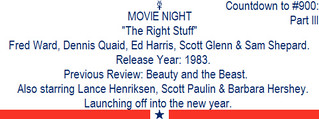
The Right Stuff.


Review #892: The Right Stuff.

Cast: 
Fred Ward (Gus Grissom), Dennis Quaid (Gordon Cooper), Ed Harris (John Glenn), Scott Glenn (Alan Shepard), Sam Shepard (Chuck Yeager), Lance Henriksen (Wally Schirra), Scott Paulin (Deke Slayton), Barbara Hershey (Glennis Yeager), Veronica Cartwright (Betty Grissom), Jane Dornacker (Nurse Murch), Harry Shearer and Jeff Goldblum (NASA recruiters), Kim Stanley (Pancho Barnes), Pamela Reed (Trudy Cooper), Charles Frank (Scott Carpenter), Donald Moffat (Lyndon B. Johnson), Levon Helm (Jack Ridley and Narrator), and Mary Jo Deschanel (Annie Glenn) Directed by Philip Kaufman.

Review: 
Watching epic movies (especially historical ones) can be interesting, provided that that the pacing and the subject matter make for good entertainment, with this being adapted from the non-fiction book of the same name by Tom Wolfe, which covered both the story of the Project Mercury astronauts (also known as the Mercury Seven) along with the pilots dealing with high-speed aircraft such as Chuck Yeager, ranging from his breaking of the sound barrier in 1947 to the launch of Mercury-Atlas 9 in 1963. Even with a 192 minute (over three hour) run time, obviously some liberties had to be taken in order to tell a story like this, and the end result is certainly satisfying enough, with spectacle and cast to boot. Even after Project Mercury is introduced by the first hour, it doesn't merely become about the crew, as it also continues to give time to Yeager, while also not being just a technical story. The two stories run parallel with each other very smoothly, while showing some wonderful effects and costumes. By the time Yeager's story ends, there is a sense of triumph that carries on to the end of the other narrative that make for exquisite viewing and an ambitious movie.

Ward does a fine job, along with Quaid, who make for entertaining scenes together. Harris (playing the recently departed John Glenn) stands out amongst the crew, likely due to his charm but also the determination he manages to show in someone as interesting as John Glenn was. Glenn (playing Alan Shepard) is pretty entertaining, having some quips along with some sort of charm. Shepard (playing Chuck Yeager) plays the role with a straight laced but ultimately interesting way.  The rest of the cast is also pretty good, with Moffat being quite entertaining as LBJ. As said earlier, the film takes liberties with certain events (such as the Mercury-Redstone 4's hatch cover blowing, with some implication toward Grissom being the cause and Jack Ridley being shown talking to Yeager after the former had died in 1957), but it does not detract too much from the story's flow. It never feels too long, nor out of its element in regards to showing these astronauts and their lives. One of the best scenes is them discussing with the scientists over installing a window, in part because you see how they see themselves more than just test subjects. On the whole, this is a movie that inspires curiosity along with excitement over an age long gone but not forgotten, with enough depth and skill to make for a tremendously entertaining experience.

On that note, I wish all of you readers at home a Happy New Year as we approach 2017, and in effect Season 7 of Movie Night. Season 6 had 116 reviews (with only one review in January to begin the season), as compared to the 90 in the previous season (2014). With any luck, Movie Night will keep trying to push the limit of the standard I hold myself when writing these reviews, along with trying to cover a diverse amount of movies, the good and the bad.

Thank you for reading, and I will see you in the new year. 10, 9, 8...

Overall, I give it 9 out of 10 stars.