
Showing posts with label Gary Cooper. Show all posts

July 26, 2024

The Naked Edge.

Review #2232: The Naked Edge.

Cast: 
Gary Cooper (George Radcliffe), Deborah Kerr (Martha Radcliffe), Eric Portman (Jeremy Clay), Ray McAnally (Donald Heath), Diane Cilento (Mrs. Heath), Hermione Gingold (Lilly Harris), Peter Cushing (Mr. Evan Wrack), Michael Wilding (Morris Brooke), Ronald Howard (Mr. Claridge), and 
Sandor Elès (Manfridi St John) Directed by Michael Anderson (#717 - Logan's Run and #1393 - Around the World in 80 Days)

Review: 
Admittedly, there is a bit of appeal in wondering what the fuss is about with the poster and a certain fact. The film is based on the 1955 novel First Train to Babylon, as written by Max Ehrlich. Joseph Stefano wrote the screenplay adaptation, and if you've seen the poster, that was the writer behind the screenplay adaptation for 1960's Psycho, likely his most famous accomplishment (in general, Stefano was involved more with television writing and occasional producing, such as the original The Outer Limits). Perhaps not surprisingly, the poster, and the last line of the film itself, as told to us by voiceover, do a gimmick similar to that film in not wanting audiences to be seated "during the last 13 minutes" (for a 97-minute film, but naturally it works to tell people to really hold in that break). Of course, now that one has that out of the way, this was the final film for its star in Cooper, who died of cancer on May 13, 1961, a month before the release of the film, which wasn't exactly a hit. He had worked with Anderson before with The Wreck of the Mary Deare (1959); the film was shot in London and at Elstree Studios in Borehamwood, Hertfordshire. 

The runtime is a funny one to have a "don't seat folks for the last couple" trick to, particularly for a film that seems to drag its tension out as much as possible. Really this is the kind of movie where people get suspicious of folks because of having the most amusing choice of words for phrasing, as evidenced by a scene where our lead is telling about raising money for a venture that came out because he "made a killing" on the stock market. One could possibly make a few edits and make it a comedy about a guy who does increasingly outlandish things with his wife that thinks he may be guilty (such as say, asking her to join him on the edge of a cliff - actually, that's in the film). The intro with a stabbing and the time spent with Cushing in the courtroom stuff does appeal to the most basic curiosities of mine, at least. Of course, Kerr was actually a pretty good actress in her own right to match up with Cooper (who was 20 years older than her). She makes those worries and doubts seem workable for something that really would've floundered under the weight of such amusing ambiguity with a lesser actress involved. That isn't to say that Cooper doesn't pair well with Kerr, but I think one can be forgiven for stating that there are times where a weary-seeming Cooper is not so much acting as it is a man trying to push through being tired. Cooper is worrisome enough to make Kerr's queries and fears over what really may be possible (or not) worth watching, although the best scene is with Cilento in terms of force and grace. Portman is at least adequate in the middle. The eventual ending is probably not ideal in the actual rundown, particularly with portions involving a struggle, but that doesn't sink the film completely at least because if one gets far enough to appreciate the film beforehand with its look in terms of cinematography (as shot by Erwin Hillier and Tony White) and bubbling dread, then one can't be too off. As a whole, it isn't exactly the finest hour for its stars or its director, but it has a nice look and probably enough ambiguity to seek out once if the curiosity factor is there enough to go in as cold as possible for its mystery, which for me just manages to make it over the finish line.

Overall, I give it 7 out of 10 stars.

September 13, 2023

High Noon.

Review #2083: High Noon.

Cast: 
Gary Cooper (Marshal Will Kane), Thomas Mitchell (Mayor Jonas Henderson), Lloyd Bridges (Deputy Marshal Harvey Pell), Katy Jurado (Helen Ramírez), Grace Kelly (Amy Fowler Kane), Otto Kruger (Judge Percy Mettrick), Lon Chaney Jr (Martin Howe), Harry Morgan (Sam Fuller), Ian MacDonald (Frank Miller), Eve McVeagh (Mildred Fuller), Morgan Farley (Dr. Mahin), Harry Shannon (Cooper), Lee Van Cleef (Jack Colby), Robert J. Wilke (Jim Pierce), and Sheb Wooley (Ben Miller) Directed by Fred Zinnemann (#1377 - The Men)

Review: 
"Sheriffs are people and no two people are alike. The story of High Noon takes place in the Old West but it is really a story about a man's conflict of conscience. In this sense it is a cousin to A Man for All Seasons. In any event, respect for the Western hero has not been diminished by High Noon."

It is never a bad time for a Western, particularly ones with interesting stories beyond the camera. The film is based on the short story "The Tin Star", as seen in 1947 in Collier's magazine that was done by John W. Cunningham. Carl Foreman (the credited screenwriter of the film) claimed later that he had written an outline that apparently seemed similar to Cunningham's story, which led to him buying the rights to the story. However, Richard Fleischer claimed in his autobiography (written decades after the fact) that he had helped Foreman develop the story while they had been working together in The Clay Pigeon (1949). Anyway, let's talk about Foreman for a bit. He had studied at the University of Illinois at Urbana–Champaign as a teenager, dropped out to seek out Hollywood, went back to Illinois to study at the John J. Marshall School of Law, and then dropped out of there to work a variety of jobs (writer, reporter, and even carnival barker) before eventually returning back to Hollywood by the late 1930s; during that time, he became a member of the Communist Party, which he left by the dawn of World War II, which saw him serve with the U.S. Army Signal Corps. Foreman had done his first writing in film with the 1941 film Bowery Blitzkrieg in an uncredited manner, but he got onto a more regular pattern of work with story/writing credits for Dakota (1945) and So This Is New York (1948) - the latter was the first Foreman made in association with Stanley Kramer (who he met when they both were serving in World War II). There would be a handful of films that Foreman made as a writer for Kramer's company, which included The Men (1950), as directed by Fred Zinnemann. At any rate, Foreman's career took a beating due to the House Un-American Activities Committee (HUAAC), who labeled him as an unfriendly witness after he admitted to being a party member but did not want to name names. He later called the film a parable against blacklisting, one that seems apt when considering that Kramer essentially shortchanged him when it came to having him sell his share in the company and even tried to get him booted off the production prior to the meeting with the HUAAC (because he feared he would be implicated by Foreman, assocation or not). Living mostly in London for the rest of his days, Foreman was given the cold shoulder from Hollywood for the rest of the 1950s that saw him either work on the side away from Hollywood or with modified credit that ranged from The Bridge on the River Kwai (1957); he also did a hand of producing in addition to writing for films such as Mackenna's Gold (1969); Foreman died in 1984 at the age of 69.

Fans of the Western know that Howard Hawks made Rio Bravo (1959) as a response to what he thought about this film that he felt didn't make much of a good Western, which naturally starred John Wayne (incidentally, he called High Noon "un-American", which is probably the silliest thing ever said by Wayne in the 1950s). Of course, Zinnemann years later responded by saying he wished Hawks would leave his films alone, so there's that. It seems only apt to have Cooper here, since the film that made him a key presence for bigger things in film was The Virginian (1929), which incidentally was a film that dealt with a man recently finding love in the West having to deal with the ramifications of an old foe coming into town for revenge in a shootout. The amusing point in all of this is that the two films are basically the same in quality anyways, ones that serve as being pretty good for what they are with distinct human qualities that make for a useful Western. The anguish and fear shown in its lead character (with credit going to Zinnemann and cinematographer Floyd Crosby) make a resounding effort to make a panicky piece of entertainment that makes a suitable morality tale that also is a sharp real-time thriller of conscience. In the end, a town may be a town, but it is nothing if there are no good people willing to stand side by side with folks in need of help, whether that involves men bound to their duty and honor or not. It is the kind of film that enforces the idea that beyond the one person bound to serve and protect folks sees them exposed for who they are (cowardice, resentment, jealousy, or bad timing) when the cards are down, which isn't always the easiest thing to confront when seeing human nature that leads to a man needing to make a decision (in Zinnemann's words) "according to his conscience." Cooper makes the ideal lead to make this grand quandary worth watching, which works pretty well when presented with a collection of various recognizable presences that make the lineup of human frailty (well, aside from the Quaker and an assertive presence of who stands by their man most) that even overshadow the outlaws (a quartet led by MacDonald), which somehow seems right. Kelly makes a decent pacifist in the middle, but really the most suitable presence to counter Cooper in pursuit is Bridges or Jurado, who each show the side of just what past loyalties mean when it comes to pride. The climax proves worthwhile in showing the chase of just how much pride and devotion mean when staring at a frontier where guns are in the picture rather than the idea of safety. As such, High Noon is a worthwhile effort in showing the nature of man and pride in a story that is distinct from the general Western tales and myths that arise from gunslingers and towns of man and dirt. Analyze all you want about just where the best Western lies, but this one is a pretty good one to go along with no matter where you encounter it in your travels.

Overall, I give it 9 out of 10 stars.

July 26, 2023

The General Died at Dawn.

Review #2055: The General Died at Dawn.

Cast: 
Gary Cooper (O'Hara), Madeleine Carroll (Judy Perrie), Akim Tamiroff (General Yang), Dudley Digges (Mr. Wu), Porter Hall (Peter Perrie/Peter Martin), William Frawley (Brighton), J.M. Kerrigan (Leach), Philip Ahn (Oxford), Lee Tung Foo (Mr. Chen), and Leonid Kinskey (Stewart) Directed by Lewis Milestone (#901 - The Racket, #1336 - The Front Page, #1709 - Ocean's 11)

Review: 
Okay, it might sound a bit odd to pick this film out in the middle of a career, but Lewis Milestone is a pretty good one to spotlight again. If you can do films such as Two Arabian Knights (1927) and All Quiet on the Western Front (1930), one wouldn't be surprised to see him here with a melodrama action film. Of course, anyone was a student of Columbia University's School of Military Cinematography within the Signal Corps would have a good knowledge of photography. He started in comedy but took on various genres, one of which included adventure-melodrama. He needed it after his last two films (both musicals) in Paris in Spring (1935) and Anything Goes (1936) flopped. While he later considered The General Died at Dawn a film "of little consequence", it ended up being a pretty noted feature in his lengthy career. The film was written by Charles G. Booth and Clifford Odets. Odets was a noted playwright for his social dramas who did a handful of scripts (some without credit) while Booth was just starting out as a screenwriter (one of his future stories with The House on 92nd Street (1942) would win him an Academy Award).

So, we have a tale of a man who likes to root for the underdog and therefore has decided to help people from their oppression. In that sense, it reminds one of the real-life figure Two-Gun Cohen, a British/Canadian adventure with Jewish roots that basically became a soldier of fortune for Chinese-related efforts (such as the National Revolutionary Army). Some of this plays out pretty well in cynicism in the portrayal laid out by Cooper more so than anybody else for a film made in a time where Armenian actors are put out in latex to play Asian characters. If you enjoyed the exploits of train adventure involving warlords with Shanghai Express (1932), you will find plenty to partake here, although obviously they don't have the same dynamics. Cooper and Carroll make an adequate pair together, mostly since the latter isn't given as much to do despite being quite engaging, but their last scenes together around the climax do the job. Tamiroff, Hall, and Kerrigan are the general adversaries, although obviously attention is focused on the first one (since he was the one actor to receive an Academy Award nomination here). Tamiroff accomplishes the main goal with worthy timing and edge, while Hall makes a quality fool and Kerrigan makes a most useful sinister toady. This is basically a "wham-bam and figure the plot eventually ma'am" kind of movie, where you kind of just have to go with whatever the film is laying out and hope things play out to satisfaction. Like other adventures for others to identify, it is the kind of movie where one might as well be asking, "why not just shoot him?". Aside from its final conclusion, the movie does work out to expectations. And what I mean by that is the part where the lead character has to convince the villain to save their lives...so that they can tell others about the General's exploits due to their impending death. And, well, since you already read this, the General then orders his men to kill each other for the honor. No, really. If you can take the film seriously enough for most of its 98-minute runtime, even an ending that may verge on "convenient" may work fine enough to not ruin the general experience. I will go with what the movie is running with its attempts in the general sense of romances and adventure at dawn and call it a pleasant one to recommend. With a director like Milestone, it is a quality mission for one to accept.

Overall, I give it 8 out of 10 stars.

June 4, 2023

The Wedding Night.

Review #2016: The Wedding Night.

Cast: 
Gary Cooper (Tony Barrett), Anna Sten (Manya Novak), Ralph Bellamy (Fredrik Sobieski), Helen Vinson (Dora Barrett), Sig Ruman (Mr. Jan Novak), Esther Dale (Mrs. Kaise Novak), Leonid Snegoff (Sobieski), Eleanor Wesselhoeft (Mrs. Sobieski), Milla Davenport (Grandmother), Agnes Anderson (Helena), Hilda Vaughn (Hezzie Jones), and Walter Brennan (Bill Jenkins) Directed by King Vidor (#987 - Show People, #1015 - Bardelys the Magnificent, and #1369 - Duel in the Sun)

Review: 
It is entirely possible that certain directors will fade away in relevance with the passage of time no matter what one does or says. This is especially apparent when you consider the moods of certain folks when it comes to watching "black and white" movies or perhaps hearing directors (dork or not) talk about not knowing who directed certain famous movies. The best way to respond is to educate oneself in making suitable choices and not let silly reasoning win the day. Movie Night is here to spotlight directors until death, so one might as well try to give a spotlight to as many filmmakers as possible. So let us go with King Vidor and a semi-compelling story in a semi-compelling movie, which was actually released in the latter part of a career that lasted over four decades. He was a Galveston native that honed an interest in cameras from a young age, going from photographing them for portraits to serving as an amateur newsreel cameraman. The very first person to give him a chance to do films for places beyond his home was a judge-turned-humanitarian-turned-filmmaker Willis Brown, where he made a handful of short films all about juvenile delinquents and their rehabilitation (the irony is that Brown was actually a guy who falsely claimed to be a lawyer and was called out on it). Anyway, The Turn in the Road (1919) was his first feature film (which he wrote and directed), and he basically never stopped from there, making at least one film for various studios that ranged from Brentwood Film Corporation all the way to United Artists. Vidor was the kind of man who put forth his own "Creed and Pledge" about what he would do as a filmmaker...in 1920, one that believed in the motion picture in carrying a message to humanity that ended with him making an "endeavor to draw upon the inexhaustible source of good for my stories, my guidance and my inspiration." Time has probably been kind to the question about if he achieved his goal or not.

Oh right, there is a film to talk about. The Wedding Night was written by two folks: Edwin H. Knopf wrote the original story that was then turned into a screenplay by Edith Fitzgerald (Knopf based his story on the exploits of F. Scott Fitzgerald and his wife Zelda, since he was a close friend of Knopf). The story that goes with the film is the last real attempt to make Anna Sten a mainstream name. She was born in Kiev in the Russian Empire (the place where she was born is now what you would call Ukraine) and she had studied theater before becoming an actress for Soviet and German films in the mid 1920s. Samuel Goldwyn discovered her when trying to find an actress of his own that could be promoted in the same way as Greta Garbo (Swedish-born, but I think you get the idea) and decided to sign her to a contract along with extensive training. The result was three films: Nana (1934), We Live Again (1934), and this. They actually promoted her as "The Passionate Peasant", which is, um, interesting when coming in the era of the Depression, and it probably doesn't help that Goldwyn's attempt to make her a star became a punchline in Cole Porter's famed "Anything Goes" song. None of the films were particularly successful, and the result was that Goldwyn released her from the contract. Over the next 27 years, she would make eleven appearances in films (some with the involvement of her husband Eugene Frenke, who was a producer and director for a couple of years) but she was never as prominent as she was with these films. 

The film is actually decent, but I am sure you can figure out how it wasn't exactly destined for stardom. It is actually a fairly well-shot film (done by Gregg Toland), one with fair sensitivity towards the inevitability of a doomed strike of love that, well, you know can only go one of two ways. For the most part, Cooper shines over the rest of the cast in a semi-balanced exploration of what it means to be a writer trying to dig out of the muck and also the differences that arise from a Polish family and someone like Cooper's character. It isn't just a man finding a story in what he is watching around him, it is a man that finds himself in that very story that may or may not be too involved with his own mythmaking. So yes, Cooper outshines them when it comes to plain-spoken honesty for a name right in the middle of becoming more than just a name on certain films (Mr. Deeds Goes to Town, his first Academy Award nominated film, came out the following year), and while I can't say he makes a great "drunken writer", I will say that he trembles his way towards romance with enough conviction to carry things to where they need to go. Ruman and Vinson basically act as the plugs against the idea of the two together, whether that involves traditional coarseness in the former or cloying sensibility in the latter, which is fine. Bellamy makes a quality adversary in affections, in that it is clear where he fits and doesn't fit within an would-be arranged marriage with certain goals. Stem seemingly acts better when placed in quiet moments where one can just watch her react to what is around her rather than, say, heavy dialogue. That isn't saying anything about her accent or anything to do with chemistry, it just means that some actors do better than others when it comes to the line between actor and character played by an actor. It is mildly convincing to see her with Cooper, but one is either invested in the sheer inevitability of who these people are and what must be, or they find it very mild stuff, or perhaps just a trifle, which I guess means that those 83 minutes will either tug on your curiosity or just pass through, and I firmly sit in the middle. It is a nice little film, but that is all it ends up being, just one that you can say warm things about for a time and await further curiosities that either will pique your interest in something else similar or perhaps better. You can't go wrong within certain choices in directors or actors in the 1930s if you know where to go.

Overall, I give it 7 out of 10 stars.

December 16, 2020

A Farewell to Arms.

Review #1611: A Farewell to Arms.

Cast: 
Helen Hayes (Catherine Barkley), Gary Cooper (Lieutenant Frederic Henry), Adolphe Menjou (Major Rinaldi), Mary Philips (Helen Ferguson), Jack La Rue (Priest), Blanche Friderici (Head Nurse), Mary Forbes (Miss Van Campen), and Gilbert Emery (British Major) Directed by Frank Borzage.

Review: 
It is easy to say a film is overdue to cover when you can see it any time you like, which is particularly true for this film. It was originally distributed by Paramount Pictures, but somehow it managed to fall into the public domain when its copyright was not renewed. This was a film released in the middle of the career of established director Frank Borzage, who by this point in time was the second director to have received two Academy Awards for Best Director (he started his career in 1916, after having appeared in a few short films) with dramas such as 7th Heaven (1927) and Bad Girl (1931). The screenplay was done by Benjamin Glazer (who also co-produced the film) and Oliver H.P. Garrett, which was based on the novel of the same name by Ernest Hemingway. He had written the novel in 1929 that was based on his experiences in World War I, in which he served in the Italian Front (his stint in a Milan hospital with treatment from a nurse that he fell in love with, was dramatized into a film of its own with In Love and War decades later). This is the first of two film adaptations, with the other being released in 1957. This film was released before the advent of a tighter Production Code (hence content like abandoned duty and babies born out of wedlock and such), which means that one has a mix of romanticism and cynicism that proves quite enjoyable.

The film received four Academy Award nominations with Best Picture, Best Art Direction, Best Cinematography, Best Sound, and it won in the latter two categories, certainly earning a merit as some sort of prestige picture for its time. In other words, it is the kind of movie that you can look to and highlight from the curious era of the 1930s, just making its way out of the silent era while continuing the trend of adapting notable works of literature with spin for its target audience that just happen to deal with either war, romance, or a bit of both (besides, the Best Picture winner that this film lost to happened to involve drama and coverage of war - the inferior Cavalcade (1933), naturally). In that sense, even if Hemingway wasn't exactly thrilled by the film's tone compared to his book, I'm sure one will find enough to enjoy in a romance rift with energy and tragedy. Featured as our stars are two rising stars that would become famous names in time. Hayes was already an actress by the time she was a teenager (she is known as "First Lady of American Theatre" for a reason), and her debut in feature film with The Sin of Madelon Claudet (1931) garnered an Academy Award for her. She reportedly developed a crush on Cooper during production, and it is clear to see a brimming honesty coming from her that makes for a well performance in vulnerability. Cooper had been established as a star with film roles such as The Winning of Barbara Worth (1926) and The Virginian (1929), so it only seems appropriate to see him in a strong brimming kind of film like this, where he towers a bit over Hayes (by at least a foot, although the camera angles certainly help sometimes) that makes for an interesting romantic courtship. He composes himself well in careful charisma like a mighty oak tree, one might say. Not to be forgotten is Menjou, a name actor in silent and sound films (with a select group of lead roles owning to his suave nature that served for a five decade career), playing cavalier with Cooper that works quite well in turning the screws for what is needed without fiddling the mustache in scene-chewing. Philips goes along okay, although it is La Rue who makes memorable effort in a "wedding" sequence in the middle of the film. There were actually two endings to the film, depending on preferences of the theater at the time of release, with one following the novel and the other being more optimistic. Hemingway, displeased already by the altering of tone with his novel into less cynical, was angered by the decision for theater owners. One silver lining is that he struck up a friendship with Cooper that lasted for over 20 years (and he surely must have found it engaging to see Cooper star in another adaptation of his work a decade later). In any case, what we have here is a fine film to see play out for 88 minutes in classic traditional fare for those who like that sort of thing. It isn't great, but it certainly represents a well effort for its stars and director in entertainment, for which one can fit their curiosity for any time they like.

Overall, I give it 8 out of 10 stars.

March 26, 2020

Unconquered (1947).

Review #1371: Unconquered.

Cast:
Gary Cooper (Captain Christopher Holden), Paulette Goddard (Abby Hale), Howard Da Silva (Martin Garth), Boris Karloff (Guyasuta, Chief of the Senecas), Cecil Kellaway (Jeremy Love), Ward Bond (John Fraser), Virginia Campbell (Mrs. John Fraser), Katherine DeMille (Hannah), Henry Wilcoxon (Captain Steele), C. Aubrey Smith (Lord Chief Justice), and Victor Varconi (Captain Simeon Ecuyer) Directed and Produced by Cecil B. DeMille (#1245 - The Squaw Man)

Review: 
"Creativity is a drug I cannot live without."

When it comes to innovators and crucial pieces of cinema to link past and present, Cecil B. DeMille serves as a key member of sound and silent cinema for America. He made 70 films from 1914 to 1958 that were known for their epic scale and showmanship. He developed a love of the theater from his playwright father (who suddenly died when Cecil was 11), and he graduated from the American Academy of Dramatic Arts (after time with military college) in 1900. He started his career as an actor that same year, and he would later turn to directing and producing plays in the 1910s. He was soon introduced to Broadway producer Jesse L. Lasky by his producer mother Beatrice, and the two would join forces with Samuel Goldwyn alongside Oscar Apfel to form the Jesse L. Lasky Feature Play Company in 1913, with their studio being a barn in Hollywood, one of the first in the region that is now a state landmark (named after Lasky and DeMille). Their landmark first feature was from DeMille and Apfel with The Squaw Man (1914), which was DeMille's debut (he of course would later film two remakes of the material). DeMlle spent his time directing numerous films nonstop, with his style soon being characterized by having extensive research that turned into collaboration with writers to mold a story together in his vision, which also applied to his efforts on visuals along with editing and lighting. He did not tend to give direction much to actors, preferring to work with them in the office with read-throughs as opposed to doing so on set, where he was an authoritarian that commanded attention from his cast and crew, no matter how big they could be. Actors who did not want to take physical risks for the sake of the film could incur his wrath, such as with this film, where Goddard objected to risk herself for a scene with hurling fireballs (which not surprisingly was proven correct when the stuntwoman later got burned for the scene). He didn't speak to her for years and later denied her a role in one of his subsequent films. Although he is known for his spectacle epics, he directed a variety of genres over the course of his career, ranging from Westerns to romances to comedies, with numerous highlights being Cleopatra (1934), The Greatest Show on Earth (1952, his lone Best Picture win), and The Ten Commandments (1956, a remake of his 1923 film that served as his last venture), and he has served as influence and inspiration to directors such as Steven Spielberg and Martin Scorsese.

The film was written by Charles Bennett, Fredric M. Frank and Jesse Lasky Jr, with un-credited work by Jeanie Macpherson. DeMille had been inspired by The Judas Tree, Neil Swanson's novel about people who had been sent to 18th century America to be sold as slaves after conviction in England. Despite hiring two experts to research about the topic of colonial slavery, he wanted to romanticize the American colonial conquest more than anything else, which means that the final result is a film that seems to go anywhere it wants with its colonial setting, certainly seeming the part with costumes and its cinematography from Ray Rennahan than with other aspects, a ridiculously watchable curiosity. It certainly does seem a bit bloated at 146 minutes, complete with a $4.3 million budget and a shooting schedule that was just as excessive and a battle sequence that had over 800 extras and plenty of dynamite. Cooper (in his fourth and final collaboration with DeMille) pulls off a subtle performance as usual, one that we care to follow along with no trouble because of how natural he plays the hero. Goddard drives the screen with some passion, rolling just fine in chemistry with Cooper in a rustled role that seems fitted for a dime-store novel, complete with color to really emphasize her bright hair for sequences such as the impromptu auction or the bathing one. Da Silva (known for his stage work alongside his work in film) makes for a conniving adversary that the audience can seethe at whenever sharing the screen with either lead, although the climax certainly proves anticlimactic for both sides. Karloff (who was asked to study the Seneca language for the role) seems reserved here for his brief time on screen. Kellaway and Bond give a moment of levity or two, at least. One may very well call this film kitsch and get away with it because of how silly it can get with characters and situations (particularly when relating to history) so overblown that might make The Outlaw and Duel in the Sun bat an eye. It doesn't mean I despise the film however, since there are aspects in terms of cast and design that do tend to work out well - if you are going to make a film resemble a damsel-in-distress novel with big costumes, one can't go too wrong with something like this, which is too long, too big and too perfect for a few moments to gawk and perhaps have amusement with, for better or worse.

Overall, I give it 7 out of 10 stars.

March 7, 2020

Meet John Doe.

Review #1356: Meet John Doe.

Cast: 
Gary Cooper (John Doe/Long John Willoughby), Barbara Stanwyck (Ann Mitchell), Edward Arnold (D.B. Norton), Walter Brennan (The Colonel), Spring Byington (Mrs. Mitchell), James Gleason (Henry Connell), Gene Lockhart (Mayor Lovett), Rod La Rocque (Ted Sheldon), Irving Bacon ("Beanie"), Regis Toomey (Bert), and J. Farrell MacDonald ("Sourpuss") Directed by Frank Capra (#102 - Mr. Smith Goes to Washington, #319 - It's a Wonderful Life and #456 - It Happened One Night)

Review: 
Frank Capra was a director of tremendous skill who came out of the rags to make great memorable entertainment in the 1930s and 1940s. He had emigrated from Italy with his family at the age of five to America, eventually ending up in Los Angeles. By the time he was 25, he had done a variety of jobs before and after graduating college, ranging from selling newspapers to working at the laundry facility at the California Institute of Technology (where he graduated from in chemical engineering). He would serve in both World Wars, serving as a teacher of mathematics to artillerymen in the former and as a director for war information documentaries (Why We Fight) in the latter. He found his way to films in gagwriting and luck. He directed his first film with independent Fireside Productions in 1922 with Fultah Fisher's Boarding House, getting the job by touting his experience with film (which was scant) but it proved effective. He also wrote gags for the Our Gang series alongside scripts for comedian Harry Langdon, which led to his feature film debut with The Strong Man (1926). After one more film with Langdon, he was fired by the comedian. He eventually found himself with newly named Columbia Pictures, which at the time was a start-up studio in minor status compared to the big icons that had their own facilities and distribution. From 1928 to 1939, he made 25 features for the company, including numerous classics such as Lady for a Day (1933) and Mr. Deeds Goes to Town (1936) among others, winning Best Director at the Academy Awards three times in a period of four years. This film was one of two films that he did with Warner Bros (the other being Arsenic and Old Lace) along with the last before America entered World War II. The screenplay was done by Robert Riskin (his tenth and last collaboration with Capra) with story from Robert Presnell that was adapted from Richard Connell's A Reputation, a 1922 story originally published in Century Magazine.

Of course who better to headline the film than Cooper and Stanwyck, both veteran actors who had previous experience with Capra that would have decades-long careers of success. They both prove important to the film's success in material that is dark but still relevant in its message about the everyman and creeping corporate influence when dealing with hope. Cooper makes it worth his while as a folksy everyman, rising to the occasion through gradual evolution from anonymous tramp to club-creating philosopher. Stanwyck proves just as well, ambitious but warm to follow along with in her zealous energy. Arnold proves a conniving clever presence, and Brennan proves a worthy tramp foil for Cooper alongside Byington for Stanwyck. Gleason makes a worthy hard-driving role, particularly in one scene where he reveals a deception about to take place to our star while espousing about the good done by him (including unwittingly creating a grassroot movement) to folks that need it. Lockhart and the rest prove just as worthy with filling the details for the film to make its statements without needless aspects for a diverting 122 minutes. The ending is certainly an interesting one. There were numerous ideas shot or edited that found their way into previews, owing in part because Capra hadn't had a clear idea of how it should end when production began. All of them revolved around the exposing the truth of John Doe (done at a convention), with one ending directing ending on the convention scene with his disgrace. Another apparently ended up with him committing suicide, while others involved him being saved or the reforming of Arnold's character. A comment from a preview led to a fifth and eventual ending, where some of the club members show up to express their still-present belief in him and the club (along with a statement by Stanwyck's character about how another "John Doe" already gave himself up for humanity). The film holds itself together without too many troubles, making its point about media and hope without becoming sanctimonious or overly cynical. It's a fair comedy-drama, balancing its way through with enough competency worth a viewing alongside other Capra movies. In fact, it is an easy one to do because of its public domain status (occurring due to a failure in copyright renewal). For each of its main talents at stars and director, it's a good one to go with for curiosity and perhaps some subsequent discussion afterwards.

Overall, I give it 9 out of 10 stars.

February 20, 2013

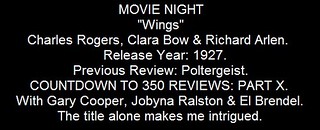
Movie Night: Wings (1927).


 Review #349: Wings.

Cast
Charles Rogers (Jack Powell), Clara Bow (Mary Preston), Richard Arlen (David Armstrong), Gary Cooper (Cadet White), Jobyna Ralston (Sylvia Lewis), El Brendel (Herman Schwimpf), Richard Tucker (Air Commander), Gunboat Smith (Sergeant), and Roscoe Karns (Lieutenant Cameron) Directed by William A. Wellman.

Review
Wings is an unique film in some ways. It was the first film to win Best Picture (known as Outstanding Picture at the time) at the first Academy Awards, the only silent film to win the award, and it also includes aerial action from the yesteryear of 1927, over 85 years ago. But does this film still hold up? Yeah, pretty much. The actors do try to convey emotion, to convey message with expressions rather then voice (Obviously considering this is silent), which works decent. Clara Bow does a memorable job, though, having a certain zing which manages to make you interested in her character, which helps. The aerial action is understandably cool. It works really well, especially with the brief flash of color when the planes go down. The story isn't a whole lot, but the action and the relative enjoyment exceed overall. Is it great? Not precisely, but it is a fixture of importance in film and in history, which is more than enough. Countdown to 350 Reviews: 10, 9, 8, 7, 6, 5, 4, 3, 2, 1.

Overall, I give it 9 out of 10 stars.