Showing posts with label William Holden. Show all posts

June 17, 2020

The Towering Inferno.

Review #1447: The Towering Inferno.

Cast: 
Paul Newman (Doug Roberts), Steve McQueen (Michael O'Hallorhan), William Holden (James Duncan), Faye Dunaway (Susan Franklin), Fred Astaire (Harlee Claiborne), Susan Blakely (Patty Duncan Simmons), Richard Chamberlain (Roger Simmons), Jennifer Jones (Lisolette Mueller), O. J. Simpson (Harry Jernigan), Robert Vaughn (U.S. Senator Gary Parker), Robert Wagner (Dan Bigelow), Susan Flannery (Lorrie), Sheila Matthews Allen (Paula Ramsay), Norman Burton (Will Giddings), Jack Collins (Mayor Robert "Bob" Ramsay), Don Gordon (Kappy), Felton Perry (Scott), and Gregory Sierra (Carlos) Directed by John Guillermin (#726 - King Kong (1976) and #1231 - Shaft in Africa)

Review: 
"You know, there's really nothing like an exciting film on a big screen. Hopefully, I've made a few in my career."

Here's an idea: How about a film based on not one, but two books? No wait, here's one better, how about one released by two major studios? This film, adapted from The Tower by Richard Martin Stern and The Glass Inferno by Thomas N. Scortia and Frank M. Robinson, was released in the United States by 20th Century Fox and worldwide by Warner Brothers, as Irwin Allen (who would direct the action sequences) convinced them to make one film together rather than just adapting the novels separately for film. There were numerous disaster films of this era, but The Towering Inferno likely topped them all, despite attempts for others to try to raise the heights, considering 1974's output in this film, Earthquake, and Airport 1975 (the sequel to the original film with familiar disaster star Charlton Heston). Simply put, if something existed that had people nearby, by George would there be a disaster waiting to happen, whether that involved rollercoasters (with Sensurround!), football games (sniper or blimp, take your pick), or meteors. The one fitting to helm a big budget action adventure would be John Guillermin, noted for his intense perfectionist attitudes for his film that crept to his stars and producers for a varied career of distinct hits at times in a career that spanned over three decades.

This is an interesting duo for a film, since both Newman and McQueen apparently have the same amount of lines despite the latter not appearing until forty minutes into a 165 minute film (he actually was meant to star as the architect but lobbied for the architect role and got it). One thing this film certainly has enough of is ludicrous spectacle, a film that builds and builds and builds until it nearly becomes too much about a massive fire that engulfs its audience and stars to make for fair entertainment in parts with enough effects and silliness for a lifetime. It is arguable to say which Allen epic is better with The Poseidon Adventure or this, but it can't be denied that they have had their own types of lasting appeal, with both making plenty of money and receiving accolades (mostly technical awards along with title songs, oddly enough) that make them interesting pieces for their era. Newman (who apparently described the film later as a "turkey" before appearing in another Allen film years later in When Time Ran Out) is quite casual here, rolling with the occasional line about safety and exposition without trouble. McQueen (who appeared in three more films before his death after taking a four-year hiatus following this film) is calm and collected in leading the fire aspects that keeps your attention in a balance that favors the two stars without engulfing them in a scenery-chewing contest. Holden, who described his part as one that spends all the time talking on the phone (while clearly liking the money more than the script), does just fine with a role that doesn't really require too much besides just interacting with the occasional figure in a room - as long as he doesn't seem to be lost in the fun, it works out. Dunaway definitely gets close to being lost in all of this, since she only interacts with Newman for a few scenes before being mostly in the background. There are little highlights within the rest of the cast, such as the kindly professional Astaire paired with the equally kind Jones (in her last role), or a snidely Chamberlain, or even sprinkles of football star-turned-actor Simpson and his rescue of a cat (who then only reappears at the end to give the cat away to a survivor, naturally). One is here to see who will come out of alive, and while there may not be as much of a seeable count of vanquished stars, it still makes for a thrilling film at times, if only because of the thought of a building on fire from below does seem pretty scary. There are plenty of spectacle moments such as the stairwell rescue, the outsider elevator debacle and rescue, the daring attempts to rescue people (and cats) from fires, and a two million gallon water climax. For those who seek out something brimming with spectacle and stars that overflow the pot with mostly satisfaction, you can't quite go wrong with this film - a worthy disaster film highlight for its era.

Overall, I give it 8 out of 10 stars.

April 10, 2020

Stalag 17.

Review #1384: Stalag 17.

Cast: 
William Holden (J.J. Sefton), Don Taylor (Lieutenant James Dunbar), Otto Preminger (Colonel von Scherbach), Robert Strauss (Stanislas "Animal" Kuzawa), Harvey Lembeck (Harry Shapiro), Peter Graves (Price), Sig Ruman (Sergeant Johann Sebastian Schulz), Neville Brand (Duke), Richard Erdman ("Hoffy" Hoffman), Michael Moore (Manfredi), Peter Baldwin (Johnson), Robinson Stone (Joey), Robert Shawley ("Blondie" Peterson), William Pierson (Marko the Mailman), and Gil Stratton (Clarence Harvey "Cookie" Cook / Narrator) Produced and Directed by Billy Wilder (#106 - Some Like It Hot, #194 - Ace in the Hole, #422 - The Fortune Cookie, #641 - The Apartment, and #809 - Sunset Boulevard)

Review: 
"Trust your own instinct. Your mistakes might as well be your own, instead of someone else's."

Nobody could quite as versatile as Billy Wilder for film. Born in Austria-Hungary, he found himself wanting to become a journalist from viewing a newsreel (as opposed to prelaw in college or the family business in cakes). He worked for magazines and newspapers in both Austria and Germany, but he eventually found himself wanting to be a screenwriter, with his first credit being for The Daredevil Reporter (1929). During his time in Germany, one notable film he wrote for was People on Sunday (1930), which had notable collaborators such as Edgar G. Ulmer. However, he left the country in 1933 for Paris after the rise of the Nazis. He had his directorial debut with his collaboration with Alexander Esway in Mauvaise Graine (1934) before deciding to leave for America. Over the next few years, he would find himself collaborating on film scripts that gradually found attention, most notably with Charles Brackett. For over a decade, the two would write scripts together (with a few occasions having an additional writer), with the first major hits coming in 1939 with Midnight and Ninotchka. Anxious at the idea of directing and not being confined with just writing, Wilder was given a chance with The Major and the Minor (1942). It was here that he met another important figure in honing the craft in editor Doane Harrison, who had edited Wilder and Brackett's Hold Back the Dawn the previous year. With Harrison on set, Wilder credited him for helping him in technical knowledge in terms of cutting so that there wouldn't be excess footage to deal with. The two would work together for the next two decades. Over the course of the next four decades, Wilder would direct and write plenty of noted successes in genres from noir to comedy drama, such as Double Indemnity (1944), The Lost Weekend (1945), and Sabrina (1954). In his career, he would win six Academy Awards on 21 nominations, with three of them being for screenplay, two for direction, and one for Best Picture.

The film is an adaptation of the Broadway play of the same name by Donald Bevan and Edmund Trzcinski, who had based it on their experiences in a prison camp named Stalag 17B in Austria. When it comes to a war film about prisoners, there certainly wasn't anything like this film before it came out, one that balances dark humor with suspense alongside a claustrophobic atmosphere that makes for a compelling two hour viewing. One key star that was part of some of Wilder's successes for the decade was William Holden, who appeared in three of his features (with one more years later in Fedora). It was the result of these films that elevated him to prime star status, with this being his one Academy Award winning performance of three nominations, although he felt that he didn't deserve to win (instead favoring Burt Lancaster in From Here to Eternity). In fact, he actually disagreed with the characterization of the role (which had Charlton Heston and Kirk Douglas thought of before Holden), since he felt it was selfish and he wanted Wilder to make him nicer, which was rejected. In any case, one finds plenty to draw themselves into Holden and his world, a heel-hero with smarmy complex charm beyond the usual expectations for a film with suspense like this one, which plays to the film's favor in drawing out its traitor twist (kept under wraps by filming in sequential order) through subtlety in both Holden and the camera movement. The rest of the cast keep up with him in establishing the close-knit and hard-driven members contrast with the menace and bluster on the other end. In that sense, the ones who shine best are Strauss, Graves, Brand, Ruman, and Preminger, each delivering a distinct layer that makes the film operate as well as it does without feeling monotonous. There is a key balance of drama and humor that earns the film key moments that can go from a sequence involving a telescope on friendly Russian women to the discovery of the traitor to the whole group. In the long run, this is an entertaining film in a long line of Billy Wilder achievements that merits a watch as a key piece for the decade in balancing drama and humor without too much trouble.

Overall, I give it 9 out of 10 stars.

June 11, 2016

Sunset Boulevard.


Review #809: Sunset Boulevard.

Cast
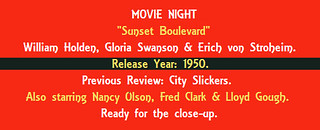
William Holden (Joe Gillis), Gloria Swanson (Norma Desmond), Erich von Stroheim (Max von Mayerling), Nancy Olson (Betty Schaefer), Fred Clark (Sheldrake), Lloyd Gough (Morino), Jack Webb (Artie Green), and Cecil B. DeMille. Directed by Billy Wilder (#106 - Some Like It Hot, #194 - Ace in the Hole, #422 - The Fortune Cookie, and #641 - The Apartment)

Review
The inventive (if not quirky) device of narration by our freshly dead main character certainly sets the tone for what is at all counts a fairly well-made movie that was later added to the National Film Registry as a film noir. Nostalgia is something that we all encounter at least once in our lives, whether it be for a different past time or for our own past. Sunset Boulevard certainly expresses nostalgia in the form of Swanson's character, from her private movie theater that shows her silent movies to playing bridge with a few "waxworks" (played by three silent film stars of the era: Buster Keaton, Anna Q. Nilsson, and H. B. Warner). The transition from the silent era to sound led to new horizons but also the decline of a good deal of the silent stars that had graced the screen and the hearts of moviegoers as well. The cinematography by John F. Seitz is excellent, making the movie look very well shot, particularly the final scene, with Swanson seemingly fading into the glitz of the camera. There's a certain sort of allure that Swanson brings to her character that makes her irresistible to watch on screen - her banter with Holden is especially entertaining. Von Stroheim is also wonderful to watch in his attempts at appeasing this husk of a star, with all of the desperation and pity in full display. Holden does a good job at telling this yarn, with enough quips along the way. One of my favorite lines is about how people don't really know the writing it takes to make a movie, assuming that the actors make it up as they go along. There's a certain mythic quality to these actors of yesteryear that is hard to explain at times but is always present, with a presence as large as Norma Desmond. Sure, one could figure out who killed who soon enough, but it's the spectacle that gives the movie breath. It's a movie with much to remember, from the main trio to the dialogue ("I'm ready for my close-up" being one of them) that makes for a fine thing to watch.

Overall, I give it 10 out of 10 stars.

June 12, 2014

Movie Night: The Wild Bunch.


Review #591: The Wild Bunch.

Cast
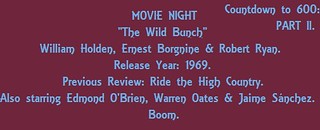
William Holden (Pike Bishop), Ernest Borgnine (Dutch Engstrom), Robert Ryan (Deke Thornton), Edmond O'Brien (Freddie Sykes), Warren Oates (Lyle Gorch), Jaime Sánchez (Angel), Ben Johnson (Tector Gorch), Emilio Fernández (General Mapache), Strother Martin (Coffer), L. Q. Jones (T.C.), Albert Dekker (Pat Harrigan), and Bo Hopkins (Clarence 'Crazy' Lee) Directed by Sam Peckinpah (#590 - Ride the High Country)

Review
Yeah, I should've known that I would review The Wild Bunch. I mentioned it previously in the last review, heck I even knew I was going to watch it before I finished my review of Ride the High Country. I was aware of the reputation this movie had, known for its violence, which was quite bloody, for a Western, the genre that normally treated the West like it was a happy place to be, full of villains easily taken down by the good guy. Peckinpah wanted to change all that. The movie begins and ends with violence, but the main point is to try and make it unsettling and according to Peckinpah, "twist it so that it's not fun anymore, just a wave of sickness in the gut." He succeeds with his goal, though it probably won't make people forget all the blood, which is very present all throughout. The action is well directed and the movie is well made, the flashbacks may not be set up always coherently, but they are at least decent to look at. The characters are outlaws, but we still can identify them as relics in an aging world where the West is slowing dying (in fact, one of the best quotes of the movie is about that: "We've got to start thinking beyond our guns. Those days are closing fast."), and the man hunting them down was once their friend. The whole gang of outlaws are still fun though, they may be outlaws, but they're still enjoyable to watch in their antics. The violence may be a bit unsettling (unless of course you can handle it), but it's very well shot and very well made, and Peckinpah certainly deserves credit for a movie that does all it wanted and a little bit more.

Overall, I give it 9 out of 10 stars.

April 22, 2011

Movie Night: Network.

Review #036: Network.

Cast
Faye Dunaway (Diana Christensen), William Holden (Max Schumacher), Peter Finch (Howard Beale), Robert Duvall (Frank Hackett), Wesley Addy (Nelson Chaney), Ned Beatty (Arthur Jensen), Beatrice Straight (Louise Schumacher) Jordan Charney (Harry Hunter), William Prince (Edward Ruddy), Lane Smith (Robert McDonough), Marlene Warfield (Laureen Hobbs), and Conchata Ferrell (Barbara Schlesinger) Directed by Sidney Lumet (#035 - 12 Angry Men)

Review
Review to be updated at a later point in time - hopefully by the end of 2018 or 2019. 

This film is excellent. Its a fun film that parodies the news and what happens if we let sensationalism win...which in retrospect we may already have let happen to us. The acting especially by Finch is good. He is a riot, as he makes you giggle and more (a shame that this was his last role). This isn't just a movie about Finch, this is a satire that reflects the time it was made while having an angry but collected tone that works. The movie won four Academy Awards, winning for Best Actor (Finch), Actress (Dunaway), Supporting Actress (Straight, who is in the movie for five minutes), and Original Screenplay (Chayefsky) while being nominated for five more. The film flows alright, as the direction by Lumet is (as with the previous film reviewed here) good. This is a fine film that hasn't aged badly.

Overall, I give it 8 out of 10 stars.